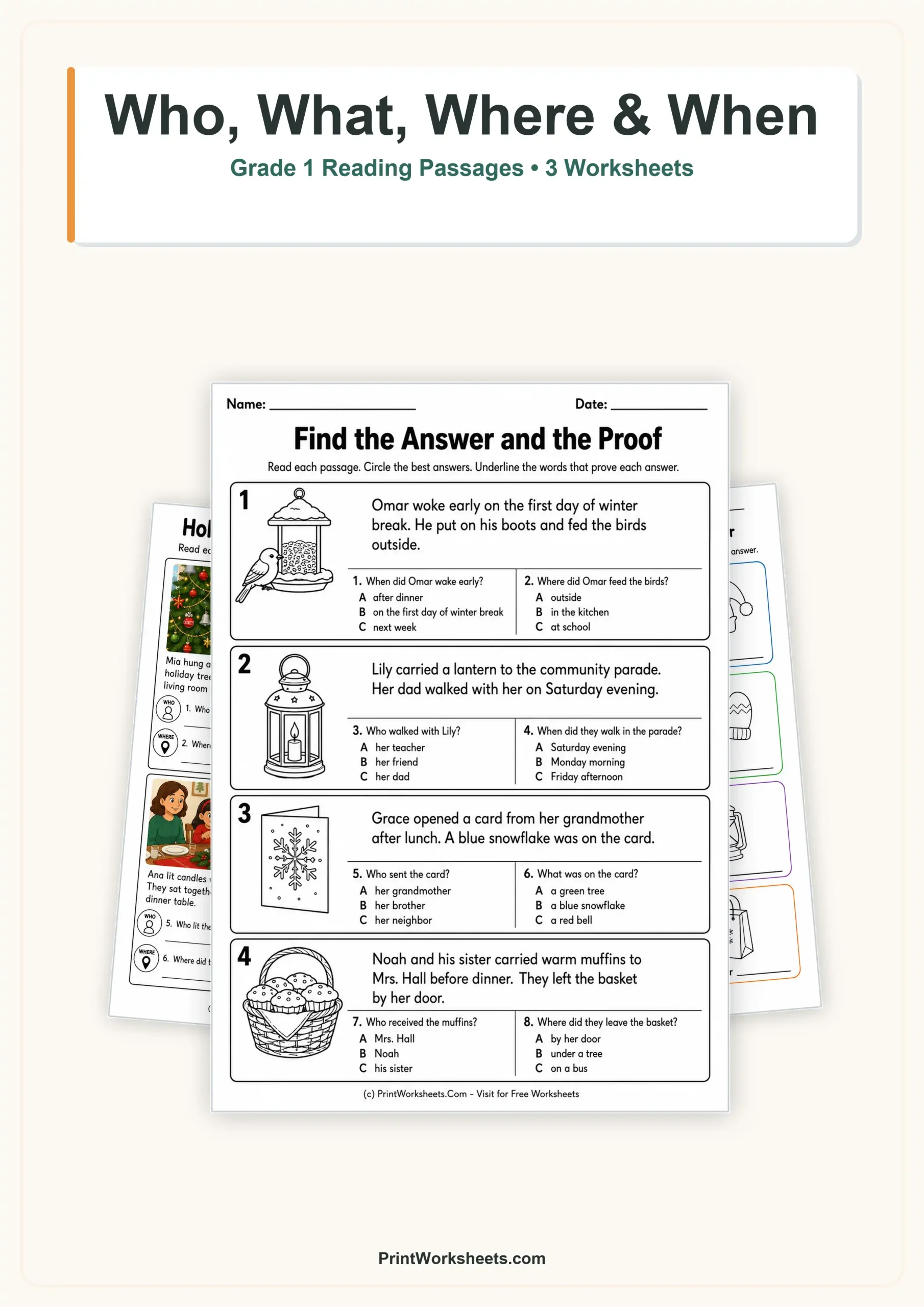
Question words give young readers a practical way to slow down, locate important details, and show that an answer comes from the text. These ask and answer questions reading passages for Grade 1 use short, concrete situations so children can practice finding who, what, where, and when information without being overwhelmed by long paragraphs. Across the printable set, students move from answering direct questions to proving answers with text evidence and deciding which questions can actually be answered from a passage.
Ask and Answer Questions with Short Grade 1 Passages
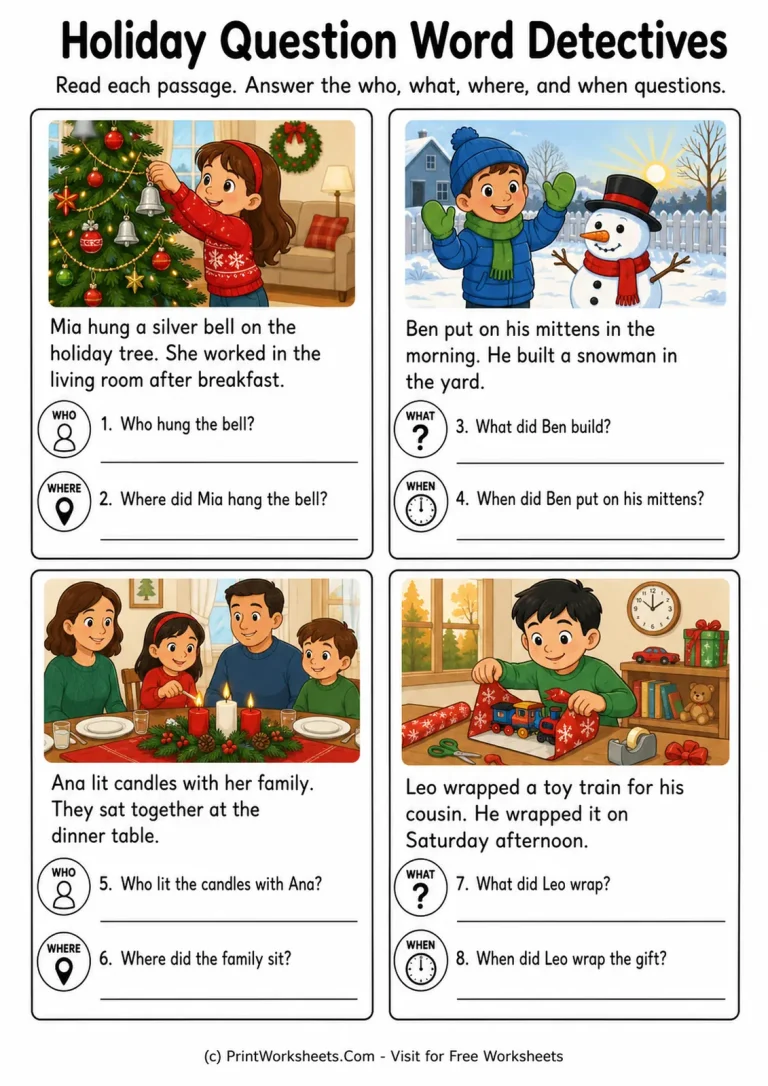
The first worksheet uses four holiday-themed mini passages with eight written-response questions. Mia hangs a silver bell on a holiday tree, Ben builds a snowman after putting on his mittens in the morning, Ana lights candles with her family at the dinner table, and Leo wraps a toy train on Saturday afternoon. Each passage contains clear details that support a specific who, what, where, or when question. Students must return to the sentence, locate the relevant information, and write a concise answer.
This format is especially useful for beginning readers because the question word points them toward the type of detail they need. A who question calls for a person, a where question calls for a place, and a when question calls for a time. Teachers can ask students to name the question word before rereading the passage, then have them point to the exact phrase that supports their answer.
Build the Habit of Finding Text Evidence
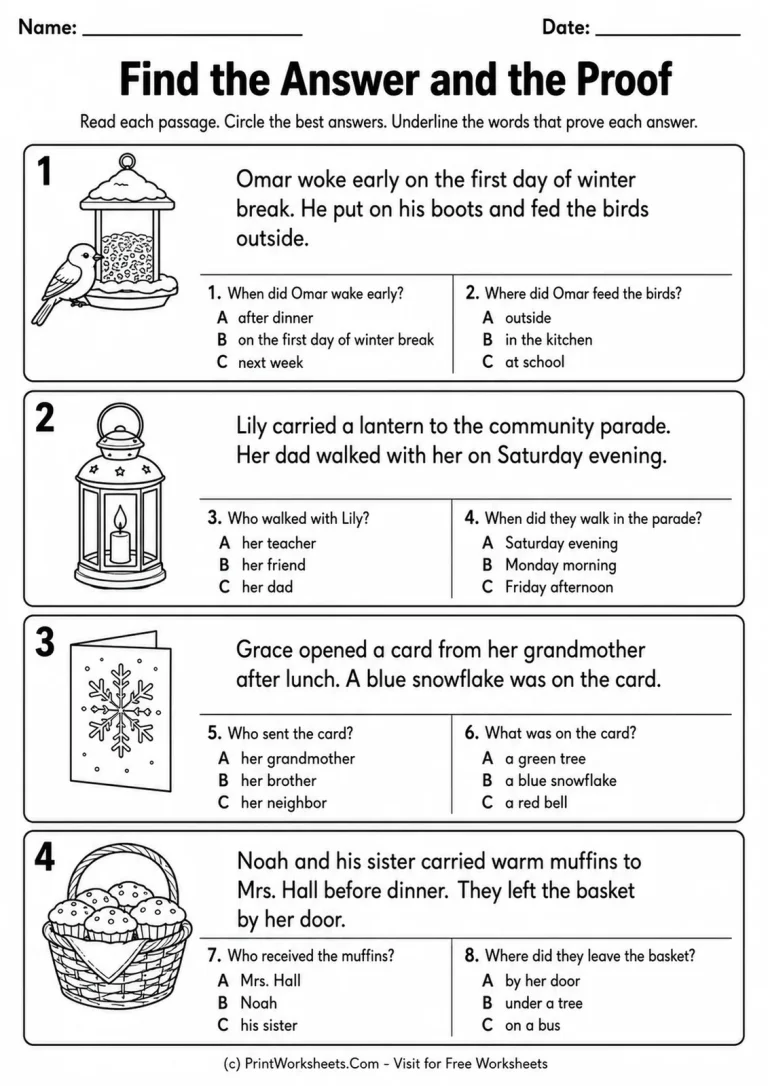
The next activity strengthens the same comprehension skill by adding proof. Students read short winter passages about Omar feeding birds outside, Lily carrying a lantern to a community parade with her dad on Saturday evening, Grace opening a card from her grandmother, and Noah delivering warm muffins to Mrs. Hall. For each passage, children circle the best multiple-choice answer and underline the words that prove it.
This small extra step changes the task from simple recall to evidence-based reading. A child may remember that Lily went to a parade, but the worksheet asks for details such as who walked with her and when they walked. Underlining phrases like “her dad” or “Saturday evening” encourages students to connect an answer directly to the sentence that contains it. That routine can also help teachers spot whether a student is guessing from the picture or actually using the passage.
Practice Which Questions a Passage Can Answer
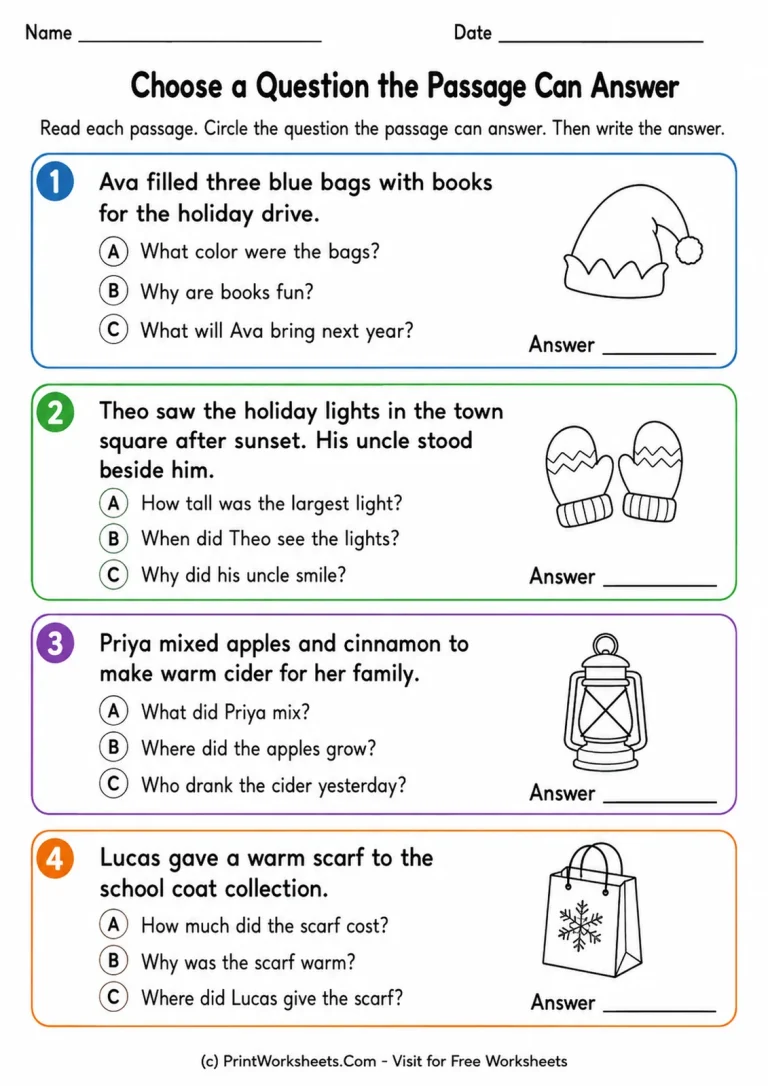
The third worksheet asks students to make a different kind of reading decision: Which question is supported by the information given? Ava fills three blue bags with books, Theo sees holiday lights after sunset, Priya mixes apples and cinnamon for warm cider, and Lucas gives a warm scarf to a school coat collection. For each mini passage, students choose among three questions, circle the one the text can answer, and then write the answer.
This activity introduces an important comprehension idea for Grade 1: not every interesting question is answered by the text. For example, a passage may tell students the color of Ava’s bags but say nothing about why books are fun or what she will bring next year. Learning to separate stated information from missing information supports stronger reading habits and prepares students for later work with text-dependent questions.
Ways to Use These Reading Comprehension Worksheets
These pages can work as whole-group modeling, independent practice, literacy-center work, homework, or a quick comprehension check. During guided reading, an adult can read the passage aloud first and ask the student to identify the question word. On a second reading, the student can find and mark the sentence that contains the answer. More independent readers can complete the page on their own and explain why the other answer choices are not supported.
For extra support, focus on one question type at a time. Ask students to highlight people for who, places for where, and time words for when before answering. For an extension, have students write one new question that the passage can answer and one question that it cannot answer. This encourages them to think about both information that is present and information that is missing.
If you want another early-elementary set with seasonal short texts, the fall reading comprehension passages for Grades 1–2 provide additional practice with finding details in brief passages. Together, these resources can help students become more deliberate readers who look back at the text before answering.