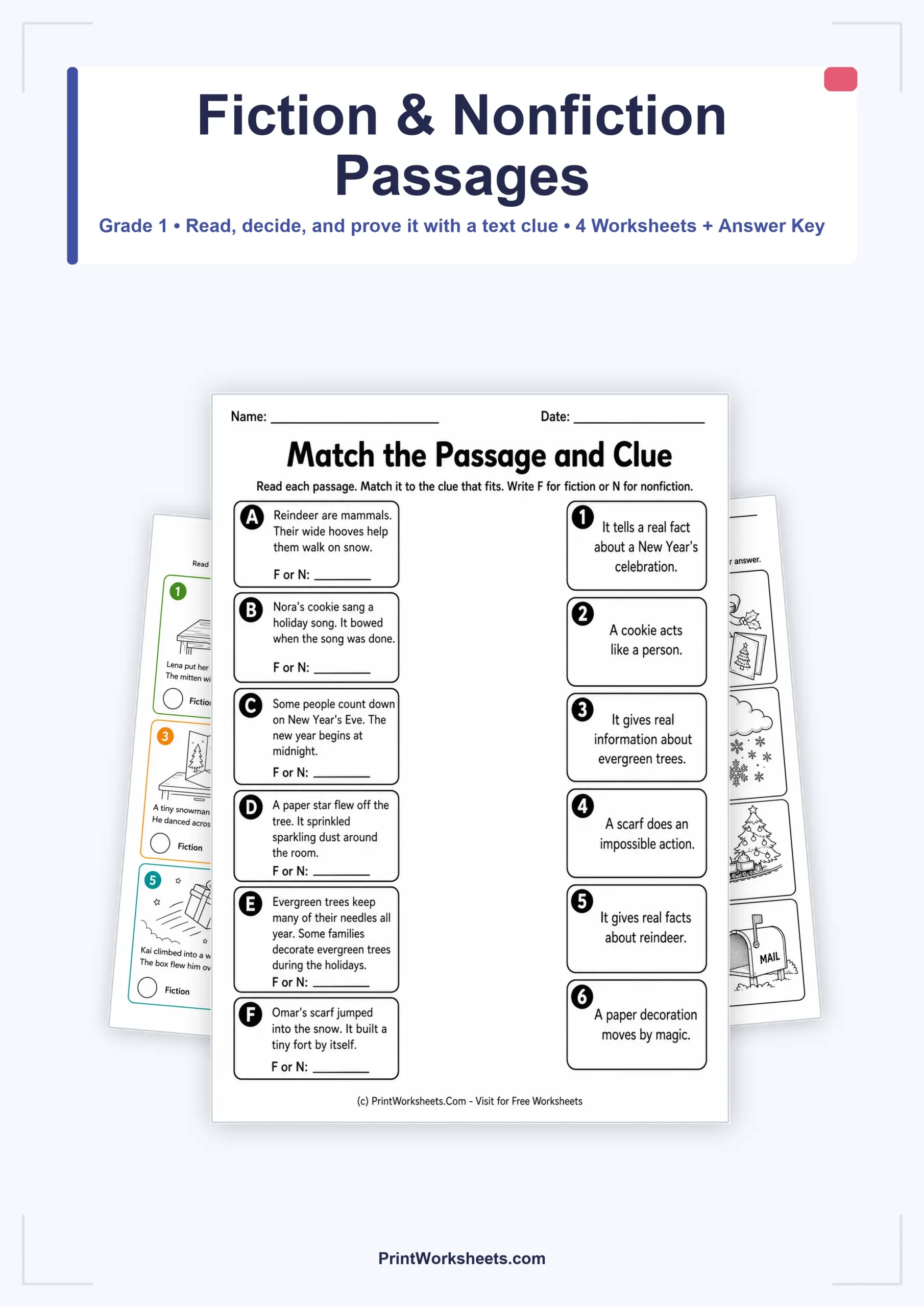
These fiction and nonfiction passages give first graders a concrete way to decide whether a text tells an imagined story or shares real information. Instead of asking children to memorize a definition, the activities point them toward visible evidence: a mitten that winks, a snowman that steps out of a card, facts about snowflakes, information about holiday lights, and details about New Year’s Eve. Across four student pages, readers move from simple classification to explaining exactly which clue proves their choice.
Fiction and Nonfiction Passages With Clear Text Clues
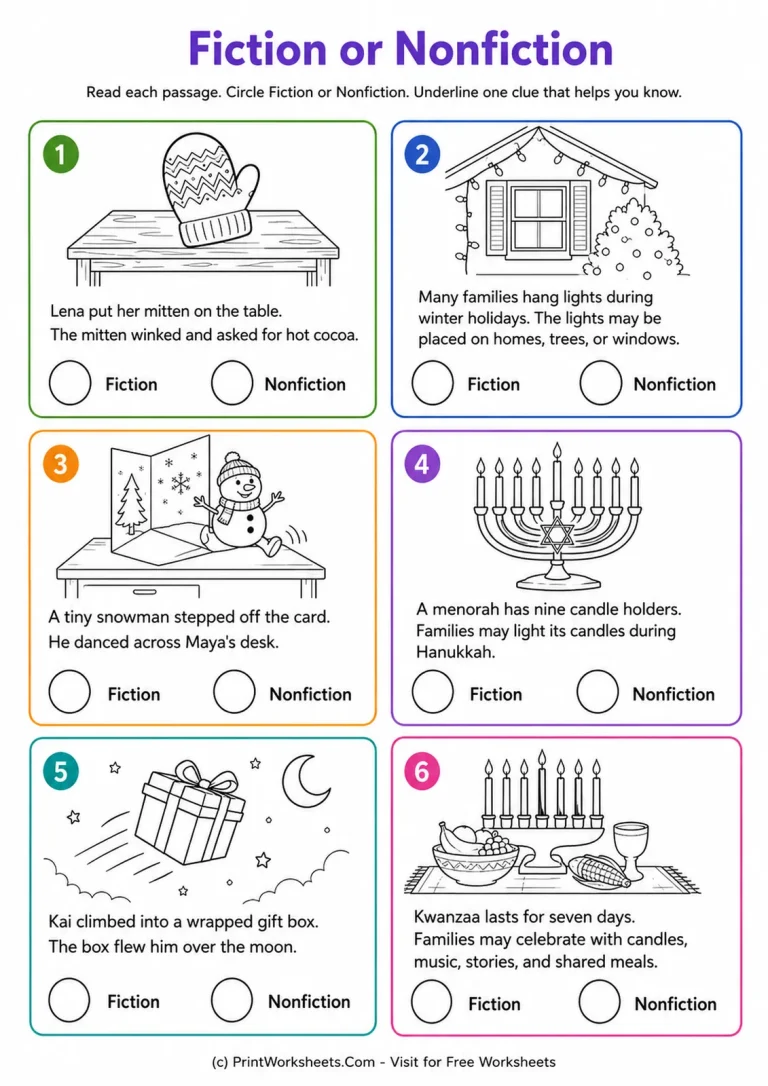
The first page begins with six short passages that make the contrast easy to notice. Students circle Fiction or Nonfiction and underline one clue that helps them know. A mitten that asks for hot cocoa, a tiny snowman that dances across a desk, and a gift box that flies over the moon are unmistakable fiction clues because they describe impossible actions. The nonfiction examples use straightforward facts about winter holiday lights, a menorah with nine candle holders, and Kwanzaa lasting seven days. This mix gives young readers repeated practice noticing whether a detail could happen in real life or is part of an imagined story.
Match Each Passage to the Clue That Fits
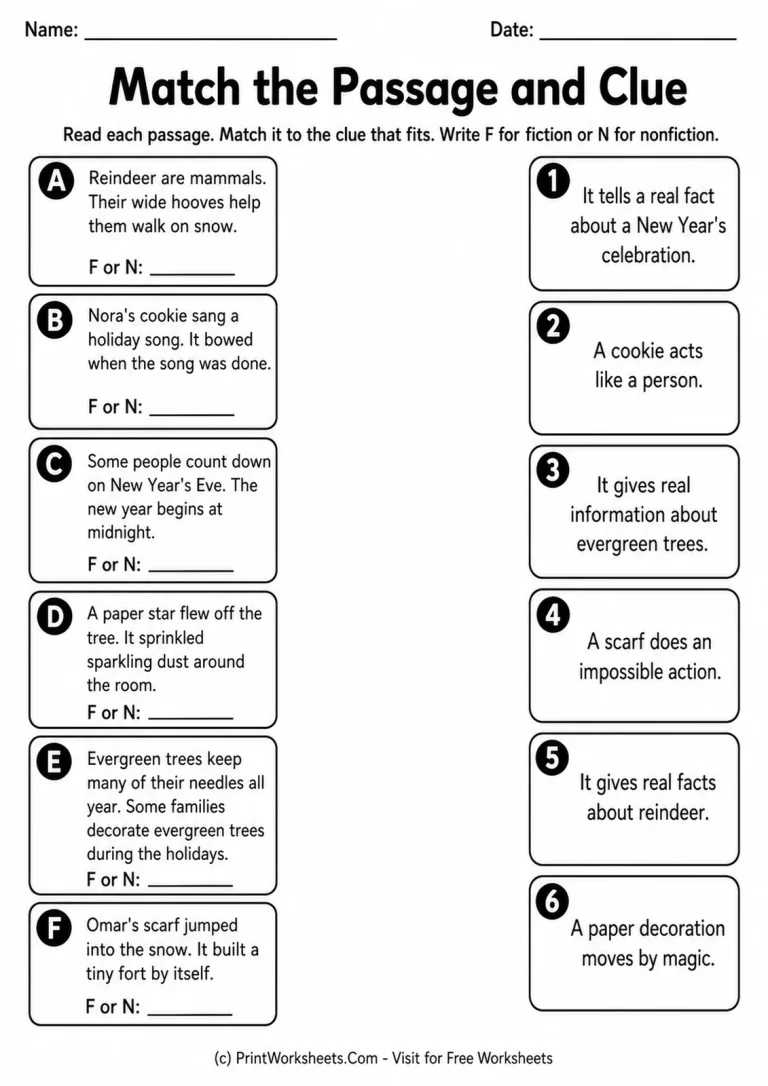
The second page adds another layer of thinking. Six labeled passages must be matched to six explanation cards, and students also write F for fiction or N for nonfiction. The real-information passages include reindeer as mammals with wide hooves, a New Year’s Eve countdown, and evergreen trees that keep many of their needles throughout the year. The fiction passages feature a singing cookie, a paper star that moves by magic, and a scarf that jumps into the snow and builds a tiny fort by itself. Because each clue describes the key feature of one passage, students practice connecting a conclusion to the evidence that supports it.
Prove the Choice With a Text Detail
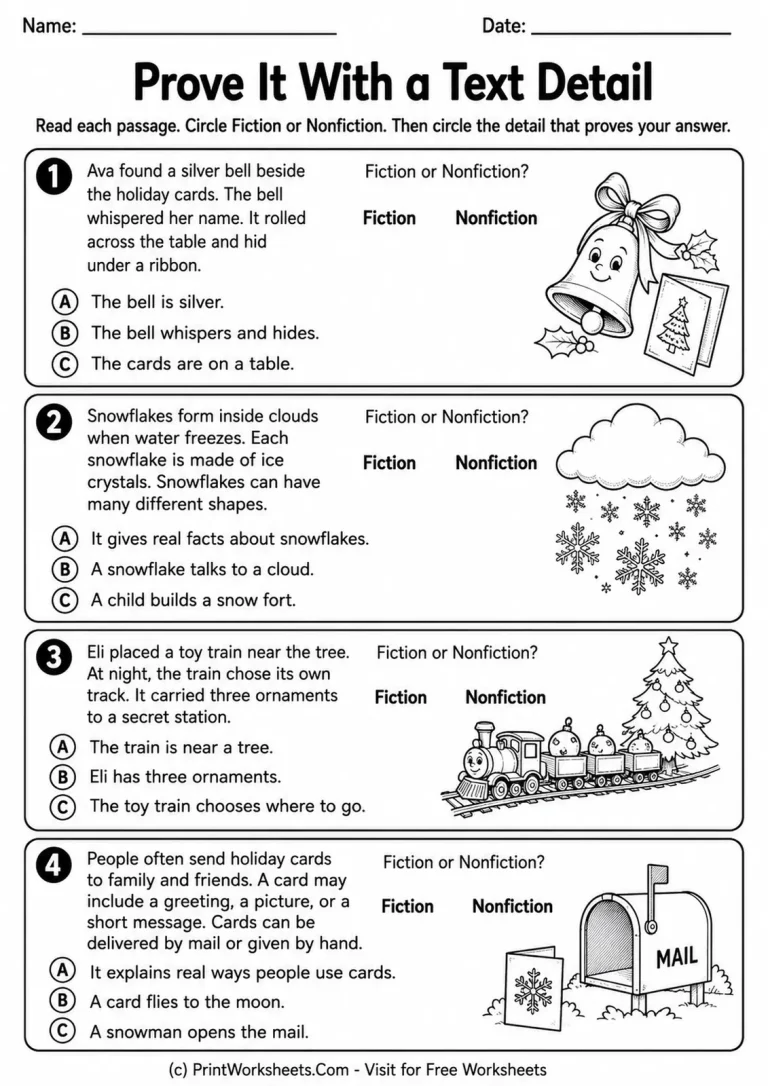
On the third page, students must do more than label the passage. After deciding between Fiction and Nonfiction, they choose the detail that proves the answer. One passage describes a silver bell that whispers a child’s name and hides under a ribbon. Another explains that snowflakes form when water freezes and are made of ice crystals. A toy train chooses its own track in another fictional passage, while a nonfiction passage describes common ways people send and use holiday cards. The multiple-choice details help early readers distinguish a relevant piece of evidence from a detail that may be true in the passage but does not actually prove the text type.
Compare Fiction and Nonfiction Side by Side
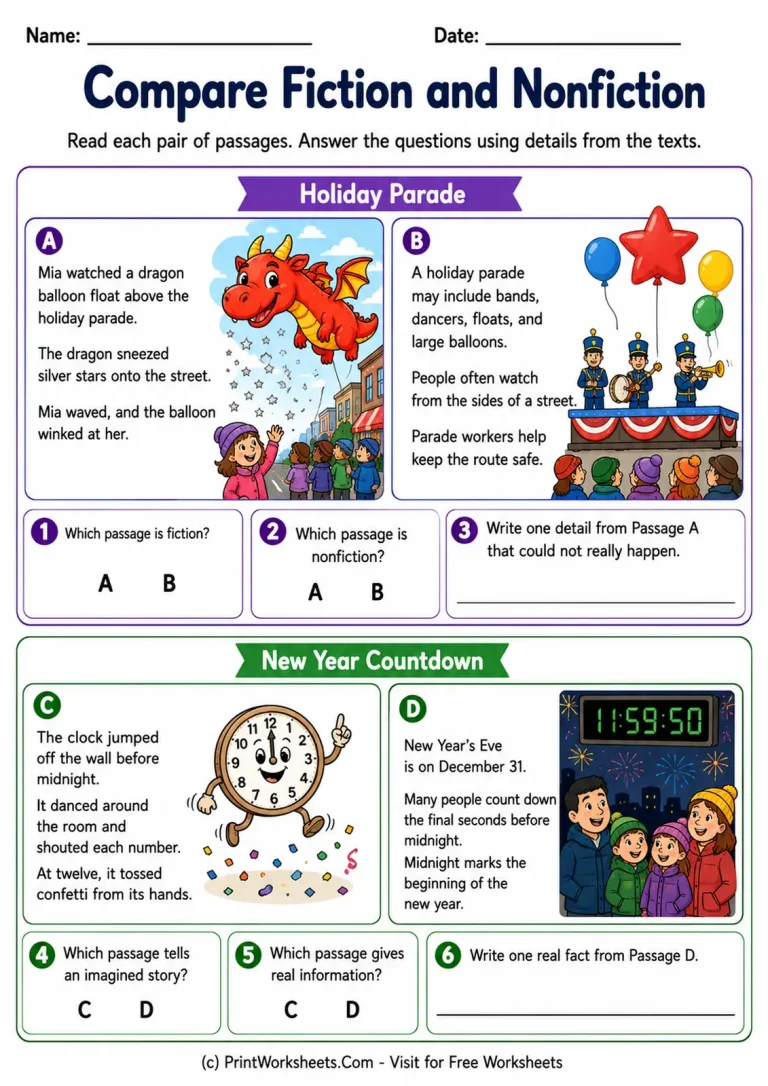
The fourth page shifts to paired reading. In the Holiday Parade section, Passage A tells an imaginative story about a dragon balloon that sneezes silver stars and winks at Mia, while Passage B explains real features of parades such as bands, dancers, floats, large balloons, spectators, and route safety. Students identify which passage is fiction, which is nonfiction, and write one detail from the fictional passage that could not really happen.
The New Year Countdown pair uses the same structure. Passage C describes a clock jumping off the wall, dancing around the room, and tossing confetti from its hands. Passage D gives real information about December 31, counting down before midnight, and the beginning of the new year. Students identify the imagined story, select the informational passage, and write a real fact from the nonfiction text. This paired format is especially useful for showing that fiction and nonfiction can share the same topic while using very different kinds of details.
Ways to Use These Grade 1 Reading Pages
Teachers can use the first page as a quick introduction or independent check, then move to the matching and evidence pages during small-group reading. The paired-passage page works well after students can already identify obvious fiction clues because it asks them to compare two texts on a related topic and write evidence in their own words. For extra oral practice, ask students to explain a choice using a sentence frame such as “I know this is fiction because…” or “I know this is nonfiction because…” before they mark the page.
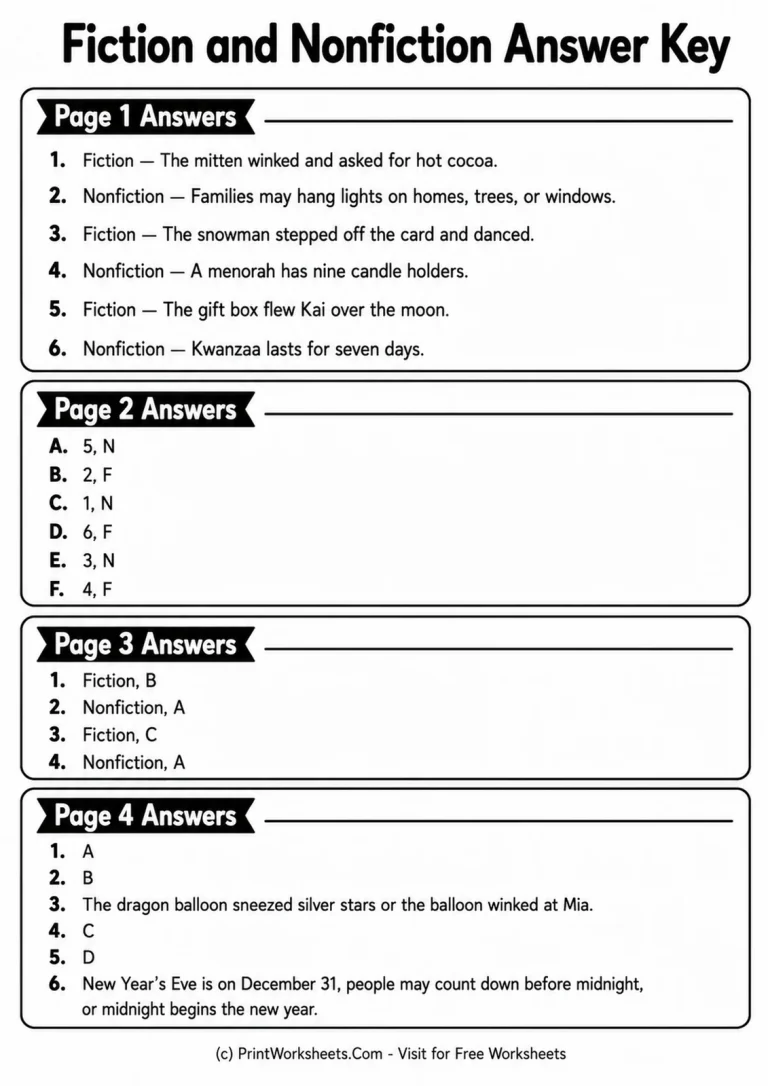
Readers who need more support can first circle the unusual or factual detail in each passage before choosing the text type. Students ready for an extension can name a second clue or explain why another detail does not prove the answer. An answer key is included for the classification, matching, evidence, and paired-passage tasks, including acceptable examples for the short written responses.
For more short-text practice, the fall reading comprehension passages provide another way to work with brief passages and text-based questions. Teachers who also want repeated oral-reading practice can use the summer reading fluency passages alongside these fiction and nonfiction activities.