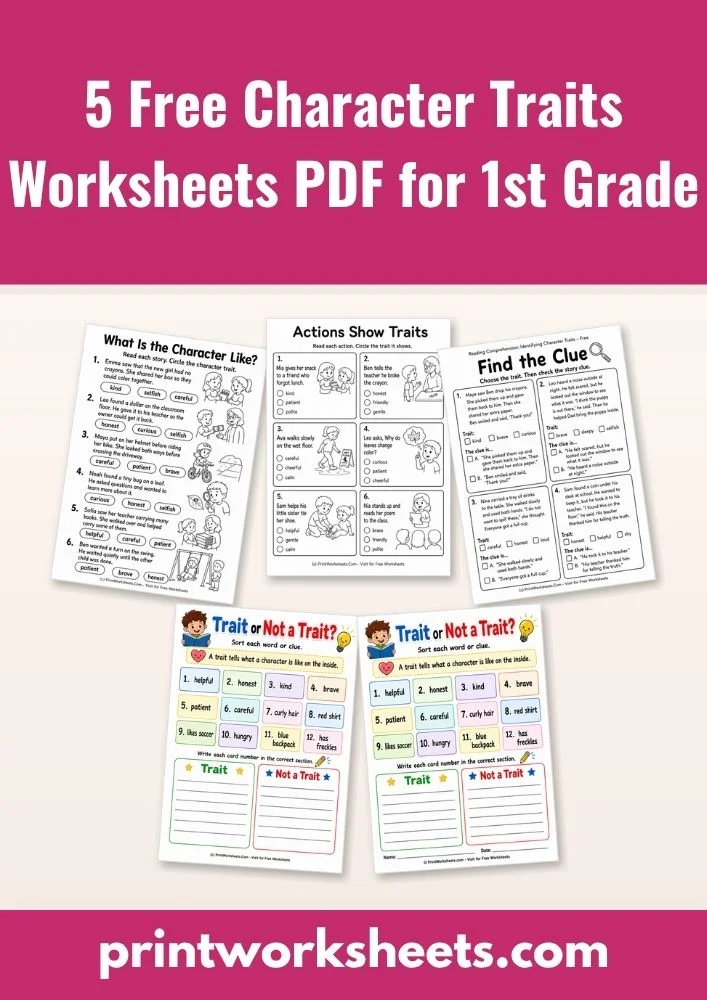
What are character traits? Character traits are descriptive words that explain a character’s internal personality, revealed through their actions, dialogue, and thoughts in a story. Print character traits worksheets to build essential analytical reading skills for first and second-grade students. Advanced reading comprehension requires young readers to move beyond basic decoding and understand exactly how characters feel and behave. This printable literacy PDF delivers rigorous learning centers focusing heavily on identifying character traits and mapping logical text clues. By engaging with sorting activities, targeted reading passages, and text evidence drills aligned with Common Core ELA Standards, educators ensure early readers develop the critical thinking necessary for complex literacy. Printing these targeted character traits worksheets guarantees your students can accurately analyze story characters.
Educators and homeschool parents rely on identifying character traits reading comprehension worksheets during morning work, independent literacy rotations, and small group reading interventions. Consistent exposure to personality vocabulary prevents reading confusion and aids in future narrative writing. To construct a complete baseline for early childhood literacy, pair this reading comprehension pack directly with our cause and effect worksheets. Securing logical text relationships alongside character analysis establishes the ultimate core reading framework required for primary grade success.
Inside the Character Traits Worksheets PDF
Clear formatting, targeted illustrations, and structured vocabulary blocks make these printables highly effective for early elementary classrooms. The layouts minimize visual clutter to maximize focus on character analysis. Each printable activity page targets specific primary grade core reading standards.
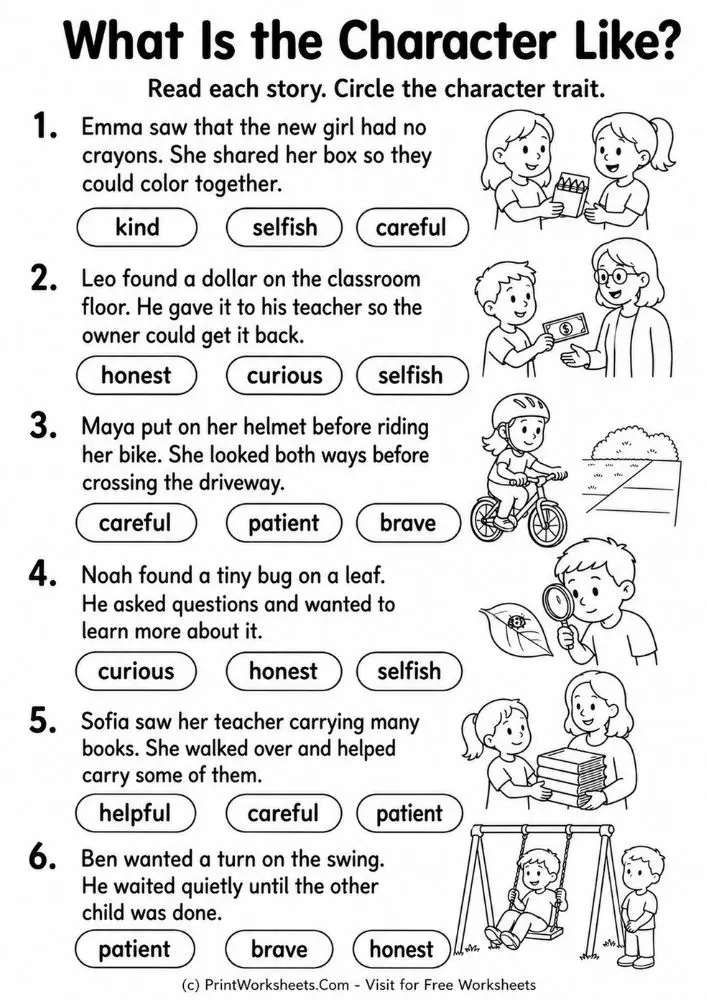
- What Is the Character Like A foundational character analysis worksheet. Students read six short paragraphs detailing everyday scenarios. Students analyze the character actions and circle the correct personality vocabulary word from three provided choices.
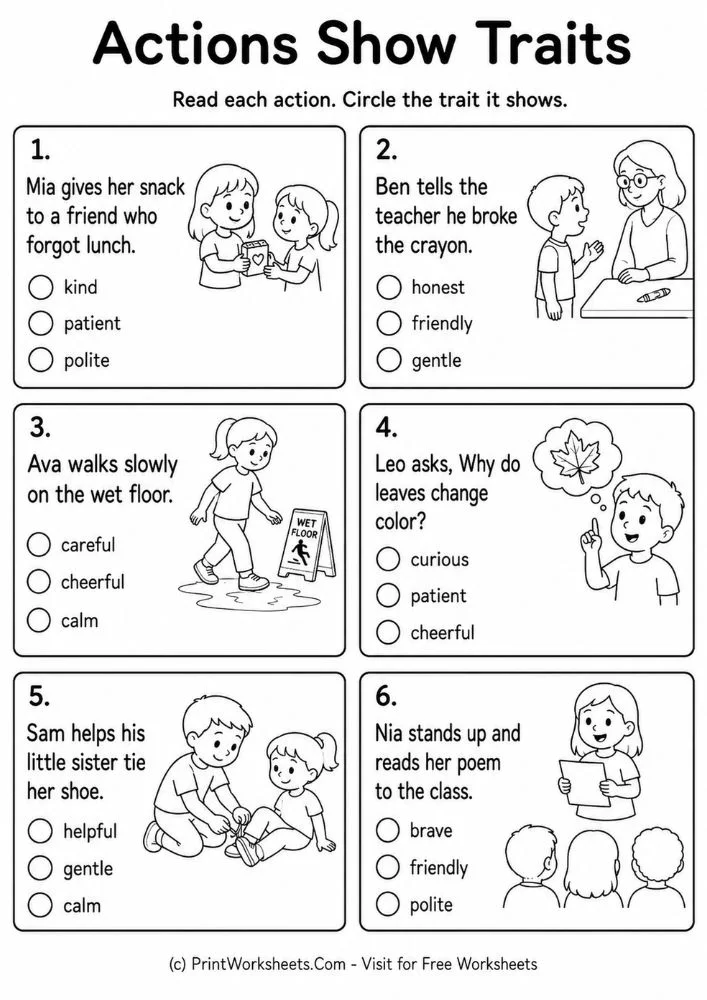
- Actions Show Traits High-level reading comprehension pages. Students read short actions and dialogue. The worksheet challenges students with multiple-choice questions asking explicitly what specific trait the action reveals, forcing them to isolate the context from the surrounding text details.
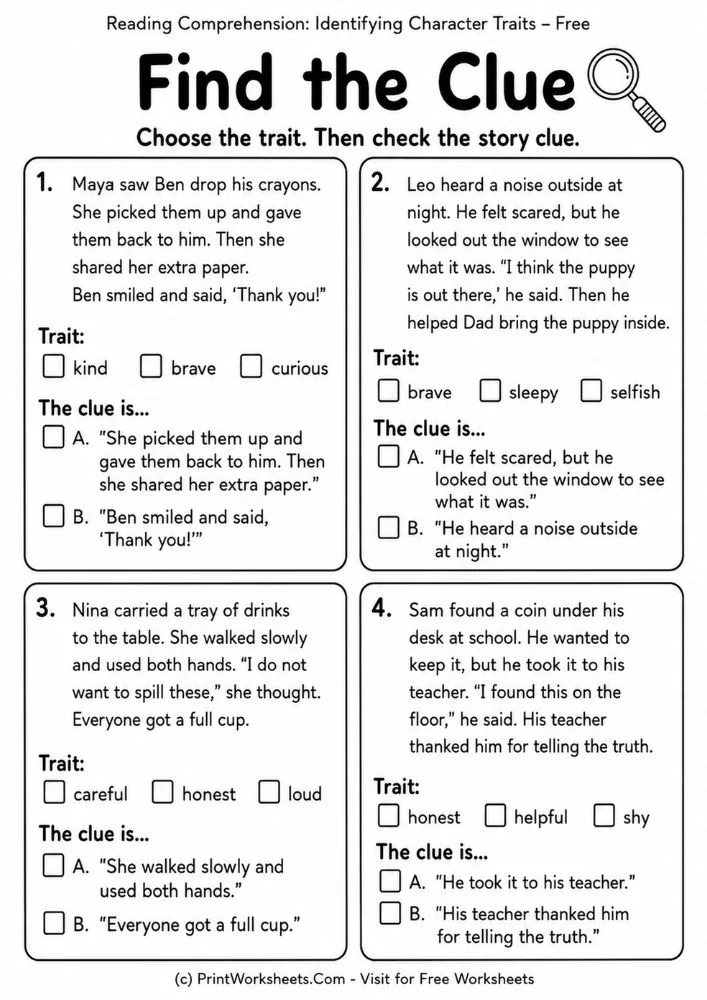
- Find the Clue An explicit text evidence worksheet. This page focuses entirely on proving answers using reading signals. Students read passages, select the correct personality word, and then check the exact text clue sentence that proves their answer.
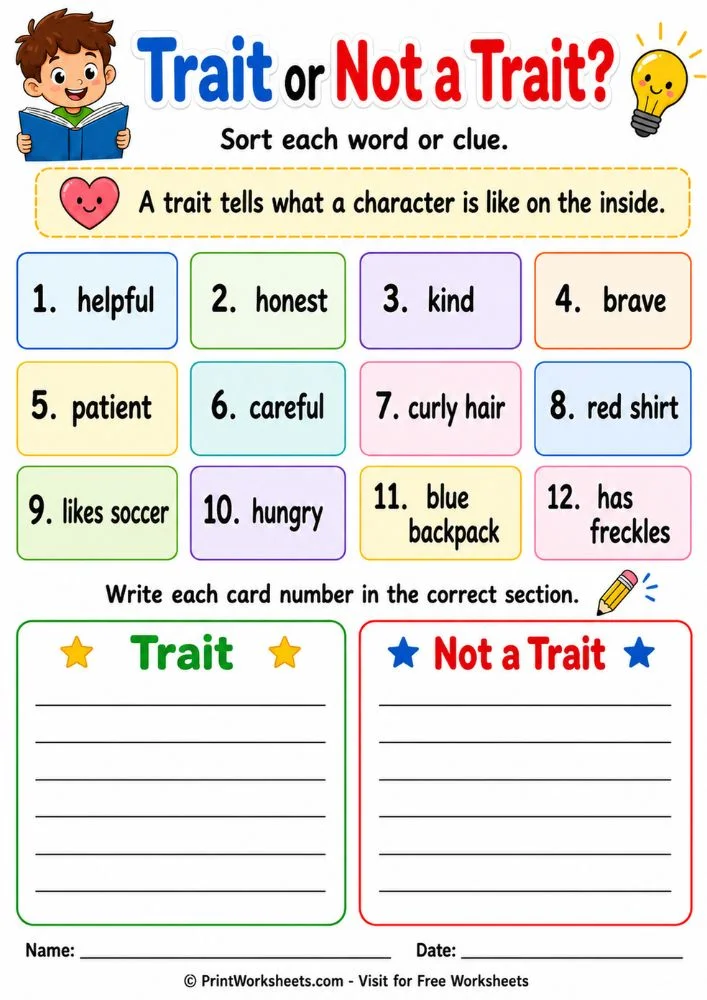
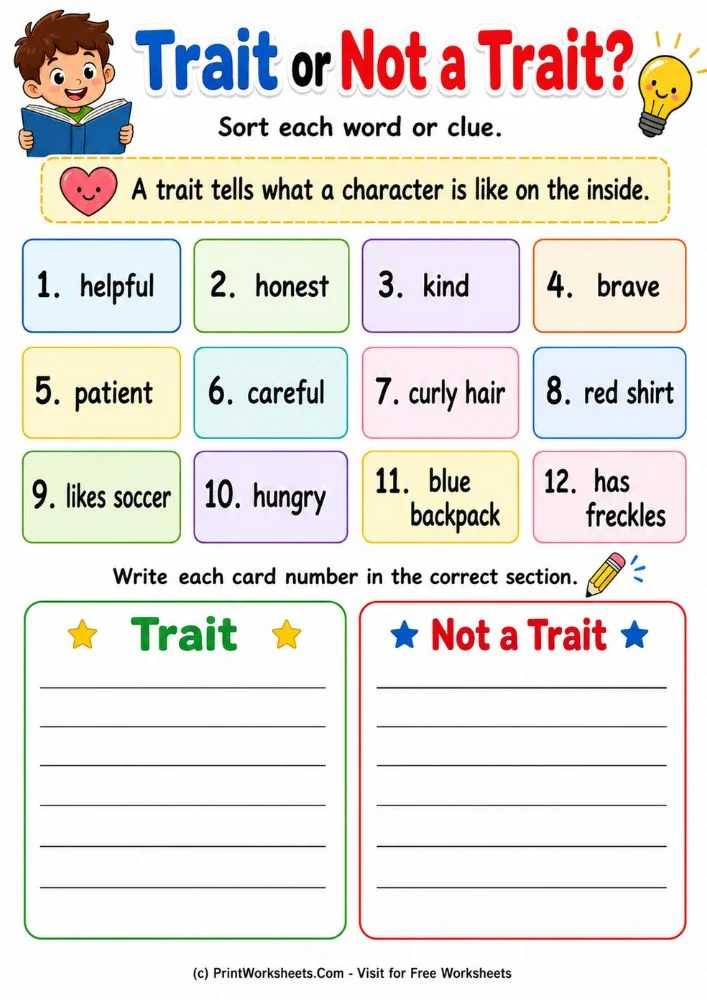
- Trait or Not a Trait An advanced vocabulary sorting page. Students read twelve different descriptive words and phrases. They must actively sort the internal personality words into the Trait column and the external physical descriptions (like curly hair or red shirt) into the Not a Trait column, proving deep structural comprehension of the text.
Effective Literacy Center Implementation
Print these high-resolution reading pages directly on standard 8.5 x 11 copy paper. Integrating physical color-coding routines alongside the character traits worksheets guarantees maximum text structure retention. During the Find the Clue activity, provide students with colored highlighters. Instruct them to highlight the text evidence in the passage. This tactile color-coding bridges visual reading directly to analytical processing.
To maximize literacy center efficiency, place the sorting and multiple-choice pages inside heavy-duty dry-erase sleeves. Provide students with fine-tip washable markers. This straightforward preparation allows multiple classroom groups to practice personality vocabulary repeatedly throughout the instructional week without consuming excess printer ink or copy paper.
Frequently Asked Questions
Why are character traits important for 1st grade?
Identifying character traits is important because it forms the foundation of reading comprehension and critical thinking. When young students understand why a character takes a specific action, they transition from simply reading words on a page to deeply analyzing the overall story.
How does text evidence improve reading skills?
Text evidence improves reading skills by forcing students to justify their logical conclusions with actual proof from the story. Teaching students to actively hunt for clue sentences makes it significantly easier for them to break down informational passages and track complex character motivations accurately.
What grade levels use these printables?
These printable reading activities are designed specifically for standard 1st grade and 2nd grade core English Language Arts expectations. Advanced kindergarten classrooms can utilize the picture-matching pages during small group teacher-led interventions. First and second-grade educators print these exact sheets for independent reading centers to assess baseline analytical tracking skills.