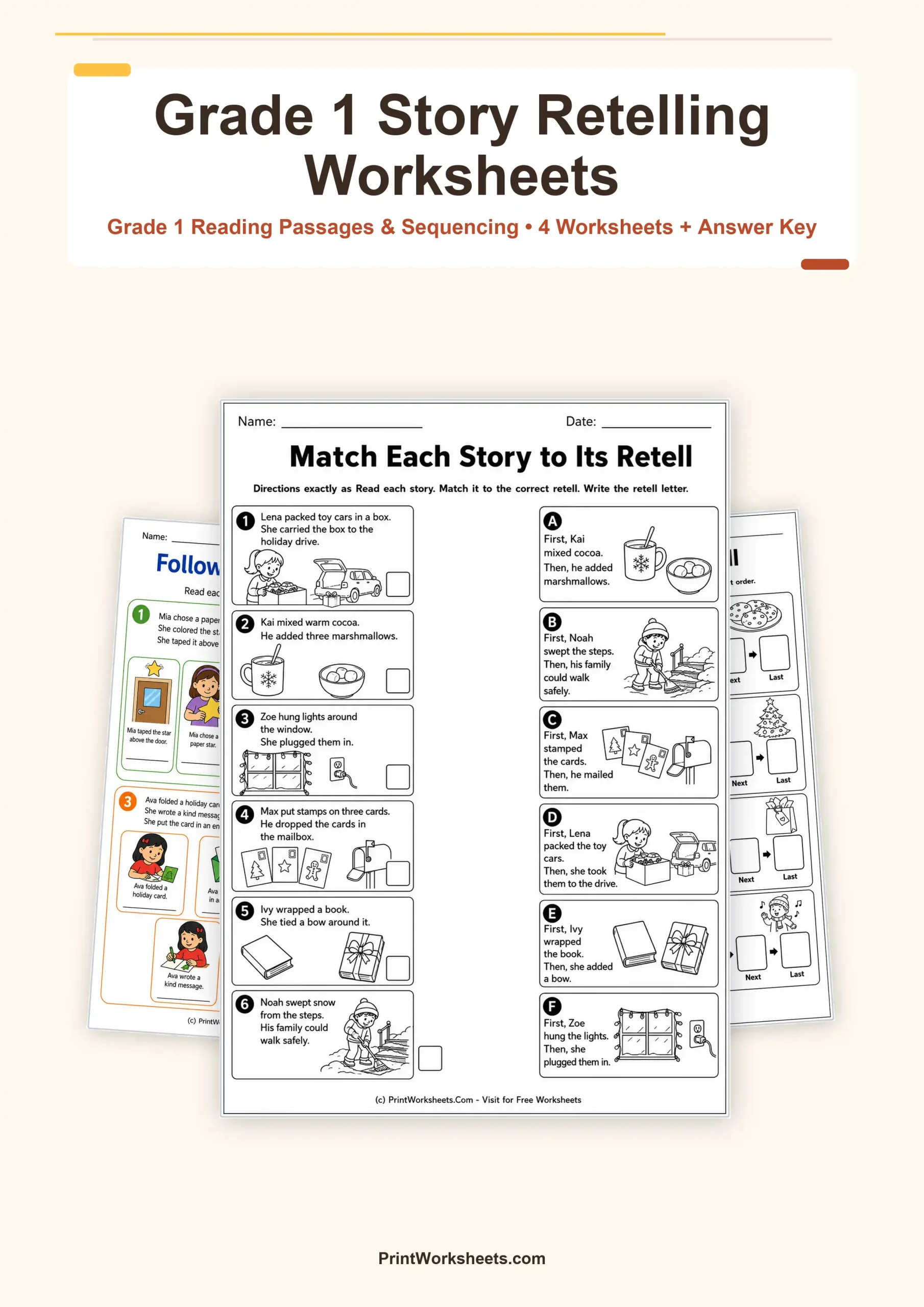
Story retelling becomes much easier for first graders when the events are short, concrete, and clearly connected. This printable set gives students four different ways to practice that skill with brief holiday and winter-themed reading passages. Children begin by identifying what happened first, next, and last, then move into matching complete retells, fixing mixed-up event sequences, and finally writing the important parts of a story in their own words. The variety makes the set useful for introducing retelling as well as checking whether students can preserve a story’s chronology without copying every detail.
Story Retelling Practice That Builds Step by Step
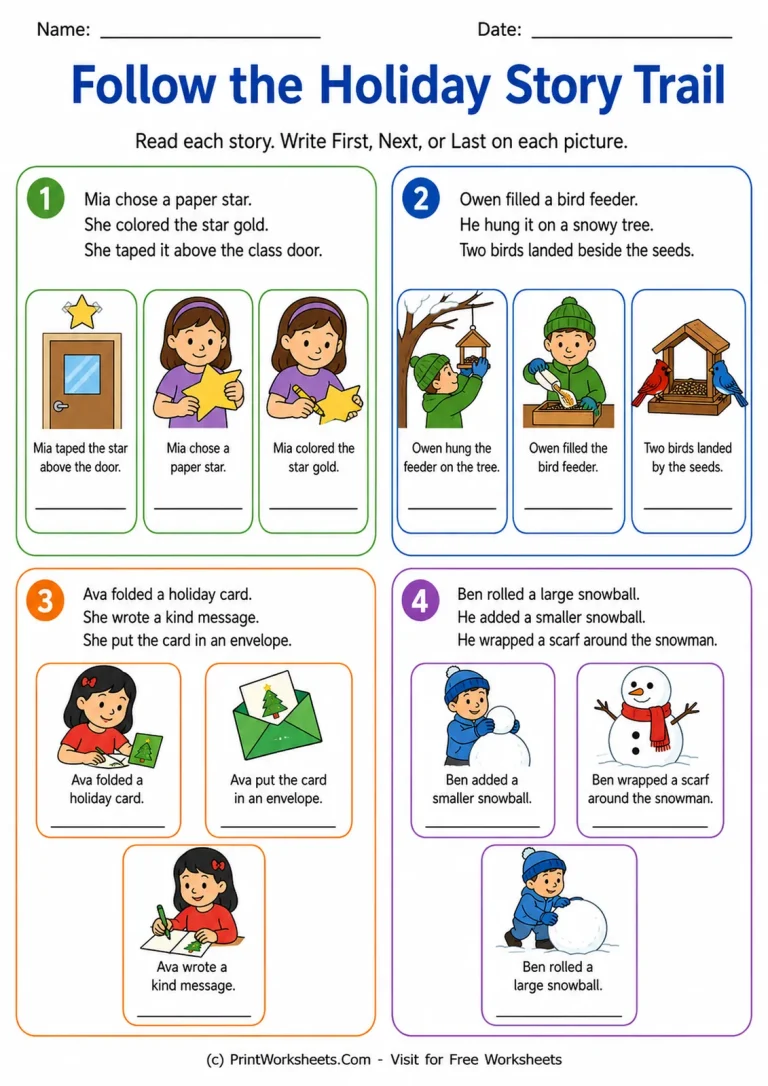
The first worksheet uses four three-event stories with picture support. Mia chooses a paper star, colors it gold, and tapes it above the class door. Owen fills a bird feeder, hangs it on a snowy tree, and then sees two birds land beside the seeds. Ava folds a holiday card, writes a kind message, and puts the card in an envelope. Ben rolls a large snowball, adds a smaller one, and wraps a scarf around the finished snowman. The pictures are intentionally shown out of order, so students must read the passage and write First, Next, or Last below each scene.
This page is especially useful when students understand a story orally but still need visual support for sequencing. Rather than asking them to produce a full retell immediately, it isolates one essential comprehension skill: recognizing the order in which events happened.
Matching a Story to the Correct Retell
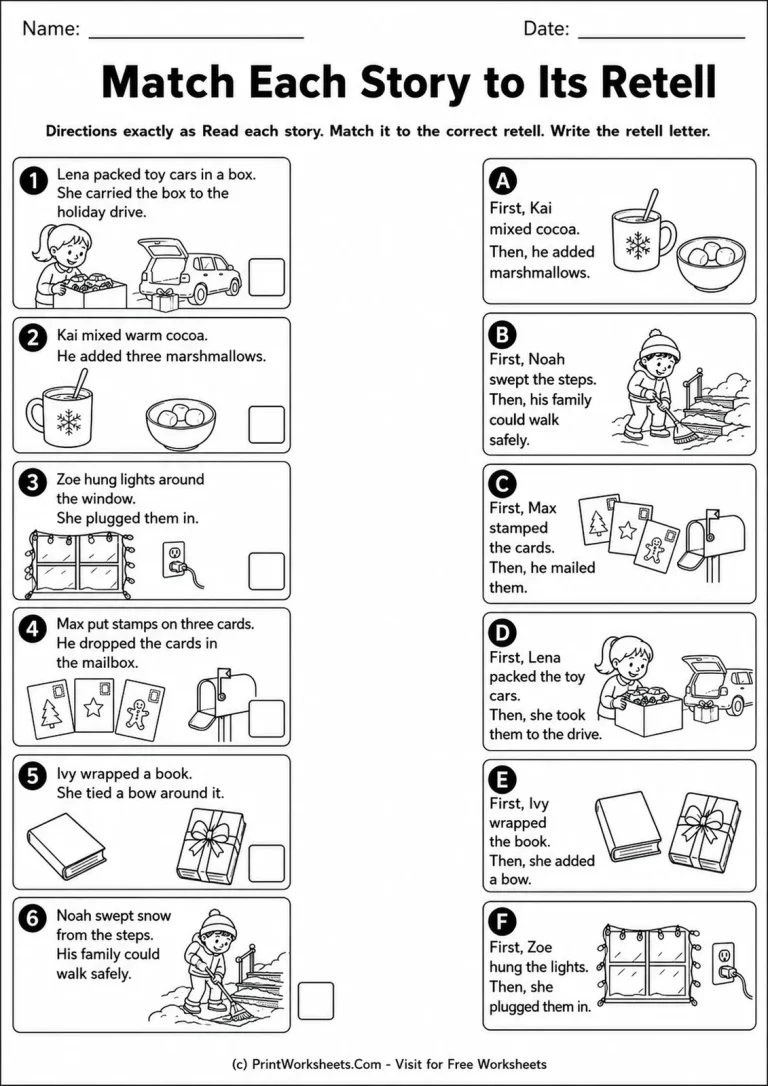
The second worksheet changes the response format. Six short stories about Lena, Kai, Zoe, Max, Ivy, and Noah appear on the left, while six lettered retells appear on the right. Students read each original story and write the letter of the matching retell. The pairs focus on preserving both the main actions and their order. For example, Lena packs toy cars before taking them to a holiday drive, and Max puts stamps on cards before mailing them.
This matching format helps students notice that a good retell can use fewer words than the original while still keeping the essential events. Teachers can use it as a bridge between simple sequencing and independent summarizing. For additional seasonal reading practice, students can also work with fall reading comprehension passages that provide another context for reading short texts and discussing what happened.
Fixing Mixed-Up Events
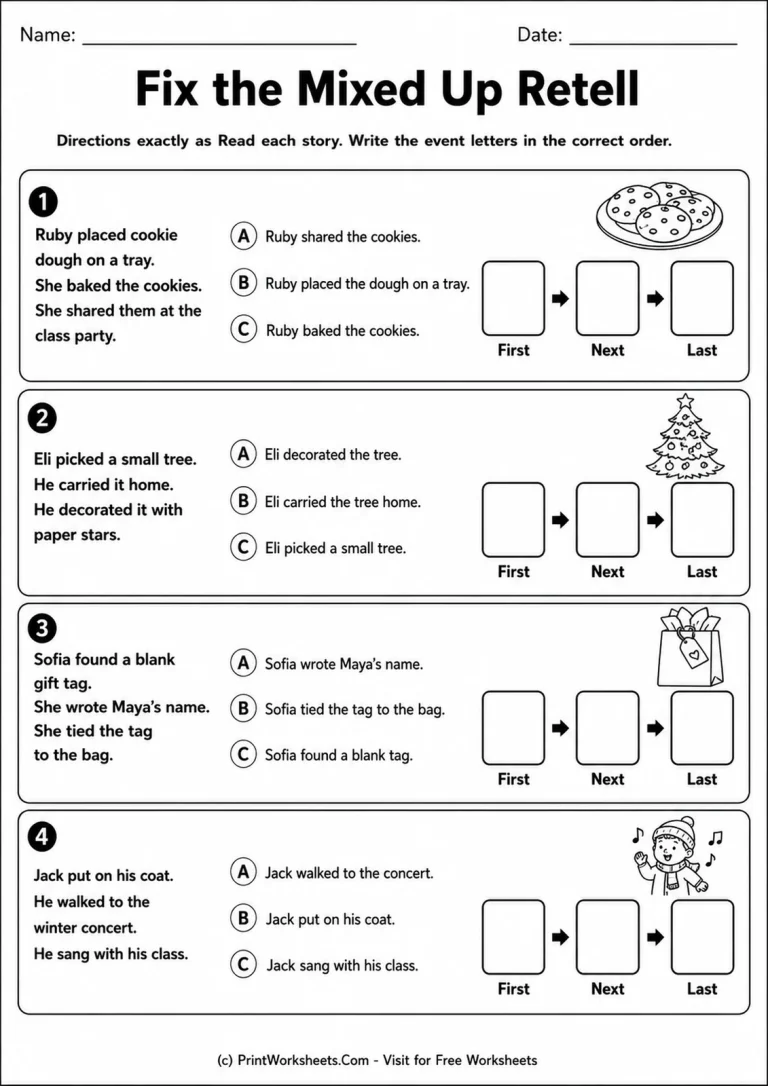
The third page removes some of the picture-by-picture support and asks students to order event letters. Ruby places cookie dough on a tray, bakes the cookies, and shares them at a class party. Eli picks a small tree, carries it home, and decorates it with paper stars. Sofia finds a blank gift tag, writes Maya’s name, and ties the tag to a bag. Jack puts on his coat, walks to a winter concert, and sings with his class. Students choose the correct A, B, and C sequence for First, Next, and Last.
This activity works well for students who can identify individual events but sometimes lose track of chronology when details are presented in a different order. Asking a child to explain why one event must come before another can turn the worksheet into a quick oral comprehension lesson.
From Sequencing to Written Retelling
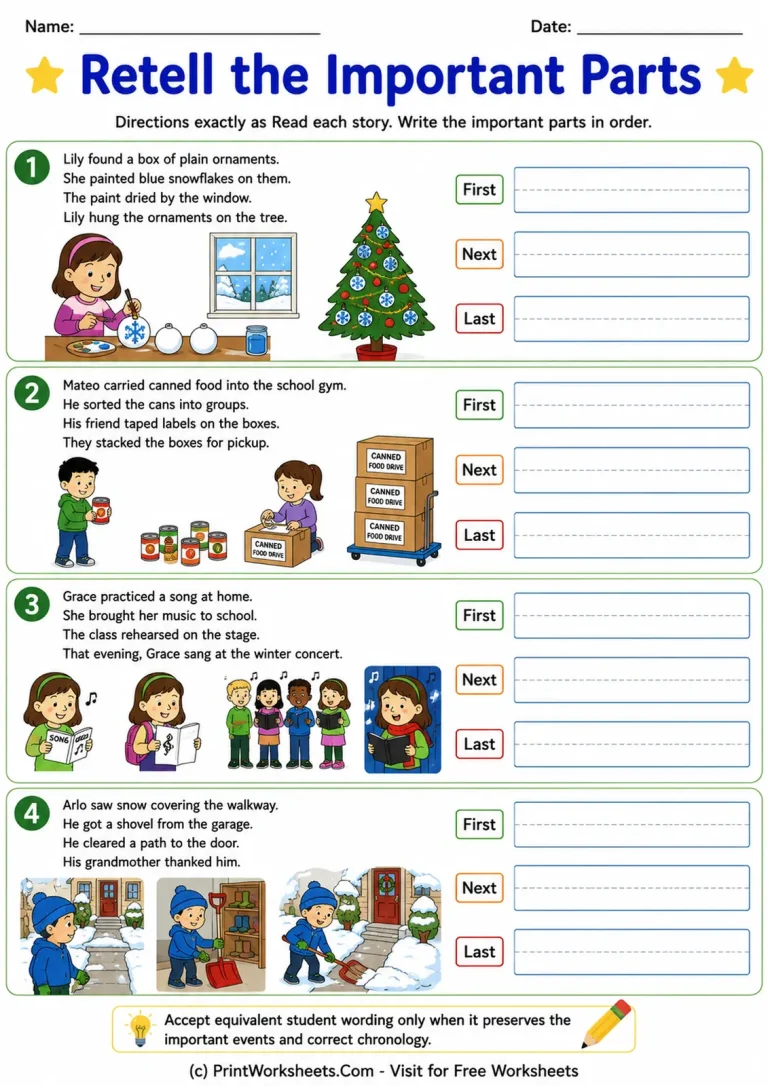
The final student worksheet asks for a more independent response. Each passage contains four events, but students write only the important parts in First, Next, and Last spaces. Lily finds plain ornaments, paints snowflakes, lets the paint dry, and hangs the ornaments on a tree. Mateo helps organize canned food for a school drive. Grace moves from practicing a song at home to rehearsing at school and performing at a winter concert. Arlo sees snow on the walkway, gets a shovel, clears a path, and is thanked by his grandmother.
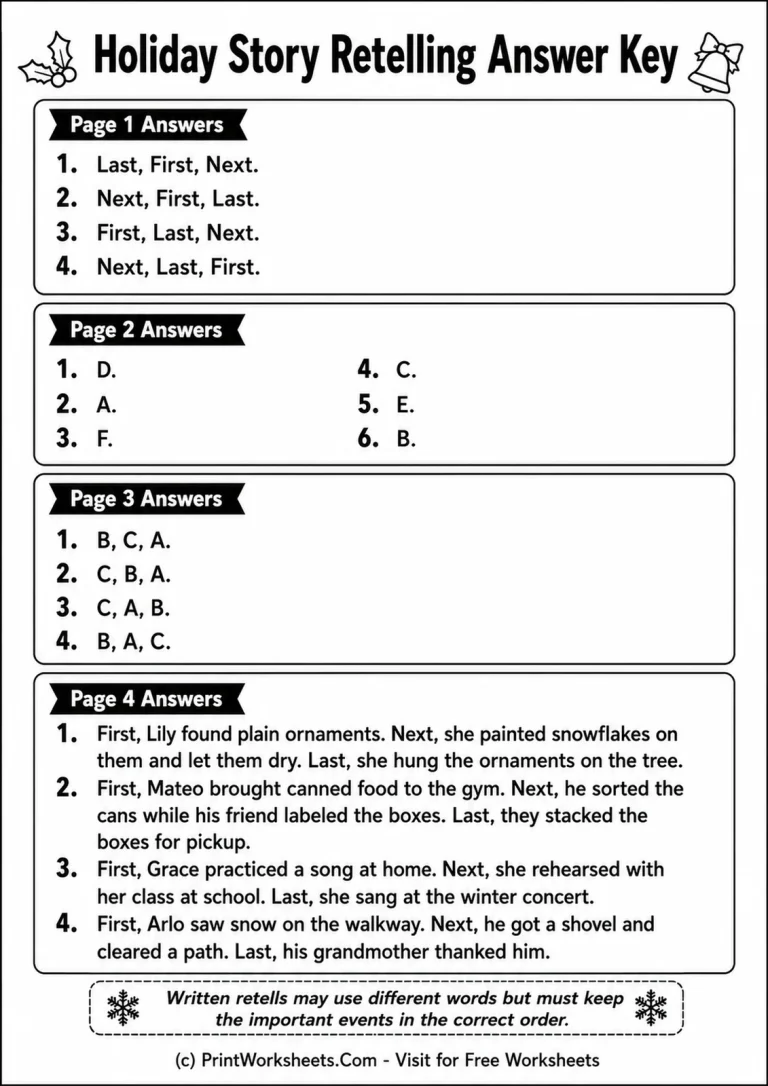
Because students may combine closely related actions, this page supports flexible wording rather than requiring one exact sentence. The goal is to keep the key events and correct chronology. A complete answer key provides the objective sequences for the earlier pages and model retells for the written activity.
Ways to Use These Grade 1 Retelling Worksheets
For students who need support, read one passage aloud and have them point to the event that happened first before writing anything. Students ready for more challenge can cover the passage after reading and retell it orally from memory before completing the boxes. In a small group, compare two possible retells and discuss which details are essential and which can be left out. The same skill can be reinforced with first grade reading fluency passages by pausing after a passage and asking students to recount the main events in order.
Across the four worksheets, students repeatedly practice the central idea of retelling: remember what matters, keep events in the right order, and communicate the story clearly. That progression makes the set practical for whole-class instruction, literacy centers, intervention groups, homework, or a short reading-comprehension assessment.