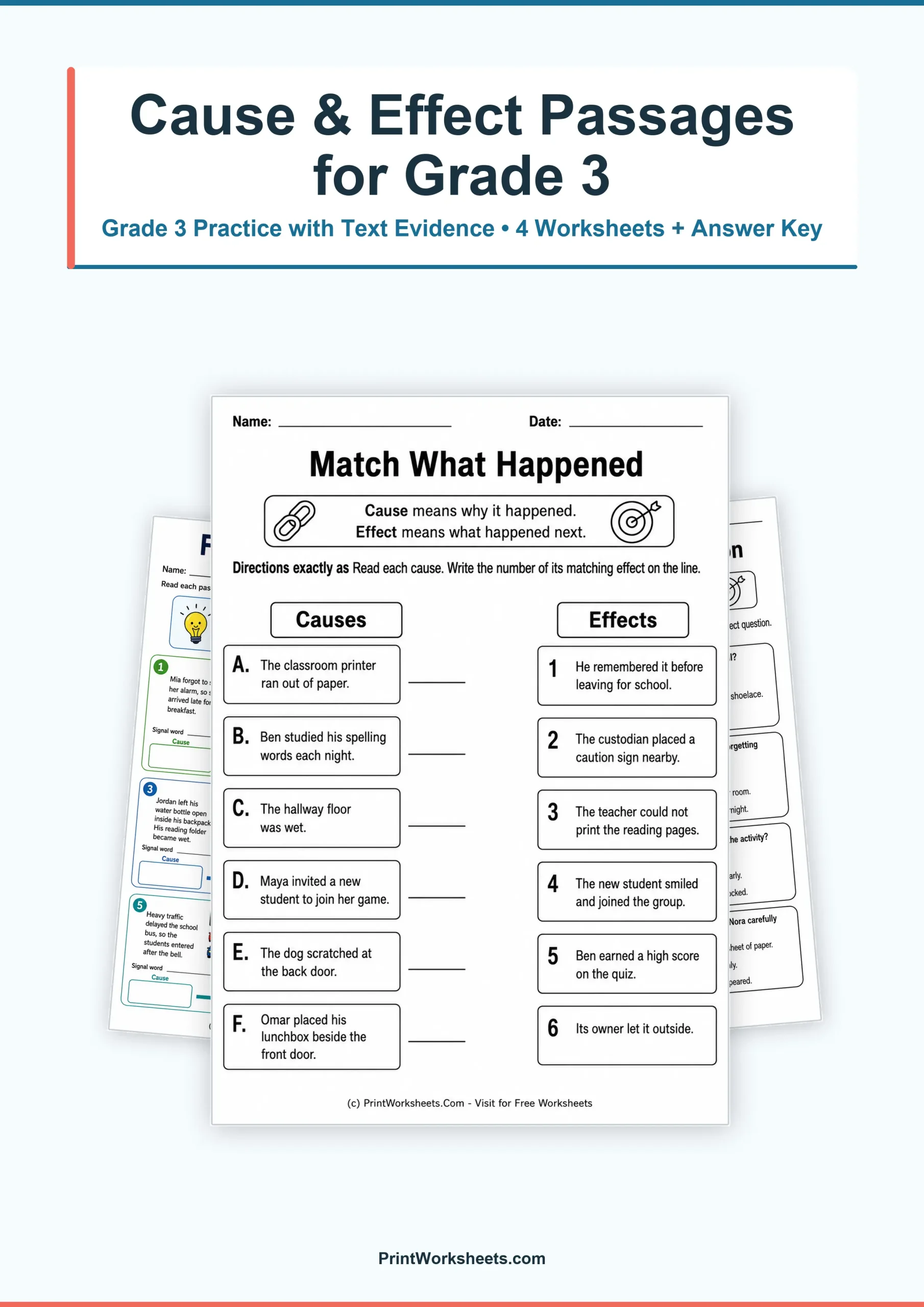
Cause and effect passages give third graders a clear way to see how one event leads to another. In this printable set, students work with familiar school and everyday situations such as missing an alarm, stepping on an untied shoelace, forgetting to water a plant, sharing supplies, and preparing for a class performance. Across four student worksheets, the work changes from identifying simple relationships to explaining them with evidence from the passage, so students practice both comprehension and written reasoning.
Cause and effect passages with four different task types
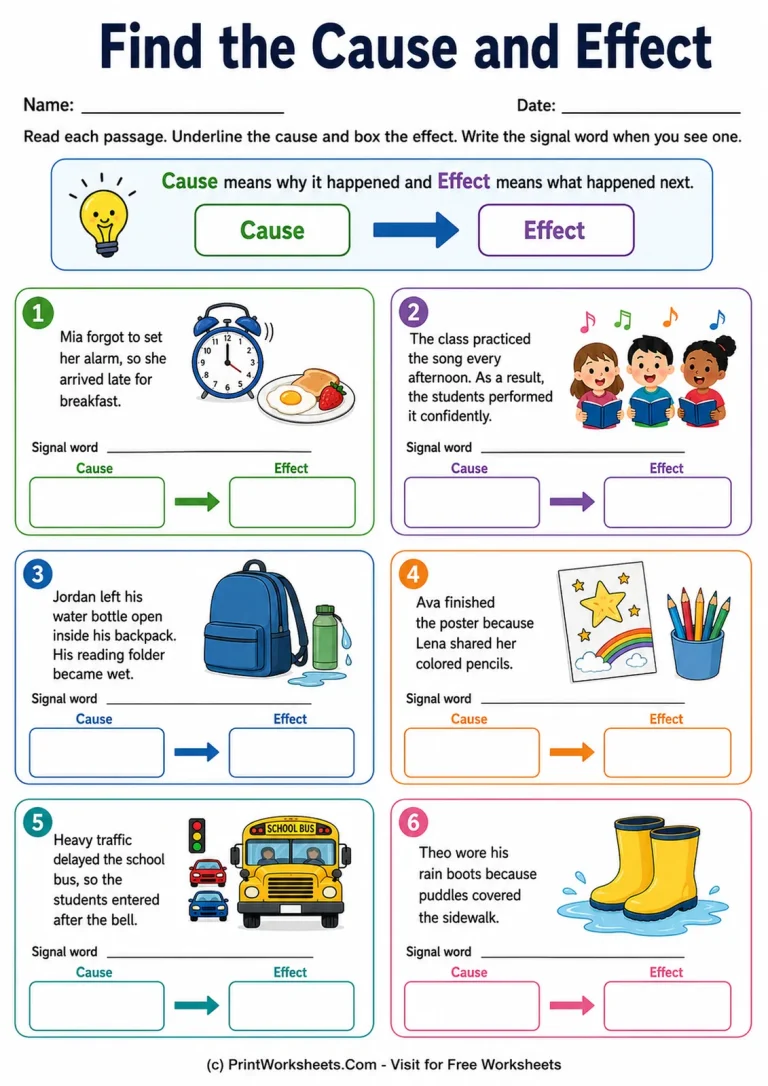
The first worksheet, Find the Cause and Effect, gives students six short situations and asks them to separate what happened first from what happened next. Students also record a signal word when one appears. The examples include so, because, and As a result, but one passage intentionally has no explicit signal word. That contrast is useful because it shows students that a cause-and-effect relationship can still be present even when the author does not provide a clue word.
Match causes with their logical effects
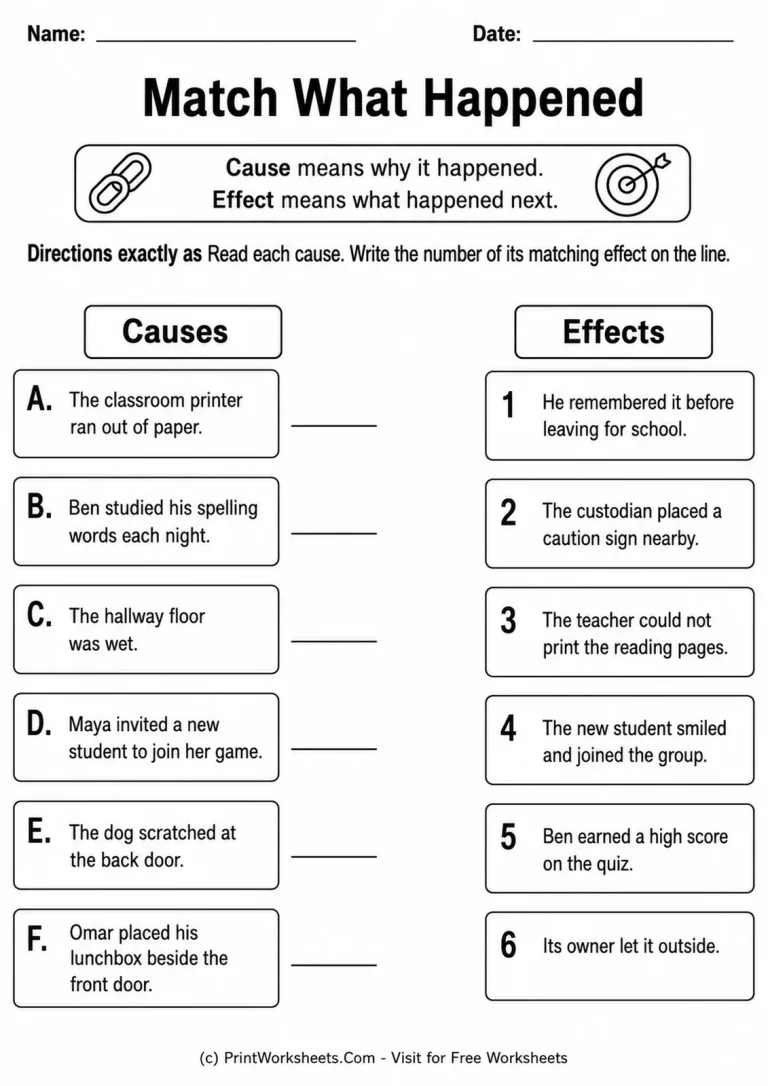
The second worksheet changes the response format. Students read six causes labeled A through F and match each one with a numbered effect. The situations include a classroom printer running out of paper, a wet hallway floor, a dog scratching at the back door, spelling practice, welcoming a new student into a game, and placing a lunchbox beside the front door. Because each cause has one clear matching result, this page works well for checking whether students understand the relationship itself rather than simply copying words from a passage.
Read, choose, and explain the connection
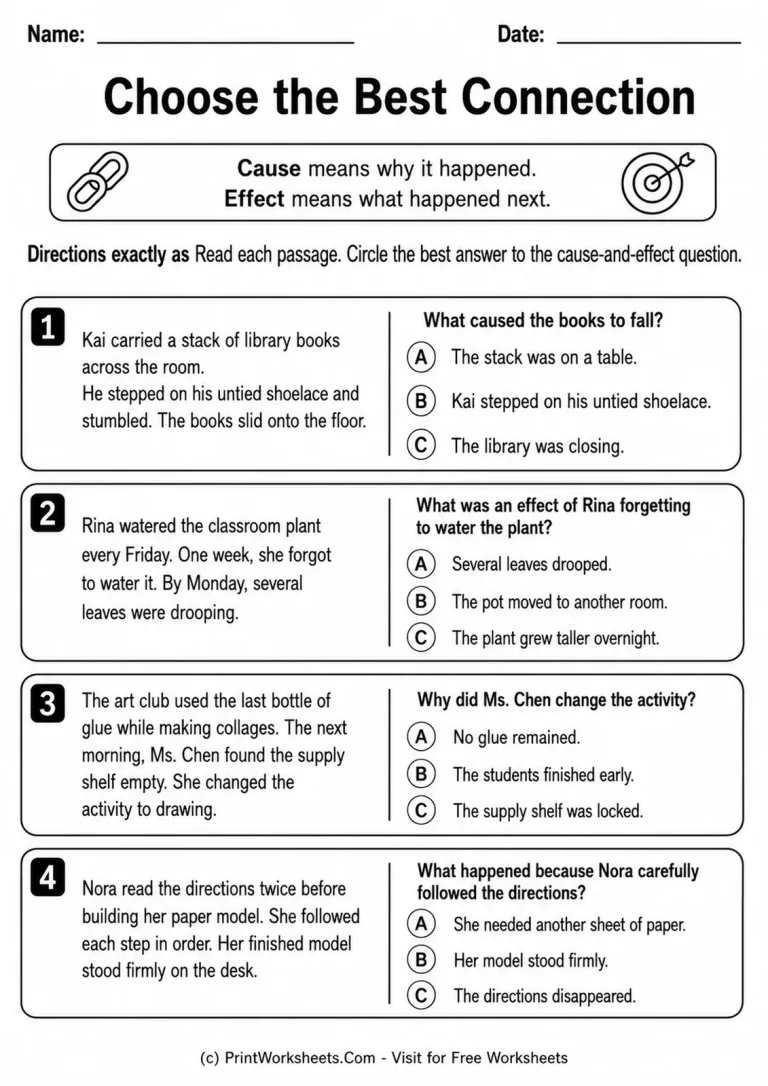
The third page uses four short reading passages with multiple-choice questions. Students decide what caused the books to fall after Kai stumbled, what happened when Rina forgot to water the classroom plant, why an art activity changed after the glue was used up, and what resulted from Nora carefully following directions for a paper model. The questions alternate between asking for a cause and asking for an effect, which helps students practice reading the wording of the question carefully.
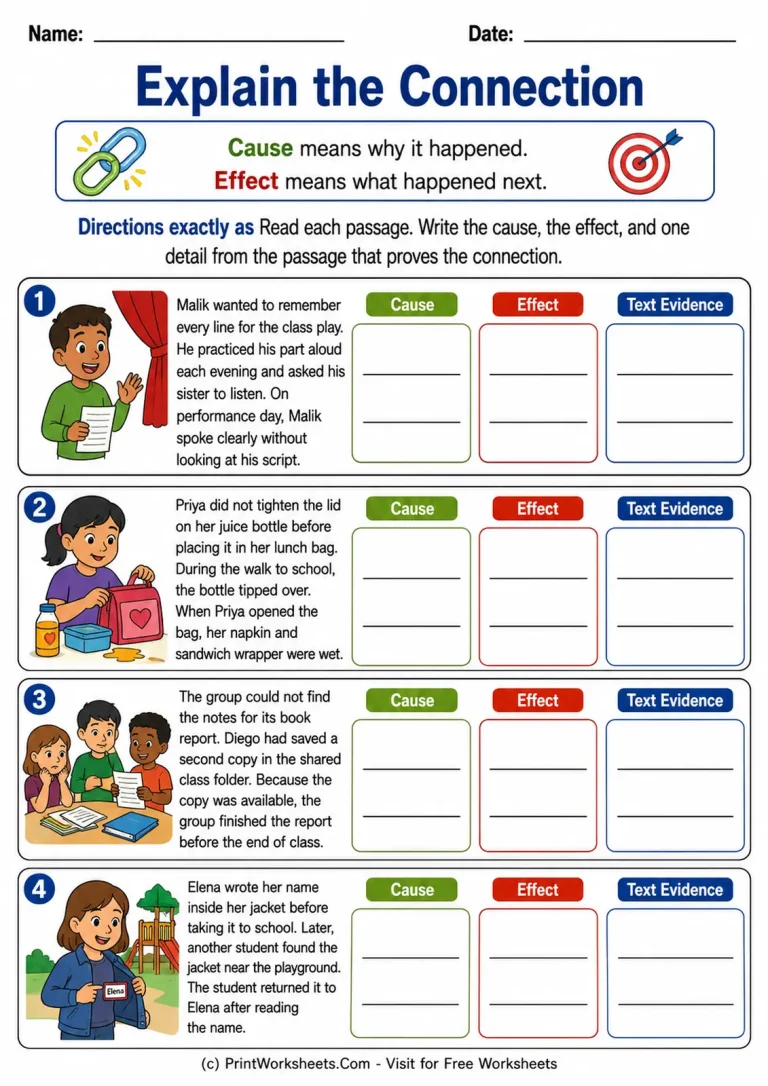
The fourth worksheet adds a stronger written-comprehension step. For each passage, students record the cause, the effect, and one piece of text evidence that proves the connection. They work with Malik practicing for a class play, Priya’s loose juice-bottle lid, Diego saving a second copy of group notes, and Elena writing her name inside a jacket. The separate Text Evidence box makes students return to the passage and justify their answer instead of stopping after identifying the two events.
How to use these Grade 3 cause and effect worksheets
The pages can be used in sequence over several reading lessons or selected individually for review. Page 1 is a practical starting point for students who are still learning to distinguish why something happened from what happened afterward. Page 2 provides quick matching practice, while Page 3 is useful for independent reading comprehension or a short assessment. Page 4 fits well after students are comfortable identifying the relationship and are ready to support an answer with a specific detail.
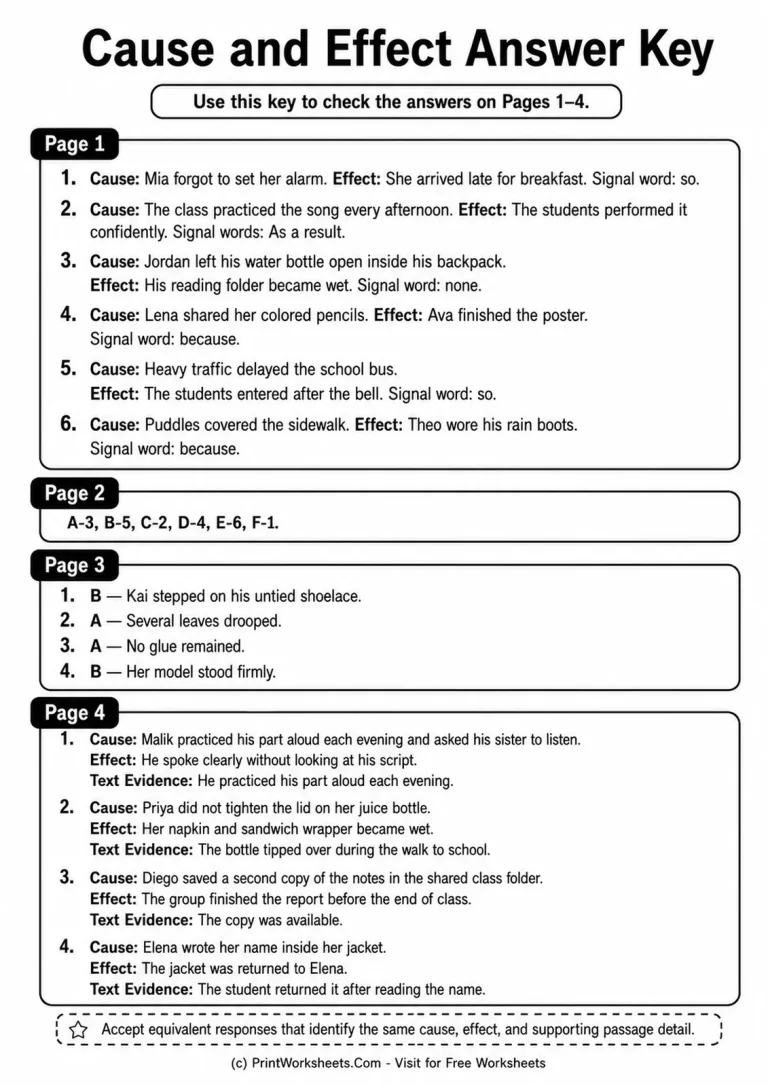
Teachers can also compare this passage-based set with the broader cause and effect worksheets collection when planning additional practice. The included answer key covers all four student pages and accepts equivalent responses on the written evidence activity when students identify the same cause, effect, and supporting detail.
Ways to support or extend learners
For students who need support, begin by reading a passage aloud and asking two oral questions: Why did this happen? and What happened next? On the first page, students can circle clue words before writing in the cause and effect boxes. On the matching page, consider having students explain one pairing verbally before they complete the rest. For more advanced readers, cover the multiple-choice options on Page 3 and ask them to answer the question in their own words first.
Page 4 provides a natural extension because students must cite a passage detail. Stronger readers can be asked to explain how their evidence proves the connection in a complete sentence. Students can also compare a passage with an explicit signal word to one without a signal word and discuss how readers still determine the relationship from meaning.
What students practice in this printable set
These worksheets combine several related Grade 3 reading skills: identifying causes and effects, noticing signal words, matching logically connected events, answering passage-based questions, and selecting text evidence. The variety of formats makes it easier to see whether a student can transfer the same comprehension skill from one task to another. By the final worksheet, students are doing more than naming two events; they are explaining the connection and pointing to the detail that supports their thinking.