Printable grade 3 reading comprehension finding the main idea worksheets provide targeted literacy practice for elementary students mastering text analysis. Extracting the central topic from a paragraph represents a critical academic milestone. This printable PDF reading pack forces students to evaluate short passages, differentiate between broad concepts and minor facts, and logically connect supporting details to the overarching narrative. Mastering text structure directly improves reading fluency and prevents comprehension breakdowns during standardized testing formats.
Educators deploy grade 3 reading comprehension finding the main idea worksheets into daily literacy centers, guided reading groups, and focused homework interventions. Building a comprehensive language arts curriculum requires continuous exposure to diverse text structures. Combine this main idea packet with the expansive reading resources found in our main reading comprehension category. Consistent practice isolating core topics guarantees students will successfully transition from simple story recounting to advanced analytical writing.
Inside the Grade 3 Main Idea PDF Pack
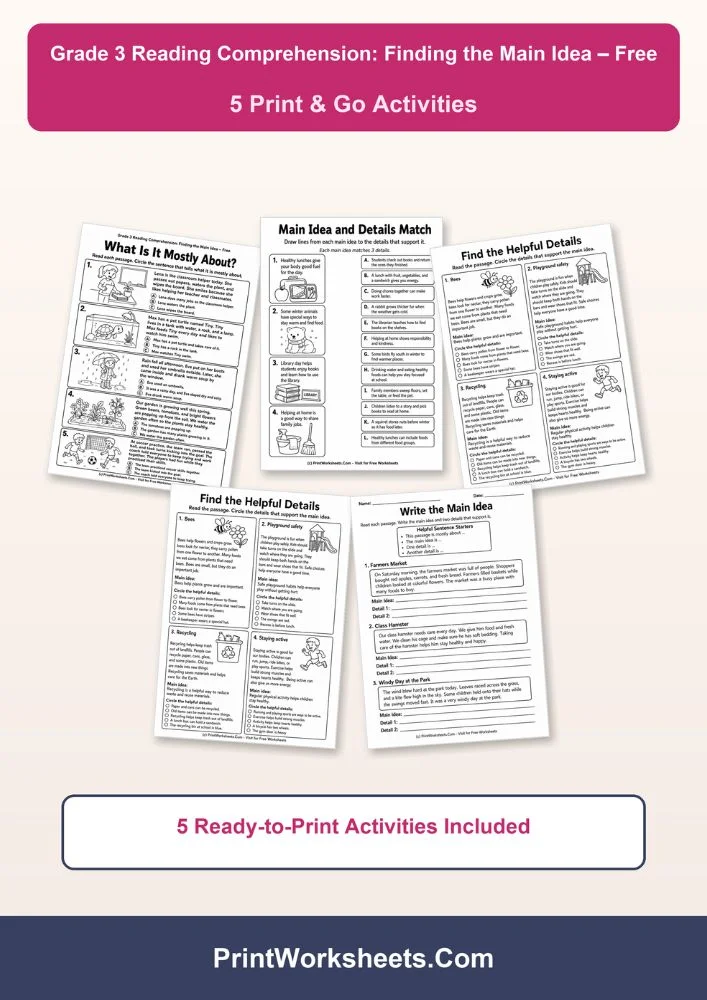
Effective reading comprehension materials require clear text formatting and age-appropriate vocabulary. This PDF utilizes highly legible fonts and distinct visual boundaries, ensuring students focus entirely on paragraph analysis rather than overwhelming page layouts. Each activity page targets a specific reading comprehension objective:
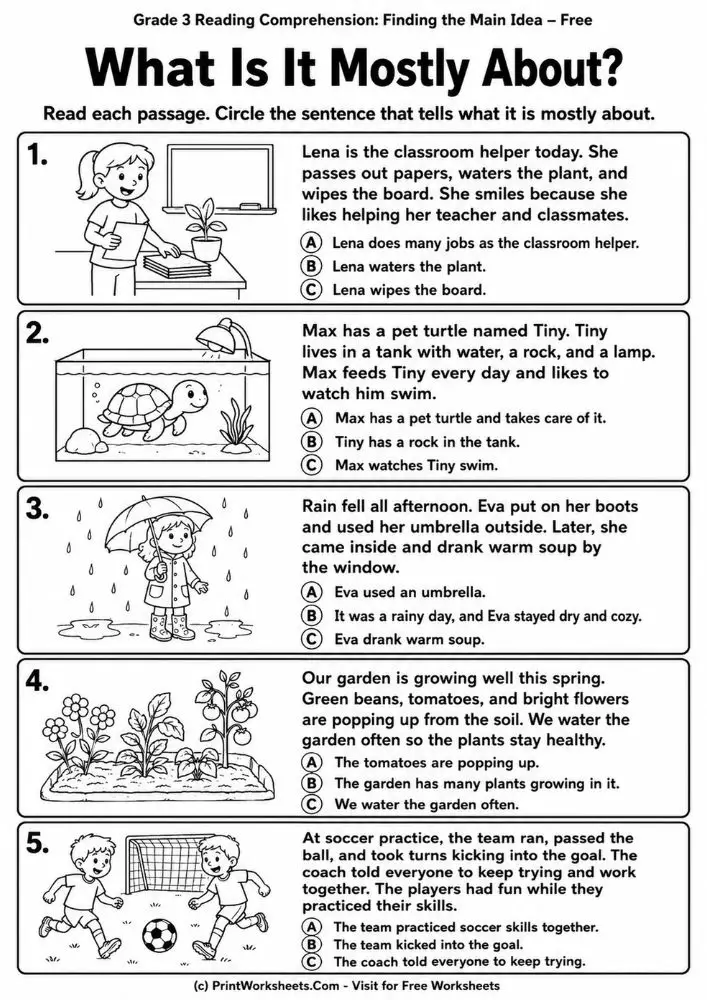
- What Is It Mostly About: A direct multiple-choice reading assessment. Students read five distinct short paragraphs detailing familiar scenarios like classroom helpers, pet turtles, and soccer practice. Following each passage, students evaluate three sentence options and circle the single sentence that accurately summarizes the entire text, eliminating overly specific minor details.
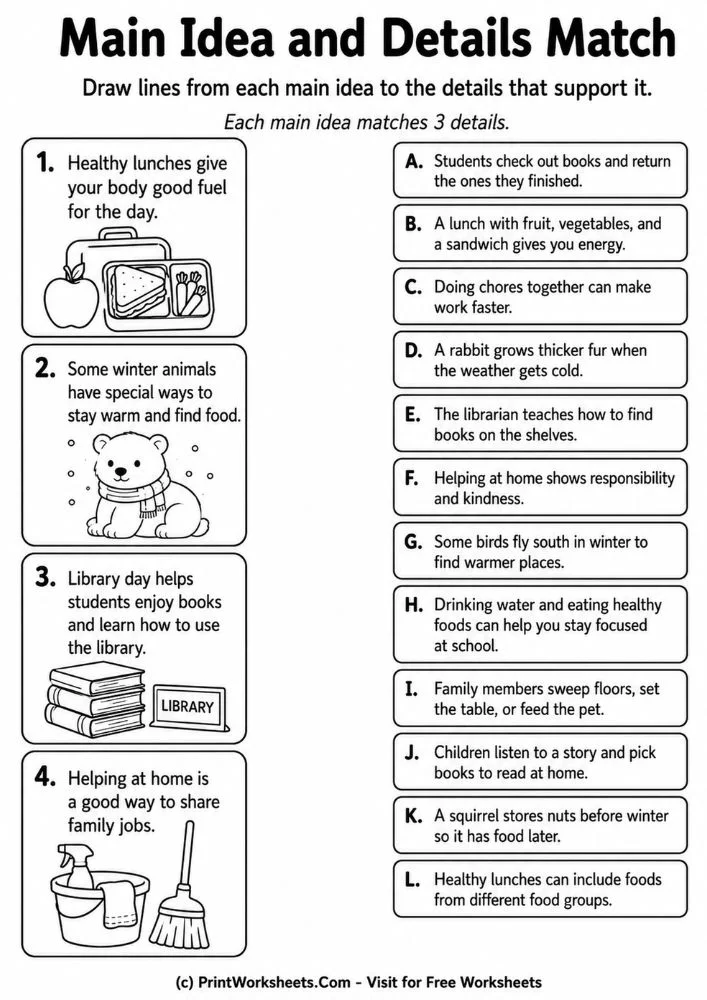
- Main Idea and Details Match: A targeted logical connection exercise. The left column presents four distinct main idea statements encapsulated in boxes. The right column lists twelve specific supporting details. Students must draw lines connecting each main idea to its three correct corresponding details. This activity visually reinforces how multiple facts collectively build a single overarching concept.
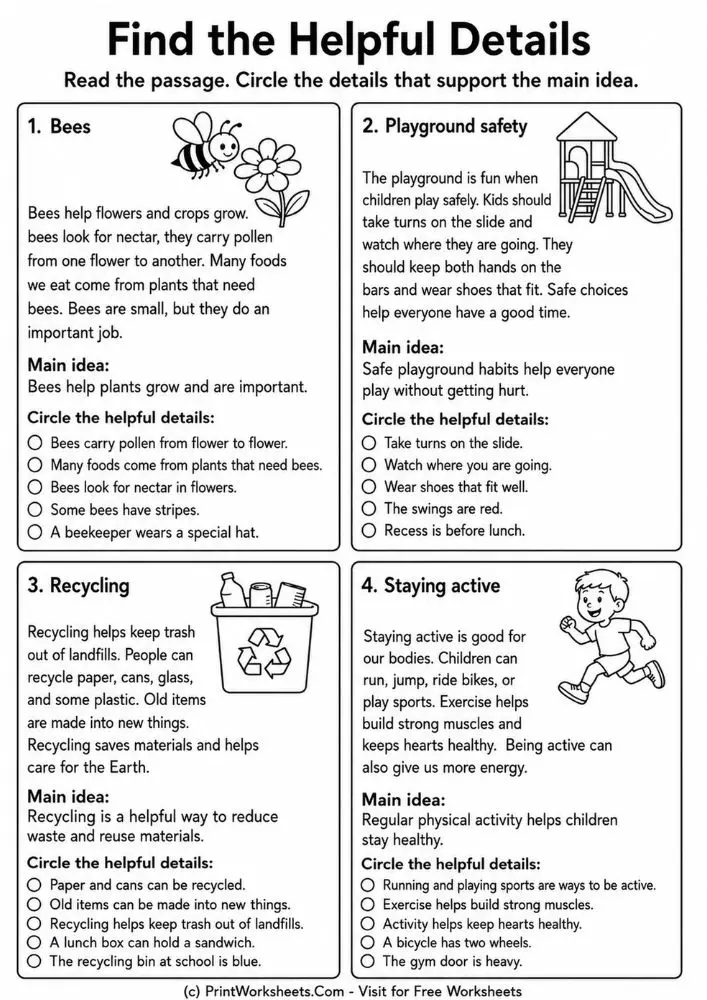
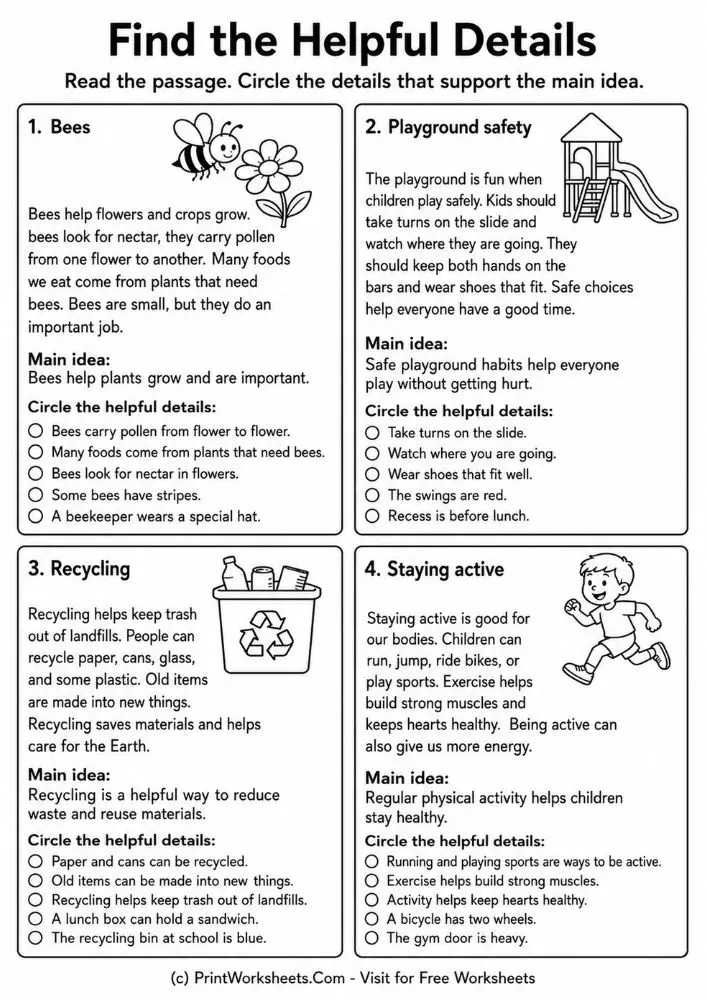
- Find the Helpful Details: An analytical text dissection activity. Students read four informational passages covering topics like bees, playground safety, recycling, and physical activity. The worksheet provides the established main idea for each passage. Students must evaluate a checklist of details and specifically circle the facts that directly support the provided main idea, purposefully ignoring unrelated true statements.
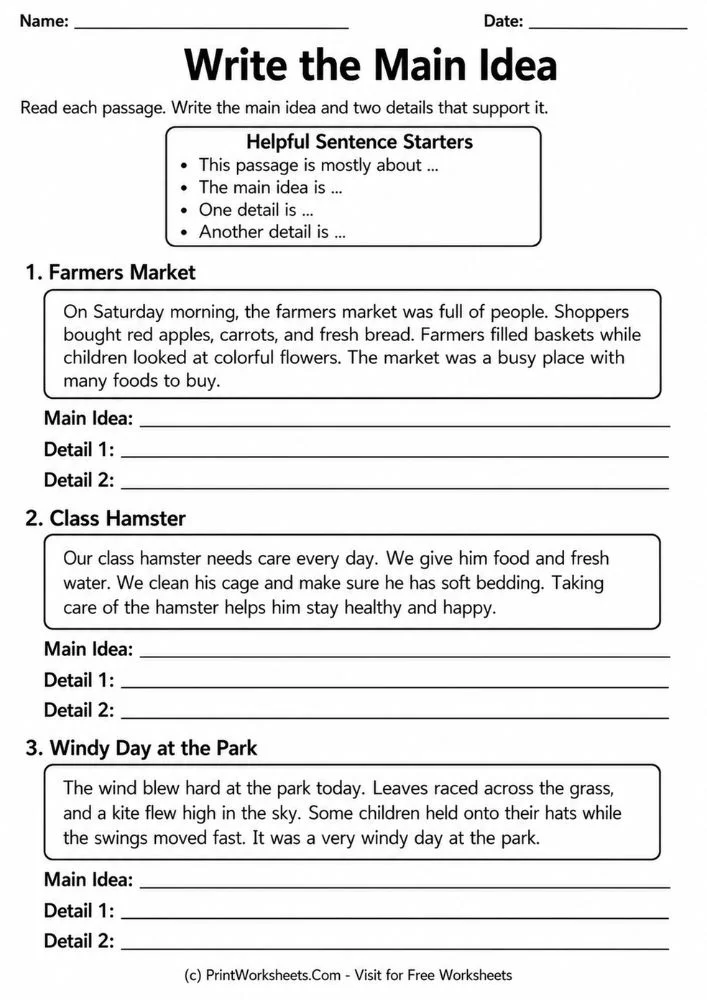
- Write the Main Idea: An independent reading and writing application. Students read unstructured paragraphs regarding farmers markets, class hamsters, and windy parks. Utilizing the provided “Helpful Sentence Starters” box, students must independently write the overarching main idea on the primary line, followed by explicitly writing two distinct supporting details extracted directly from the text.
Practical Classroom and Literacy Center Implementation
Print this high-resolution PDF directly on standard 8.5″ x 11″ copy paper. Integrating active reading strategies prior to assigning the worksheets maximizes conceptual retention. When introducing the “What Is It Mostly About” page, require students to utilize highlighters. Instruct students to highlight the most repeated words or the first and last sentences of the paragraph. Highlighting physical text grounds the abstract concept of main idea evaluation.
Utilize the “Write the Main Idea” page as a formal assessment of reading comprehension and sentence structure. Require students to write complete sentences using proper capitalization and punctuation. For repeated literacy center use, place the matching and multiple-choice pages inside heavy-duty dry-erase sleeves. Students use washable markers to draw lines and circle options, allowing multiple reading groups to practice text analysis throughout the instructional week without consuming excess printer paper.
Frequently Asked Questions
Why is finding the main idea difficult for third-grade students?
Finding the main idea requires advanced cognitive synthesis. Early readers are trained to memorize specific facts and answer direct recall questions (e.g., “What color was the dog?”). Asking a student what a passage is “mostly about” forces them to zoom out, ignore interesting but minor details, and formulate a broad summary. This transition from literal recall to abstract summarization requires explicit, repeated practice using structured worksheets.
How do supporting details validate the main idea?
Supporting details act as the structural foundation for the main idea. If a student claims the main idea of a passage is “Dogs make great pets,” they must locate sentences within the text proving that statement, such as “Dogs protect houses” or “Dogs love to play fetch.” Teaching students to match details to the central topic prevents them from making unfounded assumptions outside the provided text.
What reading level aligns with these main idea worksheets?
This reading comprehension PDF pack directly aligns with standard third-grade Lexile levels and core ELA standards. The sentence structures and vocabulary are explicitly designed for 8-to-9-year-old readers. Second-grade students reading above grade level may utilize the multiple-choice and matching pages, while fourth-grade students can use the entire packet as an early-year review for identifying text structures.