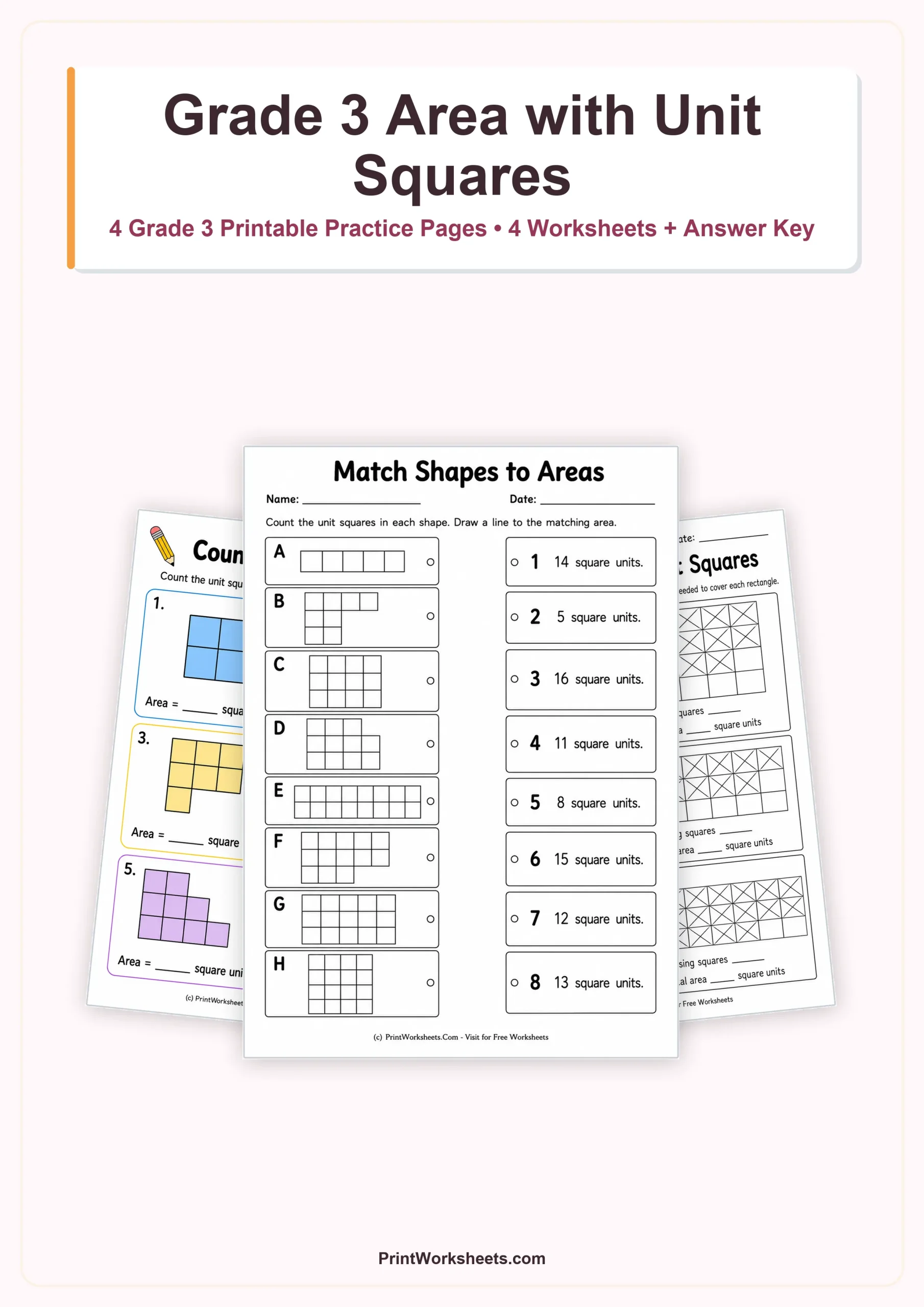
These Grade 3 worksheets build a practical understanding of area with unit squares by asking students to count, compare, complete, and interpret square-unit models. Instead of repeating one type of exercise, the four printable pages move through several ways of thinking about area. Students begin with visible unit-square shapes, continue to matching and incomplete arrays, and then apply the same idea to short real-world situations. This variety makes the set useful for classroom practice, math centers, homework, or a focused review of what square units actually represent.
Practice Area with Unit Squares in Several Ways
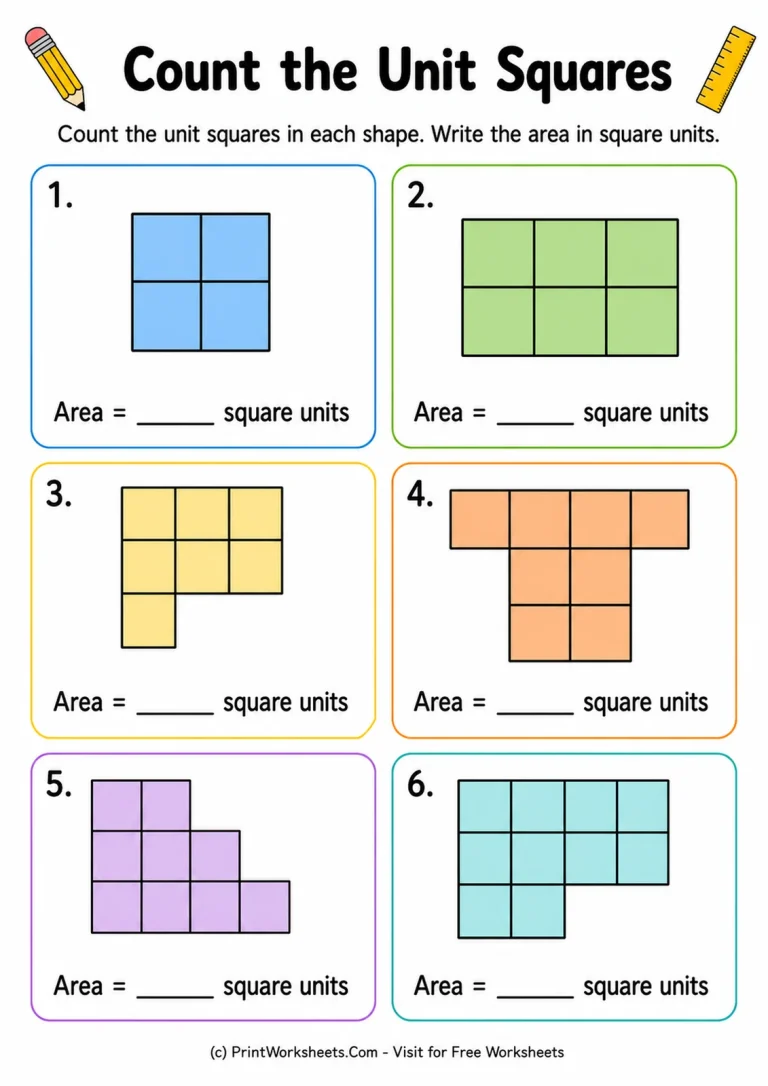
The first worksheet gives students six shapes made from equal-sized squares. Learners count the squares and record each area in square units. The early examples are simple and highly visual, while later shapes include stepped arrangements that require careful counting rather than relying only on a memorized length-times-width rule. The areas range from 4 to 10 square units, so students can concentrate on the meaning of area without being distracted by large numbers.
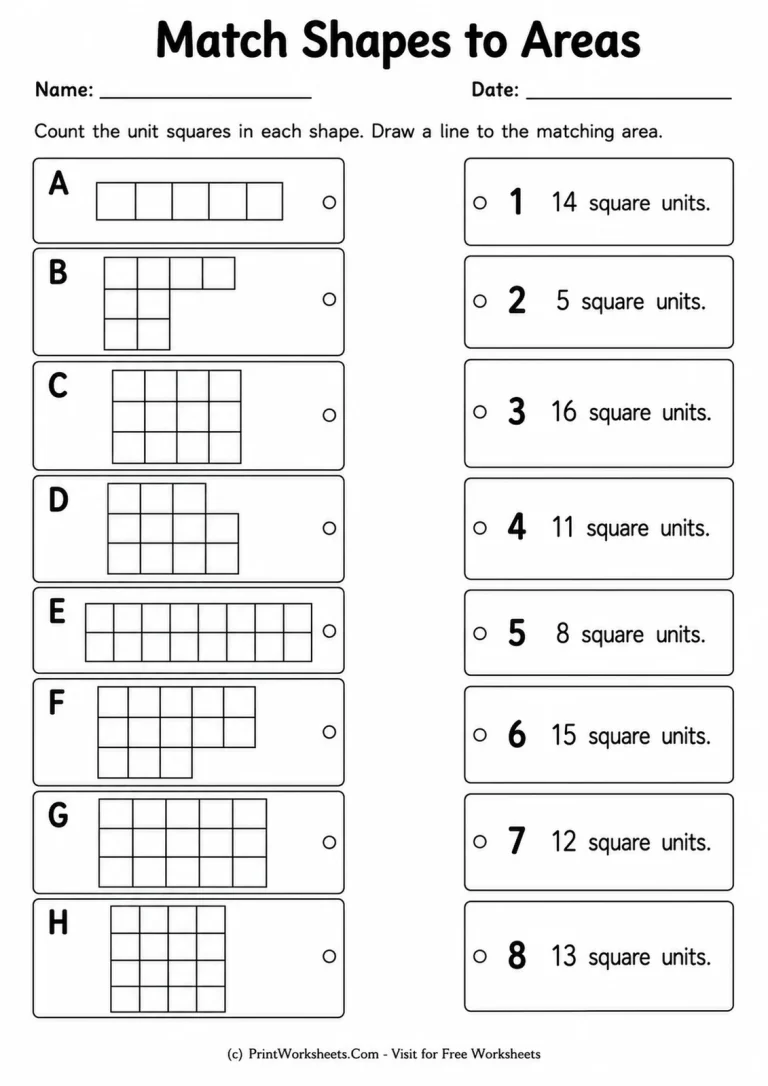
The second page changes the response format. Eight shapes labeled A through H must be matched to numbered area choices. Some figures are full rectangles, while others are composite or stepped shapes. This encourages students to determine the area first and then locate the matching value, giving them practice checking their own counting against a fixed set of possibilities. Teachers can also ask students to explain how they counted each figure, such as by rows, columns, or smaller parts.
From Counting Squares to Completing Area Models
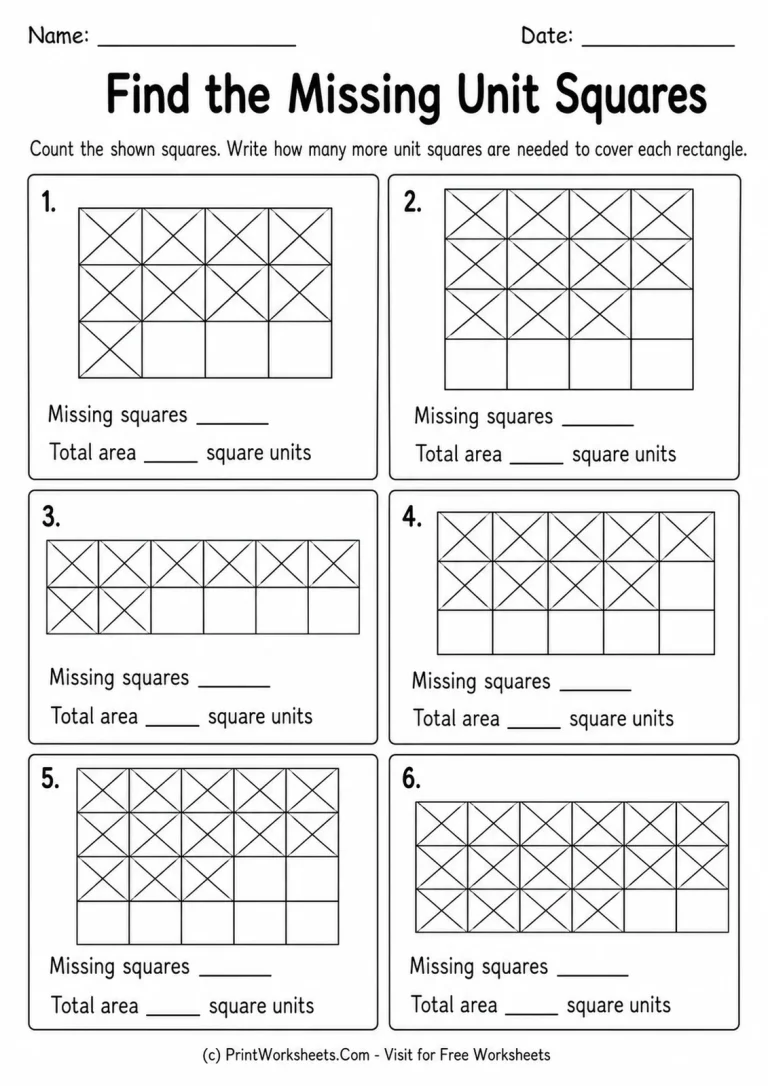
The third worksheet introduces partially shown rectangular arrays. Some unit squares are marked with diagonal X symbols, and students must determine how many more squares are needed to cover the entire rectangle. Each problem asks for both the number of missing squares and the total area. This adds an important layer of reasoning: students are no longer just counting what is visible, but using the structure of the complete rectangle to infer what is absent.
For example, a student may count the shown squares, identify the rectangle’s full number of spaces, and subtract to find the missing amount. Another student may first determine the total area from rows and columns and then compare that total with the marked squares. Both strategies reinforce that area measures the number of equal square units needed to cover a surface without gaps or overlaps.
Connect Square Units to Everyday Situations
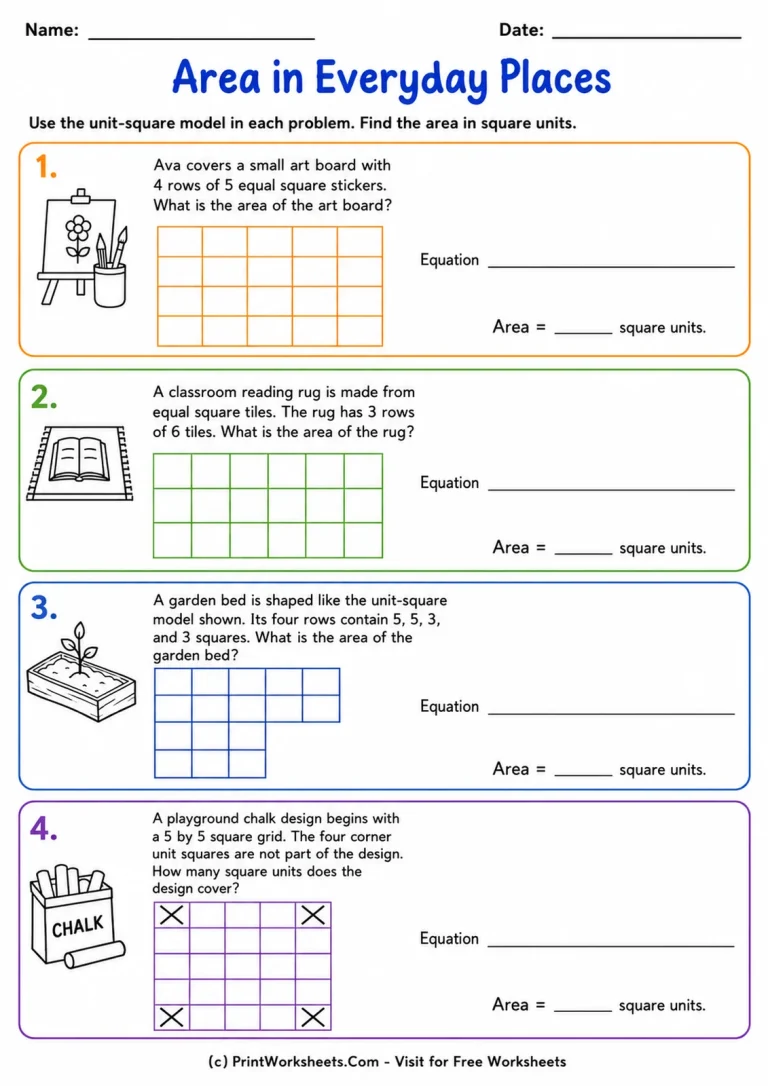
The fourth worksheet places area models in familiar settings. Students work with an art board arranged in 4 rows of 5 squares, a classroom reading rug with 3 rows of 6 tiles, a garden bed built from uneven rows of unit squares, and a playground chalk design based on a 5-by-5 grid with four corner squares excluded. Each item includes space for an equation and a final area in square units, helping students connect the picture, numerical reasoning, and written answer.
The garden and chalk problems are especially useful because they move beyond a single complete rectangle. Students can add the squares by rows or decompose the figure into smaller parts. In the chalk design, they can also recognize a full 25-square grid and subtract the four excluded corners. These different approaches support flexible thinking and show that a correct area can often be found in more than one reasonable way.
Teaching Ideas for Grade 3 Area Practice
Before assigning the pages independently, review the meaning of one square unit and emphasize that area describes how much surface is covered. On the first two pages, invite students to trace rows with a finger or lightly mark groups as they count. On the missing-square page, ask students to state the total rectangle size before deciding what is missing. For the contextual problems, have students write or discuss an equation that matches the model rather than giving only the final number.
Students who need extra support can complete the first counting page before moving to the matching activity. Learners ready for extension can redraw one of the composite shapes in a different arrangement while keeping the same area, or create their own incomplete rectangle for a partner to solve. For additional practice focused specifically on complete rectangular arrays, use the area of rectangles with unit squares worksheets.
A Flexible Four-Page Area Set
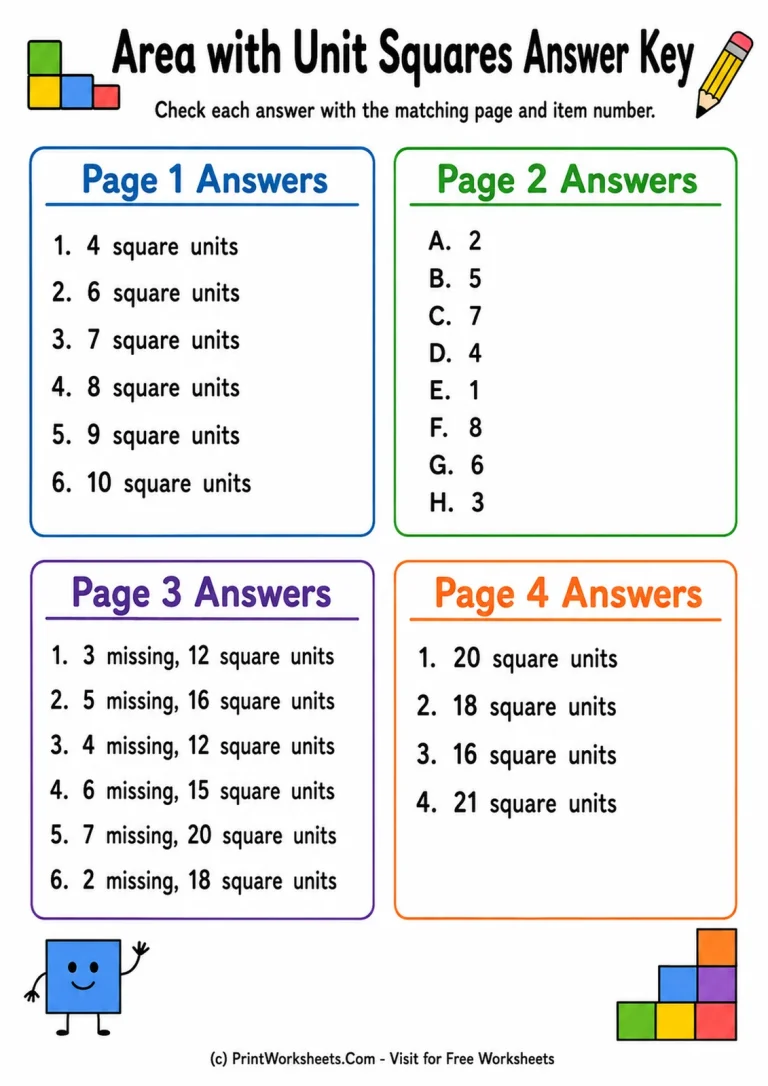
Because the pages use direct counting, matching, missing-square reasoning, and short application problems, they can be used across several lessons instead of as a single repetitive drill. One page can introduce the concept, another can serve as independent practice, and the contextual page can be used as an exit ticket or small-group challenge. The included answer key covers all four student worksheets, making it straightforward to check responses while keeping the instructional focus on how students reason about area in square units.