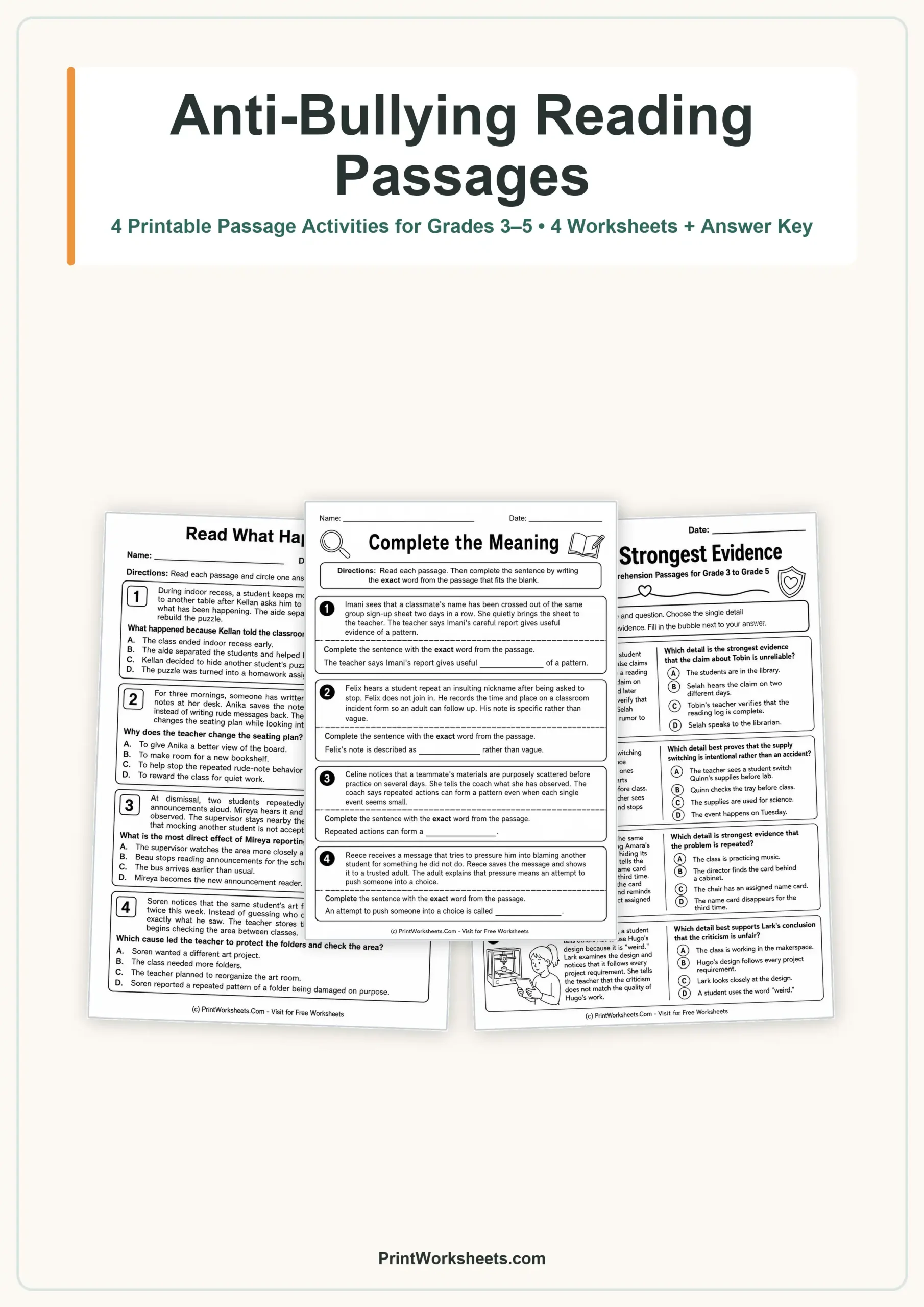
These anti-bullying reading comprehension passages give students in grades 3 through 5 meaningful practice with reading skills while they think carefully about repeated behavior, reporting concerns, evidence, and safe adult follow-up. Across four printable student worksheets, learners move from identifying causes and effects to using exact words from a passage, choosing the strongest supporting detail, and selecting accurate summaries. The school-based situations are concrete enough for students to understand, while the questions require them to return to the text instead of relying on guesses.
Anti-Bullying Reading Comprehension with Four Distinct Skills
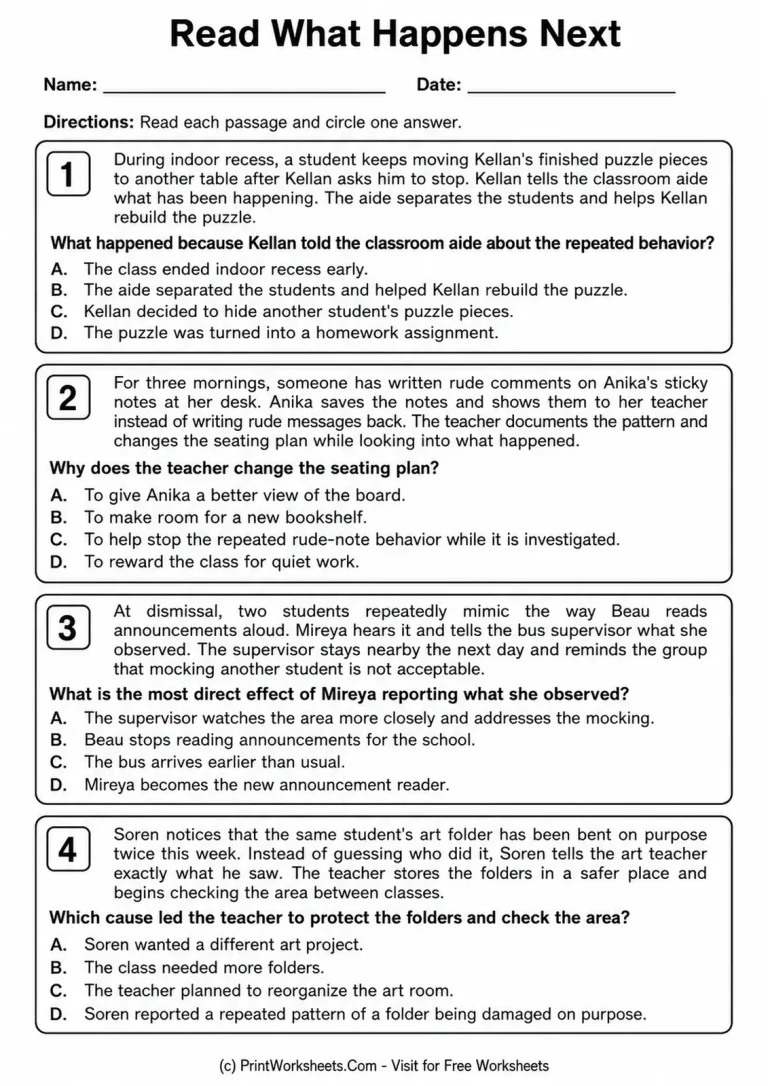
The first worksheet, Read What Happens Next, focuses on cause and effect. Students read short scenarios about repeated behaviors such as moving Kellan’s completed puzzle pieces, leaving rude notes for Anika, mocking the way Beau reads announcements, and damaging an art folder on purpose. Each question asks students to connect a reported pattern with the adult response that followed. This makes the page useful for teaching students to identify what happened because of an action and which event caused a later response.
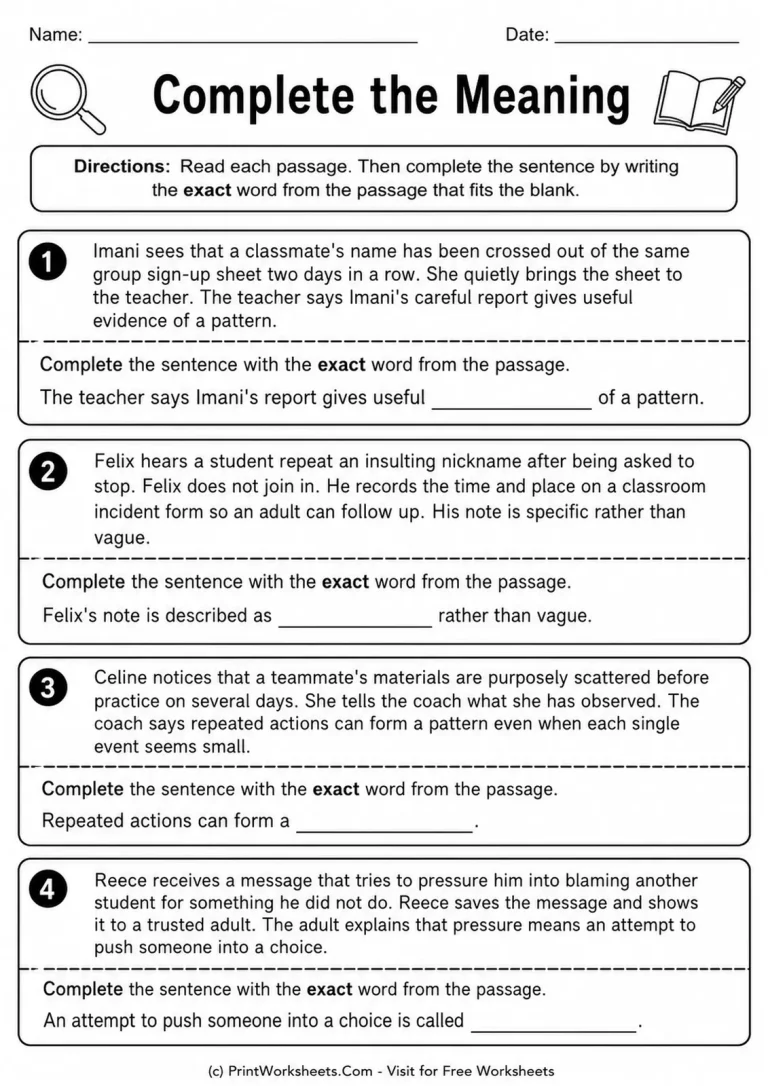
The second worksheet, Complete the Meaning, shifts the emphasis to context vocabulary and precise reading. Students must write the exact word from each passage that completes a sentence. The target words include evidence, specific, pattern, and pressure. Because the directions require the exact word from the text, students practice locating information accurately rather than simply writing a synonym that seems close.
Text Evidence and Summary Practice for Grades 3–5
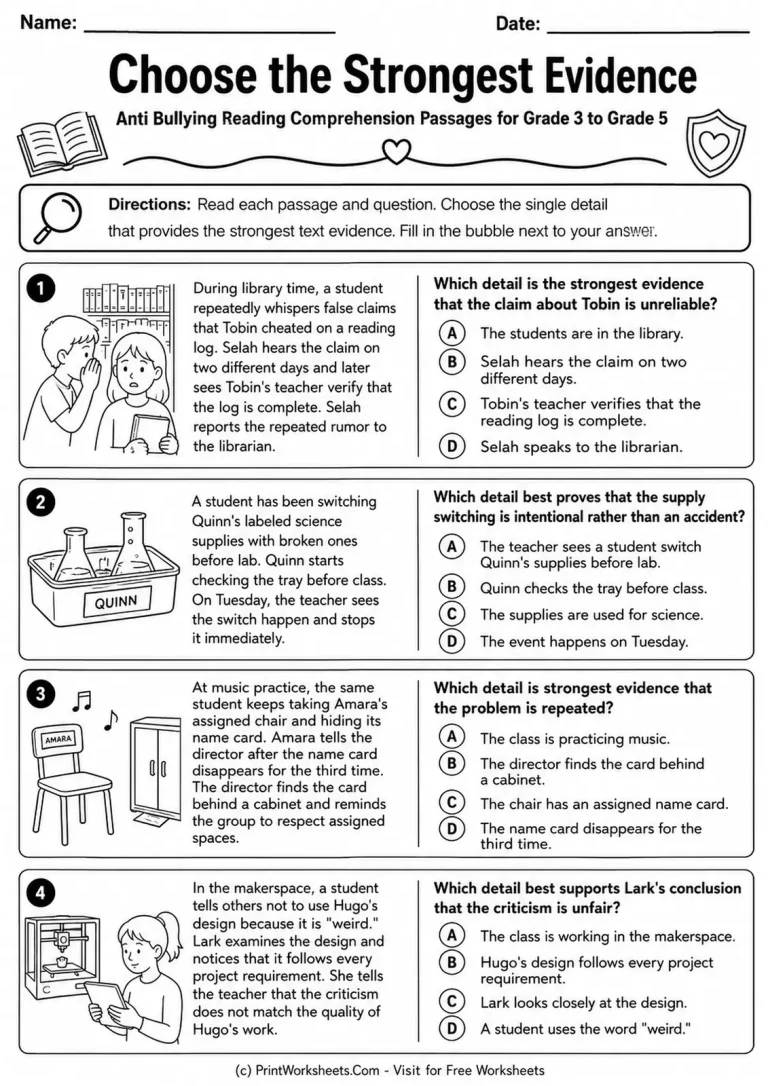
The third worksheet, Choose the Strongest Evidence, asks students to evaluate which passage detail best supports a claim. One item asks what most strongly shows that a rumor about Tobin is unreliable, while another asks for evidence that switching Quinn’s science supplies was intentional rather than accidental. Students also identify the detail proving a problem happened repeatedly and the evidence showing that criticism of Hugo’s design was unfair. These questions are especially useful for teaching the difference between a detail that is merely related to a topic and one that directly proves a claim.
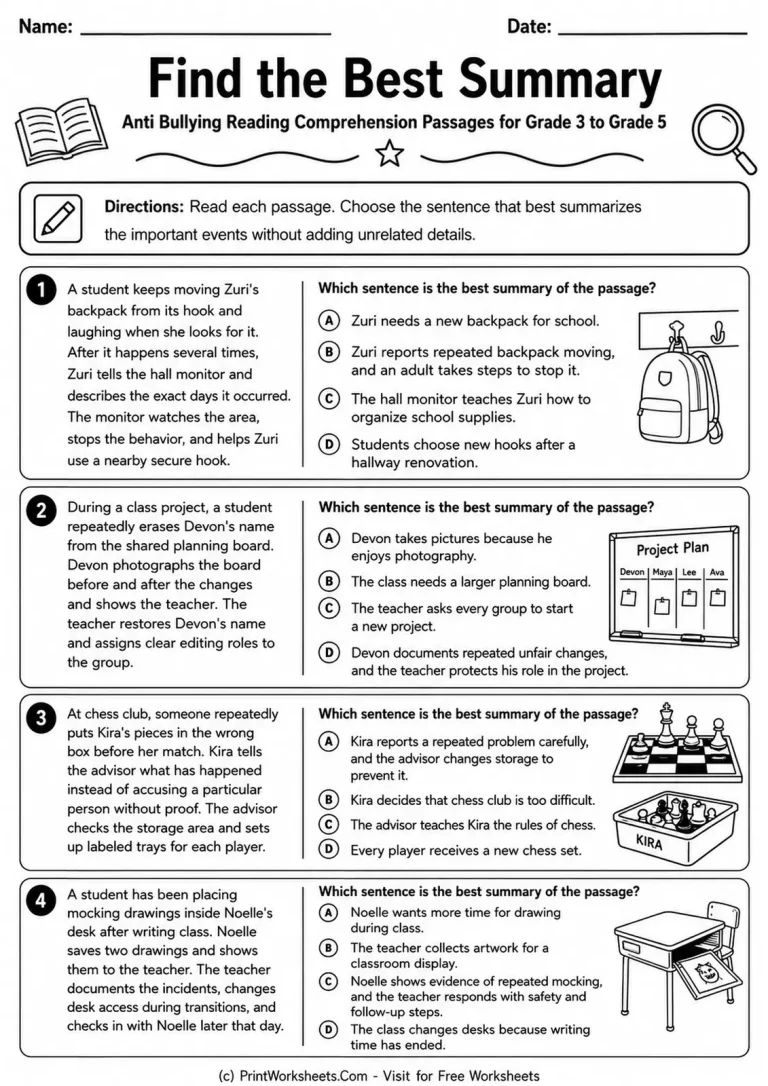
The fourth worksheet, Find the Best Summary, requires students to select the sentence that captures the most important events without adding unrelated information. The passages include Zuri reporting repeated backpack moving, Devon documenting changes to a project board, Kira reporting repeated problems with her chess pieces, and Noelle saving mocking drawings as evidence. The strongest answers include the central problem, the student’s careful response, and the adult’s follow-up without drifting into minor details.
Ways to Use These Reading Passages in Class
Teachers can use one page at a time as a mini-lesson, independent reading task, small-group activity, or review station. For cause-and-effect practice, ask students to underline the reported behavior once and circle the adult response. During the text-evidence page, have students explain why the correct detail proves the claim more directly than the other choices. On the summary page, students can cross out choices that are too narrow, unrelated, or missing the main outcome before selecting the best answer.
For students who need additional support, read each passage aloud and pause after every sentence to identify who acted, what happened, and what changed afterward. More advanced readers can extend the activity by writing one sentence that explains why a chosen answer is stronger than a distractor. The exact-word vocabulary page also works well as a quick close-reading warm-up because students must scan carefully for language that matches the sentence frame.
Teacher Notes, Differentiation, and Exit Tickets
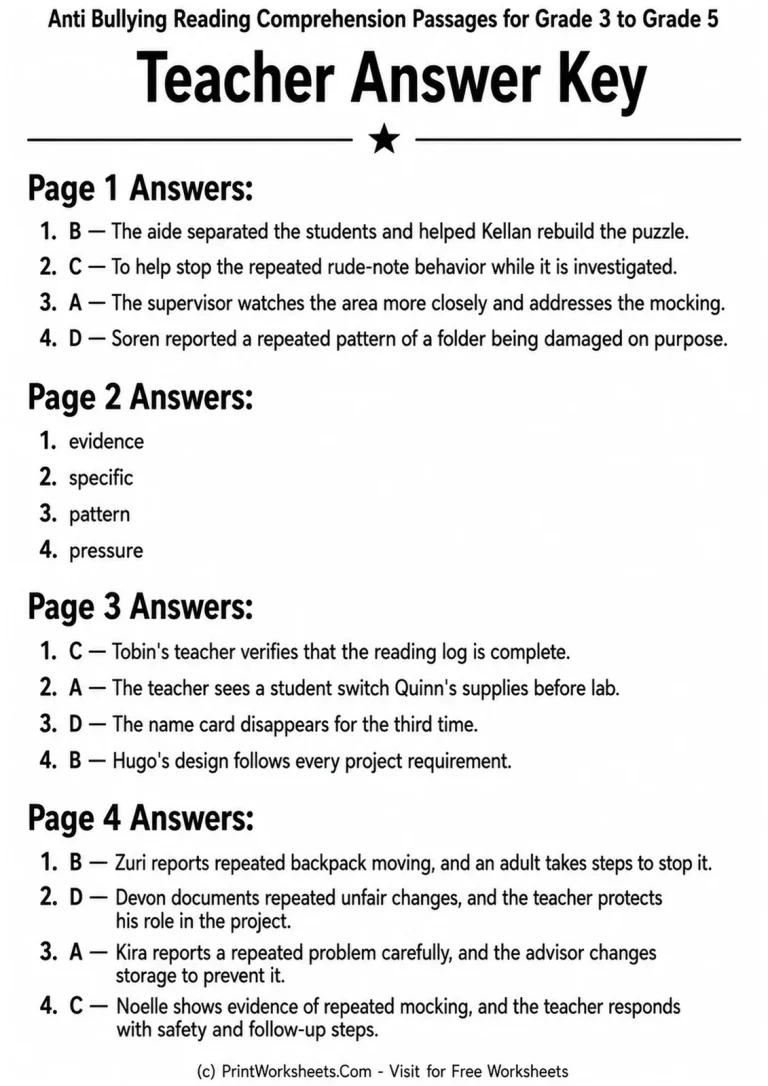
The included teacher answer key covers all four student worksheets, making the set practical for independent work or quick review. A simple exit ticket can ask students to write one difference between a supporting detail and a summary, or to name one clue that shows a behavior is repeated rather than a one-time event. As an extension, students can write a short school scenario of their own and create one evidence question for a partner to answer.
If your students benefit from additional themed comprehension work, you can also use the Halloween reading comprehension passages for extra practice identifying information in short texts. For another seasonal reading option, the Labor Day reading comprehension passages provide additional passage-and-question practice.
This four-page set works best when students are encouraged to point to the exact sentence or phrase that supports each response. That habit keeps the lesson centered on reading comprehension while reinforcing careful observation, accurate reporting, and thoughtful interpretation of repeated school situations.