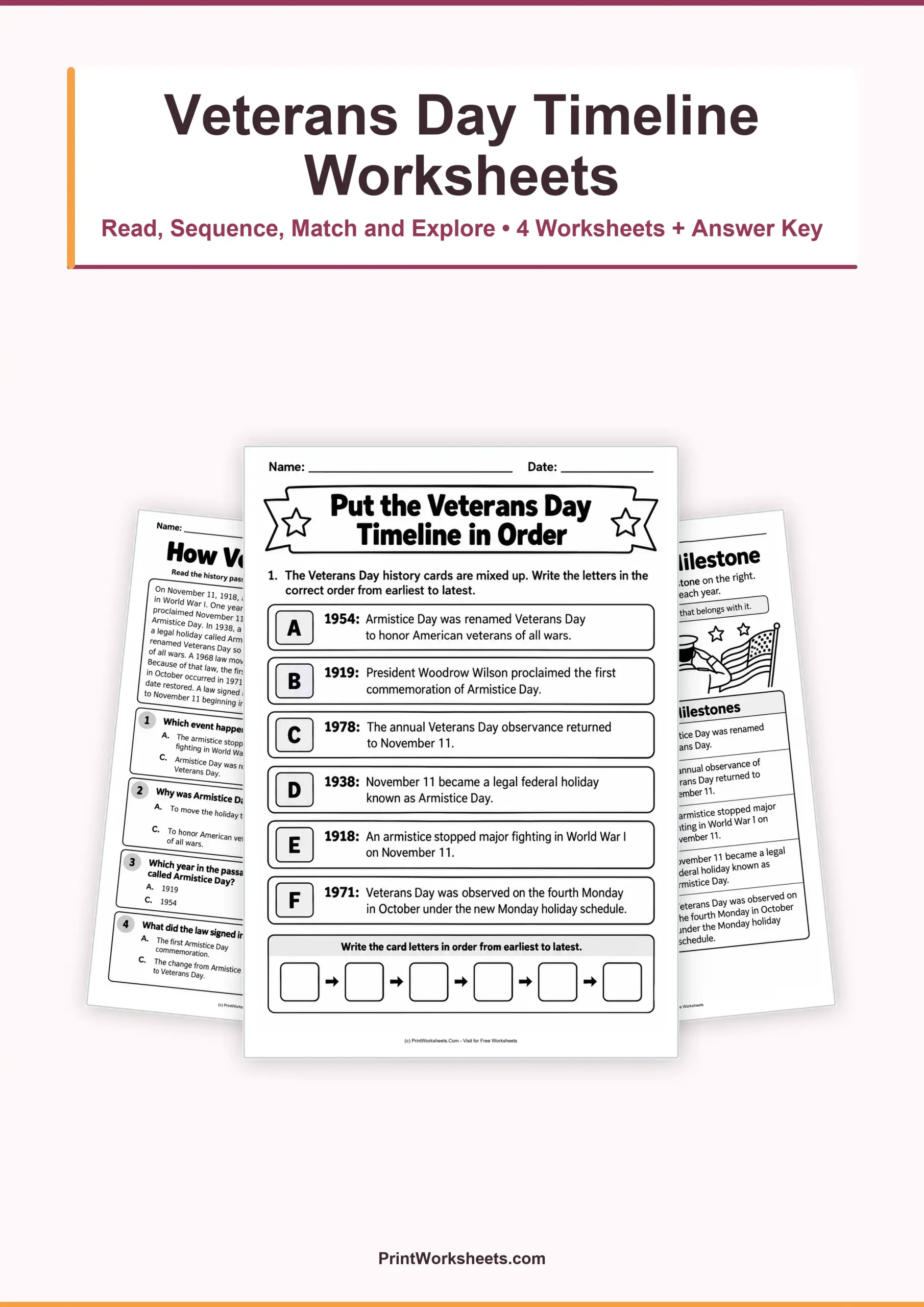
Why is Veterans Day observed on November 11, and why was it once celebrated in October? These Veterans Day timeline worksheets help students in grades 3–5 investigate the history behind those changes. Through a historical reading passage, chronological event cards, year-to-milestone matching, and a visual timeline, children practice placing events in order while learning how the holiday developed between 1918 and 1978. The printable PDF set contains four student worksheets and a teacher answer key.
Explore the Veterans Day Timeline Worksheets
Each activity approaches the same historical story from a different angle. Students begin by reading about the origins of Veterans Day, then use dates and descriptions to organize important events. The final activity combines timeline interpretation with a simple calculation involving elapsed years. This progression helps students move beyond memorizing dates toward understanding how historical events relate to one another.
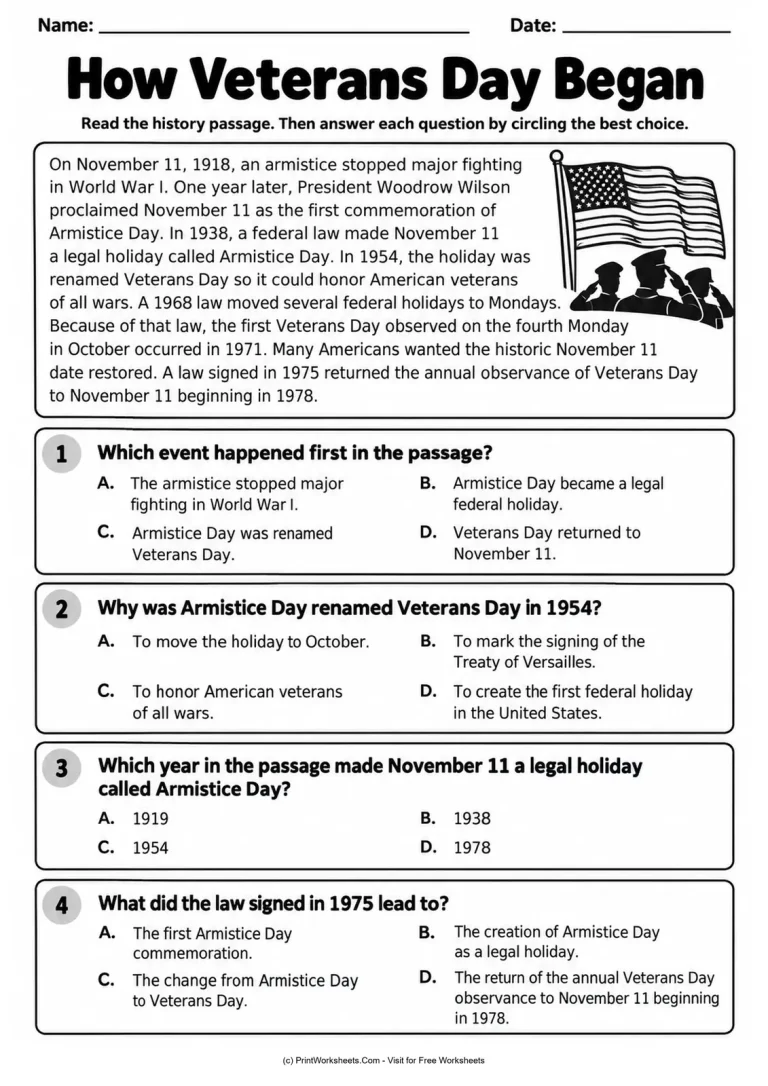
1. How Veterans Day Began: Reading Comprehension
The first worksheet presents a passage beginning with the November 11, 1918 armistice that stopped major fighting in World War I. Students learn about President Woodrow Wilson’s 1919 commemoration of Armistice Day, its recognition as a legal federal holiday in 1938, and the decision to rename it Veterans Day in 1954. The passage also explains the temporary change to an October observance and the eventual restoration of November 11.
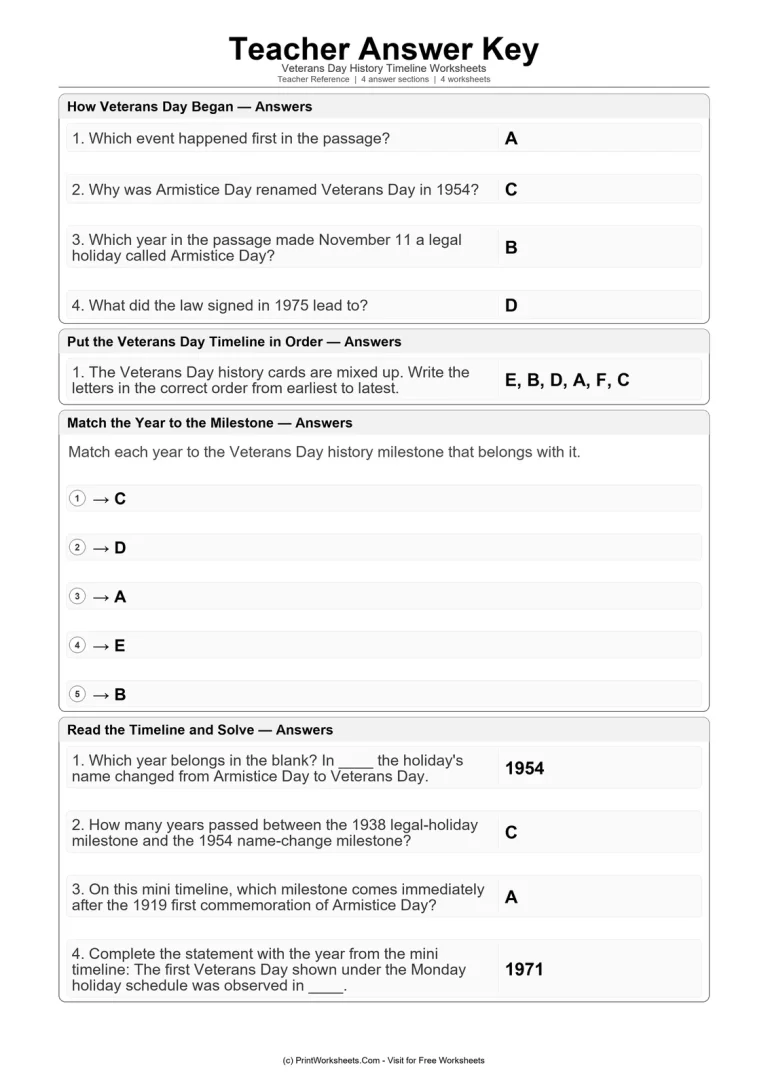
After reading, students answer four multiple-choice questions. They identify the earliest event, explain why the holiday was renamed, recognize the year of federal holiday recognition, and determine what resulted from the law signed in 1975. These questions encourage careful reading and help students connect historical causes with their consequences.
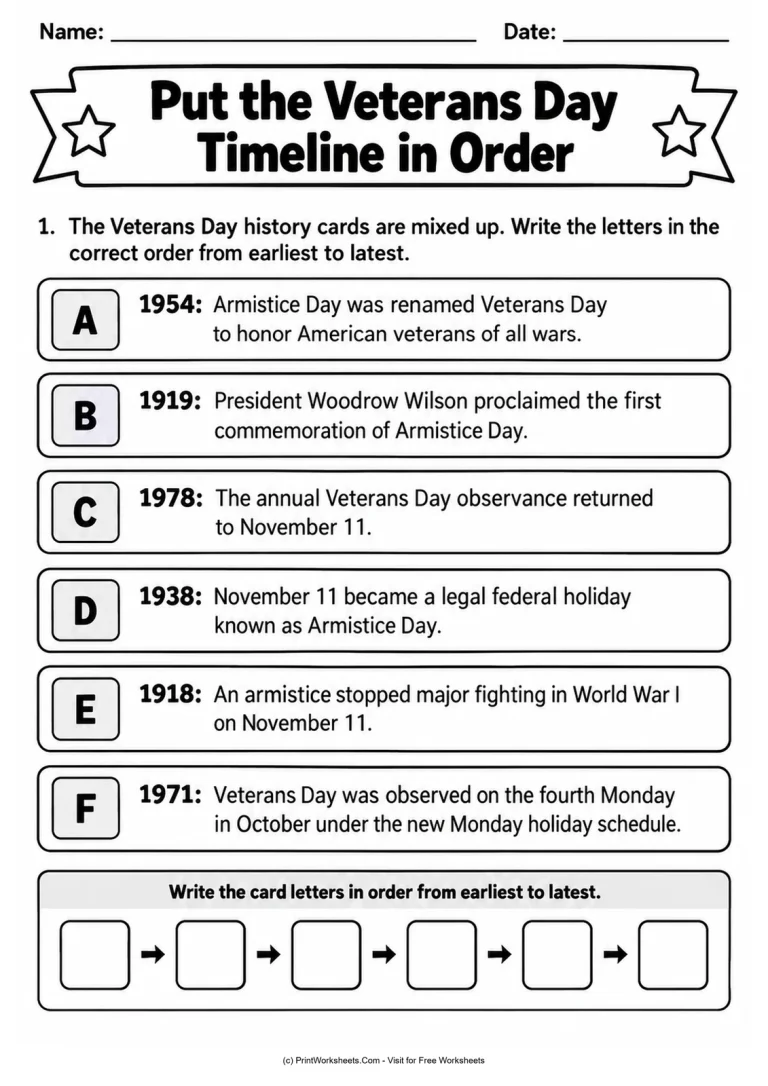
2. Put Six Veterans Day Events in Chronological Order
The second worksheet turns the history into a sequencing challenge. Six labeled event cards appear in mixed order, representing 1918, 1919, 1938, 1954, 1971, and 1978. Students read each description and write the corresponding letters in six connected boxes, beginning with the earliest event.
Because the cards include both years and short explanations, students can check how the events connect as they build their sequence. Teachers can also ask students to explain why the 1954 renaming belongs before the 1971 October observance or what changed between 1971 and 1978.
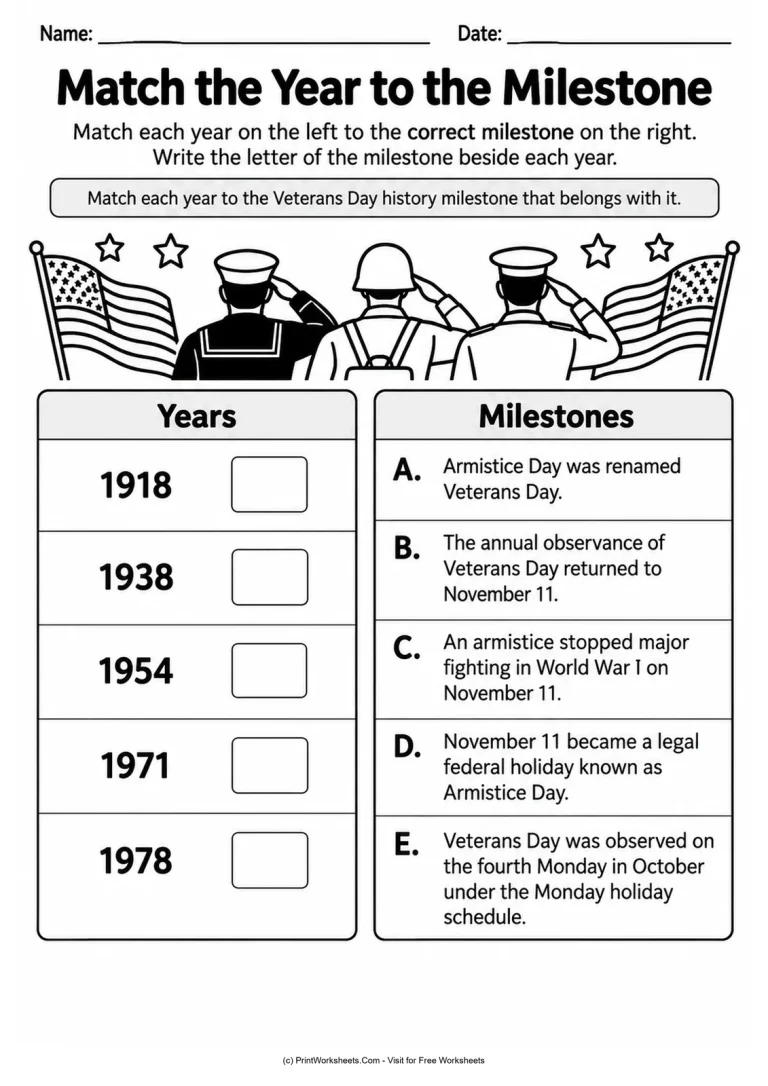
3. Match the Year to the Historical Milestone
The third worksheet reinforces five significant years: 1918, 1938, 1954, 1971, and 1978. Students match each year to a lettered description of the corresponding Veterans Day milestone. These include the World War I armistice, the establishment of Armistice Day as a legal federal holiday, the holiday’s renaming, the October observance, and its return to November 11.
This matching format works well as an independent review after the reading passage or sequencing activity. Instead of reconstructing the entire timeline, students concentrate on the relationship between a specific date and its historical meaning.
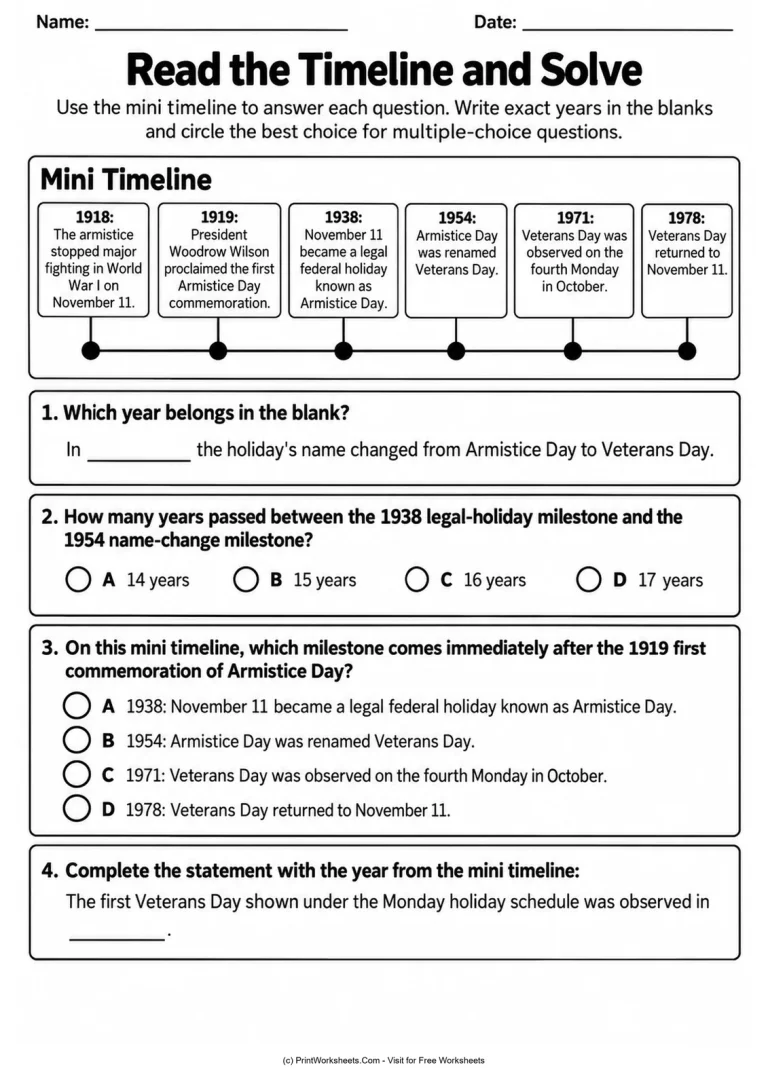
4. Read a Mini Timeline and Solve Questions
The fourth worksheet displays six dated milestones along a horizontal timeline. Students consult the visual information to complete two year-based responses and answer two multiple-choice questions. They identify the year Armistice Day became Veterans Day, calculate how many years passed between 1938 and 1954, recognize the event immediately following the 1919 commemoration, and identify the year of the October observance.
The elapsed-time question adds a useful mathematics connection: students subtract 1938 from 1954 to find a 16-year interval. The other questions develop the ability to locate information and interpret the order of events on a timeline.
Important Veterans Day Dates Students Will Learn
The activities emphasize six historical milestones. In 1918, an armistice stopped major fighting in World War I on November 11. In 1919, President Woodrow Wilson proclaimed the first commemoration of Armistice Day. In 1938, November 11 became a legal federal holiday called Armistice Day. In 1954, the holiday was renamed Veterans Day to honor American veterans of all wars. In 1971, Veterans Day was observed on the fourth Monday in October under the federal Monday holiday schedule. In 1978, its annual observance returned to November 11 following legislation signed in 1975.
Reviewing these milestones together helps students distinguish the original armistice from the later establishment, renaming, rescheduling, and restoration of the holiday. It also reinforces the idea that an important historical event and the laws governing its commemoration can occur in different years.
Teaching Ideas for Grades 3, 4, and 5
For 3rd grade, introduce the meaning of armistice, commemoration, and veteran before reading the passage together. Use the event-card worksheet as a guided sequencing activity. For 4th grade, have students complete the reading and matching independently, then explain the reasons behind the 1954 name change. For 5th grade, emphasize the difference between historical events and later holiday legislation, and ask students to justify their answers using evidence from the passage or timeline.
The worksheets can also support small-group social studies instruction, Veterans Day classroom lessons, and cross-curricular reading practice. Have students compare their chronological sequences, explain the significance of November 11, or describe how the holiday’s observance changed over time. The included teacher answer key provides answers for all four activities, making checking and discussion more manageable.
Use the Printable PDF Set
Begin with the historical passage, continue with the event sequencing and year matching, and finish with the mini timeline to check understanding. Print the student pages for classroom or home practice and keep the teacher answer key available for checking responses.
Planning Veterans Day activities for younger children? Explore Veterans Day remembrance worksheets for 1st grade or Veterans Day remembrance worksheets for kindergarten for additional grade-specific printable resources.