Character traits passages give second graders a clear way to connect what a character does with what that behavior reveals. This printable set moves beyond simply naming traits: students read short school-based scenarios, identify the best trait, and point to the detail that proves it. Across the four student pages, children work with ideas such as kindness, determination, honesty, patience, caring, bravery, generosity, carefulness, persistence, humor, fairness, helpfulness, and responsibility.
Character Traits Passages With Text Evidence
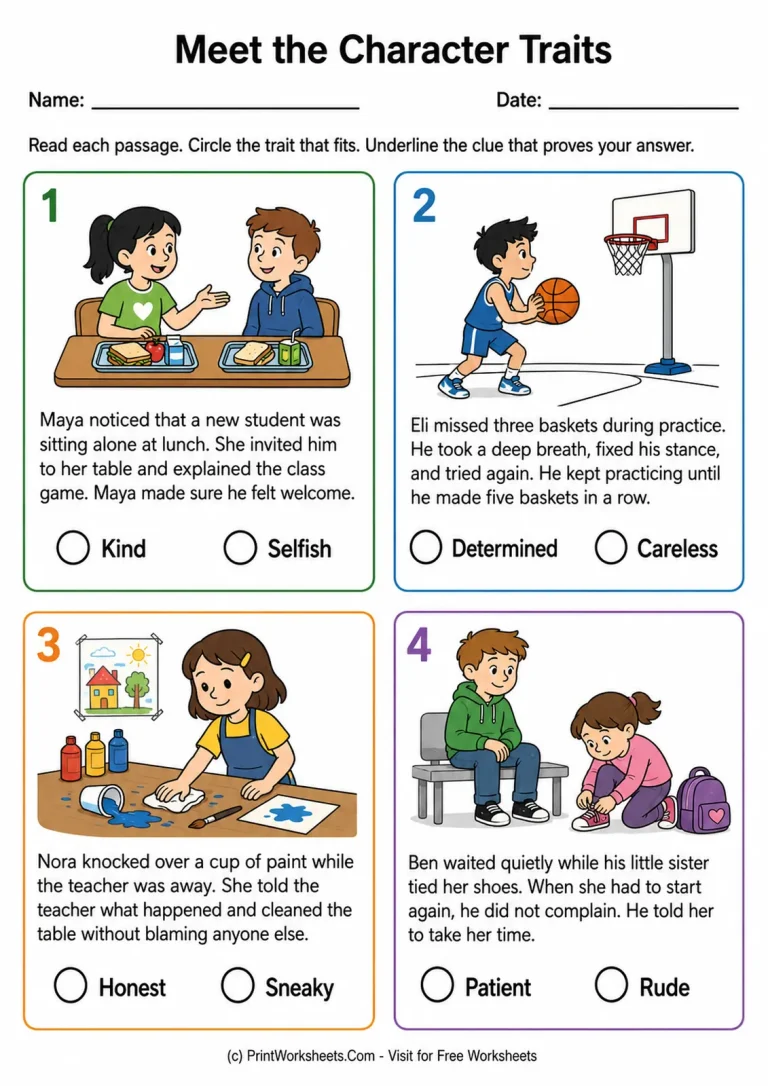
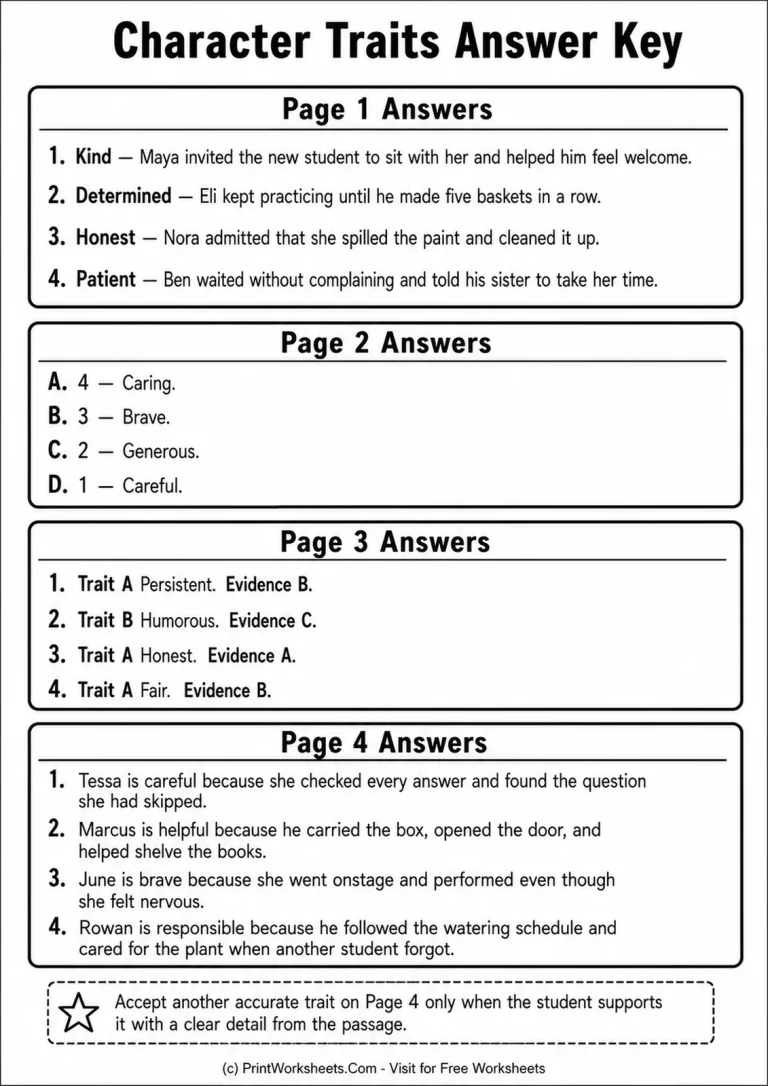
The first worksheet, Meet the Character Traits, uses four compact passages with two opposite choices under each one. Maya welcomes a new student at lunch, Eli keeps practicing basketball after missed shots, Nora admits spilling paint and cleans it up, and Ben waits calmly while his younger sister ties her shoes. Students circle the trait that fits and underline the clue that supports the choice. This format is useful for introducing the idea that a strong character-trait answer should come from an action in the passage, not from a guess.
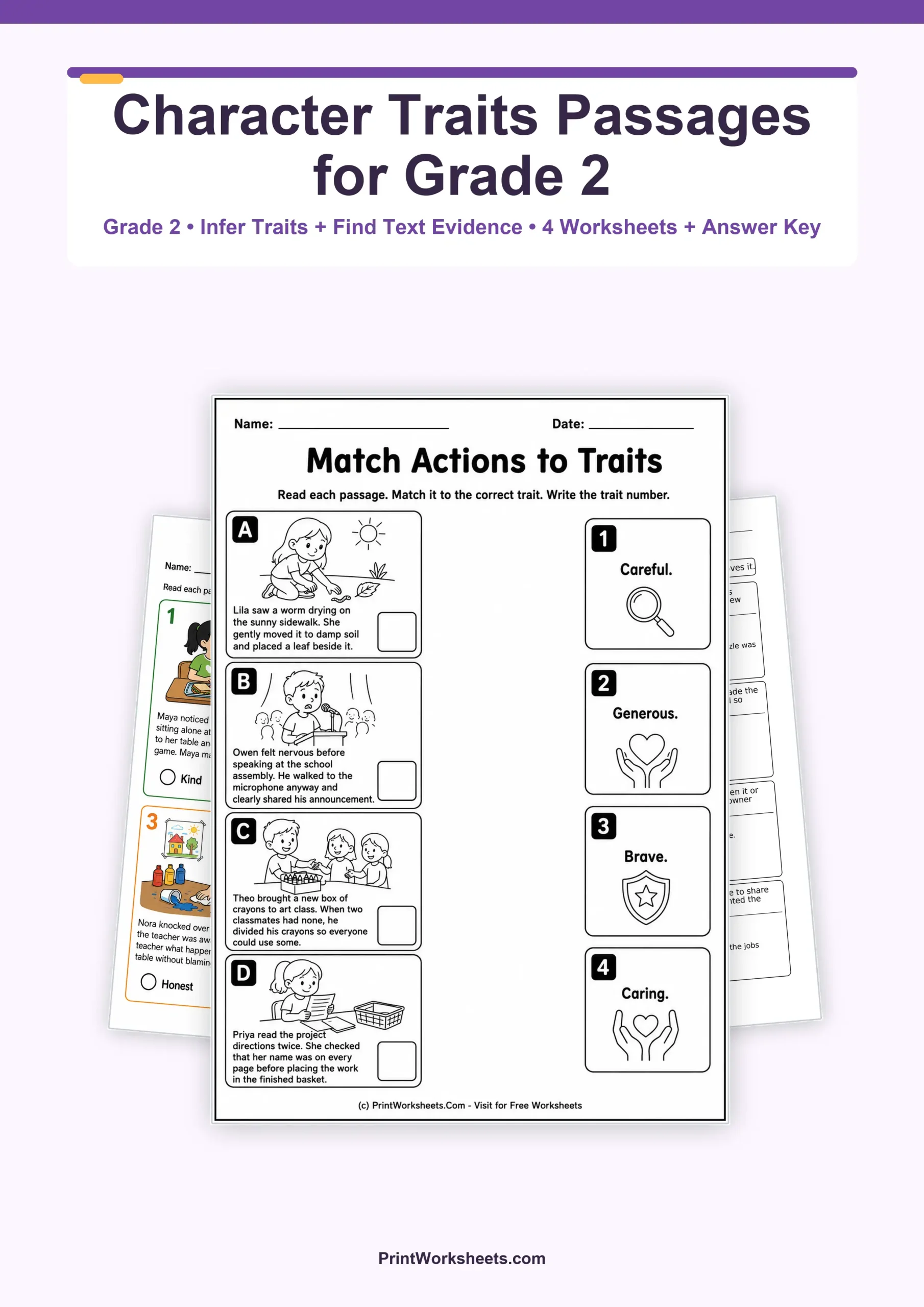
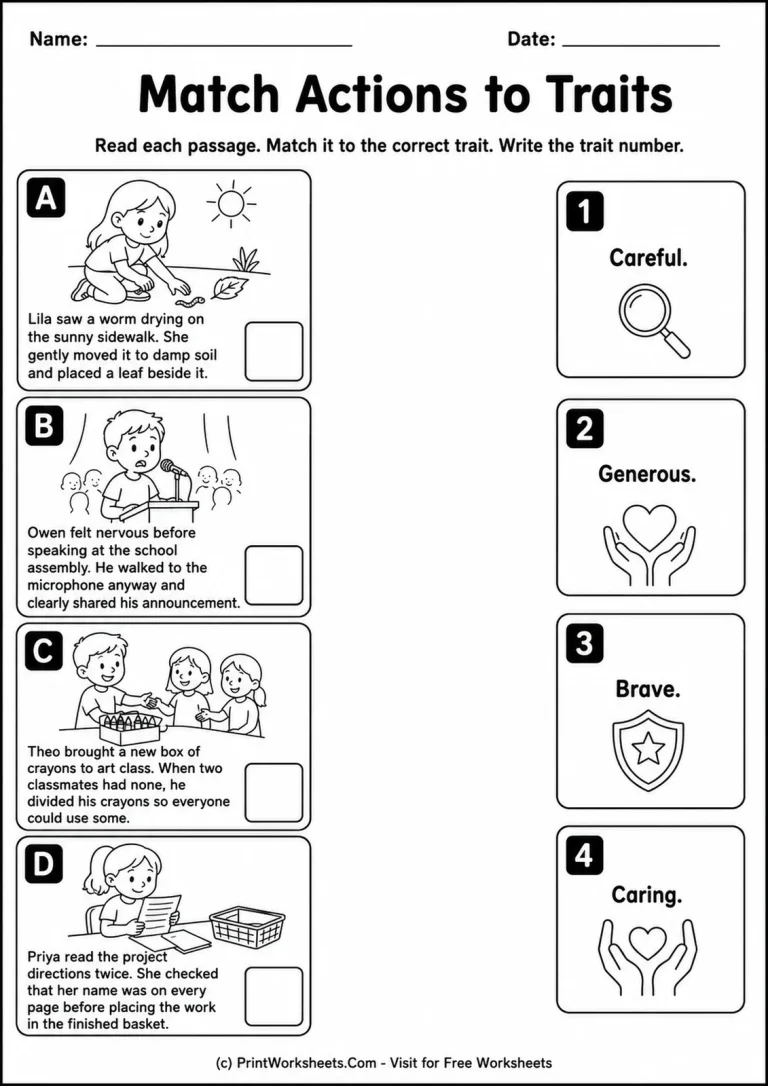
The second page changes the task. In Match Actions to Traits, students read four new scenarios and match each one to a numbered trait. Lila gently moves a worm from a hot sidewalk, Owen speaks at an assembly even though he is nervous, Theo shares crayons with classmates who have none, and Priya checks her project directions and pages before turning in her work. Because the trait choices are reused across the page, students must compare the meaning of each option before deciding.
From Choosing a Trait to Proving It
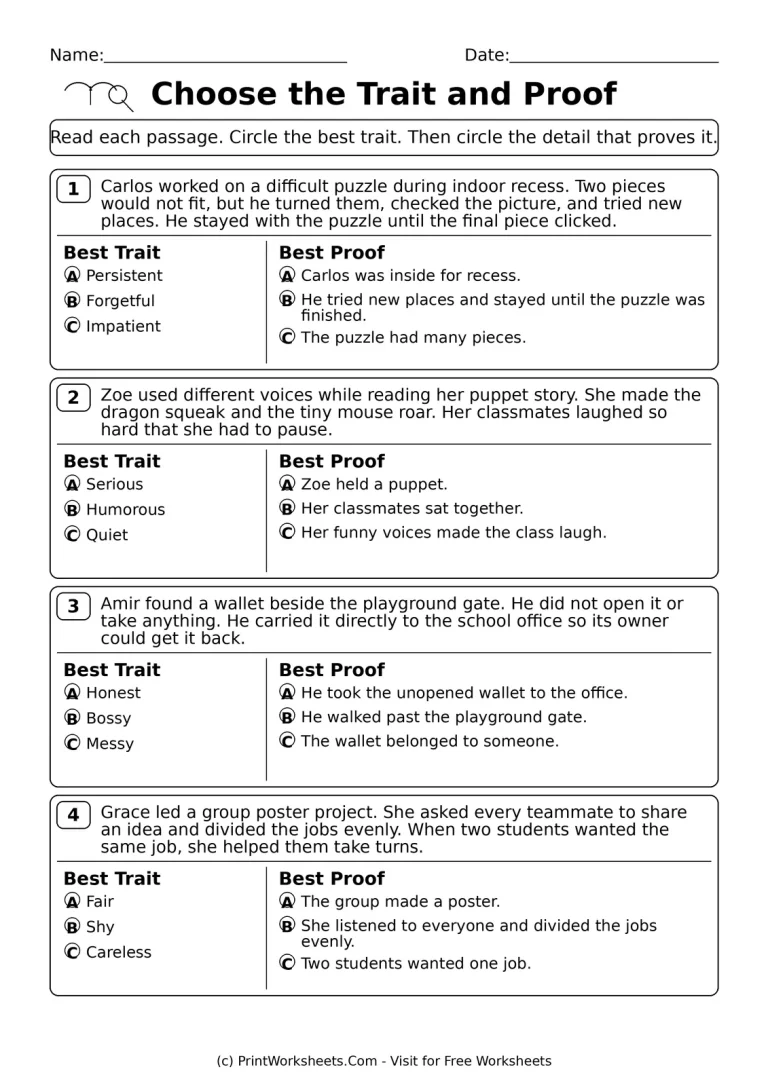
The third worksheet, Choose the Trait and Proof, asks students to make two decisions for every passage: select the best trait and then select the strongest evidence. Carlos stays with a difficult puzzle until it is finished, Zoe uses funny voices that make her classmates laugh, Amir takes an unopened wallet to the school office, and Grace divides group work evenly. The paired “Best Trait” and “Best Proof” sections make the connection between inference and evidence visible, which is especially helpful for students who can name a trait but need practice explaining why it fits.
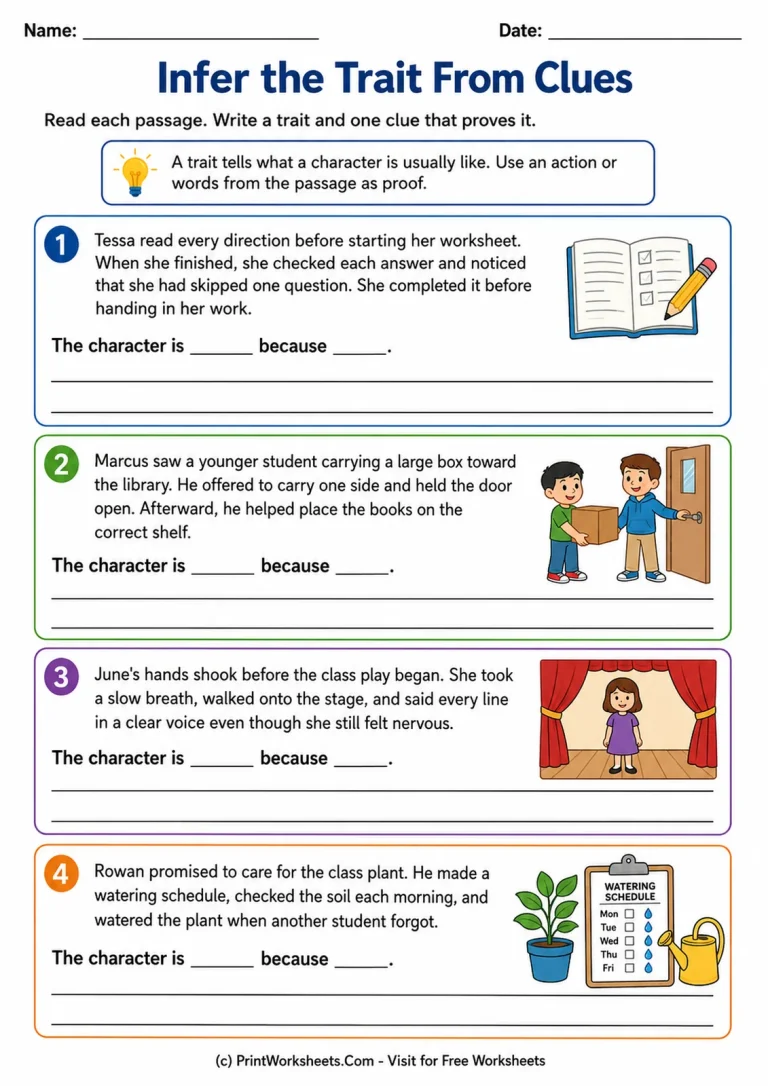
The final student page, Infer the Trait From Clues, removes the multiple-choice support. Students write a trait and a reason for four characters. Tessa carefully checks her worksheet and fixes a skipped question. Marcus helps a younger student carry a box, holds the door, and shelves books. June performs in a class play even though she is nervous. Rowan follows a watering schedule and cares for the class plant when someone else forgets. This open-response format gives students room to use accurate alternatives when they can support them with a clear detail from the passage.
Ways to Use These Worksheets in Grade 2
For whole-group instruction, model one passage by asking, “What did the character do?” before asking, “What trait does that action show?” Then have students underline or point to the exact clue. In partner work, one student can name the trait while the other must defend it with evidence. For independent practice, the set naturally progresses from two-choice identification to matching, paired trait-and-proof questions, and finally written inference.
The pages also work well for small-group reading comprehension lessons. Students who need more support can begin with the first page and use the contrasting choices as a scaffold. Students ready for a challenge can start with the open-response page and generate more than one possible trait, provided each choice is supported by the passage. The included answer key gives fixed answers for the objective pages and sample supported responses for the open-ended page.
Build a Broader Character Reading Lesson
If students need an easier entry point before working with these Grade 2 passages, the character traits worksheets for 1st grade provide a related practice option. Teachers can use the two resources in sequence when differentiating across reading levels or reviewing the difference between a character’s action and the trait inferred from it.
By the end of this set, students are not only choosing words such as brave, honest, or responsible. They are practicing the more important reading-comprehension habit of linking a claim about a character to a specific clue. That makes these pages useful for literacy centers, homework, intervention groups, and short comprehension checks where evidence matters as much as the answer itself.