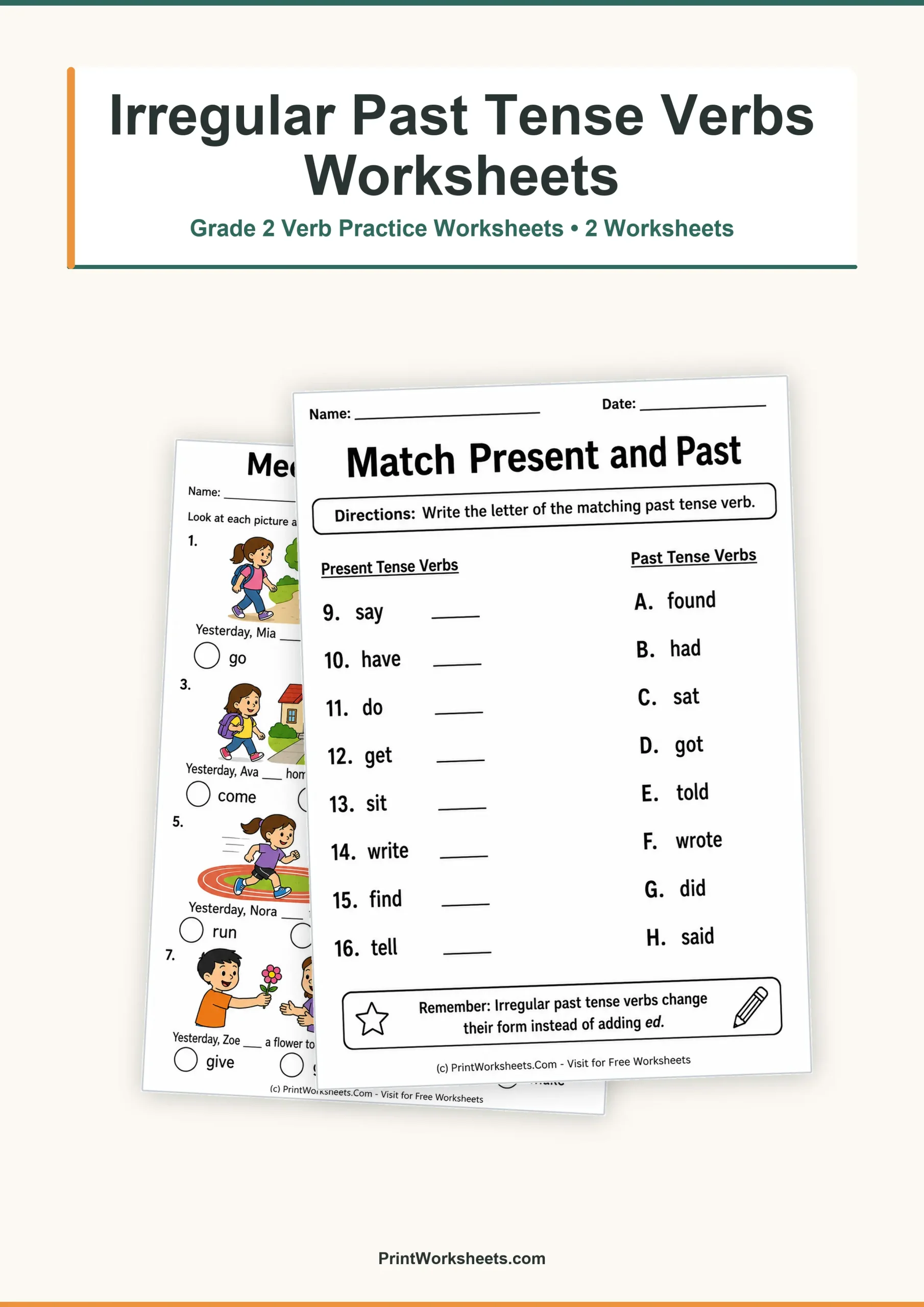
Irregular past tense verbs can be challenging for second graders because many common verbs do not simply add -ed. These Grade 2 worksheets give students focused practice with familiar verb pairs through two different activities. Children first use pictures and a clear time clue to choose the correct past-tense form, then move on to matching present-tense verbs with their irregular past forms without picture support. The sequence makes the set useful for introducing, reviewing, or quickly checking recognition of common irregular verbs.
Practice Irregular Past Tense Verbs in Context
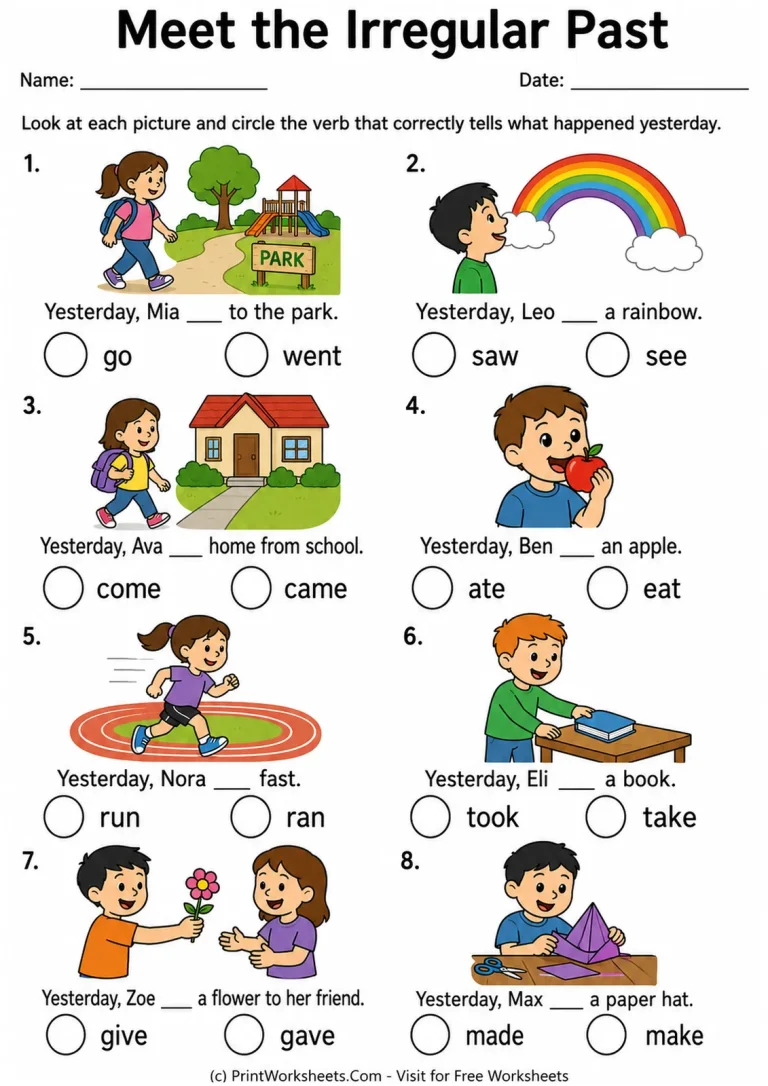
The first worksheet, Meet the Irregular Past, uses eight everyday pictures with short sentences beginning with the time clue “Yesterday.” Each item gives students two verb forms to compare, such as a present form and its irregular past-tense partner. Students circle the form that correctly completes the sentence.
The verb pairs include go/went, see/saw, come/came, eat/ate, run/ran, take/took, give/gave, and make/made. These are high-frequency verbs that children are likely to hear and use in everyday speech and early writing. Because the correct form is presented beside a competing form, students must notice that a sentence about yesterday needs a past-tense verb rather than simply choosing a familiar word.
The repeated “Yesterday” cue also helps learners connect verb form with time. Teachers can ask students to read each completed sentence aloud and identify the word that tells when the action happened. Parents can use the same strategy at home by asking children to say a new sentence with each past-tense verb after completing the page.
Move from Picture Support to Verb Matching
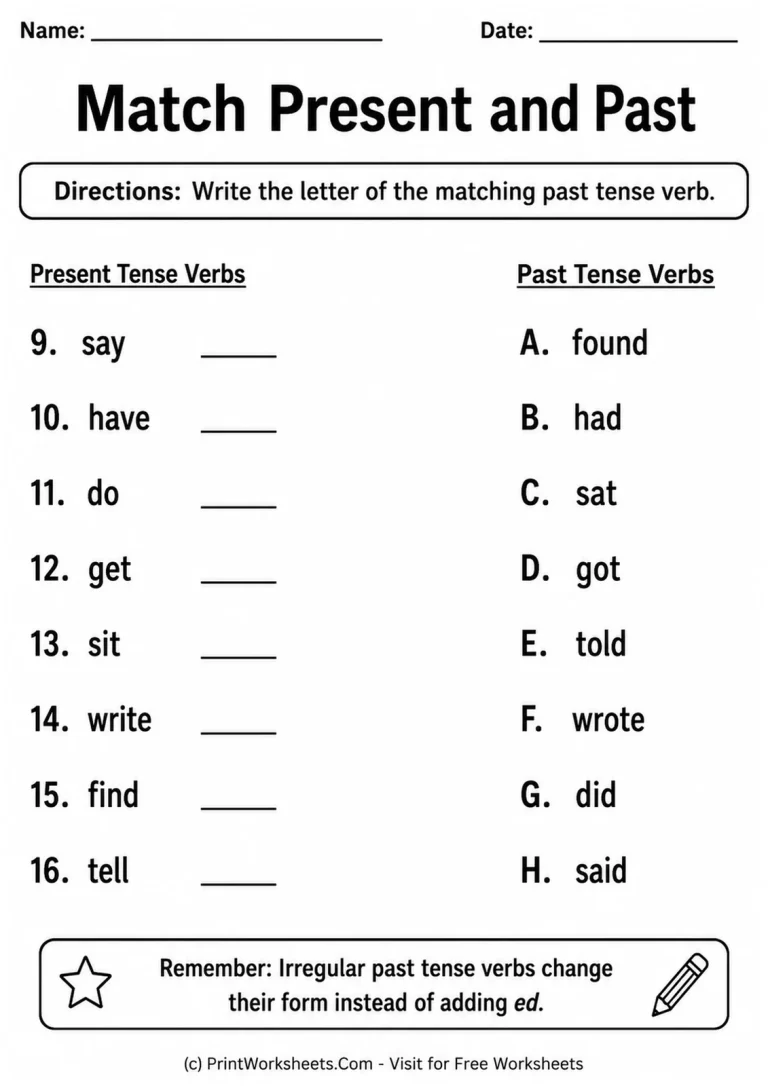
The second worksheet, Match Present and Past, reduces the amount of support and asks students to recall irregular forms more independently. Students match eight present-tense verbs—say, have, do, get, sit, write, find, and tell—to their corresponding past-tense forms.
This activity reinforces an important idea: irregular past-tense verbs do not follow one predictable spelling pattern. Students cannot solve every item by adding -ed. Instead, they need to recognize and remember changes such as have to had, do to did, sit to sat, and write to wrote. Matching the forms side by side gives children repeated exposure to these word relationships without requiring long written responses.
A Two-Step Grade 2 Verb Practice Sequence
The two worksheets work especially well in order. Page one begins with strong visual and sentence-level support. Students see the action, read a sentence with a past-time clue, and choose between two forms. Page two then shifts attention directly to the relationship between a present verb and its irregular past form. This progression lets students practice recognition before relying more heavily on memory.
For a short lesson, an adult can model one example from the first page, complete the remaining items with the student, and then use the matching page as independent practice. In a classroom, the first worksheet can also be used for guided practice or a small-group warm-up, while the second can serve as a quick follow-up check.
Useful Ways to Extend the Worksheets
After students complete the pages, ask them to choose three irregular past-tense verbs and use each one in a new sentence about something that happened yesterday. Another option is to say a present-tense verb aloud and have students respond with its past form. These quick oral activities help connect worksheet recognition to spoken and written language.
Students who need additional review can compare this focused set with the broader regular and irregular verbs worksheets, which provide practice distinguishing the two verb patterns. Together, the resources can help children see why some past-tense verbs follow a regular rule while others must be learned as special forms.
Build Confidence with Common Past-Tense Forms
These worksheets concentrate on a manageable group of common verbs instead of overwhelming young learners with a long list. The picture-based choices, repeated time clue, and present-to-past matching format give second graders several ways to notice and remember irregular verb changes. They can be printed for grammar lessons, literacy centers, homework, tutoring, or extra practice whenever students need more confidence using irregular past-tense forms.