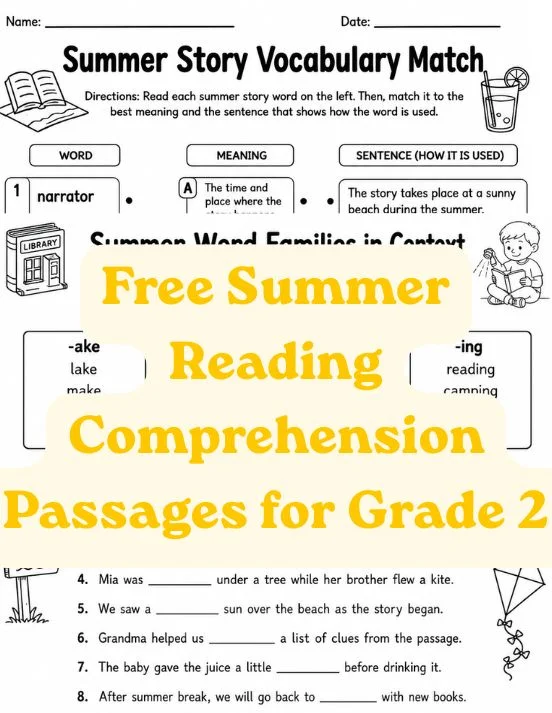
These completely free printable summer reading comprehension passages for grade 2 provide essential literacy practice to prevent the dreaded summer slide. When children step away from the classroom during June, July, and August, foundational reading skills can quickly regress. This comprehensive PDF packet is explicitly designed to keep young minds engaged by blending fun, sunny themes with rigorous academic standards. Second-grade students will actively practice identifying literary elements, decoding word families, and utilizing graphic organizers to retell short stories effectively.
Educators and parents can seamlessly integrate this targeted literacy bundle into end-of-year review plans, summer tutoring sessions, or at-home homework routines. To build a robust daily practice schedule, you can easily pair this packet with our broader English Language Arts materials, or explore additional math and seasonal review bundles within our main summer worksheets category. If your child specifically needs to focus on text analysis, be sure to bookmark our dedicated reading comprehension archive for continuous year-round practice.
Inside the Grade 2 Summer Reading PDF Packet
This printable bundle removes distracting visual clutter and focuses directly on core second-grade reading curriculum standards. The fonts are clear, the line spacing is optimized for early elementary handwriting, and the instructions are straightforward. Each activity page targets a distinct literacy milestone:
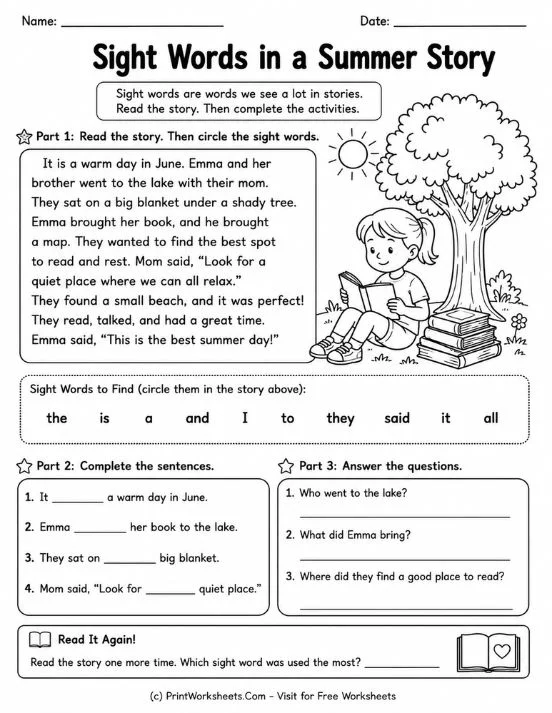
- Sight Words in a Summer Story: An excellent fluency and visual tracking exercise. Students read a short, relatable story about a family trip to the lake. They must scan the text to locate and circle eight high-frequency sight words (the, is, a, and, I, to, they, said, it, all). Following the reading, they use context clues to complete fill-in-the-blank sentences and answer direct text-based comprehension questions.
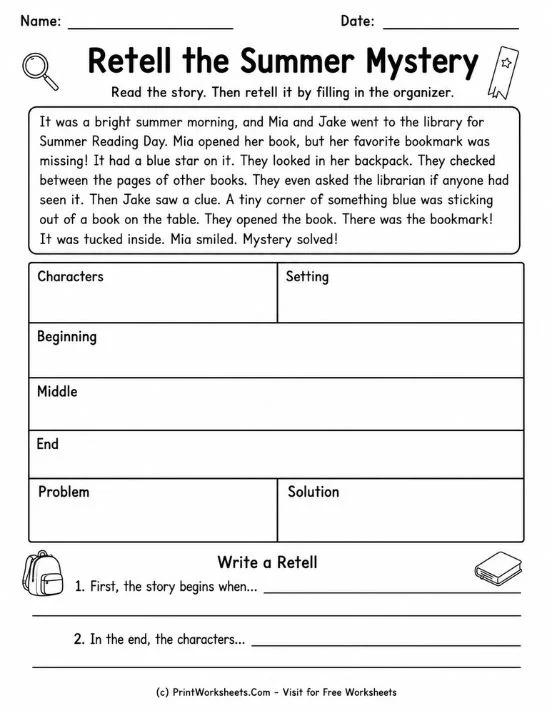
- Retell the Summer Mystery: A comprehensive story mapping and narrative writing task. Children read a highly engaging passage about two characters searching a library for a missing bookmark. Afterward, they must dissect the narrative by filling out a graphic organizer with specific literary elements: Characters, Setting, Beginning, Middle, End, Problem, and Solution. Finally, they use their organized notes to write a cohesive summary on primary-ruled lines.
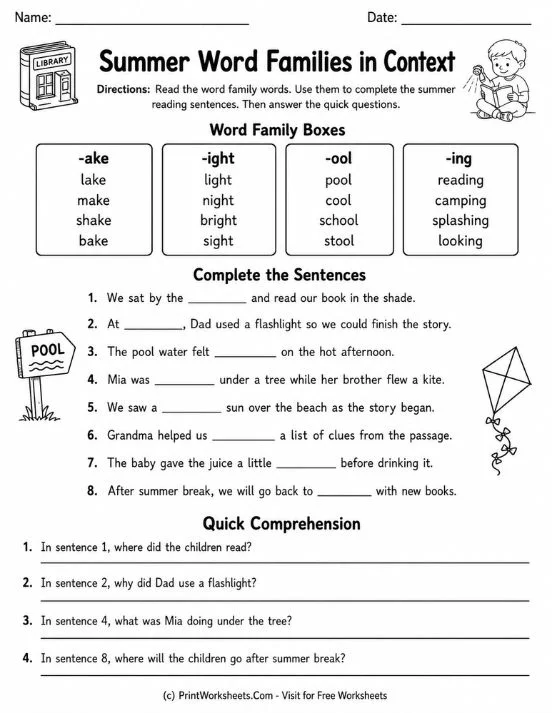
- Summer Word Families in Context: A targeted phonics and vocabulary builder. Students review four distinct word family boxes (-ake, -ight, -ool, -ing) containing words like “lake,” “bright,” “pool,” and “camping.” They must evaluate eight different sentences and choose the correct word family term to complete the thought logically, followed by a set of quick comprehension questions to ensure they understood the completed sentences.
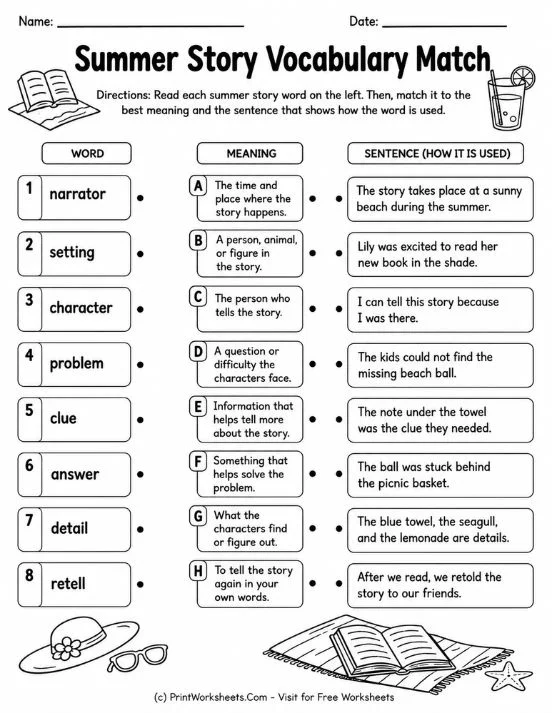
- Summer Story Vocabulary Match: An essential literary terminology assessment. Understanding the mechanics of a story is a major second-grade standard. Students read eight literary terms on the left (narrator, setting, character, problem, clue, answer, detail, retell). They must draw a line matching each word to its formal definition in the middle column, and then draw another line connecting it to an example sentence in the right column showing how the concept works in action.
Practical Summer Implementation Strategies
Download the high-resolution file and print the packet on standard 8.5″ x 11″ copy paper. Ensure your printer dialogue is set to “fit to printable area” so the lower reading questions and graphic organizer borders remain perfectly intact. We highly recommend using these pages as a “Summer Reading Camp” morning activity. Have the student complete one page per day right after breakfast before screen time or outdoor play begins.
For the “Retell the Summer Mystery” graphic organizer page, encourage children to use different colored highlighters while reading the initial text. For example, they can highlight the characters in yellow and the setting in blue. This tactile color-coding strategy dramatically improves their ability to transfer accurate information from the story paragraph down into the structural boxes below.
Frequently Asked Questions
Are these reading passages aligned with second-grade ELA standards?
Absolutely. Second-grade English Language Arts standards heavily emphasize story structure, specifically asking students to describe how characters respond to major events and challenges. The “Retell the Summer Mystery” graphic organizer explicitly assesses their ability to identify a problem, track the sequence of events (Beginning, Middle, End), and identify the final resolution. Additionally, the vocabulary matching page solidifies their grasp of formal academic language like “narrator” and “setting.”
Can I use this packet for a student transitioning from 1st to 2nd grade?
Yes. This packet serves as a perfect bridge between the two grades. The “Sight Words in a Summer Story” page acts as a fantastic end-of-year review for outgoing first graders, while the story mapping and literary vocabulary pages provide a gentle introduction to the more rigorous text analysis they will face on their first day of second grade.
How can I support a struggling reader with the word families worksheet?
If a child is overwhelmed by the “Summer Word Families in Context” page, break the task down visually. Have them read the four words inside the “-ake” box out loud first (lake, make, shake, bake). Discuss what each word means. Then, read the fill-in-the-blank sentences together and ask them which of those four specific words makes the most sense. Focusing on one word family box at a time prevents cognitive overload and builds reading confidence