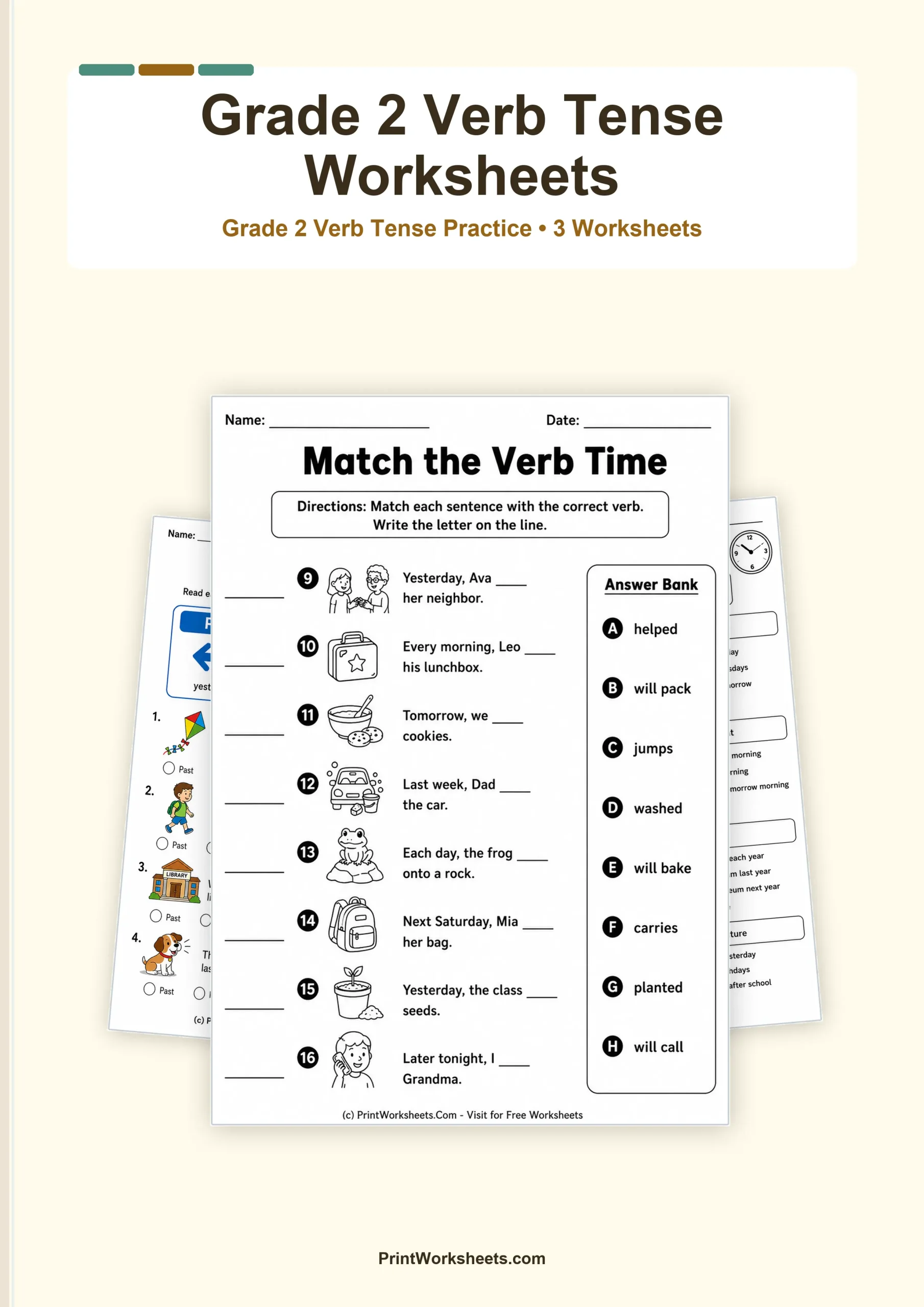
These past present and future verbs worksheets give second graders focused practice recognizing when an action happens and choosing a verb form that fits the time clue in a sentence. Across three printable activities, students work with familiar signals such as yesterday, every day, tomorrow, last week, each day, next Saturday, and later tonight. The sequence moves from identifying a sentence’s time, to matching a suitable verb form, to selecting a complete sentence that matches a stated target tense.
Past Present and Future Verbs Practice with Clear Time Clues
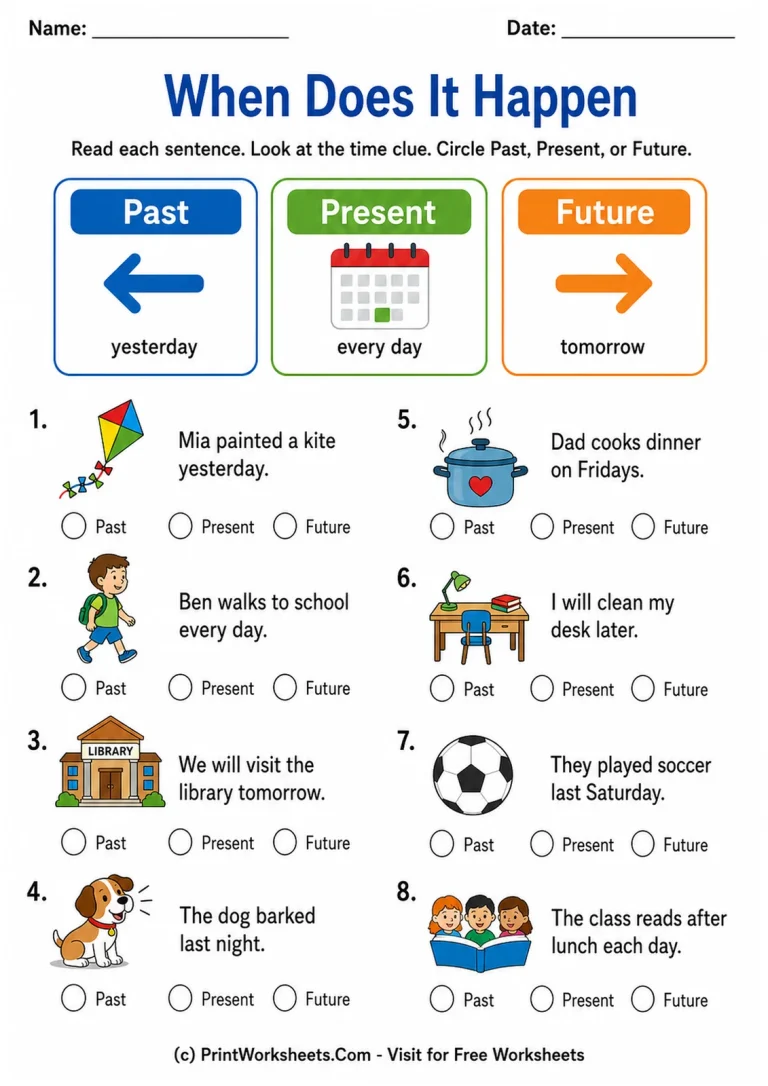
The first worksheet, When Does It Happen, introduces the three time categories in a direct visual way. Students connect yesterday with the past, every day with the present, and tomorrow with the future before reading eight short sentences. For each sentence, they decide whether the action belongs in the Past, Present, or Future category.
This format helps children pay attention to the whole sentence rather than treating verb tense as an isolated spelling rule. A sentence about something that happened yesterday gives different information from one describing a routine that happens every day or an event that will happen tomorrow. Familiar verb examples such as painted, walks, will visit, barked, cooks, and played keep the language manageable while students concentrate on the time relationship.
Match Time Expressions to the Correct Verb Form
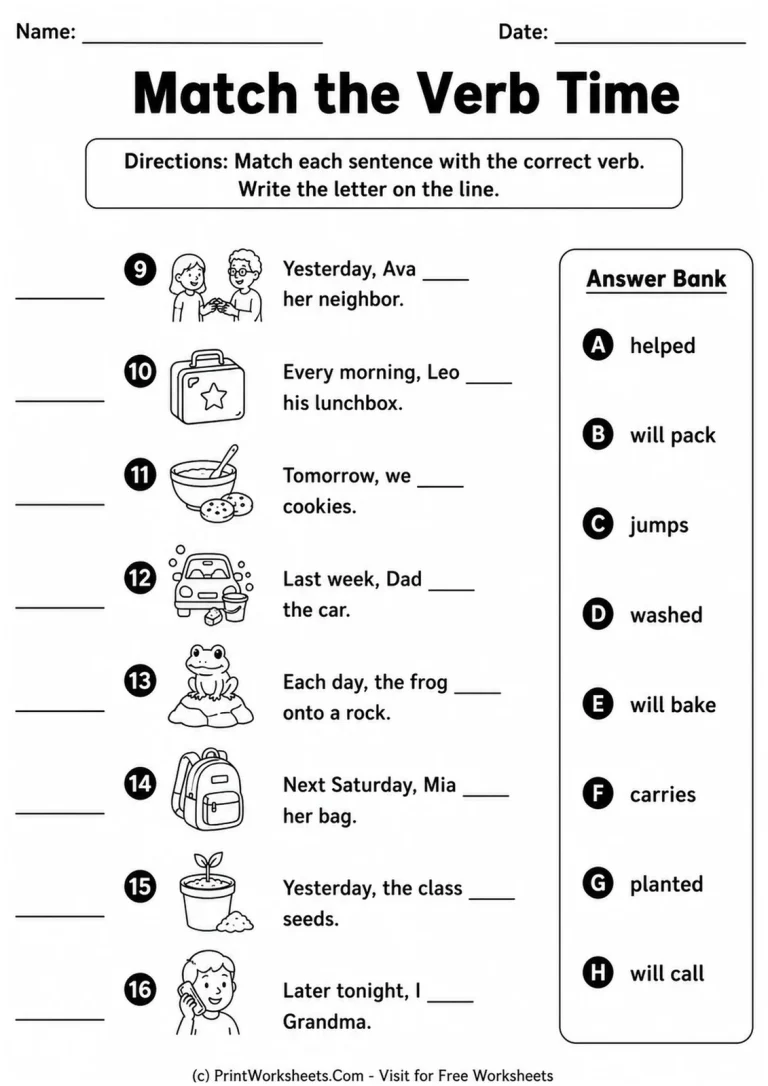
The second page, Match the Verb Time, changes the task so students must actively connect a time clue with a fitting verb form. Items 9 through 16 use an A-H answer bank, and each sentence contains a clear expression such as Yesterday, Every morning, Tomorrow, Last week, Each day, Next Saturday, or Later tonight.
Instead of simply labeling a tense, students examine the context and choose the verb form that completes the sentence logically. This encourages an important Grade 2 grammar habit: looking for words that tell when an action takes place. A phrase such as Last week points toward a completed past action, while Next Saturday or Later tonight signals an event that has not happened yet. Repeated routine clues such as Every morning and Each day support recognition of present-tense actions.
Three Activity Types Build the Skill Step by Step
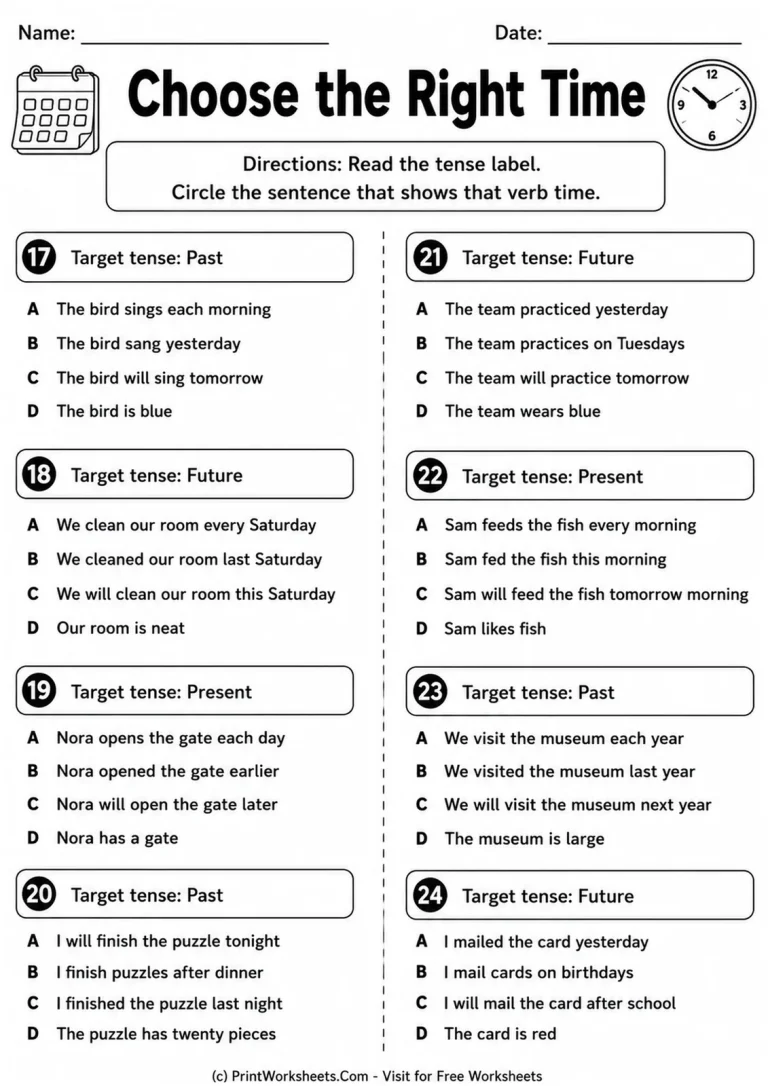
The three worksheets use different response formats so students can demonstrate the same grammar understanding in more than one way. The opening activity asks them to classify sentence time. The next asks them to choose a matching verb form from a controlled answer bank. The final worksheet, Choose the Right Time, presents items 17 through 24 with a visible Target tense label and four sentence choices.
On that final page, students compare several options and circle the sentence that matches the requested past, present, or future tense. Because the choices contrast different time meanings, students need to notice both the verb and the context of the sentence. This makes the activity useful after initial instruction because it checks whether children can discriminate among the three tense categories without relying on a single worksheet format.
Useful for Grade 2 Grammar Lessons and Independent Review
The short sentences and familiar vocabulary make this set appropriate for young learners who are beginning to work more deliberately with verb tense. Teachers can introduce the first page during a whole-group grammar lesson, use the matching page for guided or partner practice, and save the multiple-choice page for independent work. Parents can also use the pages as a compact review when a child needs extra practice connecting time words with verb forms.
The worksheets are especially useful for reinforcing the difference between actions that already happened, actions that happen now or regularly, and actions that will happen later. Students encounter the same core concept repeatedly, but each page requires a different kind of thinking. That progression makes the set suitable for classwork, homework, a grammar center, review before a quiz, or a short skills check.
What Students Practice in This Printable Set
By working through the three pages, students practice recognizing past, present, and future meaning in short sentences, using time expressions as grammatical evidence, selecting verb forms that agree with sentence context, and comparing sentences to a named target tense. The combination of visual references, an answer bank, and clearly labeled target tenses provides enough support for Grade 2 learners while still requiring independent decisions. Print the worksheets together for a short verb-tense sequence or use individual pages when students need focused reinforcement of past, present, and future actions.