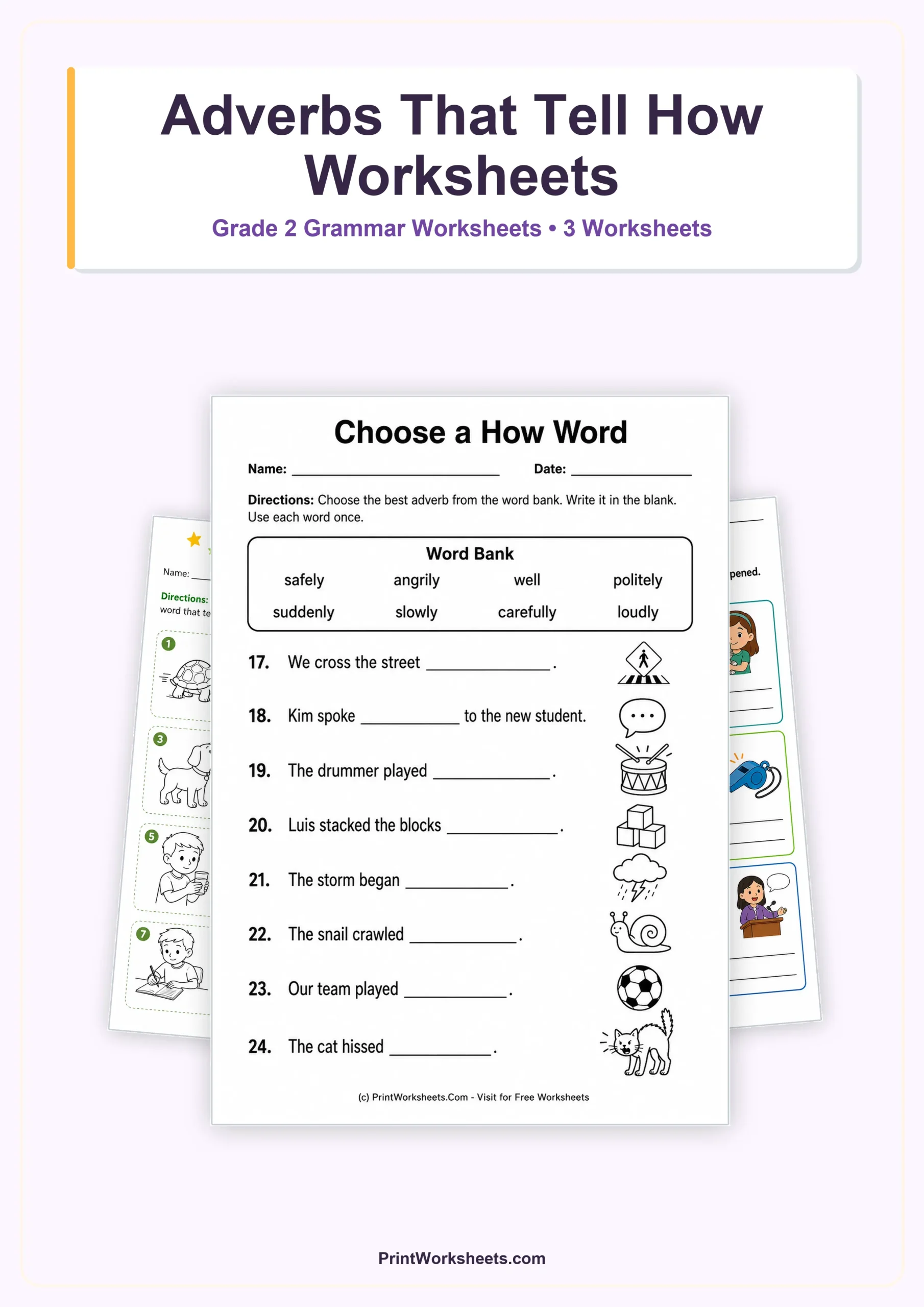
These adverbs that tell how worksheets give second-grade students several ways to practice describing how an action happens. Instead of repeating one exercise format, the set moves from finding adverbs in short illustrated sentences to choosing a fitting word from a bank and then editing sentences by selecting the correct adjective or adverb form. The progression helps students connect meaning, grammar, and sentence structure while working with familiar actions and concrete situations.
Practice Adverbs That Tell How in Grade 2 Sentences
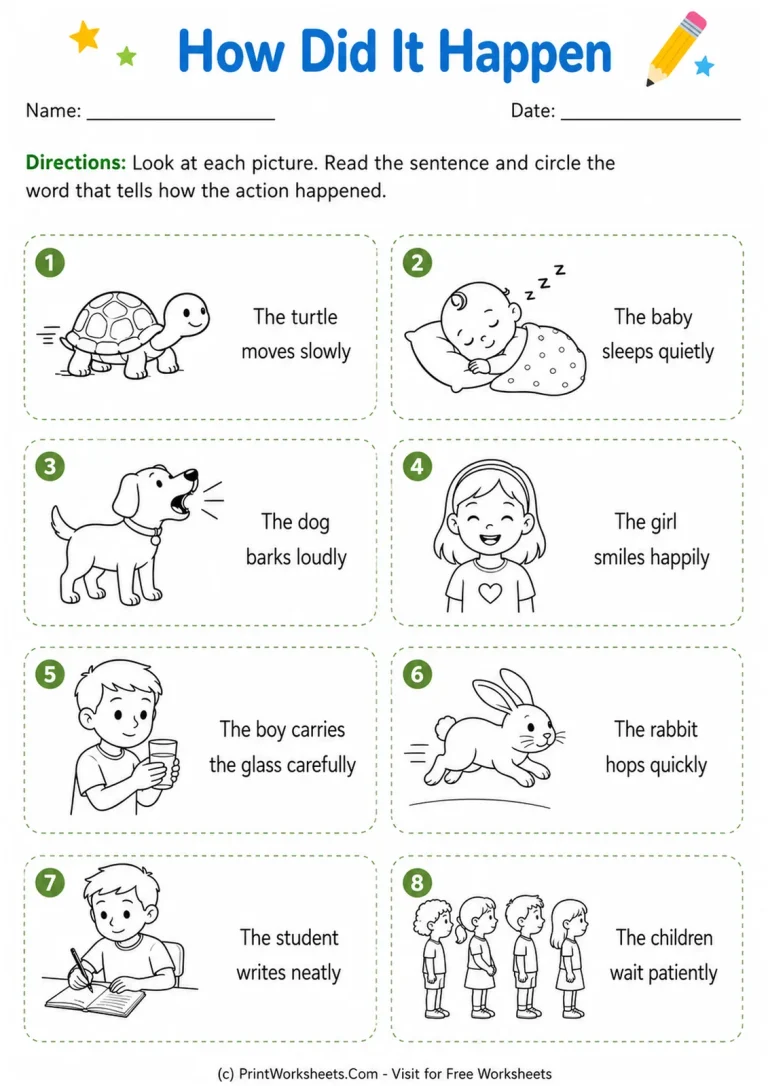
The first worksheet focuses on recognition. Students read eight short sentences and circle the word that explains how the action happened. The examples include manner words such as slowly, quietly, loudly, happily, carefully, quickly, neatly, and patiently. Small illustrations give an extra clue about each action, making the activity accessible to students who are still building confidence with grammar vocabulary.
This type of task is useful because students do not need to begin by memorizing a definition. They can look at the action in the sentence, ask themselves how it happened, and identify the word that supplies that information. Teachers can also use the page for a quick oral warm-up by having students read each sentence aloud and explain why the circled word describes the action.
Choose the Best Manner Adverb from Context
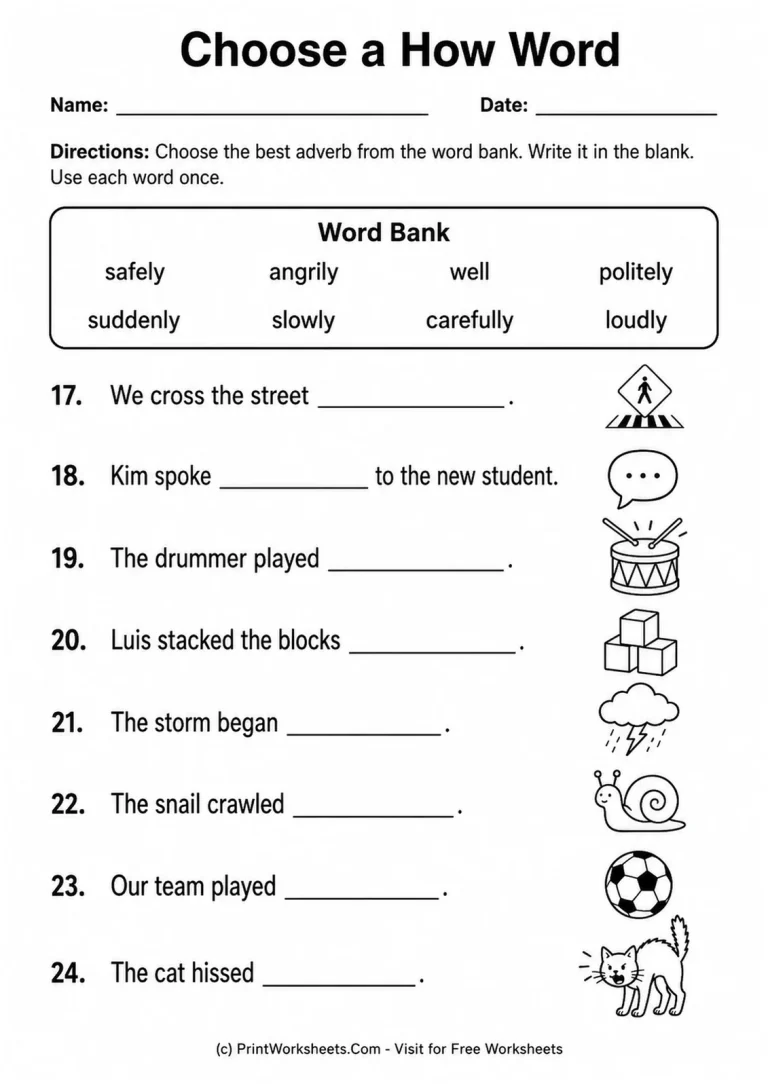
The next worksheet increases the level of decision-making. Students complete eight sentences with words from a bank containing safely, angrily, well, politely, suddenly, slowly, carefully, and loudly. Each adverb is used once, so students need to consider both meaning and sentence context rather than simply choosing any grammatically possible word.
The situations are concrete and easy to discuss. One item involves crossing a street safely, while another asks students to choose politely for speaking to a new student. Other contexts feature a drummer, a storm, a snail, a soccer team, and a hissing cat. These familiar scenes help children understand that adverbs are not isolated vocabulary words; they change the way a reader imagines an action.
Build Meaning Before Memorizing Grammar Terms
Parents and teachers can extend this practice by asking students to substitute a different adverb and explain how the meaning changes. For example, a child can compare walking slowly with walking quickly, or speaking politely with speaking angrily. This simple discussion reinforces the idea that an adverb can tell the manner in which an action is performed.
Edit Adjective and Adverb Forms
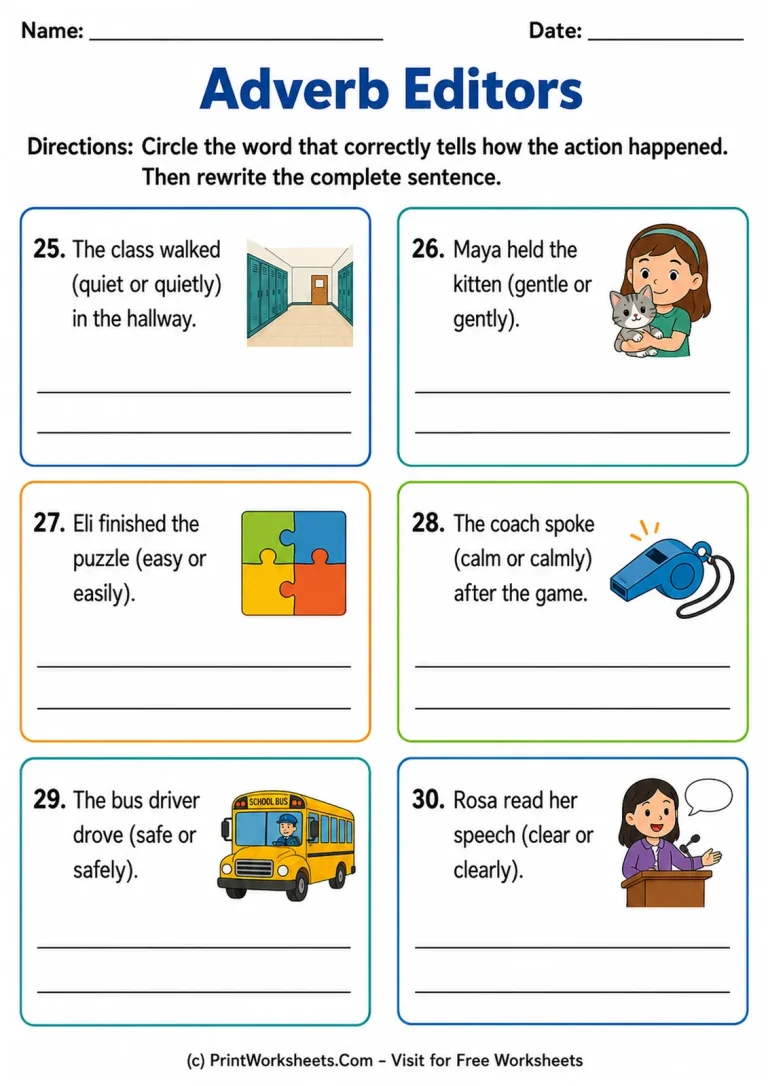
The third worksheet shifts from identifying meaning to editing grammar. Students choose the form that correctly tells how an action happened and then rewrite the complete sentence. The pairs include quiet and quietly, gentle and gently, easy and easily, calm and calmly, safe and safely, and clear and clearly.
This activity helps students notice an important difference between a describing word used for a person or thing and a word used to describe an action. Rather than only circling an answer, students rewrite the full sentence, giving them additional practice with sentence formation, spelling, capitalization, and punctuation.
A Three-Step Grammar Progression
Together, the worksheets create a practical sequence for Grade 2 grammar instruction. Students first locate a how word in an illustrated sentence, then select an appropriate adverb from context, and finally decide which word form belongs in a complete sentence. This progression works well for whole-group lessons, literacy centers, homework, review, or extra practice after an introduction to adverbs.
The set is especially useful when students already recognize action verbs but need help adding information about how those actions happen. By moving between pictures, sentence meaning, word choice, and rewriting, children practice the same grammar concept from several angles without relying on one repetitive worksheet format.
Use These Worksheets for Focused Grammar Practice
Teachers can assign the pages in order or choose the activity that matches a student’s current need. The identification page works well as an introduction, the word-bank activity provides guided practice, and the editing page offers a stronger application task. The variety also makes it easier to see whether a student can recognize an adverb, choose one independently, and distinguish the correct grammatical form inside a sentence.
These printable activities provide a focused way to strengthen Grade 2 understanding of manner adverbs while keeping the language concrete, readable, and connected to everyday actions.