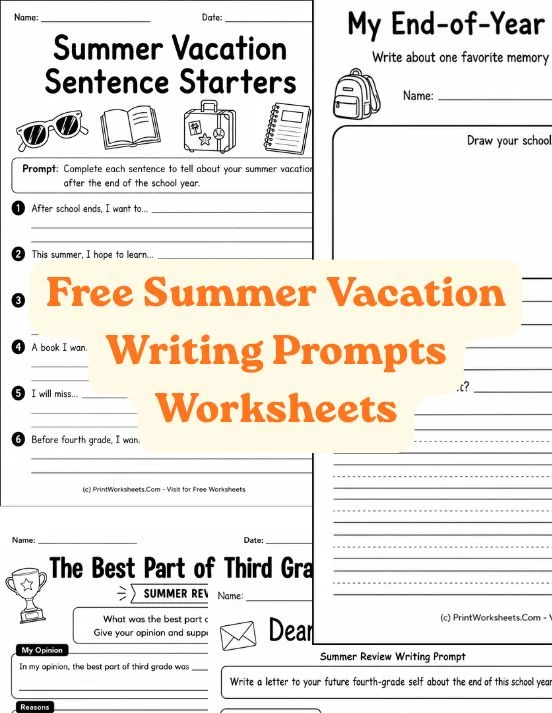
Maintaining strong academic stamina during the transition from third to fourth grade is a critical educational priority, which is why these summer vacation writing prompts worksheets for grade 3 are highly effective. As the school year winds down, students often lose focus, leading to a significant regression in their expressive language and paragraph structuring skills. This comprehensive, no-prep PDF worksheet pack prevents the “summer slide” by blending highly engaging, end-of-year topics with rigorous third-grade writing standards. By utilizing structured graphic organizers and guided sentence frames, children can confidently express their thoughts without the anxiety of staring at a blank page.
Educators and parents can seamlessly integrate this transition packet into May and June lesson plans, or utilize it as a dedicated learning-at-home portfolio during July and August. To build a robust, multi-subject seasonal curriculum, you can easily combine this specific writing pack with our broader summer worksheets collection. Furthermore, if your student requires continuous, year-round practice with grammar, sentence structure, and narrative development, we highly encourage exploring our complete archive of writing worksheets to ensure they are fully prepared for upper elementary expectations.
Inside the Grade 3 Summer Writing PDF Pack
This printable bundle deliberately eliminates unstructured, overwhelming assignments. Instead, it utilizes clear, primary-ruled baselines and targeted brainstorming sections to guide young authors through multiple text types, including narrative, opinion, and reflective writing. Each activity page serves a distinct pedagogical purpose:
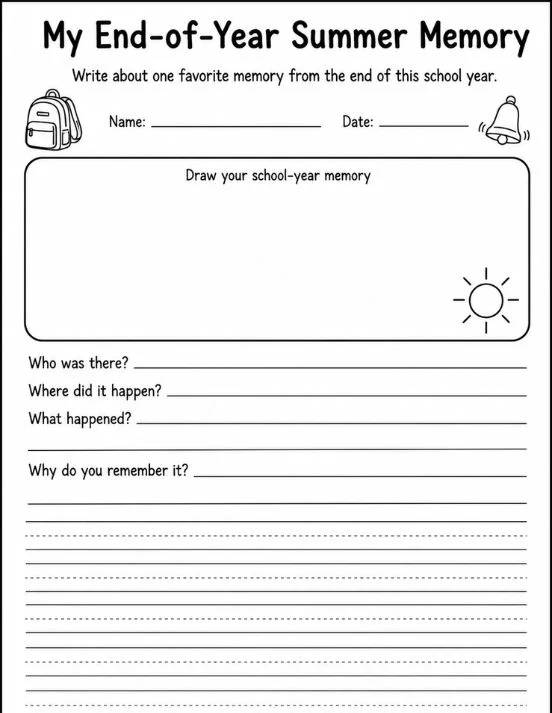
- My End-of-Year Summer Memory: A guided personal narrative worksheet. Before drafting their paragraph, students are prompted to answer four critical Wh- questions (Who was there? Where did it happen? What happened? Why do you remember it?). This built-in scaffolding ensures their final narrative paragraph contains vivid details and a logical sequence of events, alongside a dedicated space for an illustrative drawing.
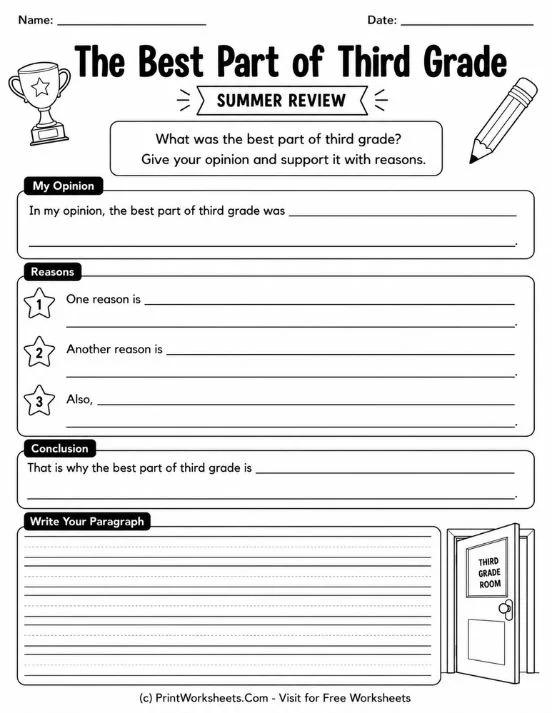
- The Best Part of Third Grade: A structured opinion writing matrix. Third-grade standards heavily emphasize supporting opinions with concrete reasons. This page forces students to explicitly state their thesis (“In my opinion…”), provide three distinct supporting reasons using numerical transition stars, and wrap up their argument with a formal conclusion sentence before drafting their final paragraph at the bottom of the page.
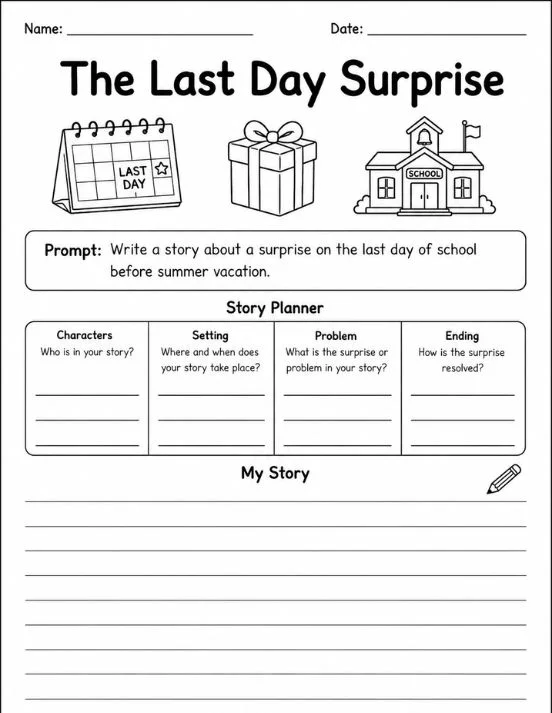
- The Last Day Surprise: A creative fiction story planner. Writing a cohesive story can be daunting, so this worksheet introduces a “Story Planner” grid. Students must explicitly define their Characters, Setting, Problem, and Ending before they are allowed to write. This pre-writing strategy prevents rambling and guarantees a properly structured narrative arc.
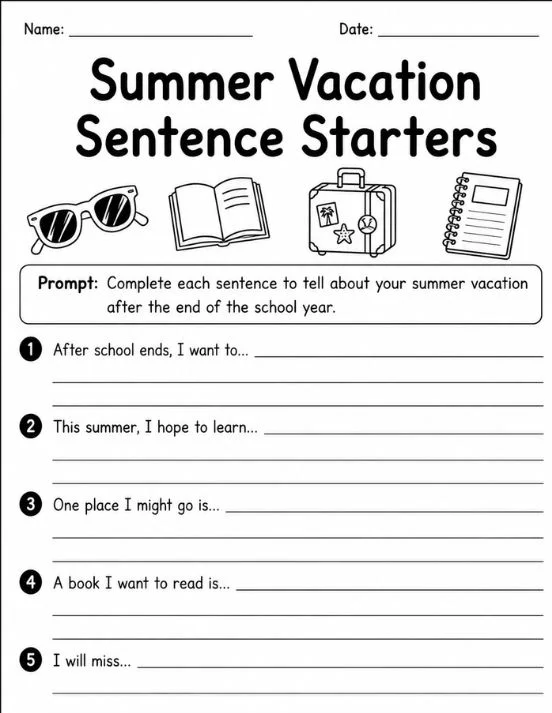
- Summer Vacation Sentence Starters: A highly approachable guided writing activity. Perfect for students who struggle with generating ideas, this page provides six specific prompts (e.g., “This summer, I hope to learn…”, “A book I want to read is…”). Students must complete the sentences, practicing proper capitalization, punctuation, and independent clause construction.
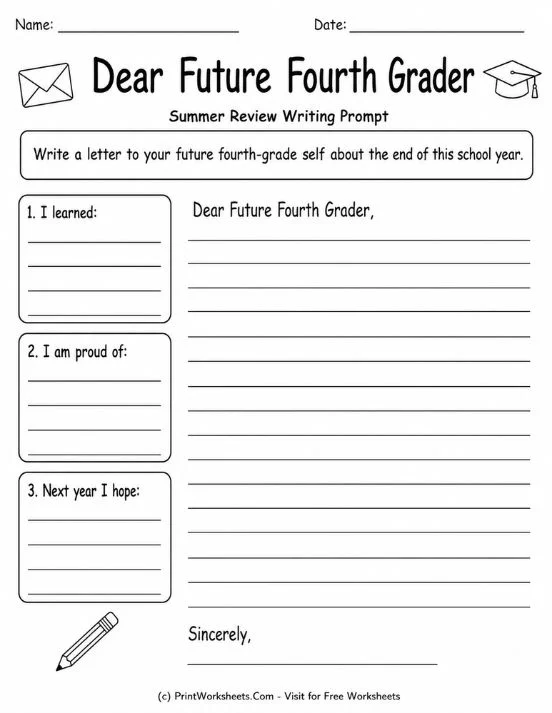
- Dear Future Fourth Grader: A reflective letter-writing template. This introspective activity asks outgoing third graders to write an advice letter to their future selves. By filling out the brainstorming boxes first (“I learned,” “I am proud of,” “Next year I hope”), students learn how to organize their thoughts before utilizing the formal greeting and closing formats required in letter writing.
Practical Classroom and Home Implementation
Download the high-resolution file and print this no-prep PDF directly on standard 8.5″ x 11″ copy paper. Because these pages demand focused cognitive effort, we highly recommend utilizing them during a dedicated, quiet morning literacy block. Do not assign the entire packet at once; instead, introduce one specific text type (like the opinion writing page) per day to ensure high-quality output.
When introducing “The Last Day Surprise” creative writing prompt, spend ten minutes conducting a whole-class or one-on-one brainstorming session before the pencil ever touches the paper. Discuss what makes a good “Problem” in a story (e.g., a missing bus ticket, a suddenly canceled field trip, a mysterious box appearing on the teacher’s desk). Once the student verbally articulates their problem and solution, they will be significantly more successful when filling out their Story Planner grid.
Frequently Asked Questions
Why is a story planner necessary for third-grade creative writing?
At eight or nine years old, children have incredibly vibrant imaginations but often lack the executive functioning skills to organize those thoughts linearly. Without a story planner, a third grader’s narrative will typically feature a rambling sequence of events with no clear conflict or resolution. The planner explicitly forces them to define the “Problem” and “Ending” first, ensuring their final story has a purposeful direction and satisfies core narrative writing standards.
How does the opinion writing worksheet support state standards?
Core literacy standards for third grade dictate that a student must state an opinion, supply reasons that support the opinion, use linking words, and provide a concluding statement. “The Best Part of Third Grade” worksheet is an exact visual representation of this standard. By visually separating the “Opinion,” the three “Reasons,” and the “Conclusion,” students learn the formal architecture of persuasive writing, which is vital for fourth-grade essay formatting.
Are these prompts suitable for students who struggle with handwriting?
Yes. We specifically engineered this PDF pack using wide, dashed-center primary baselines rather than narrow college-ruled lines. This provides struggling writers with the necessary spatial guidance to form their letters correctly, reducing physical hand fatigue and allowing them to focus entirely on their vocabulary and idea generation rather than the physical mechanics of writing.