These incredibly effective double digit addition and subtraction word problems with regrouping provide the rigorous, mixed arithmetic practice that early elementary students desperately need. When educators only provide worksheets featuring a single mathematical operation, children often stop reading the actual word problems and simply extract the numbers to perform the expected algorithm. By utilizing a mixed PDF packet that alternates between addition and subtraction scenarios, students are forced to rely on their reading comprehension skills, actively searching for specific context clues to determine whether they need to carry a ten or borrow from the tens column.
Educators and parents can seamlessly deploy this targeted mixed-review bundle into daily math centers, advanced small group rotations, or weekend homework folders. If your students struggle with deciding which operation to use, utilizing this specific mixed packet alongside the foundational activities in our broader double digit addition category ensures they master both the procedural mechanics and the logical application of advanced two-digit arithmetic.
Inside the Mixed Regrouping Math PDF Pack
This printable PDF worksheet pack eliminates mindless, repetitive busywork and focuses directly on mathematical logic, pattern recognition, and reading comprehension. Each activity page serves a highly specific pedagogical purpose designed to build true numerical fluency and independent problem-solving skills:
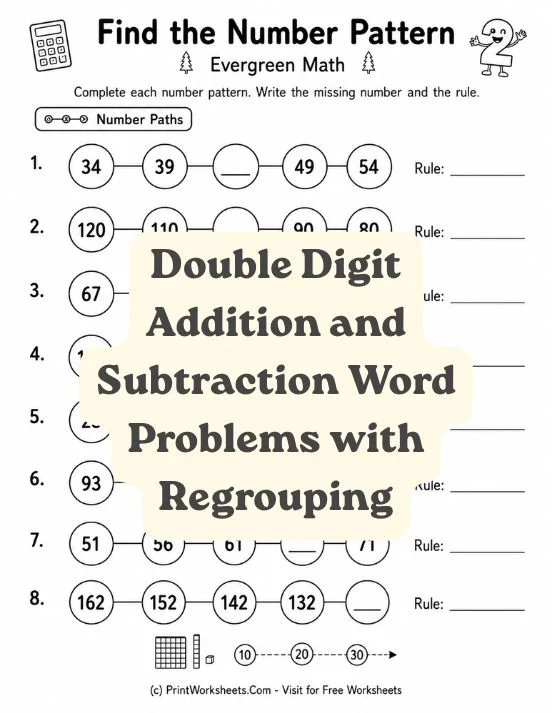
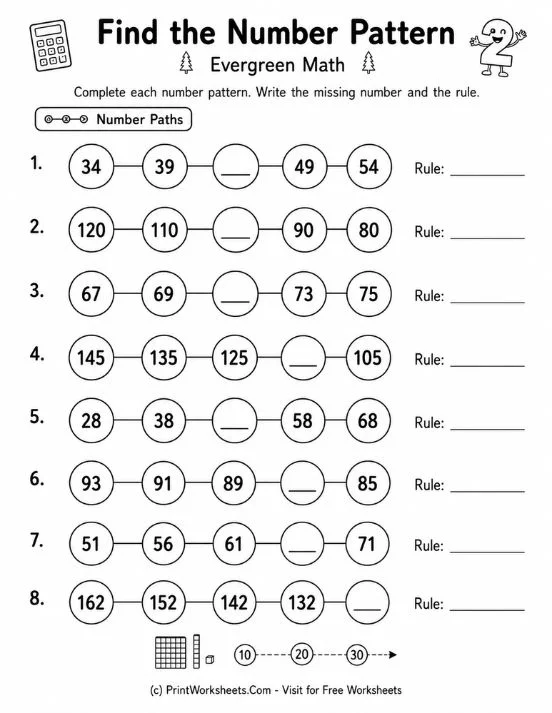
- Find the Number Pattern: A rigorous logical reasoning assessment. Students analyze eight different sequences of two-digit and three-digit numbers to determine the underlying mathematical rule. Because this packet is mixed, the patterns alternate between adding and subtracting. Students must figure out the exact numerical interval (e.g., +5, -10, +2), write the formal rule on the designated line on the right side of the page, and mentally calculate the missing number to fill in the blank circle.
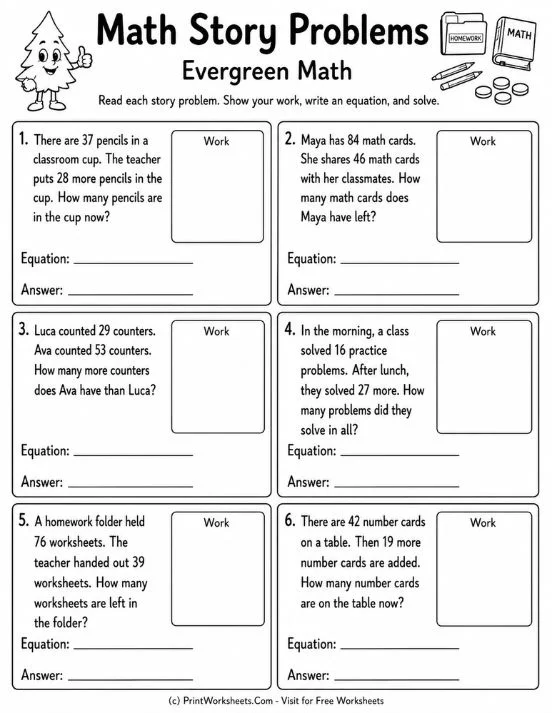
- Math Story Problems: A comprehensive reading and arithmetic challenge featuring mixed double-digit equations with regrouping. Students read six distinct real-world scenarios involving classroom supplies, practice problems, and counting activities. They must extract the correct data, determine whether the specific scenario requires addition or subtraction based on action words (like “more,” “left,” or “in all”), and utilize the large blank “Work” box to physically stack their numbers. Finally, they write the formal horizontal equation and the final answer on the primary lines located below the work box.
Practical Classroom and Homework Implementation
Download the high-resolution file and print this no-prep PDF directly on standard 8.5″ x 11″ copy paper. Because these pages demand critical thinking and careful reading comprehension rather than just rote algorithmic execution, we highly recommend utilizing the “Math Story Problems” worksheet during a guided, teacher-led math group before releasing it as an independent center.
Instruct your students to use the “CUBES” strategy when approaching this mixed worksheet. Have them Circle the numbers in the text, Underline the actual question, Box the math action words (such as “are left” for subtraction, or “altogether” for addition), Evaluate the steps, and Solve. Emphasize that the large “Work” box is absolutely mandatory for showing their regrouping steps. They must physically write out the vertical equation, showing where they carried a one for addition, or where they crossed out a ten to borrow for subtraction.
Frequently Asked Questions
Why is mixed addition and subtraction practice important?
Mixed practice is the ultimate test of mathematical comprehension. When a student completes a worksheet titled “Addition Word Problems,” they often just add the two numbers they see without reading the text. A mixed worksheet removes that safety net. It forces the child to actively read the narrative, identify the vocabulary that signals the correct operation, and then successfully execute either carrying or borrowing. This prevents lazy calculating and builds genuine, independent problem-solving skills.
How does the number pattern worksheet support regrouping skills?
Pattern recognition is the absolute foundation of mental arithmetic and algebraic thinking. When a student looks at a sequence like 120, 110, __, 90, 80, they are rapidly performing mental subtraction across multiple place values to deduce that the hidden rule is “Subtract 10.” This mental gymnastics forces the brain to practice addition and subtraction dynamically and flexibly, which dramatically increases their overall computation speed without relying on calculators or counting on their fingers.
What grade level is this mixed regrouping packet best suited for?
This specific PDF worksheet pack is heavily aligned with late second-grade and early third-grade core math standards. Second graders are formally introduced to carrying tens and borrowing in the context of mixed word problems, making this a perfect mid-year assessment or end-of-year review. Third graders can also utilize these pages at the beginning of the school year to shake off the summer slide and refresh their complex double-digit arithmetic skills before moving on to three-digit equations.