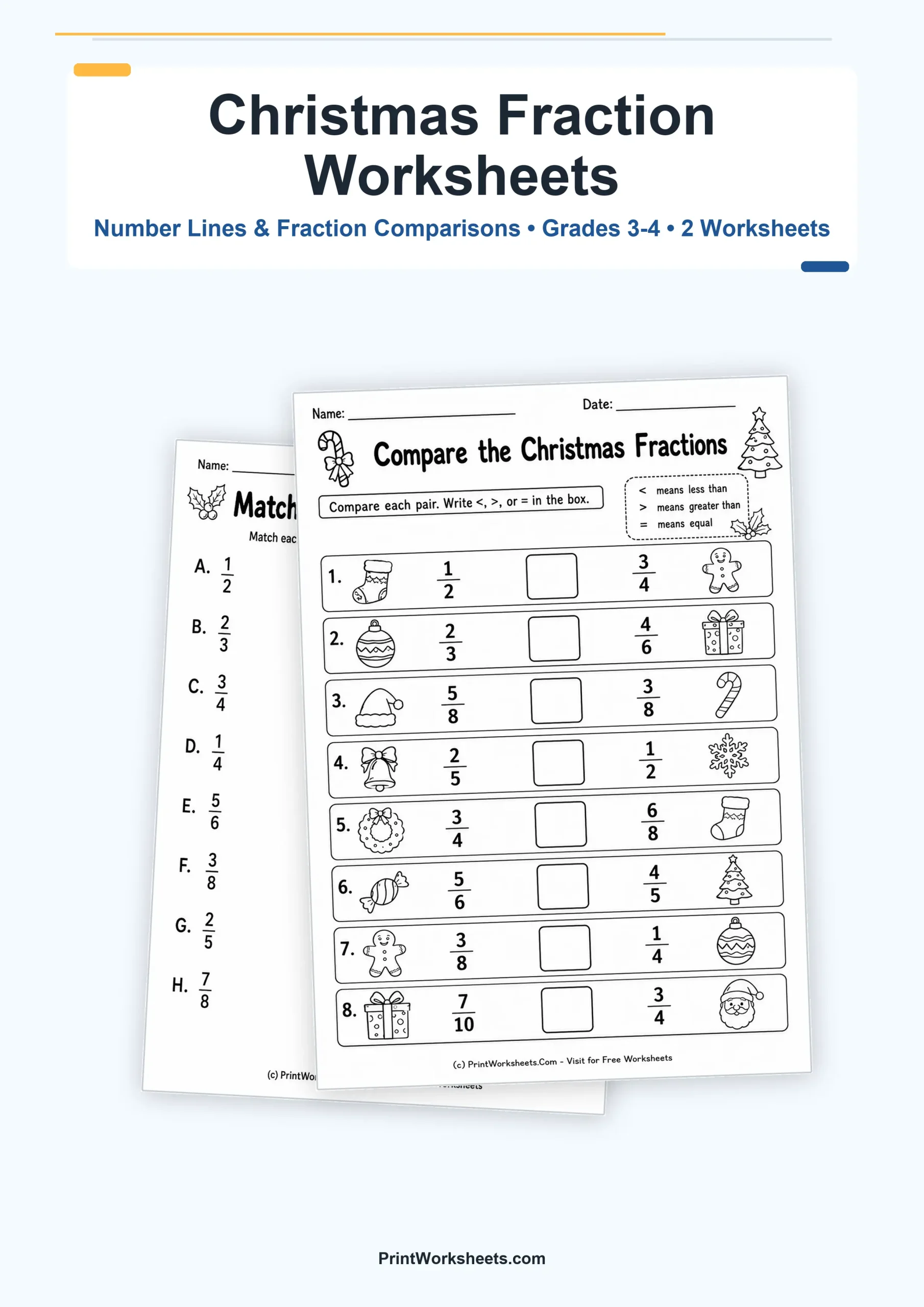
These Christmas fraction worksheets give students in Grades 3-4 focused practice with two important fraction ideas: locating fractions on number lines and comparing fraction values. Instead of repeating one question type across the set, the activities ask students to interpret fractions in two different ways. One page connects symbolic fractions to positions between 0 and 1, while the other asks students to decide which of two fractions is greater, less, or equivalent. The Christmas theme adds seasonal interest without changing the mathematical focus, making the set useful for December centers, independent work, homework, or a short review lesson.
Christmas Fraction Worksheets for Number Lines and Comparison
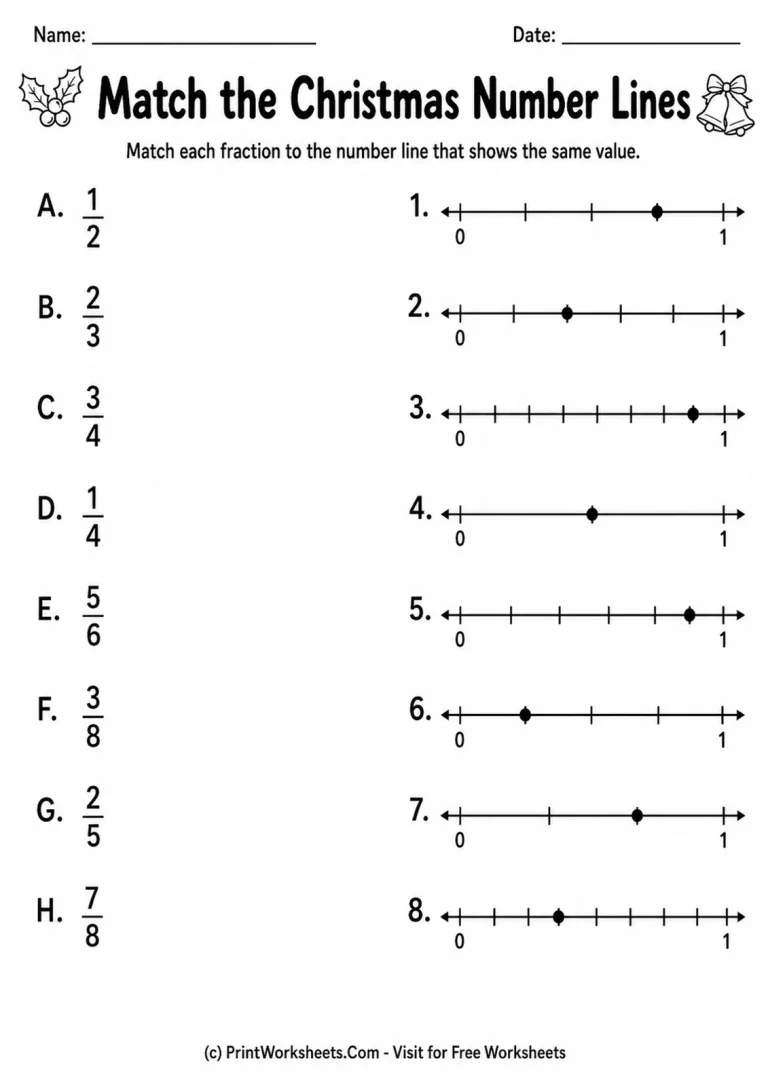
The first worksheet, Match the Christmas Number Lines, includes eight fractions: 1/2, 2/3, 3/4, 1/4, 5/6, 3/8, 2/5, and 7/8. Students match each fraction to a number line that represents the same value. Every number line runs from 0 to 1, but the intervals are divided into different numbers of equal parts. This requires students to look closely at the denominator, count equal sections, and identify the correct location rather than relying on a memorized picture.
This activity is especially useful for strengthening the connection between fraction notation and magnitude. A student who recognizes that 3/8 means three of eight equal intervals can transfer that understanding to later work with comparing, ordering, and estimating fractions. Because the page includes halves, thirds, fourths, fifths, sixths, and eighths, students also see that the size of one fractional part changes when the denominator changes.
Comparing Fractions with <, >, and =
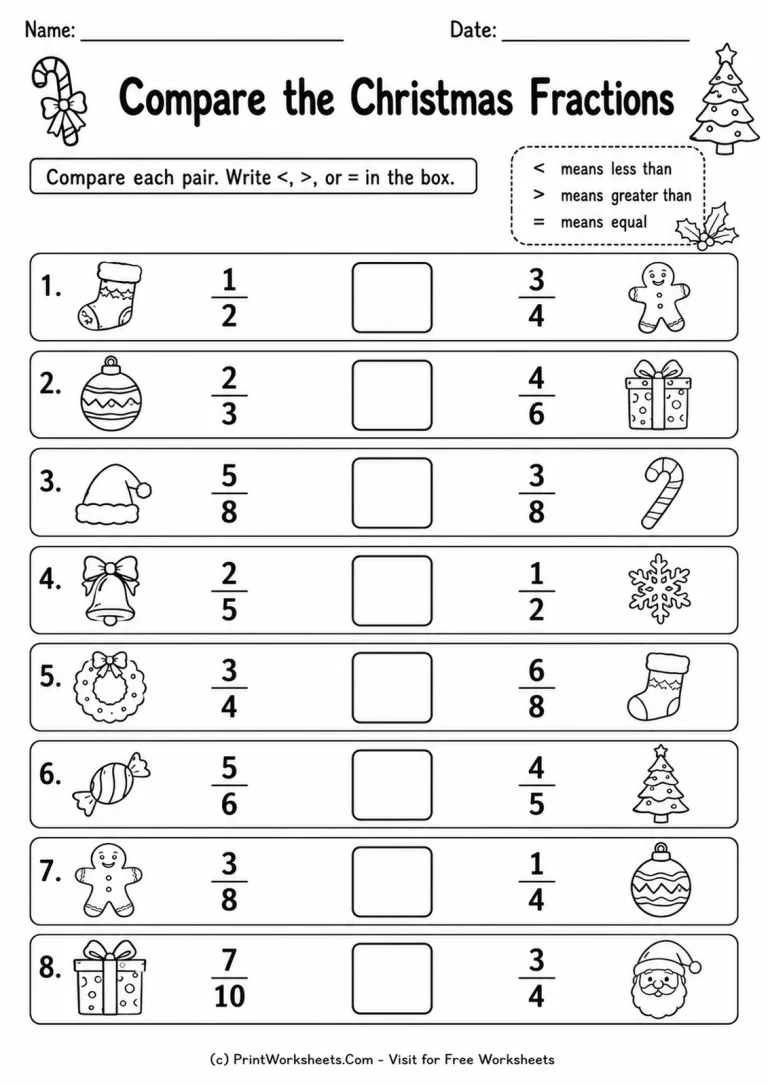
The second worksheet, Compare the Christmas Fractions, presents eight fraction pairs. Students write <, >, or = in each box to show the relationship between the two values. The problems include both equivalent fractions and fractions with different denominators, so students cannot use one single shortcut for every item.
Equivalent pairs such as 2/3 and 4/6 or 3/4 and 6/8 help students recognize that different numerators and denominators can name the same amount. Other pairs, including 5/6 compared with 4/5 and 7/10 compared with 3/4, require closer reasoning about size. Students may use benchmarks such as one-half or one whole, create equivalent fractions, or think about the distance of each fraction from 1.
How to Use These Fraction Activities in Grades 3-4
For Grade 3, the worksheets work well after students have learned that fractions represent equal parts of a whole and have begun placing fractions on number lines. The matching page can serve as guided practice first, followed by the comparison page as a more demanding application. Teachers can ask students to explain one or two matches aloud before they complete the remaining problems independently.
For Grade 4, the same pages can function as a compact review of foundational fraction concepts before work with broader comparison strategies or equivalent fractions. Students can be challenged to justify each comparison with a sentence such as, “These fractions are equal because they name the same point,” or “5/6 is greater than 4/5 because it is closer to one whole.” Adding the explanation step turns a short worksheet into useful mathematical reasoning practice.
Teacher Notes, Differentiation, and Quick Checks
Students who need extra support can use fraction strips, draw tick marks on blank number lines, or rewrite comparison pairs as equivalent fractions. For a small-group lesson, model one example by identifying the denominator first, dividing the space from 0 to 1 into equal intervals, and then locating the numerator. On the comparison page, encourage students to decide whether a benchmark such as 1/2 or 1 will help before they begin cross-multiplying or generating equivalent forms.
Students who are ready for an extension can order several of the fractions from least to greatest, write an equivalent fraction for each number-line answer, or create a new comparison pair that uses one of the fractions from the worksheets. Another useful extension is to ask students to explain why two fractions such as 2/3 and 4/6 occupy the same position even though both numbers in the fraction have changed.
For a fast exit ticket, choose one fraction from the number-line page and ask students to sketch its location between 0 and 1. Then give one comparison from the second page and require both the correct symbol and a short explanation. These two prompts quickly show whether students understand fraction magnitude rather than simply completing a seasonal activity. Used together, the worksheets provide a concise Christmas-themed review that moves from visual fraction placement to direct comparison and equivalence reasoning.