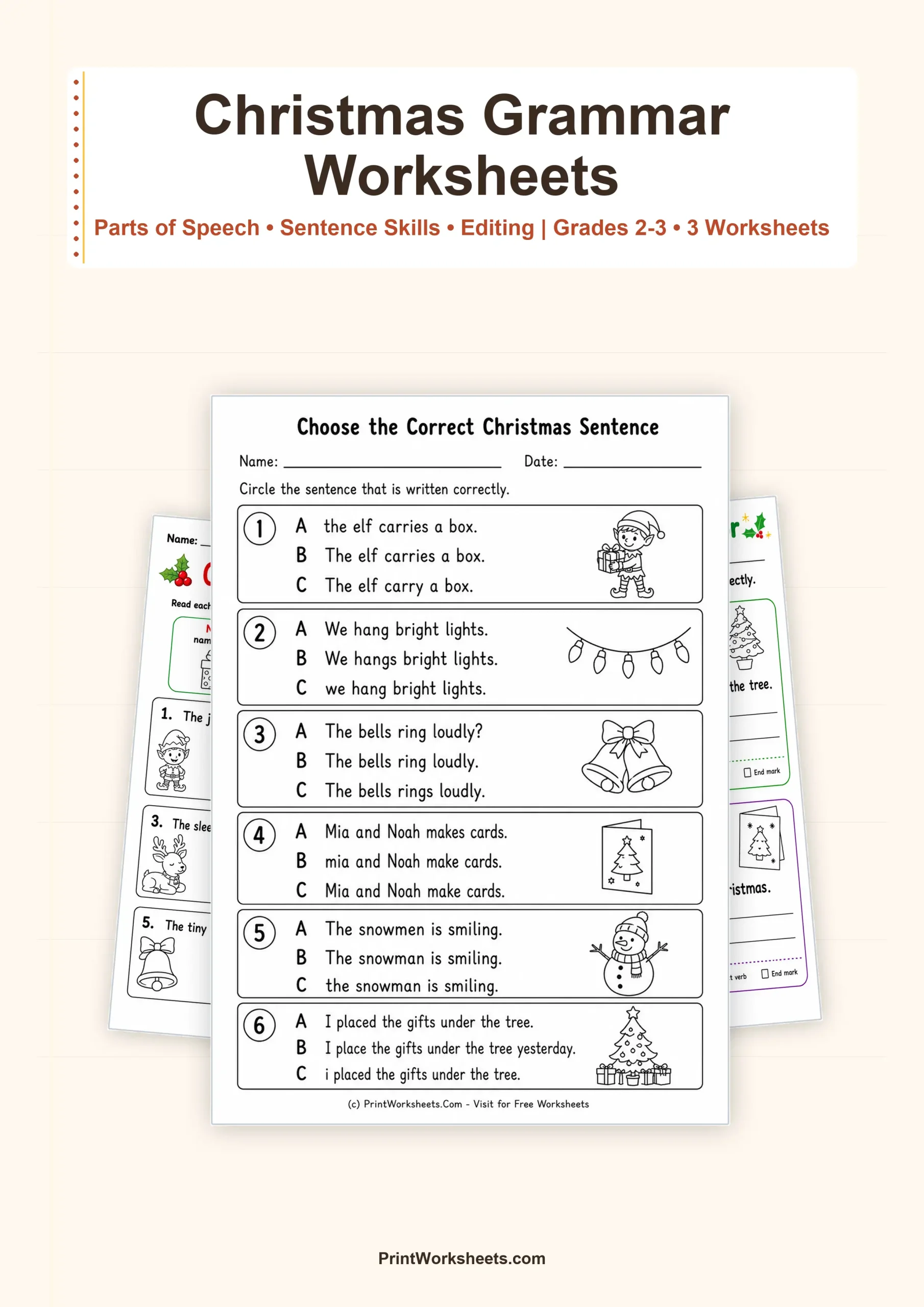
These Christmas grammar worksheets give second- and third-grade students three different ways to practice important sentence skills while working with familiar holiday vocabulary. Instead of repeating one exercise format, the set moves from identifying parts of speech to choosing correctly written sentences and then editing short Christmas messages. Students work with nouns, verbs, adjectives, capitalization, subject-verb agreement, punctuation, spelling, and basic verb tense in short activities that can fit easily into a language arts lesson.
Christmas Grammar Worksheets with Three Skill Levels
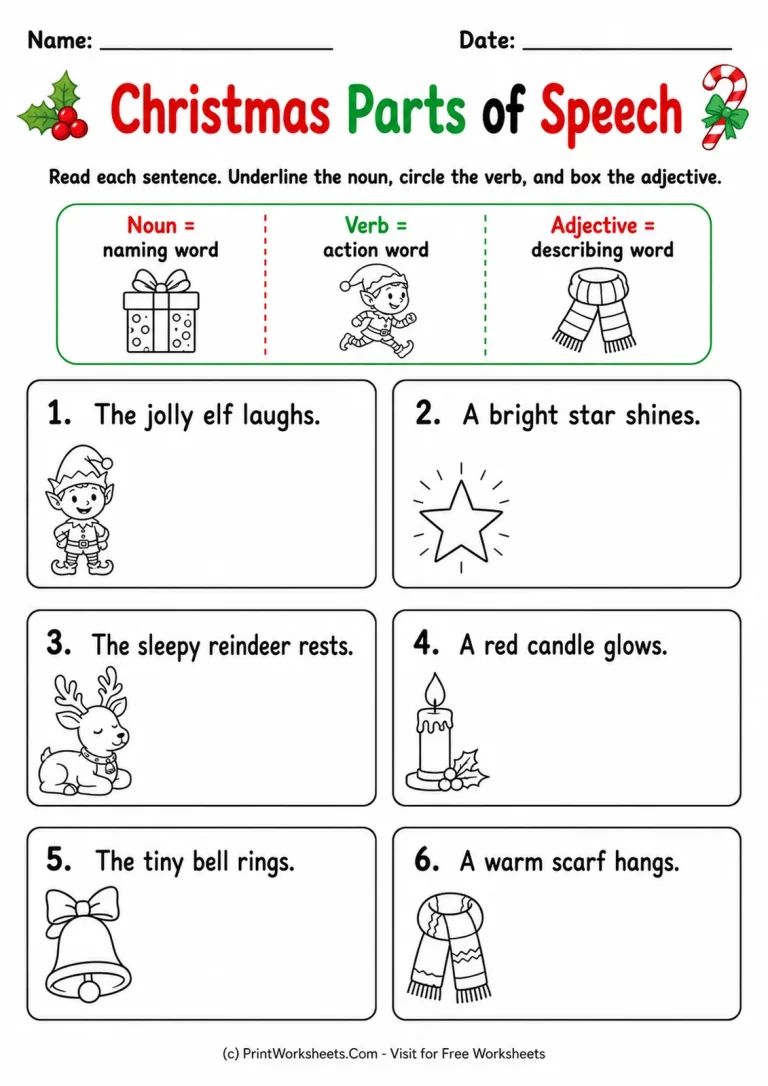
The first worksheet, Christmas Parts of Speech, focuses on recognizing how words function inside a sentence. Students read six short Christmas-themed sentences and underline the noun, circle the verb, and box the adjective. The page also includes a simple reference panel explaining that a noun is a naming word, a verb is an action word, and an adjective is a describing word. That support makes the activity useful for independent practice as well as review.
The sentences use concrete seasonal vocabulary such as an elf, star, reindeer, candle, bell, and scarf. Because the vocabulary is easy to picture, students can concentrate on the grammar task rather than decoding an unfamiliar context. Teachers can also pause after each sentence and ask students to explain why a selected word is functioning as a noun, verb, or adjective.
Practice Correct Christmas Sentences
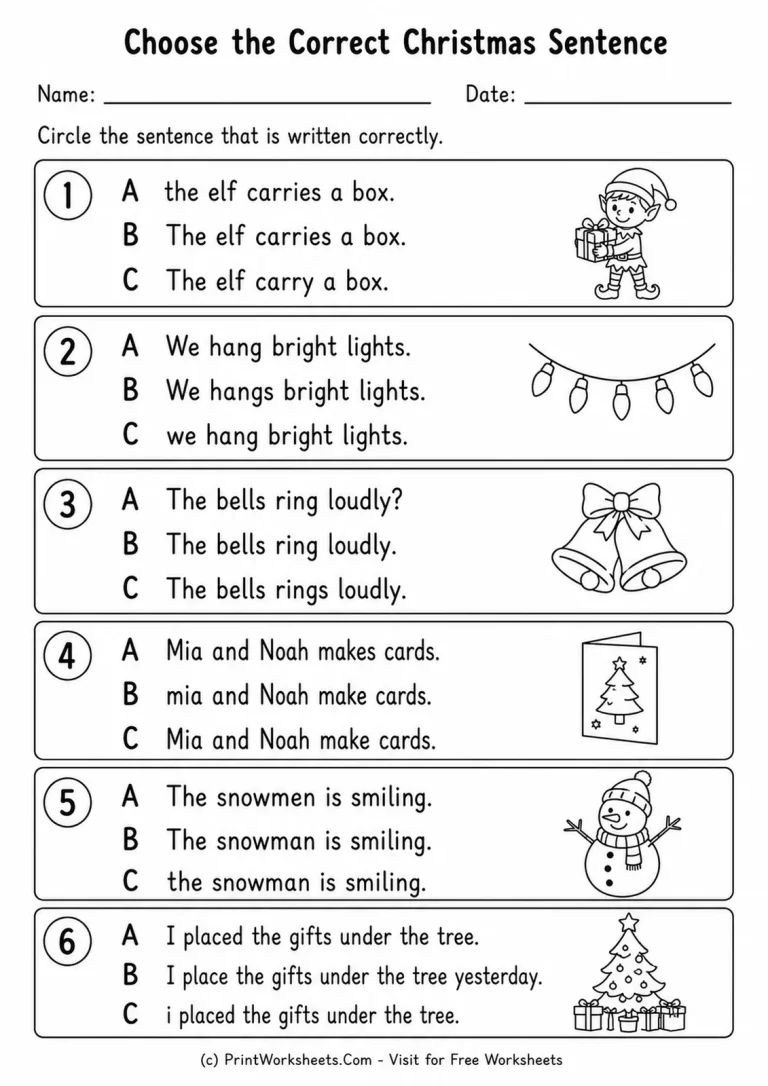
The second activity changes the thinking task from labeling individual words to evaluating complete sentences. Students choose the correctly written sentence from six Christmas-themed multiple-choice sets. The distractors are built around common Grade 2-3 errors, including missing capital letters, incorrect verb forms, weak punctuation, spelling mistakes, and tense problems.
Several items provide useful practice with subject-verb agreement. For example, students must notice the difference between ring and rings when the subject is plural bells. Another item asks students to choose the correct verb with the compound subject Mia and Noah, reinforcing why make is correct instead of makes. A past-tense item also asks students to connect a time clue such as yesterday with the correct verb form. These questions require students to read the entire sentence rather than rely on one isolated grammar rule.
Build Editing Skills with Christmas Messages
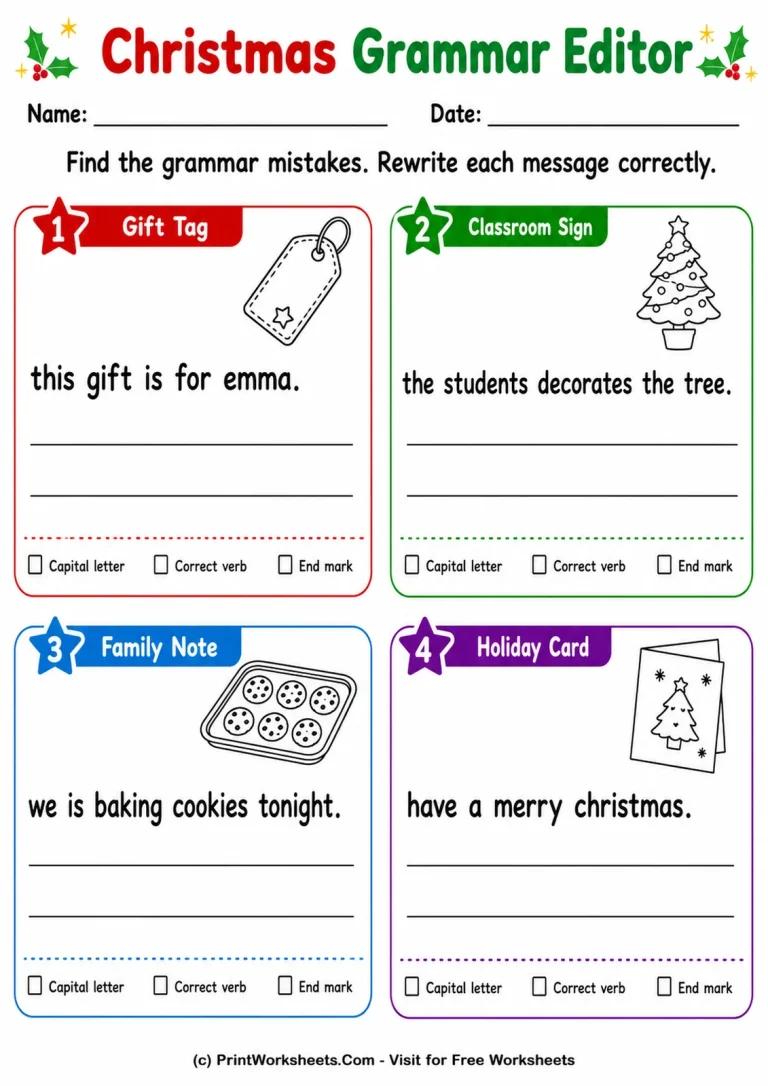
The final worksheet, Christmas Grammar Editor, moves students into active correction. Four short Christmas messages contain grammar mistakes, and students rewrite each message correctly. Checkboxes remind them to look for capital letters, correct verbs, and end marks, giving young writers a practical editing routine they can reuse in their own writing.
This progression makes the set especially useful for instruction because students move from recognizing grammar features to judging sentence accuracy and finally producing corrected sentences themselves. A teacher could use the parts-of-speech page during guided practice, the multiple-choice page as independent work, and the editing page as a quick assessment or writing-center task.
Ways to Use the Worksheets in Grades 2-3
For Grade 2 students, consider completing the first example together and reviewing the noun, verb, and adjective definitions before independent work. Students who need more support can read each sentence aloud and identify the action first, then find who or what performs the action, and finally locate a describing word. This step-by-step approach reduces the number of decisions students make at one time.
Grade 3 students can add an explanation after each multiple-choice item by naming the rule that makes the chosen sentence correct. During the editing activity, they can underline each change they make and label it with a short note such as capital, verb, or punctuation. This turns simple correction into evidence-based grammar thinking.
For an exit ticket, write one new Christmas sentence on the board with two intentional errors and ask students to correct it independently. As an extension, students can create their own holiday sentence that includes a noun, an action verb, and an adjective, then trade papers with a partner for an editing check. Used together, the three pages provide a compact seasonal review that strengthens both grammar recognition and sentence-editing habits.