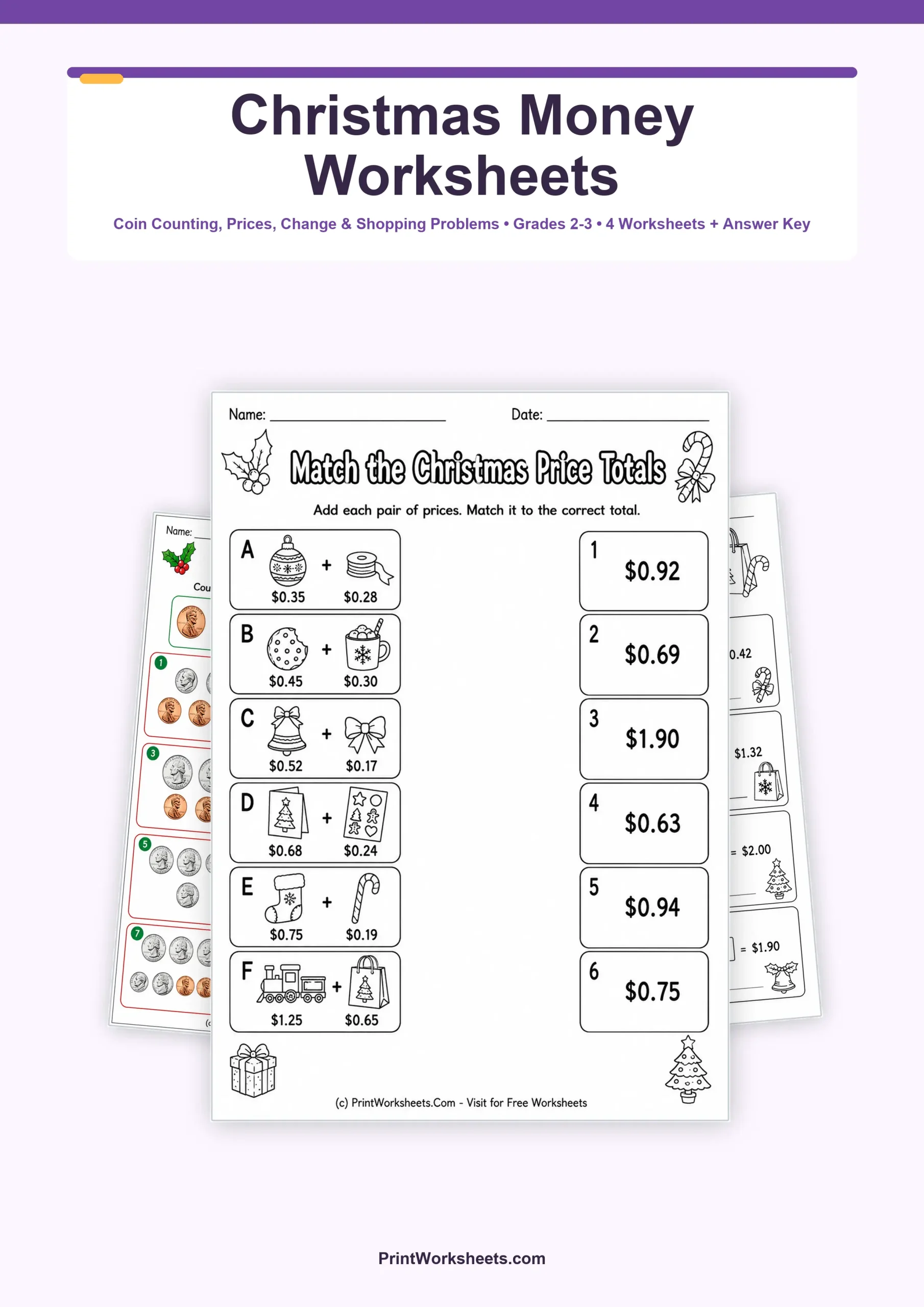
Holiday shopping situations give young learners a natural reason to work with coins, prices, payments, and change. These Christmas money worksheets for Grades 2-3 combine four related activities that move from concrete coin counting to written calculations and short shopping problems. Students begin with familiar U.S. coins, then add prices, determine missing money amounts, and finally apply the same ideas in Christmas shopping situations. A separate answer key covers every objective problem in the set, making the pages suitable for classroom practice, math centers, homework, or review at home.
Christmas Money Worksheets Build Skills in a Clear Sequence
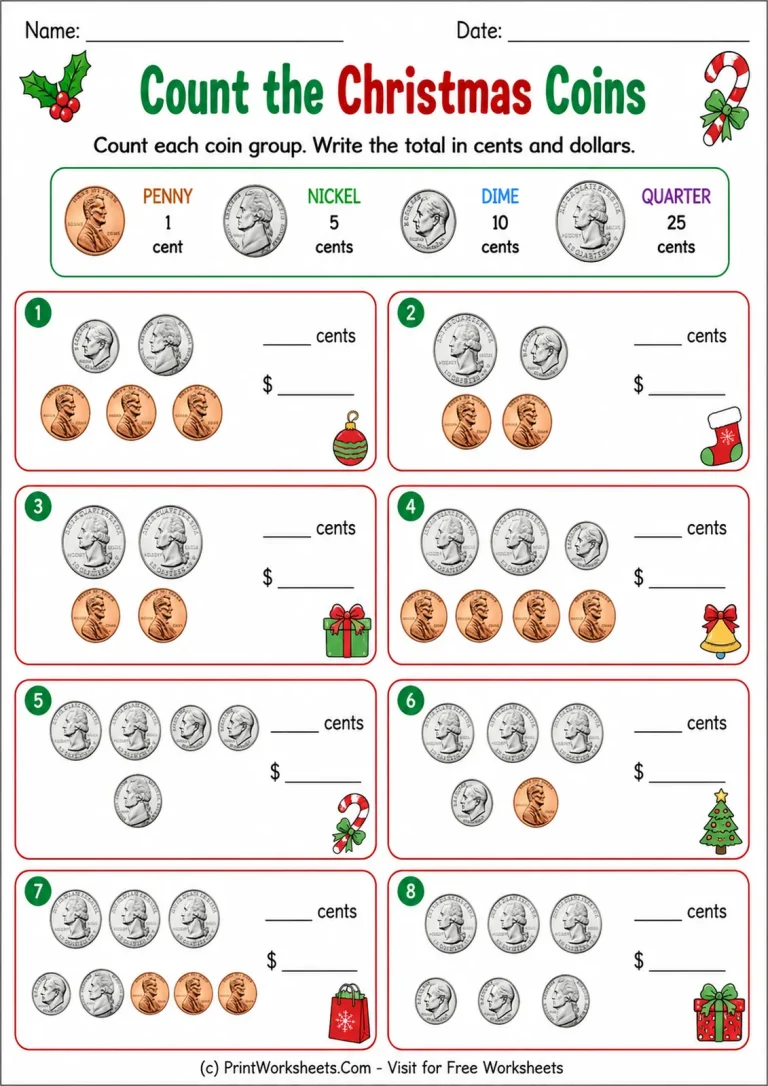
The first worksheet, Count the Christmas Coins, gives students a useful starting point because it keeps the focus on the value of actual coins. A reference strip identifies a penny as 1¢, a nickel as 5¢, a dime as 10¢, and a quarter as 25¢. Students count eight different groups of coins and record each total in both cents and dollar notation. Writing the same amount in two forms helps connect coin values such as 75¢ with decimal money notation such as $0.75.
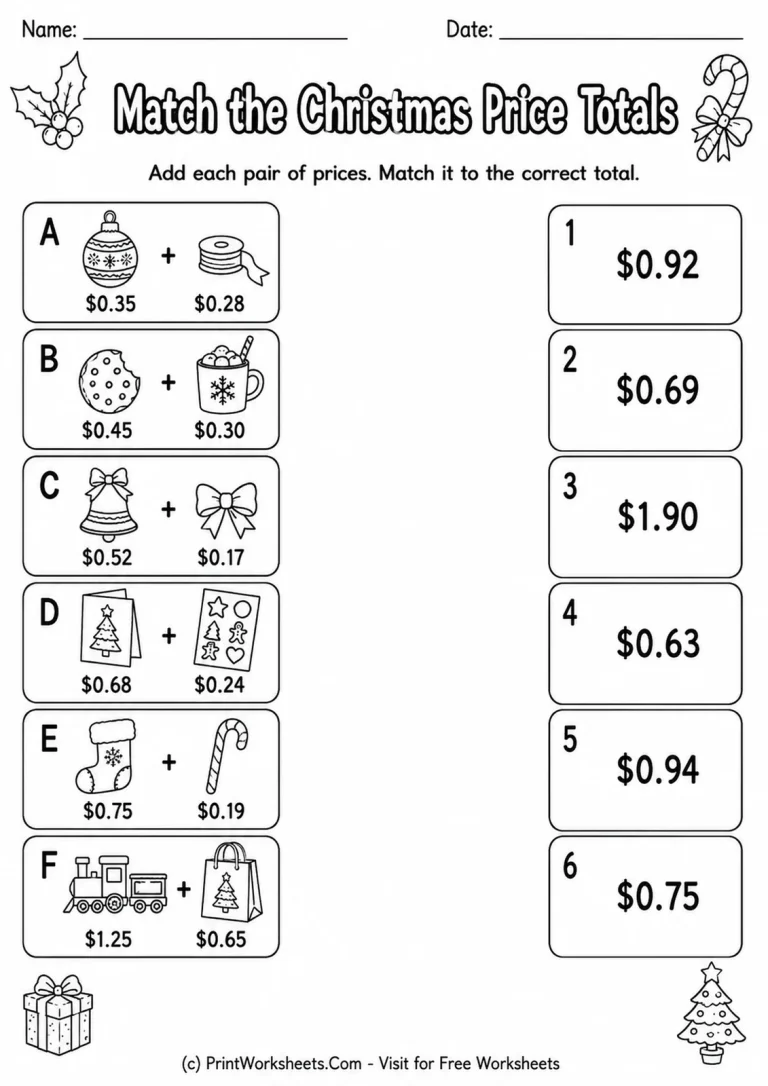
The second page, Match the Christmas Price Totals, shifts from individual coins to written prices. Students add six pairs of Christmas-themed item prices labeled A-F and match each calculation to one correct total card numbered 1-6. The amounts range from small values such as $0.17 to totals above one dollar, with examples reaching about $1.90. Because each sum has one matching answer, students practice both decimal money addition and careful checking.
Practice Missing Amounts with Addition and Subtraction
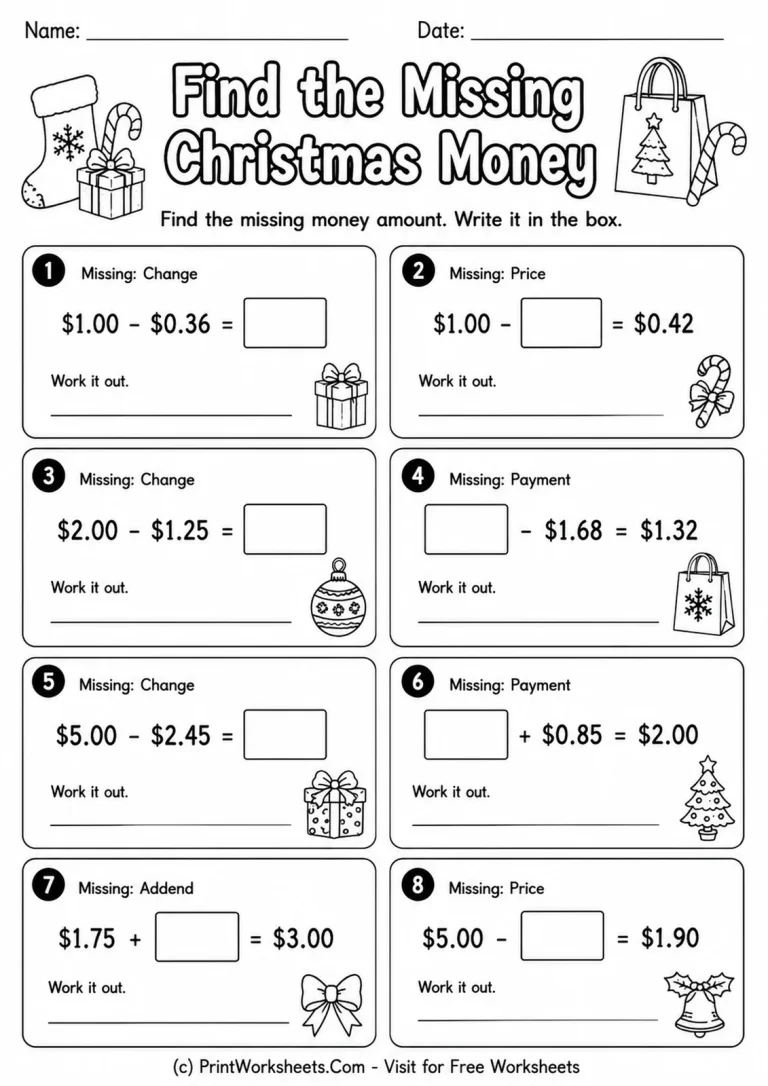
Find the Missing Christmas Money adds a different kind of reasoning. Instead of simply finding a total, students solve eight equations in which one money amount is missing. The missing value may represent change, price, payment, or an addend. Amounts are built around accessible values from $1.00 through $5.00, so students can use addition and subtraction as related operations rather than treating each problem as an isolated fact.
This page is especially useful after students understand basic money notation. A child who sees a payment and a price must decide how to determine the change. In another equation, the student may know a total and one addend and need to find the missing price. That variation encourages flexible thinking while keeping all questions within the same practical money context.
Christmas Shopping Word Problems Add Real-World Context
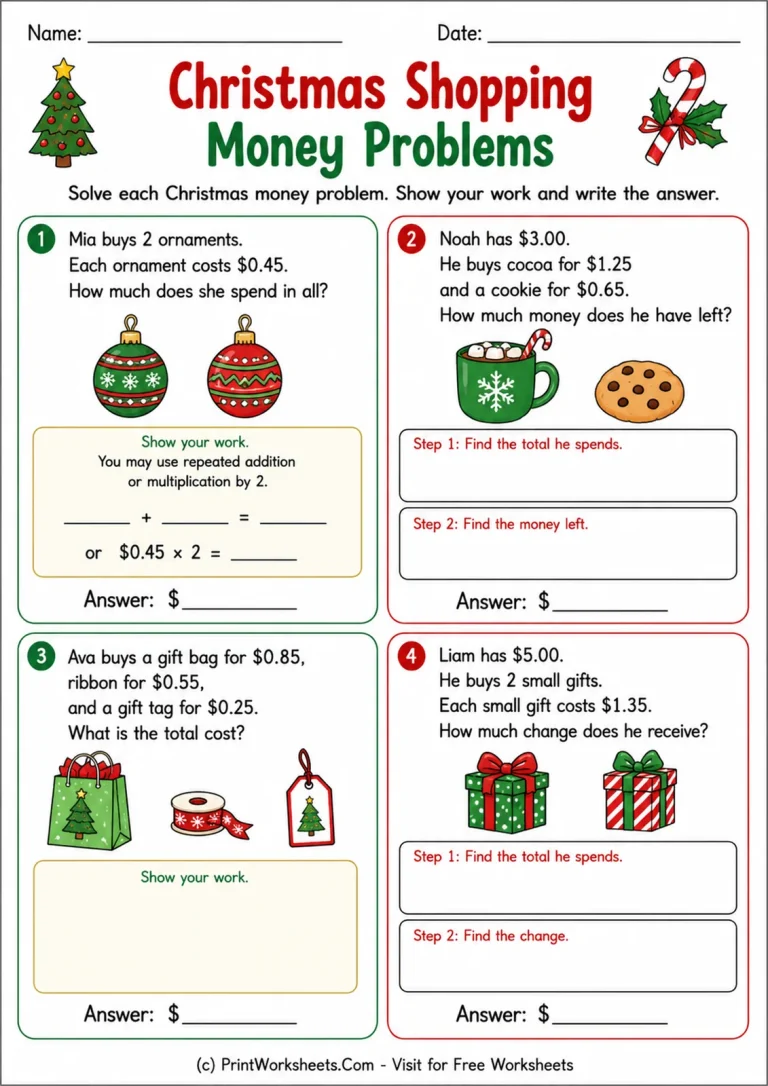
The final student page, Christmas Shopping Money Problems, asks learners to apply money operations in four short situations. Students find the cost of two identical items, determine how much money remains after a purchase, add the prices of three items, and calculate change after shopping. Some problems include workspace that naturally supports a two-step solution, giving students room to organize the calculation instead of jumping directly to an answer.
This progression makes the packet useful across more than one lesson. A teacher can begin with the coin-counting page as guided practice, use the price-matching activity for independent work, and save the missing-value equations and word problems for students who are ready to reason more deeply. The pages can also be spread across several days during a Christmas math unit without repeating the same task format.
Teaching Ideas for 2nd and 3rd Grade Money Practice
For 2nd grade money practice, begin by reviewing the four coin values shown on the reference strip before students count the eight groups. Encourage learners to group equal coins first, add quarters or dimes, and then include smaller coins. When students write both cent and dollar forms, have them explain why the two notations represent the same value.
For 3rd grade money practice, place more emphasis on choosing operations. On the missing-money page, students can label whether they used addition or subtraction and explain how they checked the result. On the shopping page, ask students to underline the amounts they need and circle words that signal what the problem is asking them to find.
Differentiation is straightforward because the four pages increase in abstraction. Students needing support can work first with coin values and price totals, while students ready for an extension can solve the missing-value and shopping questions without hints and then verify their answers using inverse operations. As a quick exit ticket, give students a payment amount and a price and ask them to find the change in both cents and dollar notation.
A Complete Printable Christmas Money Practice Set
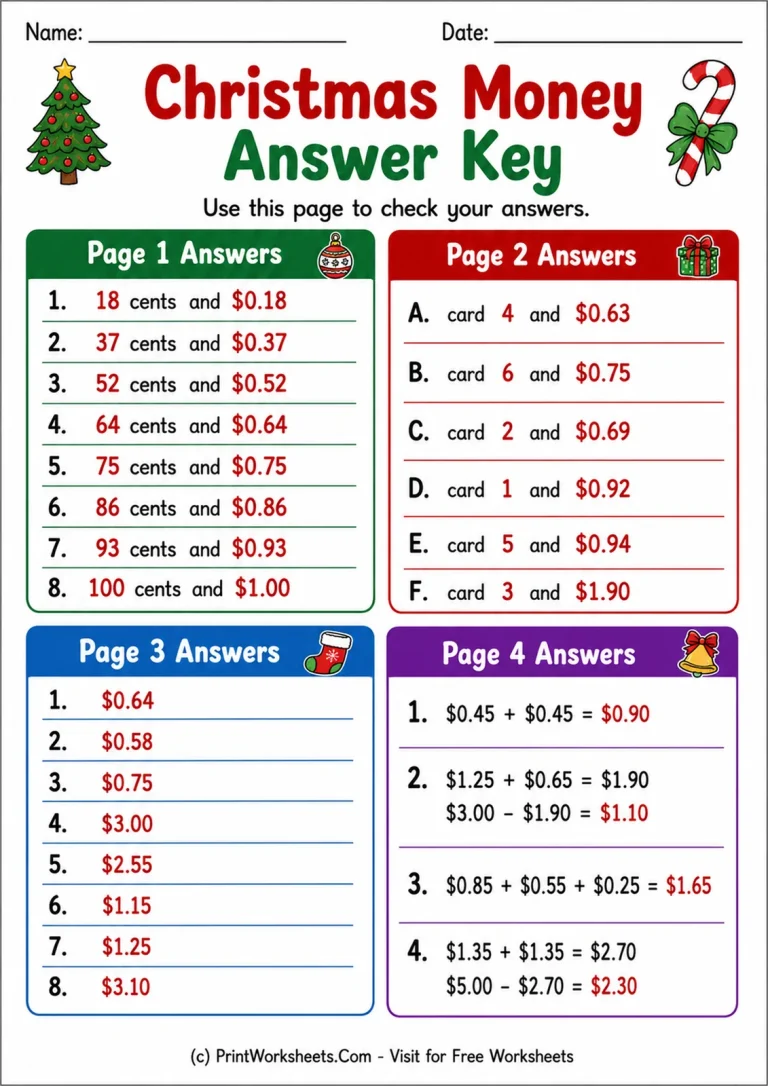
Together, the four worksheets cover coin counting, decimal money addition, missing-value equations, and one- and two-step shopping problems without relying on a single repeated activity. The Christmas theme keeps the context consistent while the mathematics becomes progressively more demanding. With the included answer key, teachers and parents can quickly check all eight coin totals, six price matches, eight missing amounts, and four shopping solutions. The result is a focused printable set for reinforcing practical money skills in Grades 2 and 3 during the Christmas season.