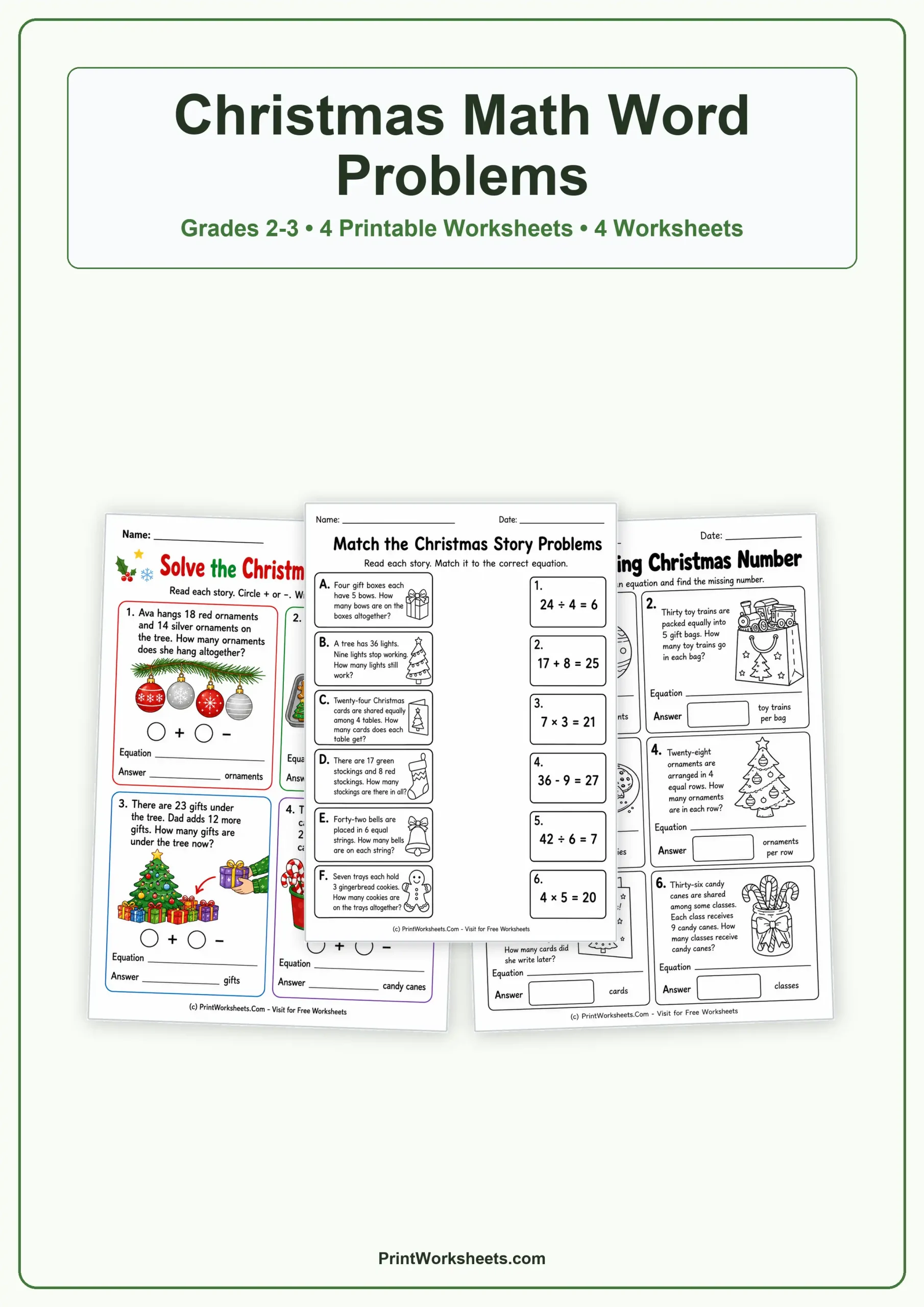
These Christmas math word problems give second- and third-grade students a seasonal way to practice deciding what a story problem is asking before they calculate. Across four printable worksheets, children work with addition, subtraction, multiplication, division, missing numbers, equation matching, and two-step reasoning. The Christmas settings include ornaments, cookies, gifts, candy canes, cards, toy trains, and other familiar holiday details, while the mathematical demand grows from straightforward one-step situations to problems that require more than one decision.
Christmas Math Word Problems That Build From One Step to Two
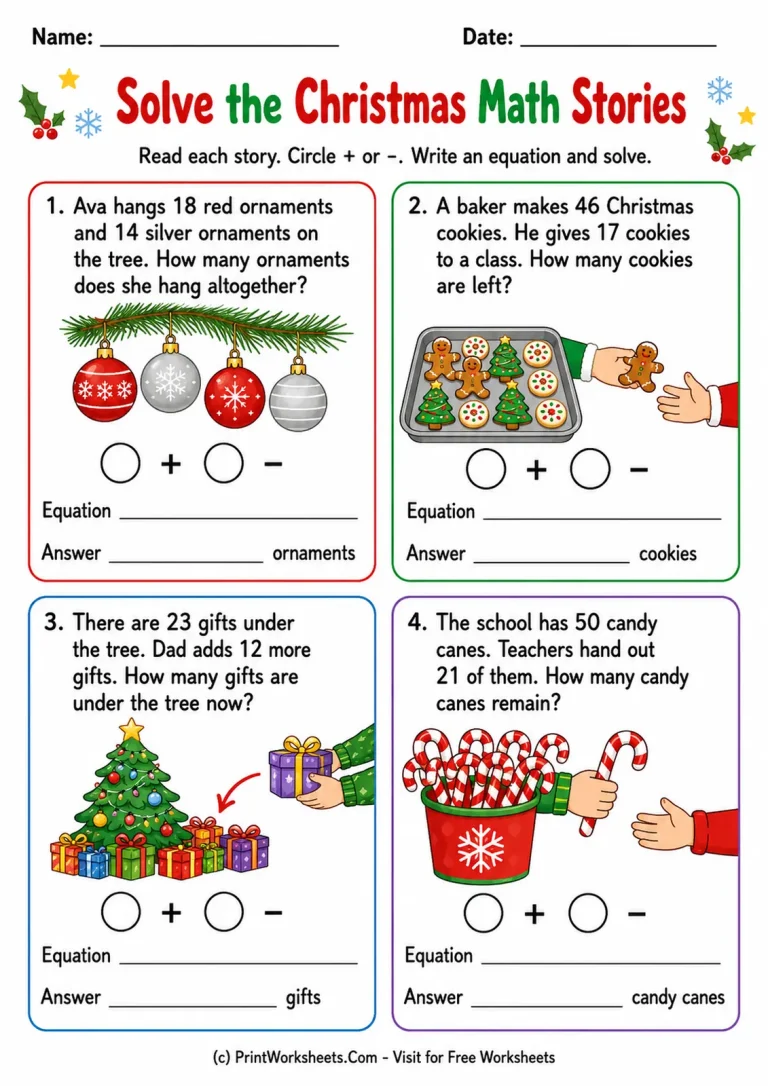
The first worksheet, Solve the Christmas Math Stories, focuses on four single-step addition and subtraction situations. Students read each short story, choose the correct operation, write an equation, and solve. One problem combines 18 red ornaments with 14 silver ornaments, while another begins with 46 cookies and asks students to determine how many remain after 17 are given away. These problems are useful for checking whether students can identify words and quantities that signal joining or separating without relying only on isolated computation practice.
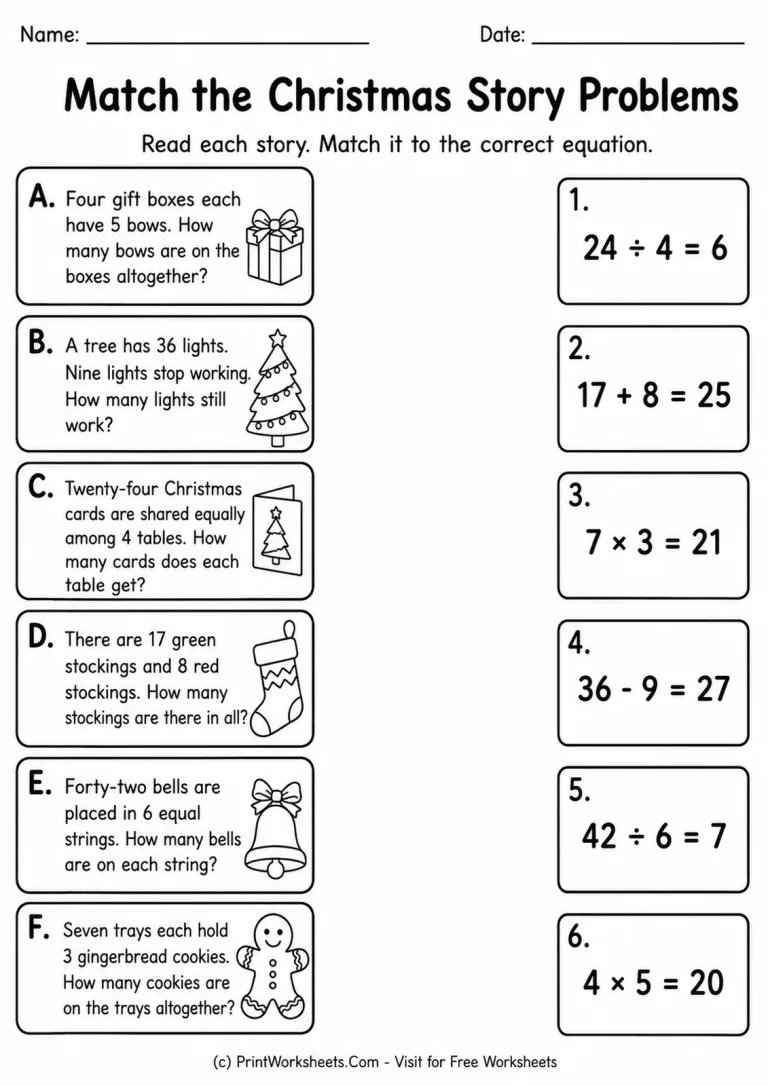
The second worksheet changes the task rather than simply adding more questions. In Match the Christmas Story Problems, students connect six labeled stories with six numbered equations. Addition, subtraction, multiplication, and division all appear, so students must pay attention to the relationship described in each situation. A story about sharing 24 Christmas cards equally among four tables, for example, requires students to recognize division instead of matching numbers by appearance. This page works well for partner discussion because students can explain why a particular equation represents a particular story.
Missing Numbers and Inverse-Operation Thinking
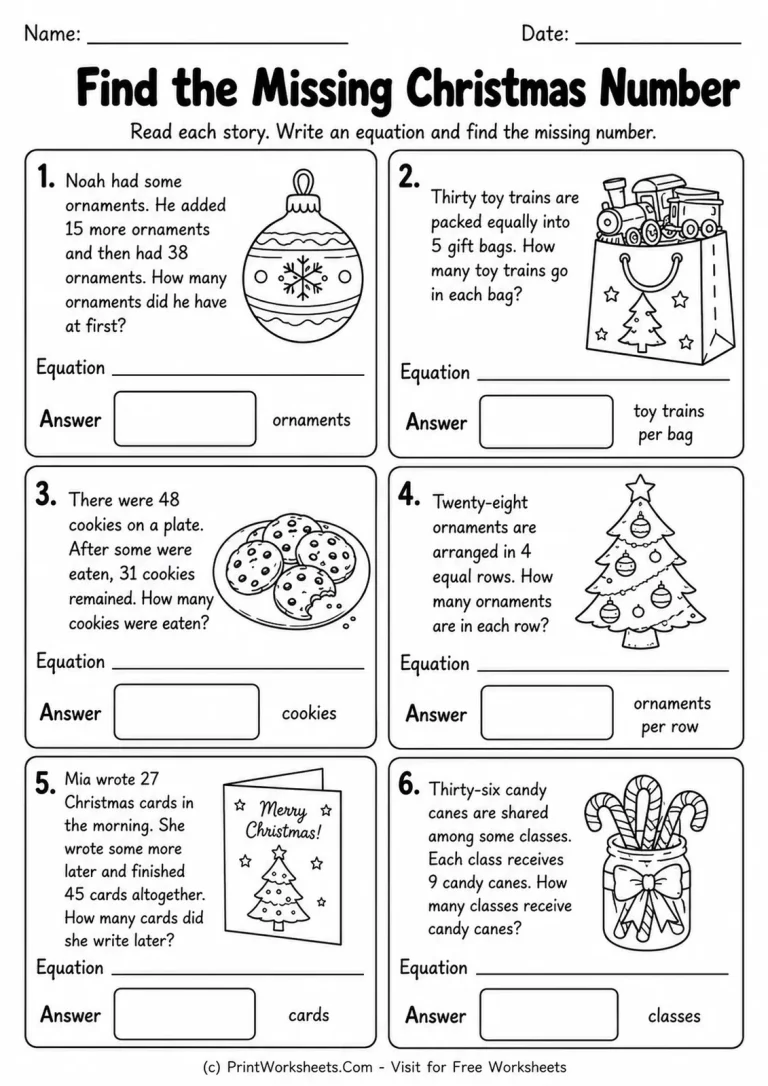
Find the Missing Christmas Number moves beyond solving for a final total. Its six problems ask students to determine an unknown starting amount, an amount removed, a group size, or a number of groups. That change encourages flexible thinking about how addition, subtraction, multiplication, and division are connected. In one situation, students determine how many cookies were eaten when 48 were available and 31 remain. In another, 30 toy trains are shared equally among five gift bags, requiring students to reason about equal groups.
Teachers can make the unknown structure visible by asking students to write a box or question mark in the equation before calculating. Students who need support can retell each problem using counters, drawings, or equal groups. Students ready for an extension can write the related inverse equation and explain how it checks the answer. This keeps the activity centered on mathematical relationships rather than keyword hunting.
Two-Step Christmas Challenges for Grades 2-3
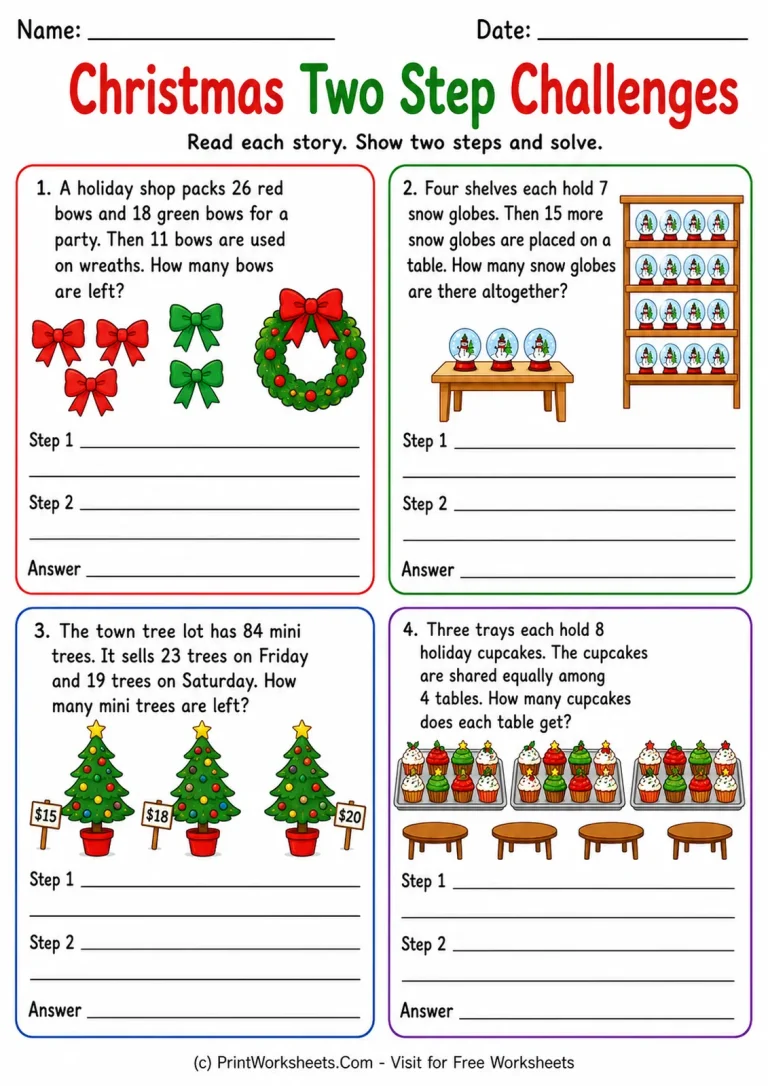
The final worksheet, Christmas Two Step Challenges, asks students to record two separate calculation steps and then state the final answer. The four problems include addition followed by subtraction, multiplication followed by addition, repeated subtraction situations, and multiplication connected with division. Showing the two steps on separate lines helps students organize the information and decide which result must be found first.
For Grade 2, these pages can be used selectively, beginning with the one-step addition and subtraction stories before introducing the matching and missing-number activities with teacher support. Grade 3 students can work through the complete progression and explain how they know which operation or combination of operations fits each story. The changing task formats also make the set useful for small groups, math centers, holiday review, or independent practice without making every page feel identical.
Ways to Use the Worksheets in a Holiday Math Block
Begin with one problem as a read-aloud and ask students to identify what is known, what is unknown, and what operation would represent the situation. During independent work, encourage students to underline useful quantities and write equations before computing. For a quick exit ticket, choose one missing-number or two-step problem and ask students to include a sentence explaining their operation choice.
If students benefit from practicing the same core skill in another seasonal setting, the fall math word problems provide another Grades 2-3 set. The Halloween math word problems can also be used for additional themed problem-solving practice earlier in the school year.
Practice Reading, Modeling, and Solving
This four-page set is especially useful because students are not asked to repeat only one type of calculation. They interpret stories, connect situations to equations, reason backward to find unknown values, and organize two-step solutions. Used together, the worksheets create a compact Christmas math sequence that strengthens both computation and the reading-and-reasoning habits students need for successful word-problem solving.