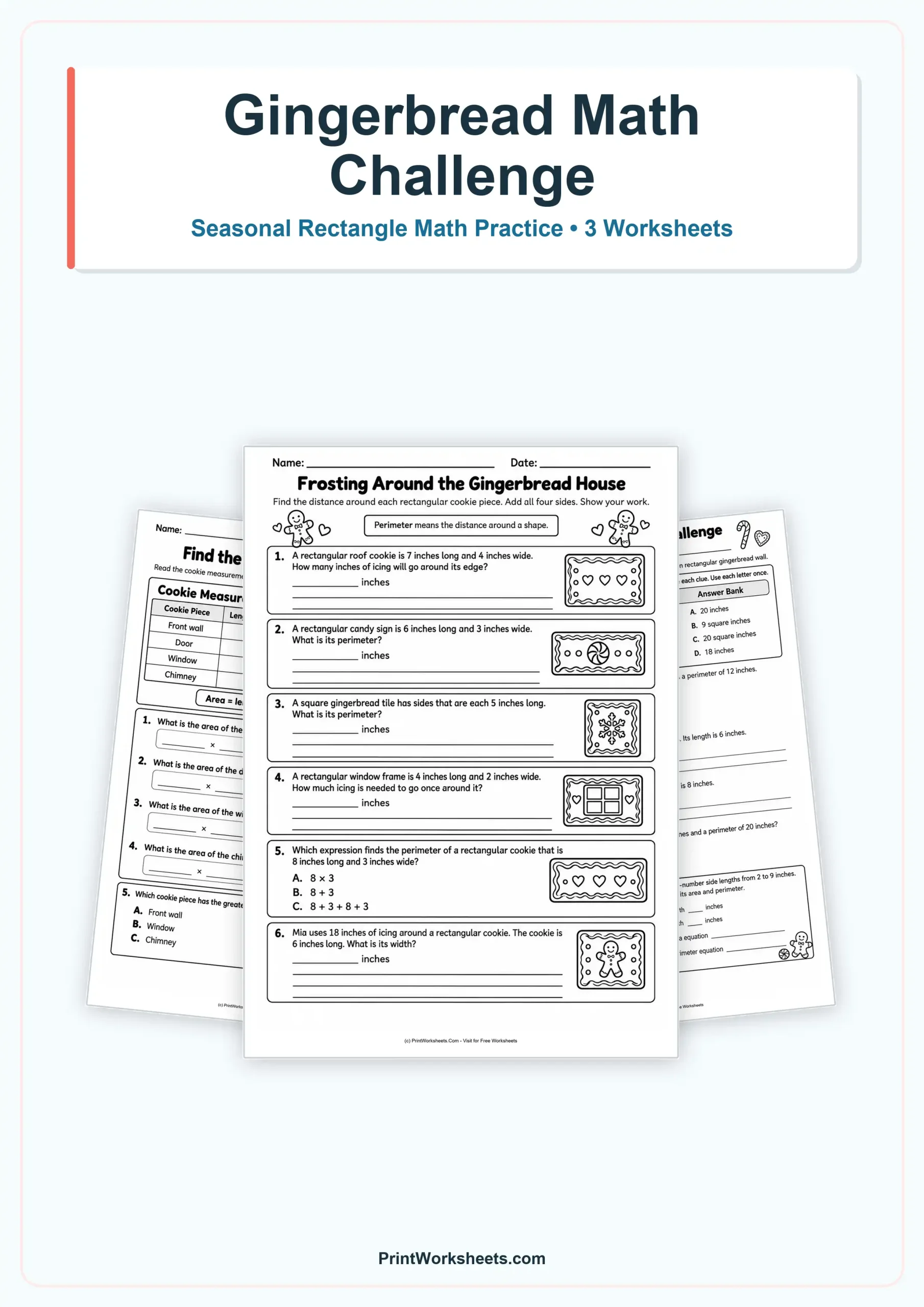
These gingerbread area and perimeter worksheets turn rectangle measurement into a seasonal math lesson built around walls, doors, windows, roof pieces, frosting, and cookie designs. Students begin with straightforward area practice, move into perimeter word problems, and then combine both skills in a mixed challenge that asks them to reason about dimensions, units, and equations. The gingerbread-house theme keeps the practice visually engaging while the mathematics stays focused on real grade-level skills.
Gingerbread Area and Perimeter Worksheets for Seasonal Math Practice
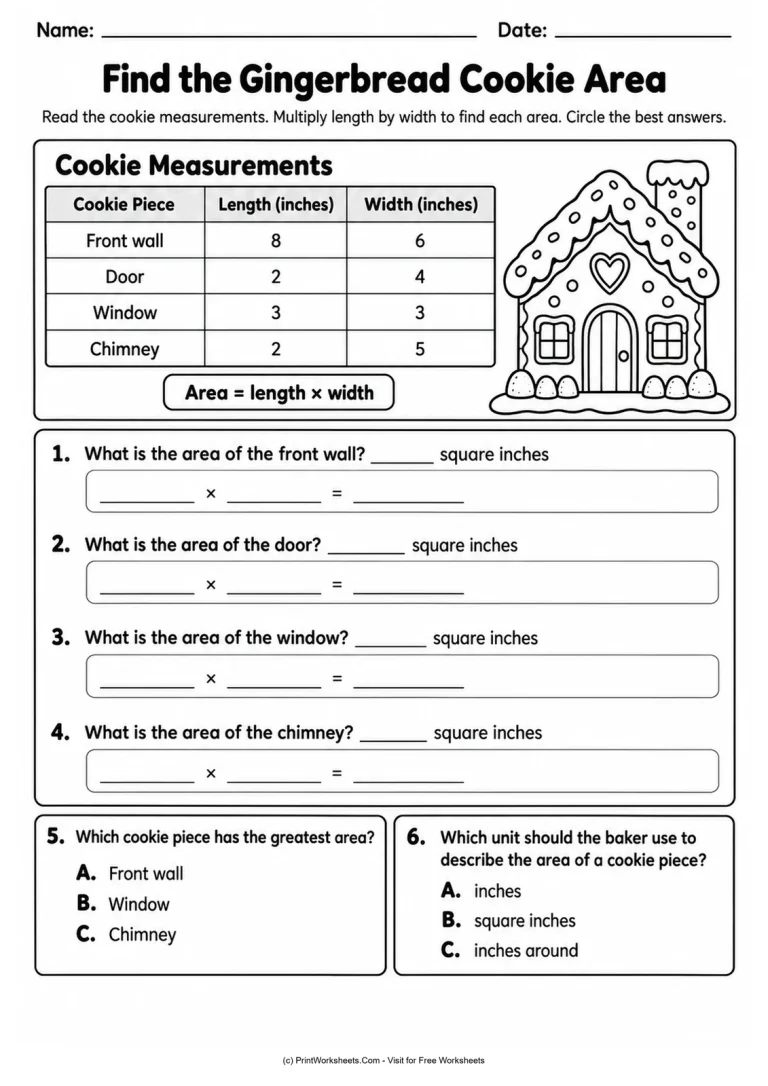
The first activity introduces area through a cookie-measurement table. Students read the length and width of a front wall, door, window, and chimney, then multiply the dimensions to find each area in square inches. The problems reinforce the area formula in a concrete way because every calculation is tied to a specific gingerbread-house piece. Students also compare their results to identify which piece has the greatest area and choose the correct unit for describing area.
This page is especially useful for students who know multiplication facts but still need practice connecting multiplication to rectangular area. The table gives all needed measurements in one place, and the written equations provide space to show length times width before recording the product. Teachers can use it as independent practice after an area lesson, a holiday math center, or a quick check for understanding.
Practice Perimeter with Frosting and Icing
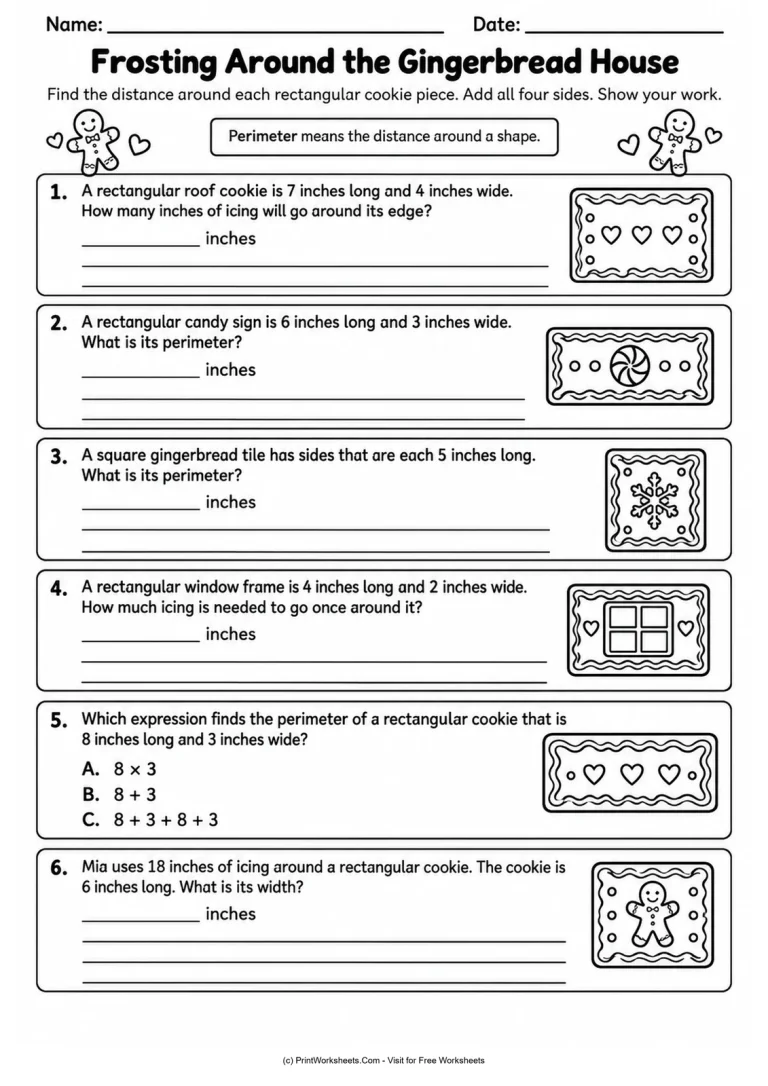
The next activity shifts from covering a surface to measuring the distance around a shape. Rectangular cookie pieces and a square gingerbread tile are described with side lengths, and students determine how much icing would be needed to go once around each edge. The context makes the meaning of perimeter easy to visualize: the icing follows the outside border rather than filling the inside.
Students solve direct perimeter problems with rectangles, calculate the perimeter of a square, and choose the expression that correctly adds all four sides of a rectangle. A later problem gives the total perimeter and one side length, requiring students to work backward to find the missing width. That change in structure helps move the practice beyond routine computation and checks whether students understand how the side lengths contribute to the full perimeter.
Compare Area and Perimeter in One Gingerbread Challenge
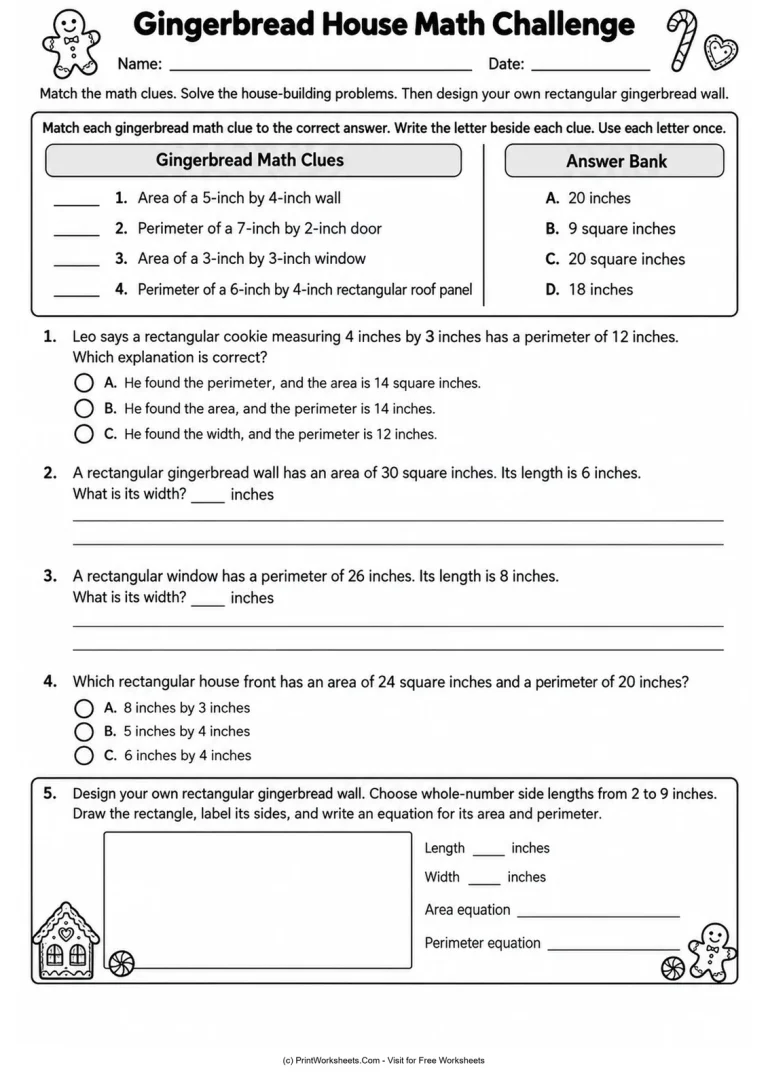
The mixed challenge brings the two concepts together so students must decide whether each situation calls for square units or linear units. A matching section includes both area and perimeter clues, such as finding the area of a wall or the perimeter of a door or roof panel. Because the answer bank contains both inches and square inches, students have to pay attention not only to the number but also to the measurement type.
The challenge continues with error analysis. Students examine a claim about a 4-inch by 3-inch rectangle and determine that 12 represents the area, while 14 inches is the perimeter. This is a valuable distinction because area and perimeter are often confused when students work with the same pair of dimensions. Additional problems ask students to find a missing width from a known area, find a missing width from a known perimeter, and identify a rectangle that satisfies both a stated area and a stated perimeter.
Finish with an Open-Ended Gingerbread Wall Design
The final design task gives students room to apply the formulas independently. They choose whole-number side lengths from 2 to 9 inches, draw a rectangular gingerbread wall, label its length and width, and write equations for both area and perimeter. Since multiple designs can be correct, this activity works well for math discussion: students can compare rectangles, explain why their equations match their drawings, and notice how different dimensions affect area and perimeter.
Ways to Use This Printable Set
These worksheets work well for a Christmas or winter math block, especially when students are studying multiplication, rectangular area, perimeter, or measurement vocabulary. The progression supports both review and differentiation: begin with the table-based area page for more guided practice, use the frosting perimeter page for focused perimeter work, and save the mixed challenge for students who are ready to connect the two concepts.
For classroom use, students can complete one activity at a time during centers, morning work, homework, or small-group instruction. Parents can also use the set for seasonal practice at home. Encourage students to write the unit with every answer and to explain whether a problem is asking about the inside space of a shape or the distance around its edge. That simple habit helps strengthen the difference between square inches for area and inches for perimeter.
Use the full printable PDF set when you want a gingerbread-themed math activity that progresses from direct computation to reasoning and design. The combination of measurement tables, word problems, matching, missing-dimension questions, and an open-ended drawing task gives students several ways to demonstrate understanding without repeating the same problem format.