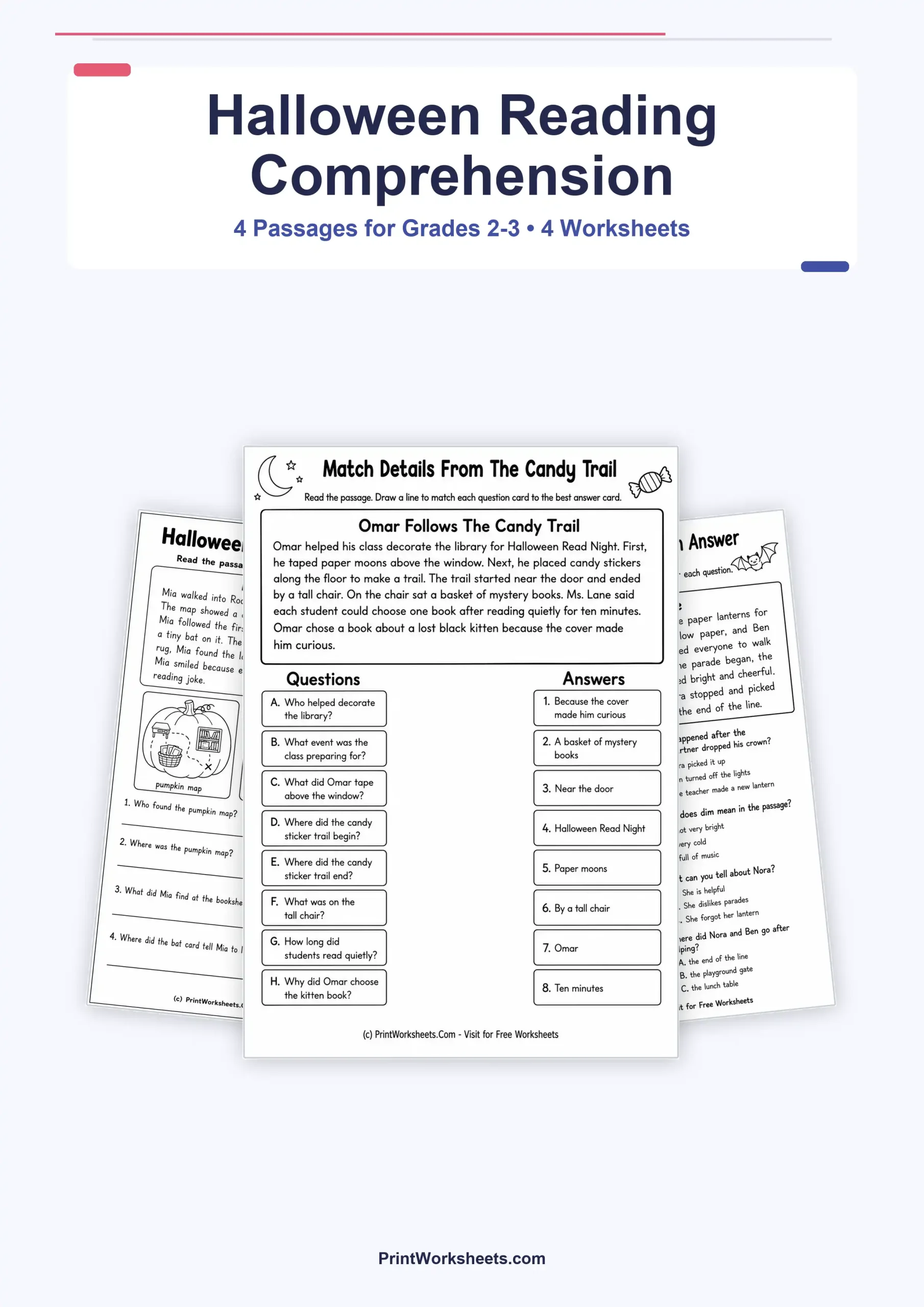
Halloween reading comprehension can feel especially engaging when the stories are short, familiar, and built around classroom-friendly seasonal details. This printable set for Grades 2-3 gives students four different ways to practice understanding a passage: answering short-response questions, matching details, choosing multiple-choice answers, and writing evidence-based responses. The activities use friendly Halloween settings such as a pumpkin clue map, a candy-sticker trail, a lantern parade, and a costume mix-up, so students can focus on reading skills without scary or overly complex content.
Halloween Reading Comprehension Skills in This Set
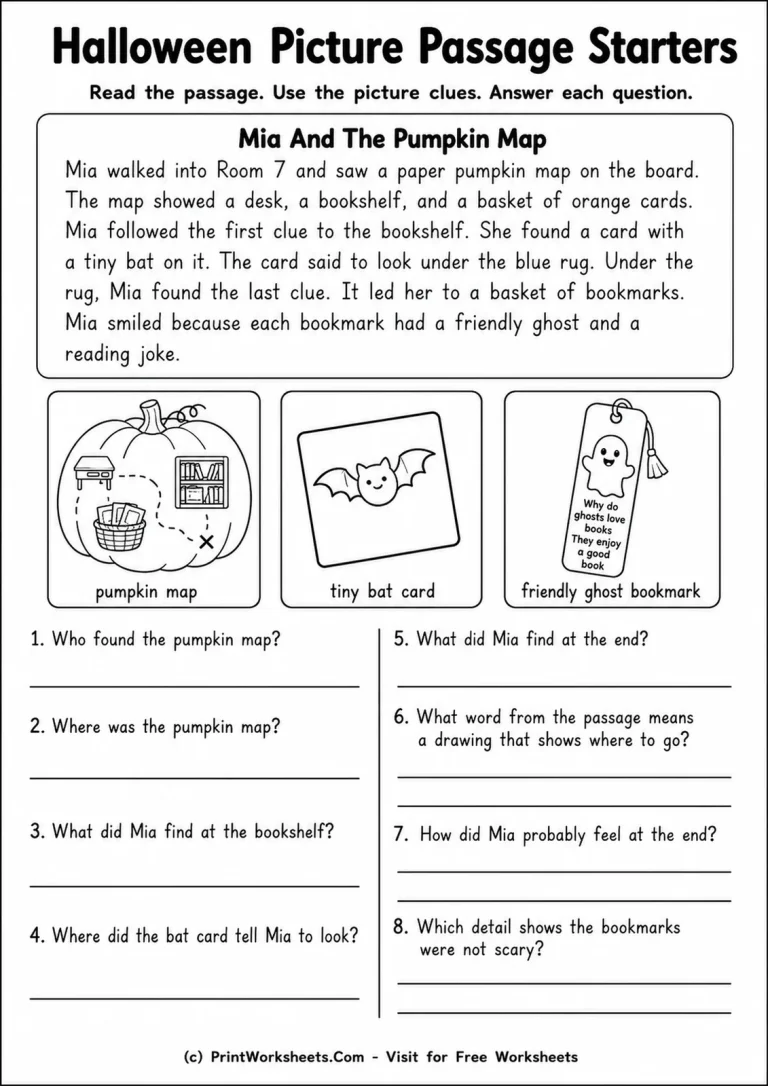
The first worksheet, Halloween Picture Passage Starters, follows Mia as she finds a paper pumpkin map in Room 7. She follows clues to a bookshelf, checks under a blue rug, and eventually reaches a basket of bookmarks decorated with friendly ghosts and reading jokes. Picture clues show the pumpkin map, a tiny bat card, and a ghost bookmark. Eight questions ask students to identify who found the map, where it was located, what Mia found at the bookshelf, where the bat card sent her, and what she discovered at the end. Students also use context to identify the meaning of map, infer how Mia probably felt, and explain which detail shows that the bookmarks were not scary.
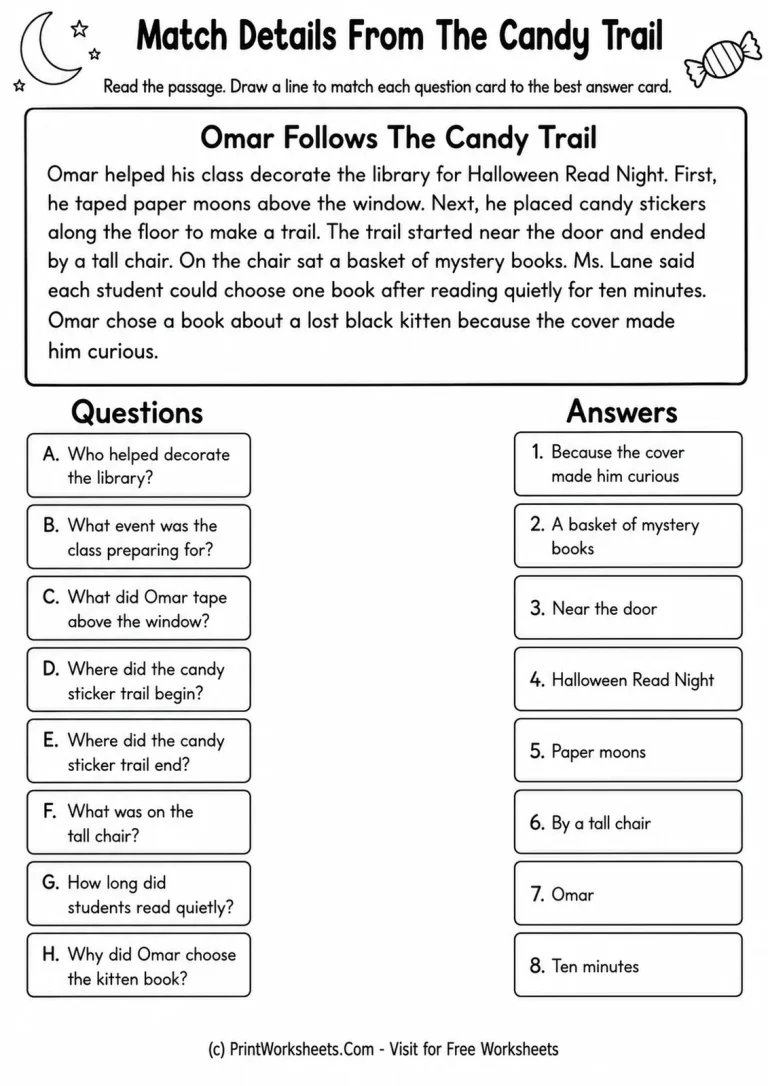
The second worksheet changes the response format with Match Details From The Candy Trail. Omar helps decorate the library for Halloween Read Night by hanging paper moons and placing candy stickers along the floor. The trail begins near the door and ends beside a tall chair holding a basket of mystery books. Students read the passage and connect eight question cards to eight answer cards. This layout gives extra practice with locating explicit details, tracking where events happen, identifying sequence information, and connecting a character’s choice to a stated reason.
From Multiple Choice to Written Evidence
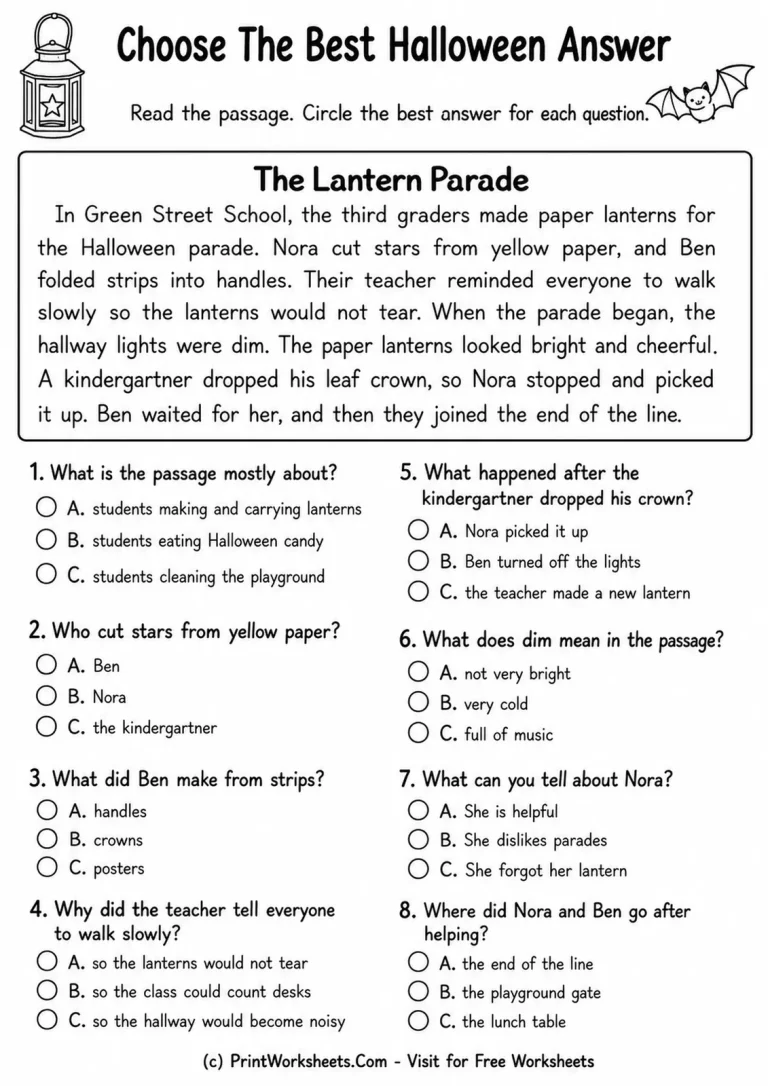
The Lantern Parade offers a more traditional multiple-choice activity. Third graders make paper lanterns for a Halloween parade, and Nora stops during the event to pick up a kindergartner’s dropped leaf crown. The questions cover main idea, character details, cause and effect, event order, vocabulary in context, and inference. For example, students determine that dim means “not very bright” in the passage and infer from Nora’s actions that she is helpful. The clear three-choice format works well for independent practice, small-group review, or a quick comprehension check.
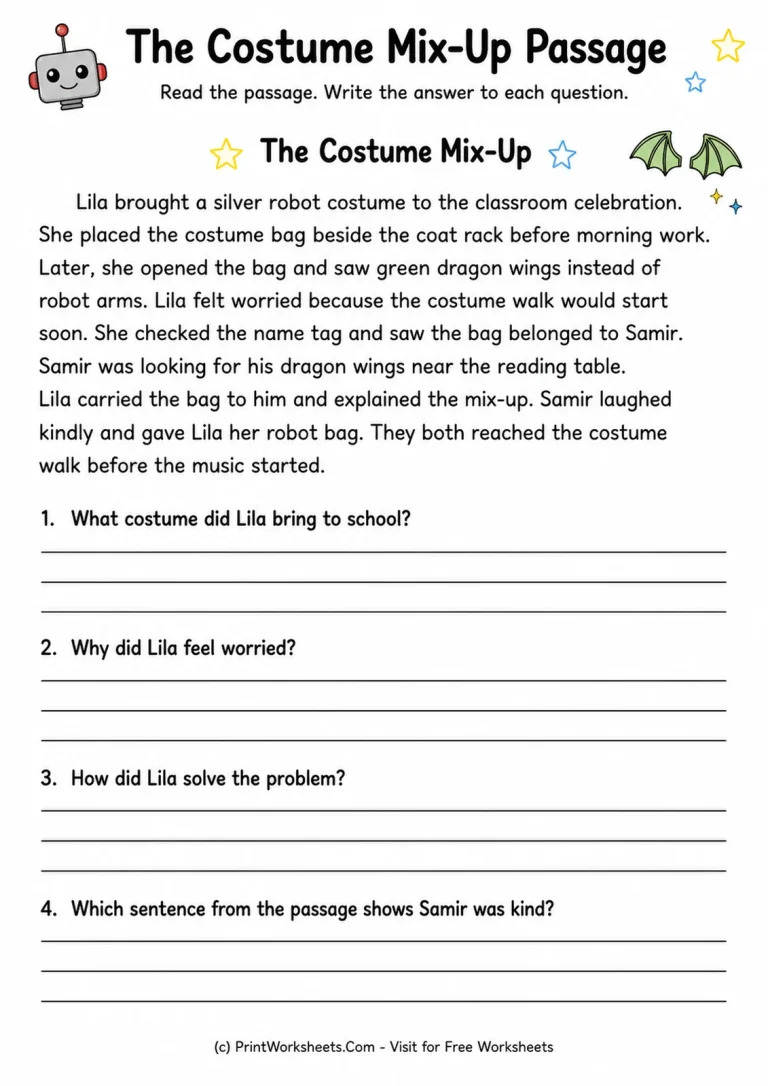
The fourth worksheet, The Costume Mix-Up Passage, asks students to write complete responses. Lila brings a silver robot costume to school but discovers green dragon wings in the bag. After checking the name tag, she realizes the bag belongs to Samir, returns it, and gets her robot bag back before the costume walk begins. Four written questions ask students to identify Lila’s costume, explain why she felt worried, describe how she solved the problem, and cite the sentence that shows Samir was kind. This activity moves beyond simple recall by asking children to explain a problem-and-solution sequence and select direct textual evidence.
Ways to Use These Halloween Reading Passages
Because the four pages use different response styles, teachers can assign them across several days rather than repeating the same question format. A student who is ready for direct-detail practice can begin with the picture-supported Mia passage. The matching page provides a structured bridge to independent comprehension, while the lantern passage checks several skills efficiently through multiple choice. The costume passage is a useful final step because students must organize written answers and support a character-trait conclusion with evidence from the text.
The set can also be used in literacy centers, morning work, homework, early-finisher folders, or seasonal reading rotations. Partners can read the passages aloud before completing the questions independently, or a teacher can model how to underline clues that support an answer. The Halloween theme gives the pages a seasonal connection while the actual reading work stays centered on core comprehension skills: recalling details, recognizing sequence, understanding vocabulary, finding causes and effects, making reasonable inferences, and supporting answers with text evidence.
More Seasonal Reading Practice
For another Grade 2-3 seasonal set with short passages, try Labor Day reading comprehension passages for Grades 2-3. Older elementary readers can continue with Patriot Day reading comprehension passages. For an earlier-school-year option aimed at younger readers, see Back to School reading comprehension passages for Grades 1-2.
A Flexible Seasonal Reading Set for Grades 2-3
These Halloween worksheets give students variety without changing the core goal: read carefully and prove understanding. The progression from visual clues and matching to multiple-choice questions and written evidence makes the set useful for mixed skill levels within a Grade 2 or Grade 3 classroom. Use one page for a focused lesson or combine several pages for a broader seasonal reading-comprehension packet.