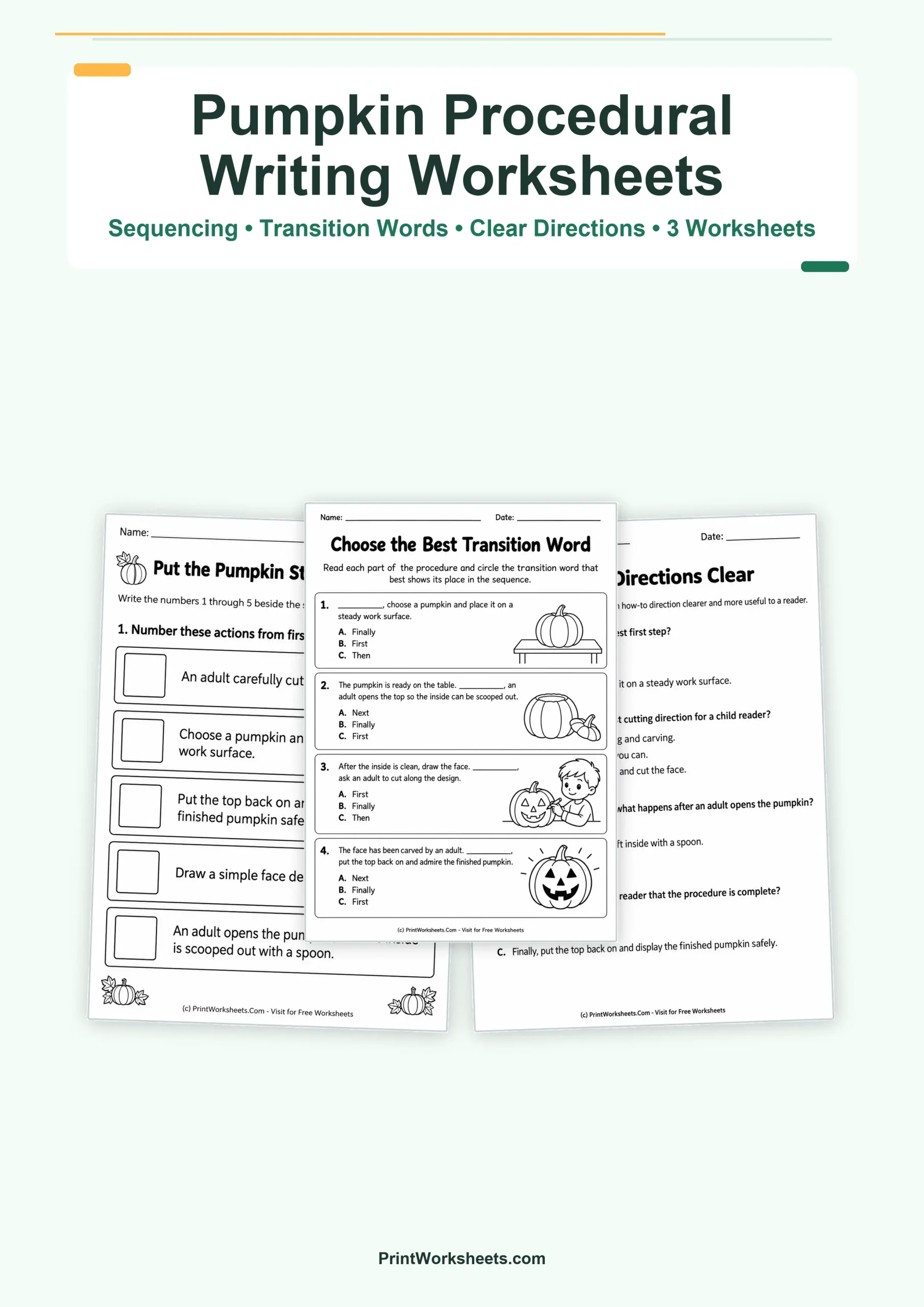
These pumpkin procedural writing worksheets turn a familiar Halloween activity into focused practice with sequencing, transition words, clear directions, and safety. Across three printable student pages, children work with the steps for preparing and carving a pumpkin without being asked to handle cutting tools themselves. The activities move from putting actions in order, to choosing words such as First, Next, Then, and Finally, to deciding which directions are specific, useful, and safe for a reader.
Pumpkin Procedural Writing Worksheets for Sequencing Practice
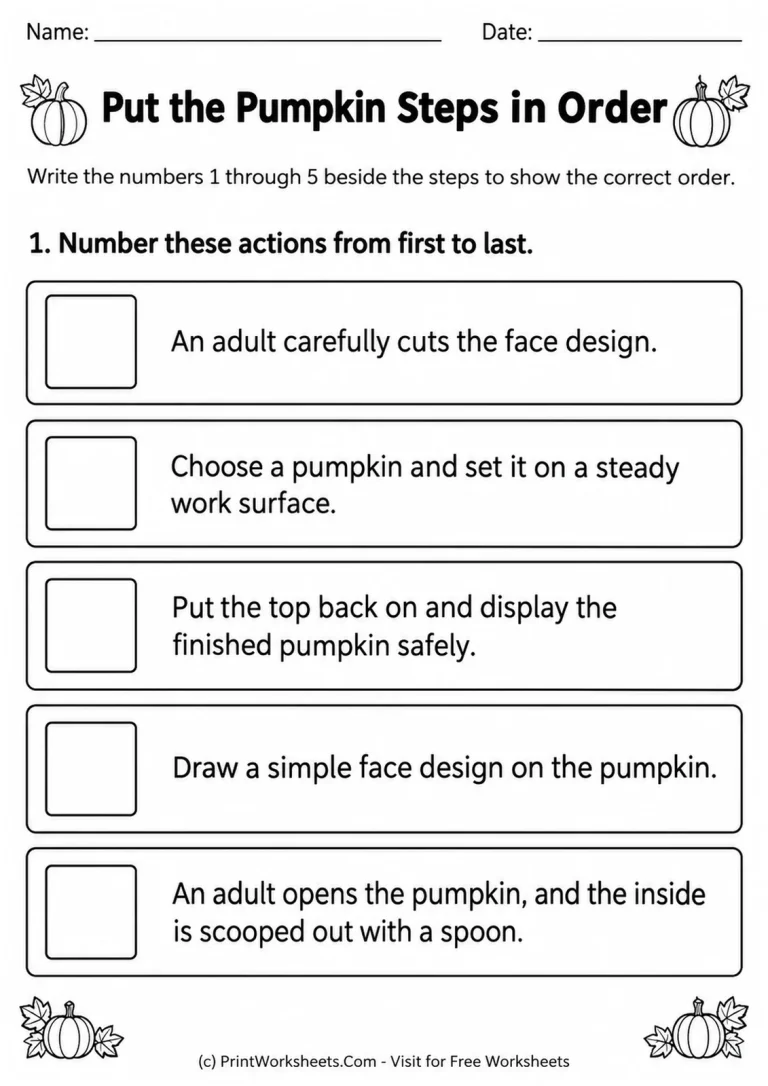
The first worksheet asks students to place five pumpkin-carving actions in the correct order. The steps are intentionally mixed, so students must think about what logically happens first, what comes in the middle, and how the procedure ends. They begin with choosing a pumpkin and placing it on a steady work surface. An adult then opens the pumpkin so the inside can be scooped out with a spoon. After the pumpkin is cleaned, the face design is drawn, an adult cuts the design, and the top is replaced for safe display.
This activity gives students more than simple number-order practice. It helps them recognize that procedural writing depends on cause-and-effect relationships and a clear sequence. A reader cannot follow directions successfully when important steps are missing, reversed, or placed too early. Because all five actions belong to one familiar task, students can focus on understanding sequence rather than decoding an unfamiliar topic.
Practice Transition Words in a Real Procedure
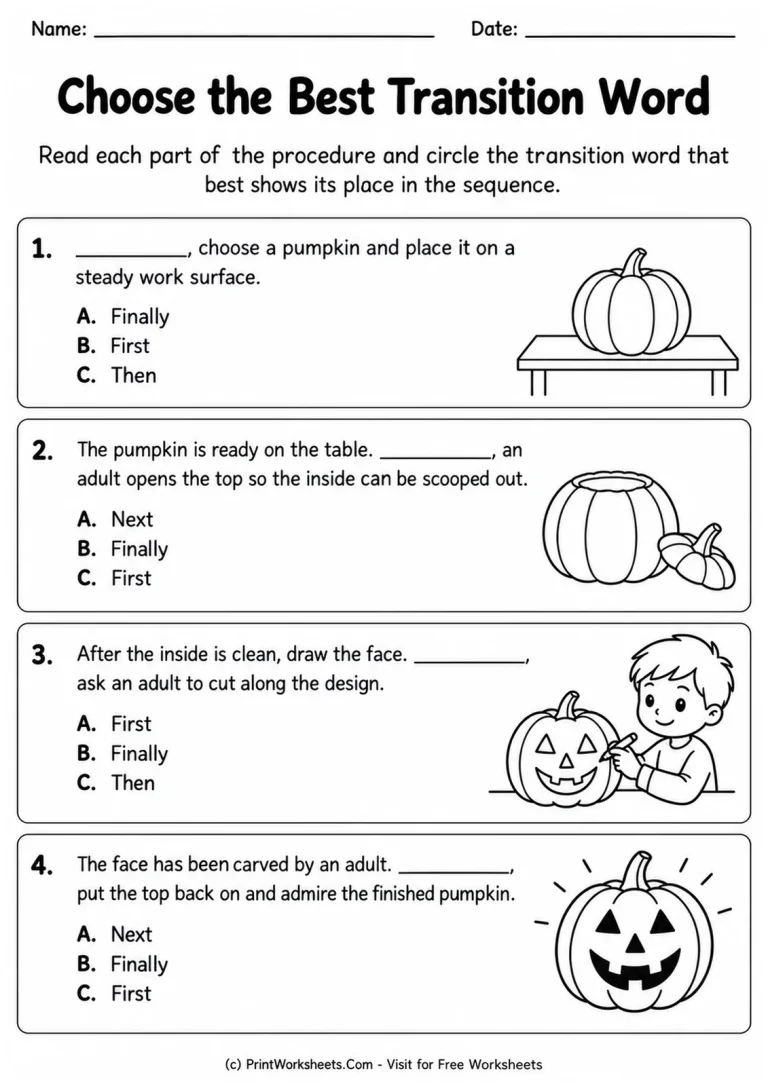
The second printable page builds on the sequence by asking students to choose the transition word that best fits each point in the procedure. Instead of studying transition words in isolation, students see how words such as First, Next, Then, and Finally signal where an action belongs.
For example, placing the pumpkin on a steady surface is clearly the beginning of the process, while putting the top back on and admiring the finished pumpkin belongs at the end. The middle items help students distinguish between transitions that introduce the next action and those that mark completion. This makes the language practice concrete and gives children a useful model for their own how-to writing.
Clear Directions and Safe Choices
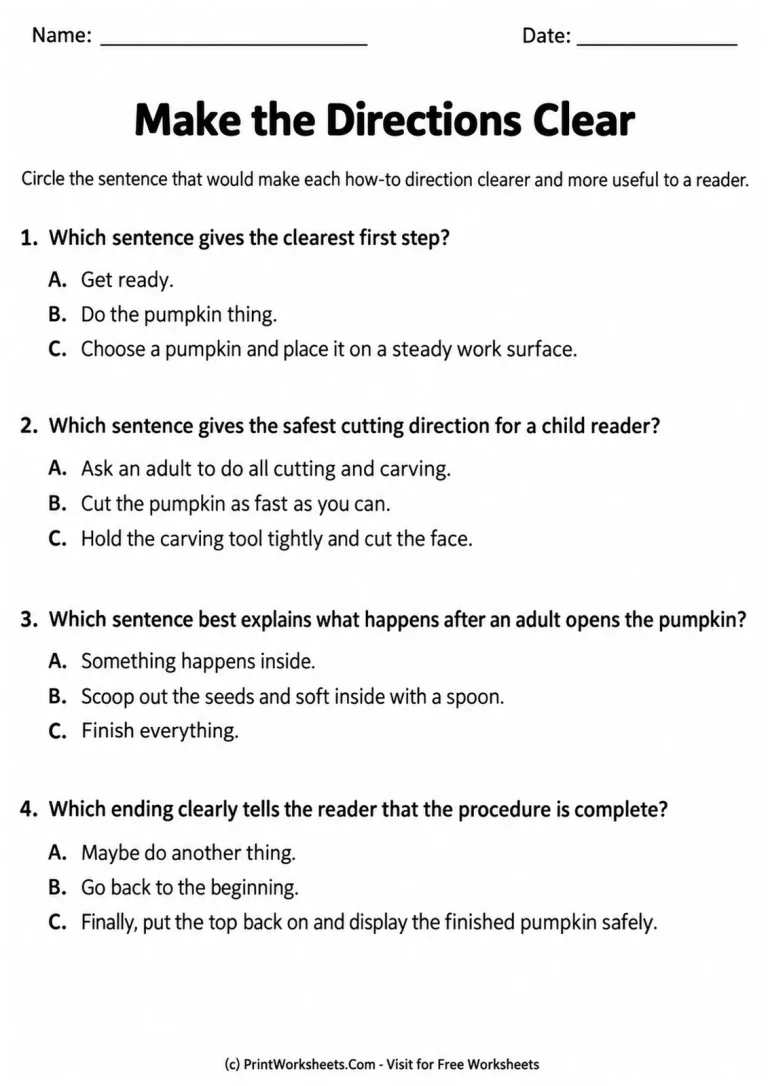
The third worksheet shifts from order to quality. Students compare possible directions and circle the sentence that would make a how-to procedure clearer and more useful. They identify a specific first step instead of vague wording such as simply getting ready. They also choose the safest cutting direction for a child reader: asking an adult to do all cutting and carving.
Other questions focus on explaining what happens after the pumpkin is opened and on selecting an ending that clearly signals the procedure is complete. Students must notice the difference between vague language and precise directions such as scooping out the seeds and soft inside with a spoon. This encourages them to think like both a writer and a reader: Does the instruction tell someone exactly what to do? Does it fit the sequence? Is it safe and practical?
Useful for Halloween ELA Lessons and Writing Centers
These pages work well for 2nd and 3rd grade language arts practice, especially during October or a Halloween-themed writing unit. Teachers can use the sequencing page as an introduction to procedural text structure, then follow with the transition-word activity and the clarity worksheet. The set can also be split across literacy centers, morning work, homework, or small-group instruction.
Parents can use the worksheets to reinforce how-to writing at home without requiring a full writing assignment. After completing the pages, a child can orally explain the pumpkin-carving process using sequence words or write a short set of directions based on the steps they practiced. Because the cutting actions are consistently assigned to an adult, the content supports discussion of both clear communication and responsible safety.
Skills Covered in This Printable Set
Students practice ordering five related actions, recognizing beginning-middle-end structure, selecting appropriate transition words, identifying precise directions, distinguishing useful instructions from vague ones, and recognizing safe language for a child audience. The shared pumpkin theme keeps the set cohesive while each page adds a different layer of procedural reading and writing practice.
Use the three worksheets together for a compact Halloween procedural-writing lesson, or choose individual pages when students need targeted practice with sequencing, transitions, or writing directions that are clear enough for another person to follow.