These bat life cycle worksheets combine simple life science with clear, kid-friendly practice for early elementary learners. Across four student pages, children sequence the stages of bat growth, connect body parts to their jobs, answer questions about how bats develop, and sort facts into life cycle or anatomy categories. The set is especially useful for 1st and 2nd grade science lessons because each page focuses on one concrete task while repeating important vocabulary such as pup, growing pup, young bat, adult bat, wing, ear, foot, and tail membrane.
Bat Life Cycle Worksheets for Early Elementary Science
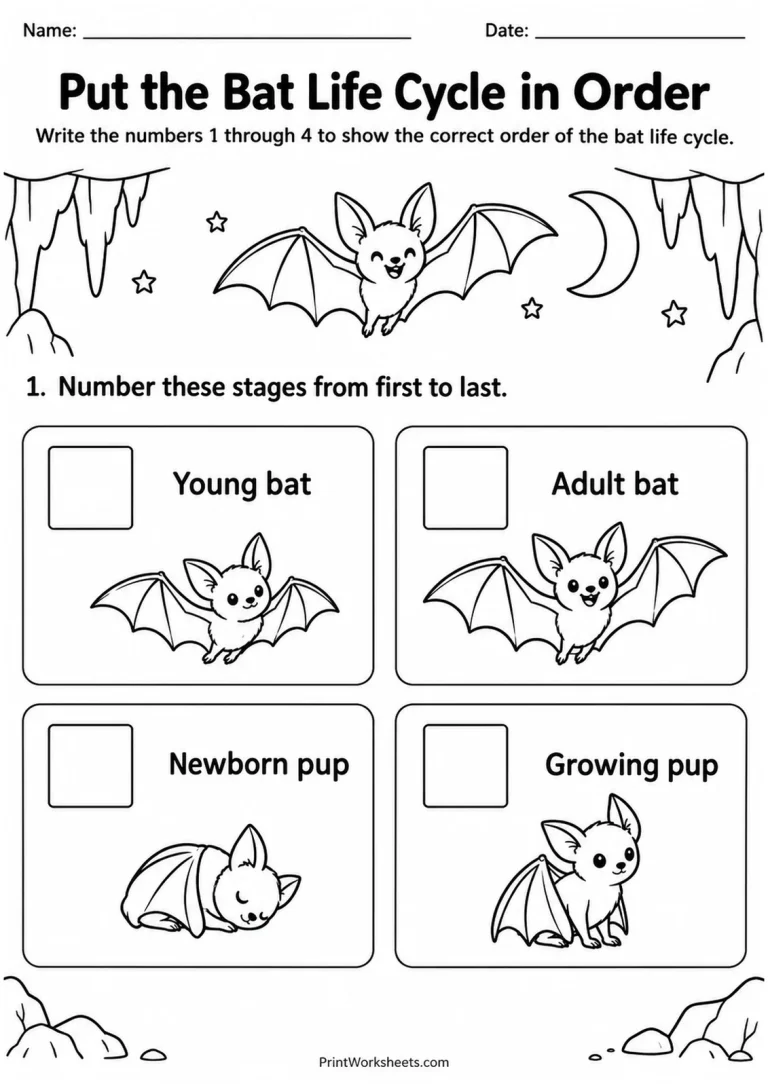
The first worksheet asks students to put four stages of the bat life cycle in order. The visible stages are Newborn pup, Growing pup, Young bat, and Adult bat. Each stage appears in its own box with a bat illustration and a place for students to write a number from 1 through 4. This gives children a straightforward way to practice chronological thinking while learning that bats are mammals that grow from pups into adults.
The sequence also supports useful classroom discussion. Teachers can ask students what changes they notice between the newborn, growing, young, and adult stages, or have children explain why one stage must come before another. Because the page uses both words and pictures, it can work well for independent practice, a science center, or a small-group lesson.
Learn Bat Anatomy Through Matching
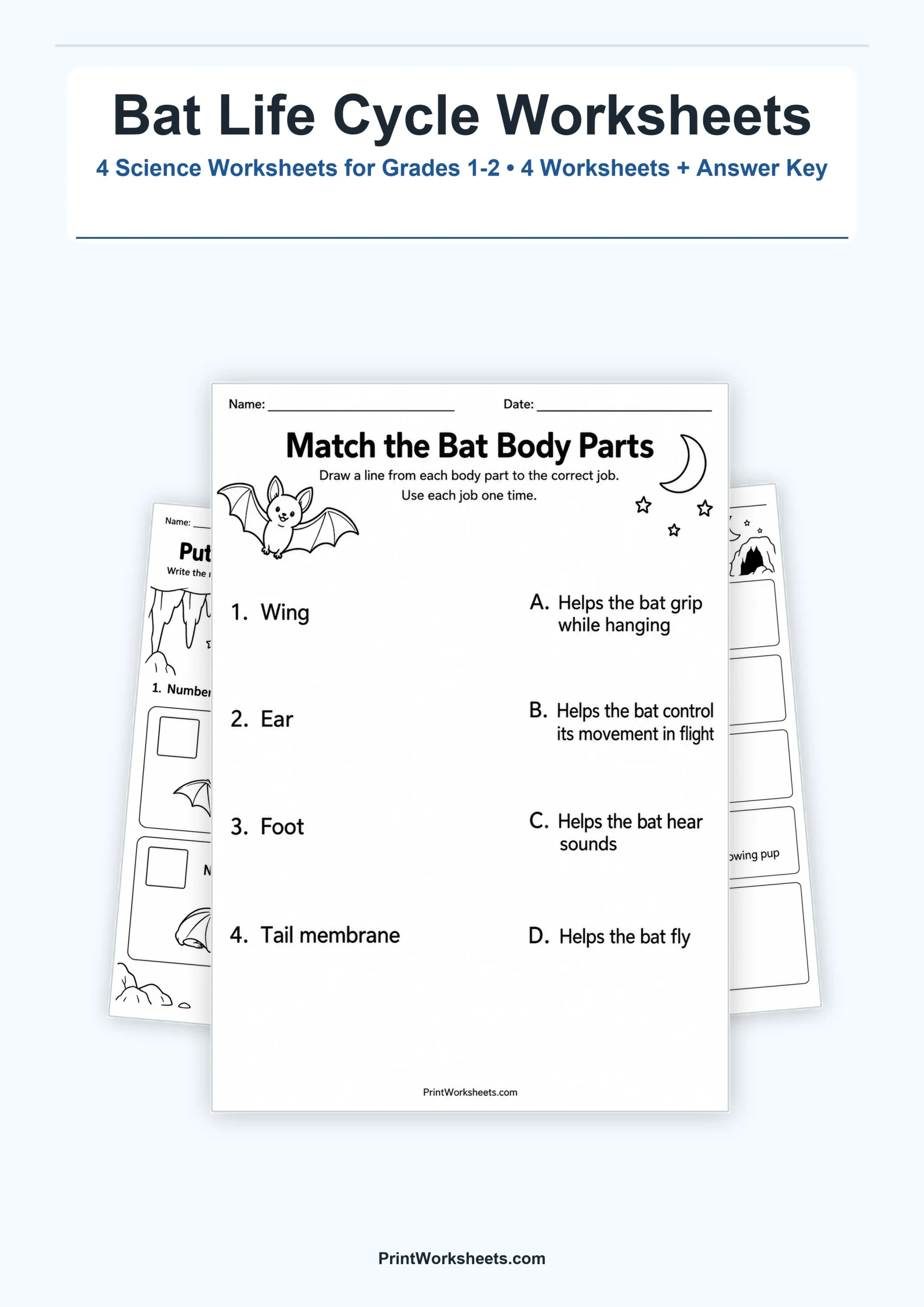
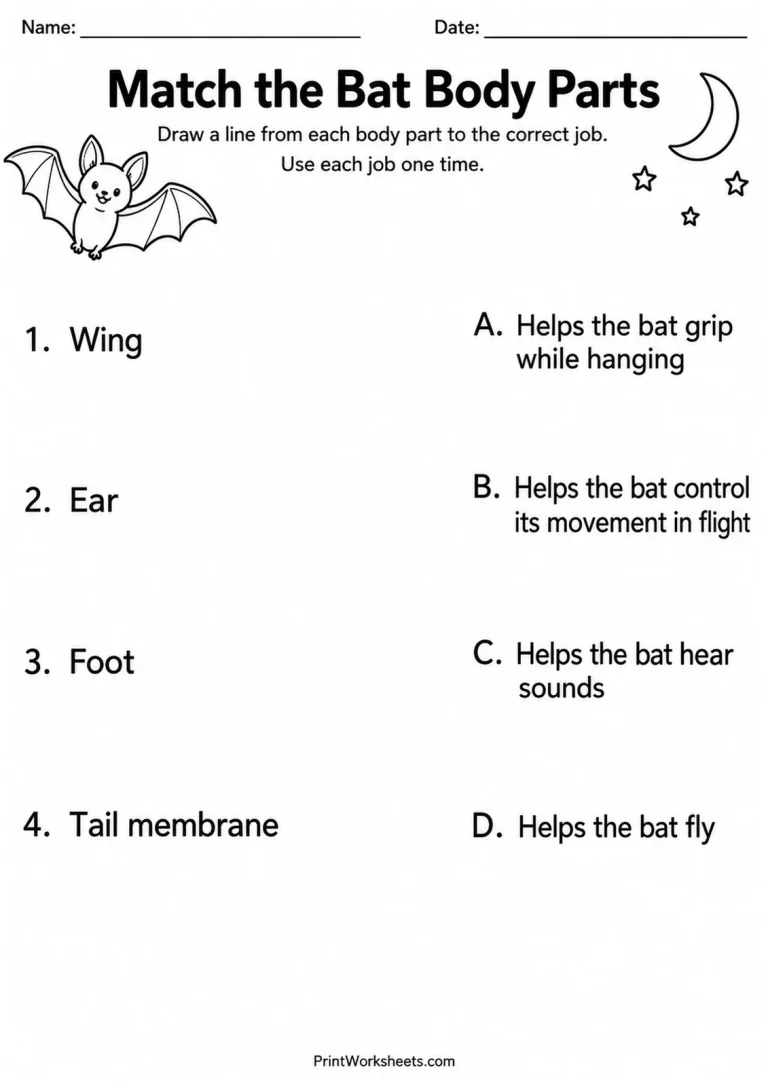
The second page shifts from growth to basic anatomy. Students match four body parts—Wing, Ear, Foot, and Tail membrane—to four jobs. The choices explain that wings help the bat fly, ears help the bat hear sounds, feet help the bat grip while hanging, and the tail membrane helps the bat control movement in flight.
This matching task gives students practice connecting a structure to its function, an important early life science skill. It also introduces vocabulary that can be revisited during animal adaptation lessons. The one-to-one matching format keeps the task manageable while still requiring students to think about what each body part does.
Check Understanding with Bat Growth Questions
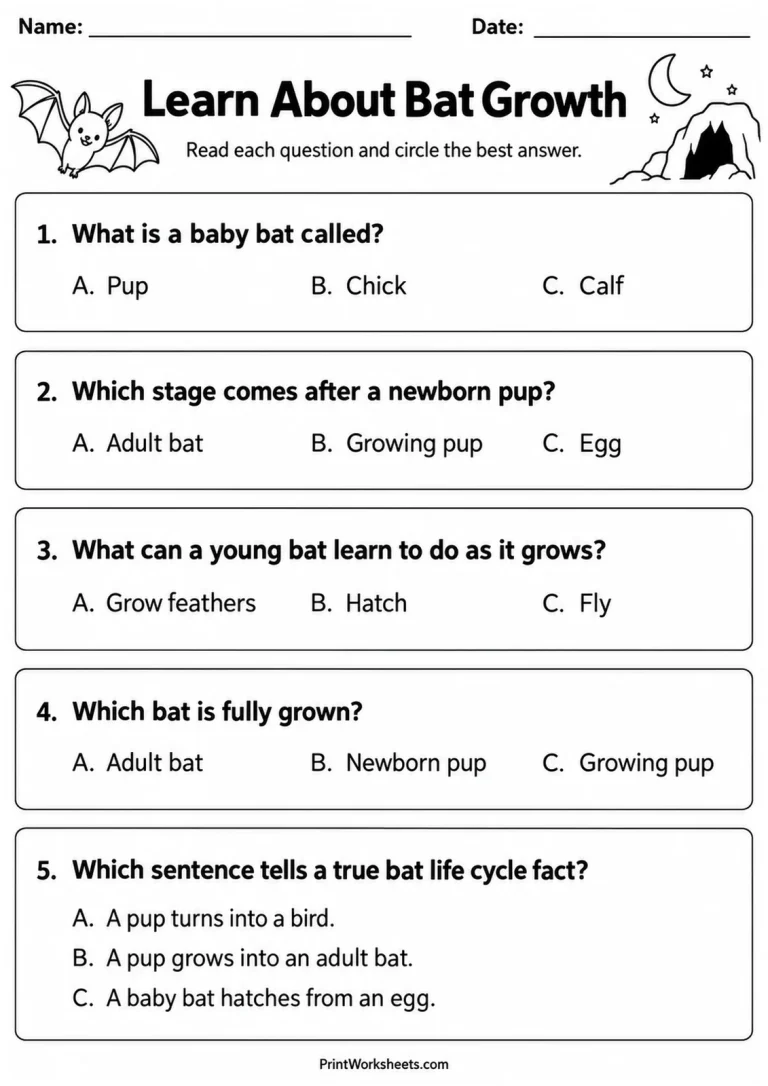
The third worksheet uses five multiple-choice questions to review key facts. Students identify that a baby bat is called a pup, choose Growing pup as the stage after a newborn pup, recognize that a young bat can learn to fly, identify the adult bat as fully grown, and select the true statement that a pup grows into an adult bat.
These questions provide a quick comprehension check after students have worked with the sequencing page. They can also be used as a short assessment because each item has one clear answer and focuses on a fact already represented elsewhere in the set.
Sort Life Cycle and Anatomy Facts
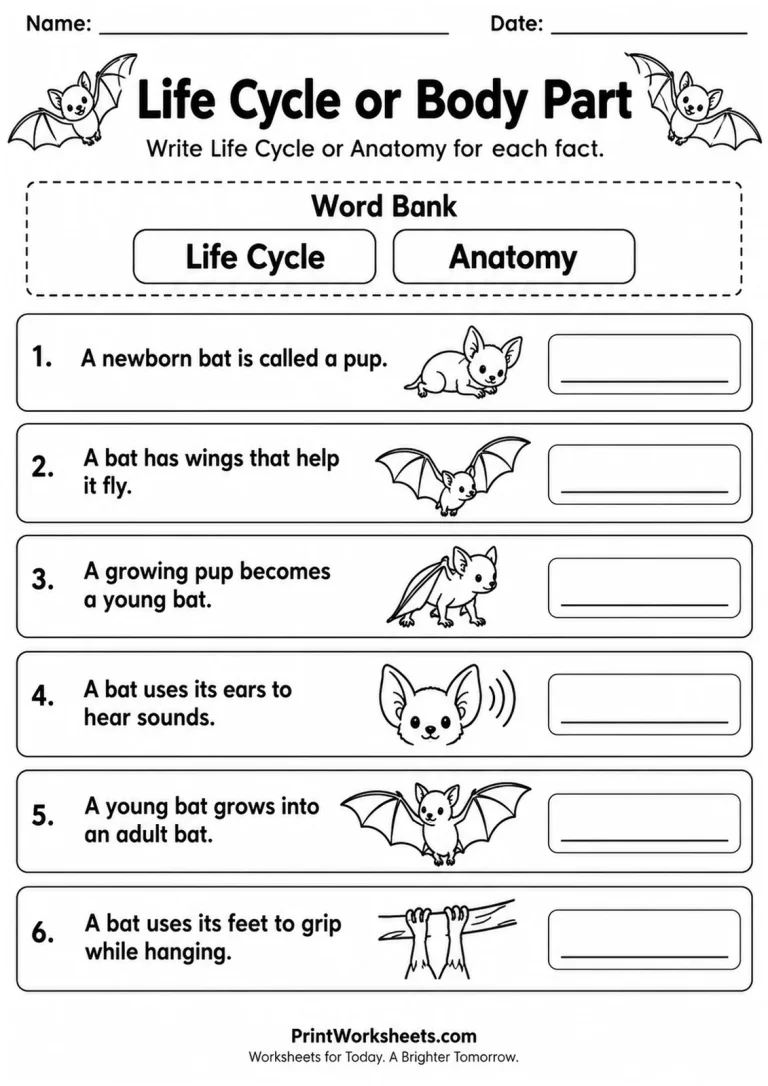
The final student worksheet combines the two main ideas in the packet. Students read six statements and label each one as Life Cycle or Anatomy. The facts include a newborn bat being called a pup, wings helping with flight, a growing pup becoming a young bat, ears helping a bat hear sounds, a young bat growing into an adult, and feet helping a bat grip while hanging.
This classification activity encourages students to distinguish between information about how an animal changes over time and information about the parts of its body. That difference can be challenging for younger learners, so the repeated vocabulary and simple two-category word bank make the skill more accessible.
Ways to Use This Bat Science Set
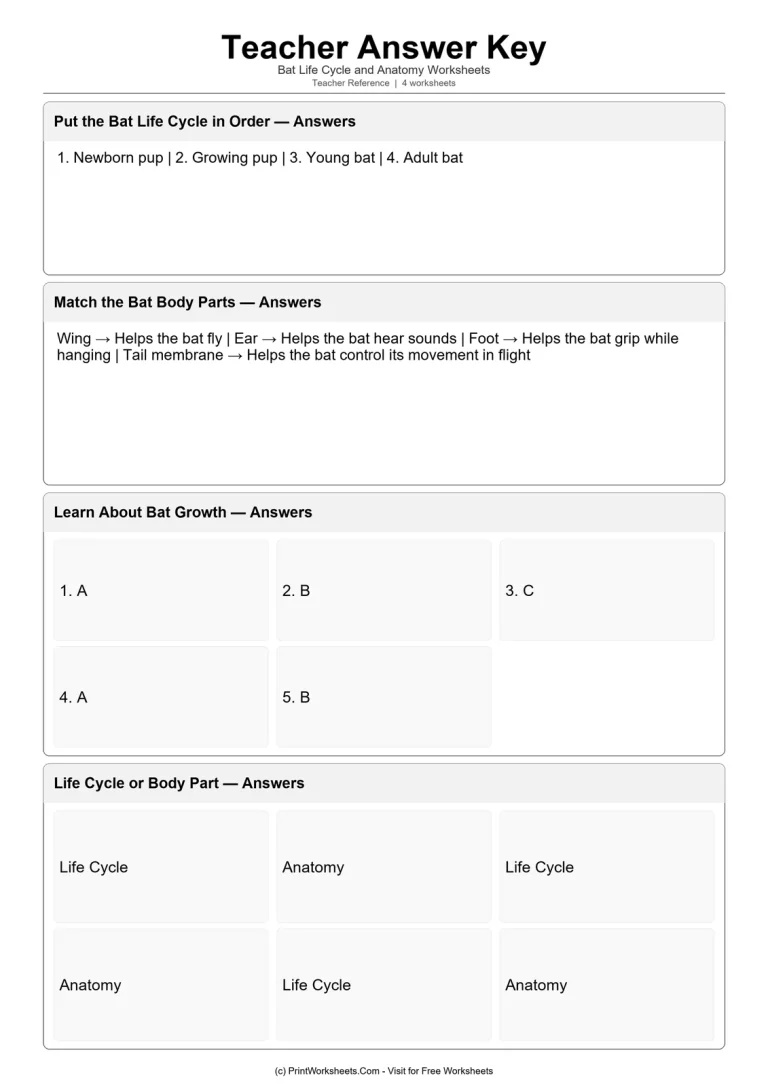
The four student worksheets can be used together as a short bat science mini-unit or separately to fit different lessons. Use the life cycle page when teaching animal growth, the matching page during an anatomy or adaptations lesson, the multiple-choice page for review, and the classification page as a final check for understanding. The included teacher answer key covers all four activities, making the set easy to check in class, at home, or in a homeschool setting.
For seasonal teaching, the bat theme can also fit naturally into an autumn or Halloween week without turning the science content into a costume or coloring activity. The learning stays centered on real bat growth and body functions. Students finish the set having practiced sequencing, matching, multiple-choice comprehension, and fact classification—all through one consistent life science topic.