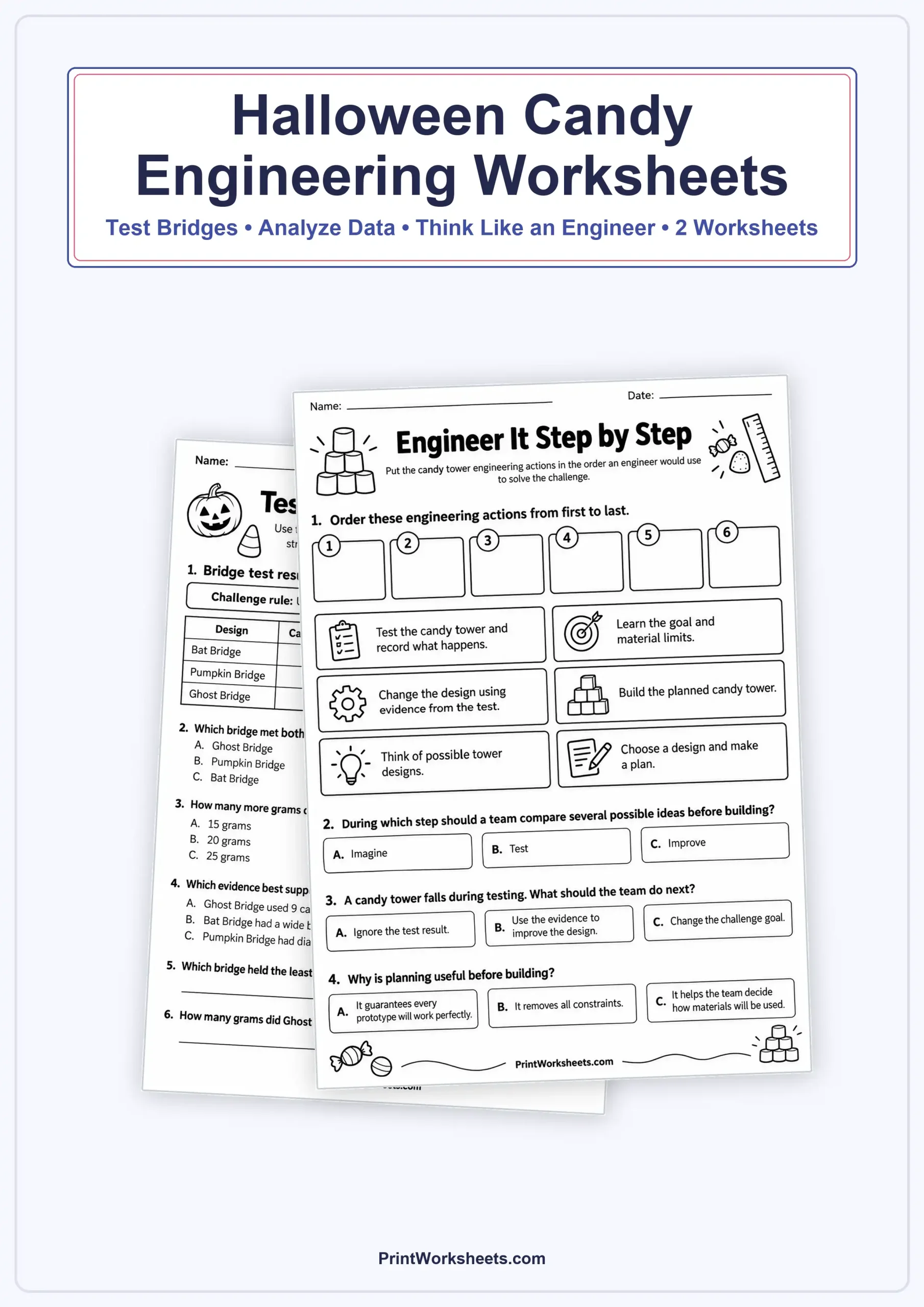
This Halloween STEM candy challenge turns seasonal candy themes into a focused engineering lesson about testing, constraints, evidence, and design improvement. Students work with visible bridge-test results, compare how much weight different designs held, identify which design met a stated challenge rule, and connect structural features to performance. A second worksheet then moves from analyzing a finished test to thinking like an engineer by putting the design process in a logical order and applying it to a candy tower challenge.
Analyze a Halloween STEM Candy Challenge with Real Test Data
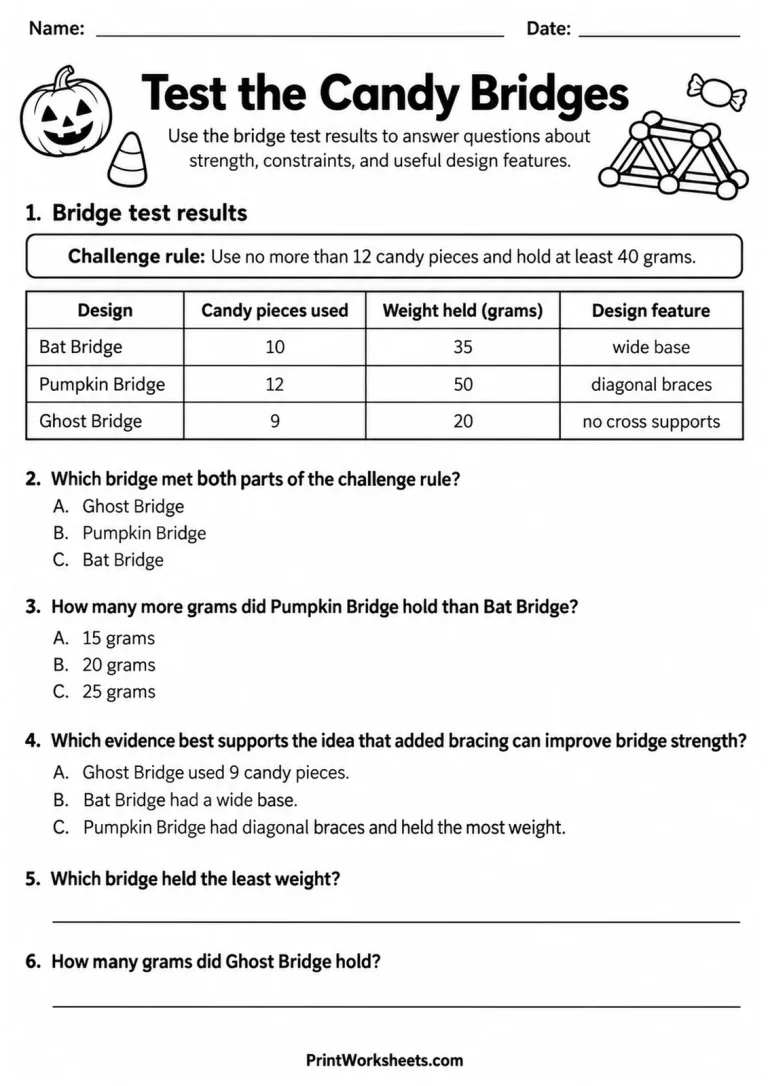
The first worksheet, Test the Candy Bridges, gives students a compact set of engineering test results to interpret. Three bridge designs are compared: Bat Bridge, Pumpkin Bridge, and Ghost Bridge. The table shows how many candy pieces each design used, how many grams it held, and one visible design feature. Students must use that information rather than guess from the Halloween theme.
The engineering constraint is clear: a successful bridge may use no more than 12 candy pieces and must hold at least 40 grams. Bat Bridge uses 10 pieces and holds 35 grams, Pumpkin Bridge uses 12 pieces and holds 50 grams, and Ghost Bridge uses 9 pieces and holds 20 grams. This gives students a practical opportunity to check two conditions at the same time instead of looking at only one number.
Questions extend beyond simple table reading. Students calculate the difference between Pumpkin Bridge and Bat Bridge, identify the bridge that held the least weight, and retrieve the exact weight held by Ghost Bridge. They also examine design evidence by connecting Pumpkin Bridge’s diagonal braces with its stronger test result. That combination of numerical comparison and structural reasoning makes the activity useful for STEM centers, science lessons, or a Halloween math-and-engineering station.
Move from Test Evidence to the Engineering Design Process
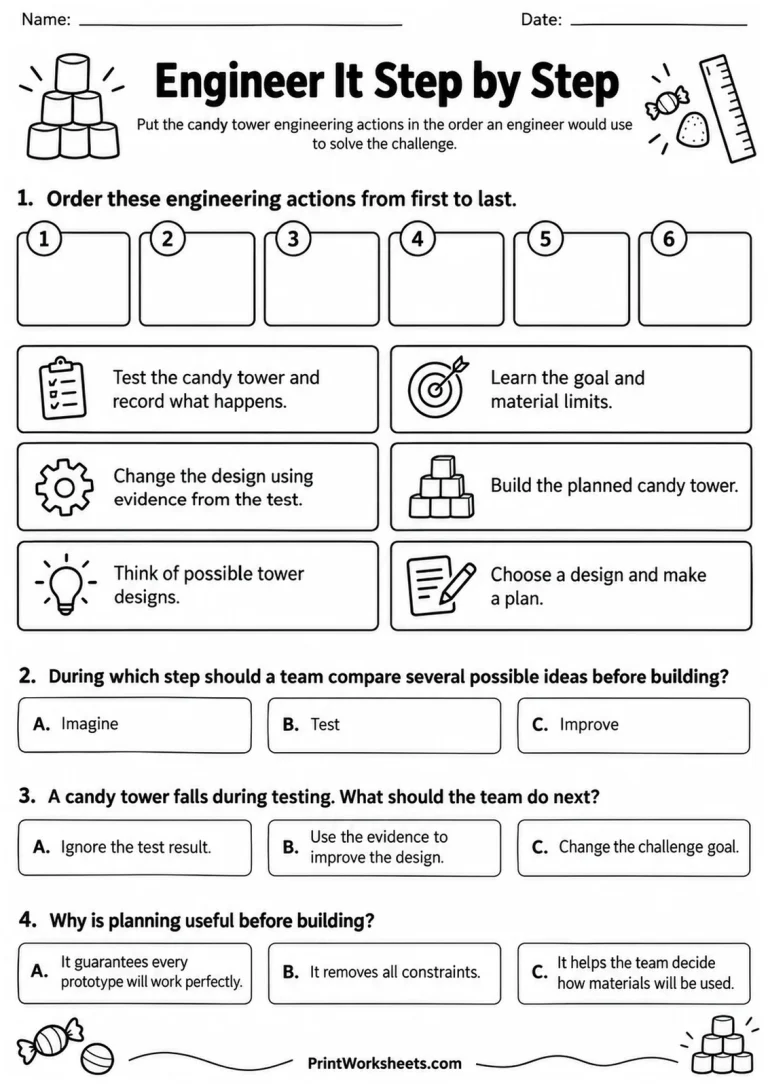
The second worksheet, Engineer It Step by Step, shifts the lesson from interpreting test results to organizing the actions an engineer would take. Students place six candy tower engineering actions in order from first to last. The sequence begins with learning the goal and material limits, then considering possible designs, choosing a design and making a plan, building the planned tower, testing and recording what happens, and finally changing the design using evidence from the test.
This progression helps students see engineering as a cycle of decisions rather than simply building something once. The follow-up questions reinforce that idea. Students identify when a team should compare several possible ideas, decide what to do after a candy tower falls during testing, and explain why planning is useful before construction begins. The correct choices emphasize imagining alternatives, using test evidence to improve a design, and deciding how materials will be used before building.
Skills Practiced Across the Two Worksheets
Together, the pages provide a short but coherent upper-elementary STEM sequence. Students read and compare data, work with grams as a measurement unit, subtract to find a difference, check a design against multiple constraints, interpret evidence, recognize a useful structural feature, and organize an engineering process. They also practice the important habit of using test results to guide the next design decision.
The Halloween setting adds interest without replacing the academic task. Pumpkins, candy, bats, ghosts, bridges, and candy towers provide the seasonal context, while the actual work remains centered on engineering reasoning. This makes the set suitable for teachers who want a festive printable that still has a clear instructional purpose.
Ways to Use These Halloween STEM Worksheets
These pages can be used independently or as a two-step lesson. One option is to begin with the bridge data sheet and ask students to justify each response with a number or design feature from the table. Afterward, use the engineering sequence page to discuss what engineers do before, during, and after testing. Students can then explain how the Pumpkin Bridge result illustrates the value of testing and evidence-based improvement.
The worksheets also work well as a STEM warm-up before a hands-on building activity. Students can first study the provided bridge and tower examples, then apply the same vocabulary of goals, limits, planning, testing, evidence, and improvement to their own classroom challenge. Because the tasks are self-contained and require only reading, reasoning, and basic computation, they are also practical for independent work, enrichment folders, early finishers, or seasonal review.
A Printable Engineering Activity with a Clear Purpose
This Halloween STEM set gives students more to do than complete a themed puzzle. They must interpret performance data, decide whether a design satisfies constraints, support an engineering idea with evidence, and understand how testing leads to revision. That makes the two-page printable especially useful for introducing or reinforcing the simple engineering cycle of plan, build, test, and improve in an engaging Halloween context.