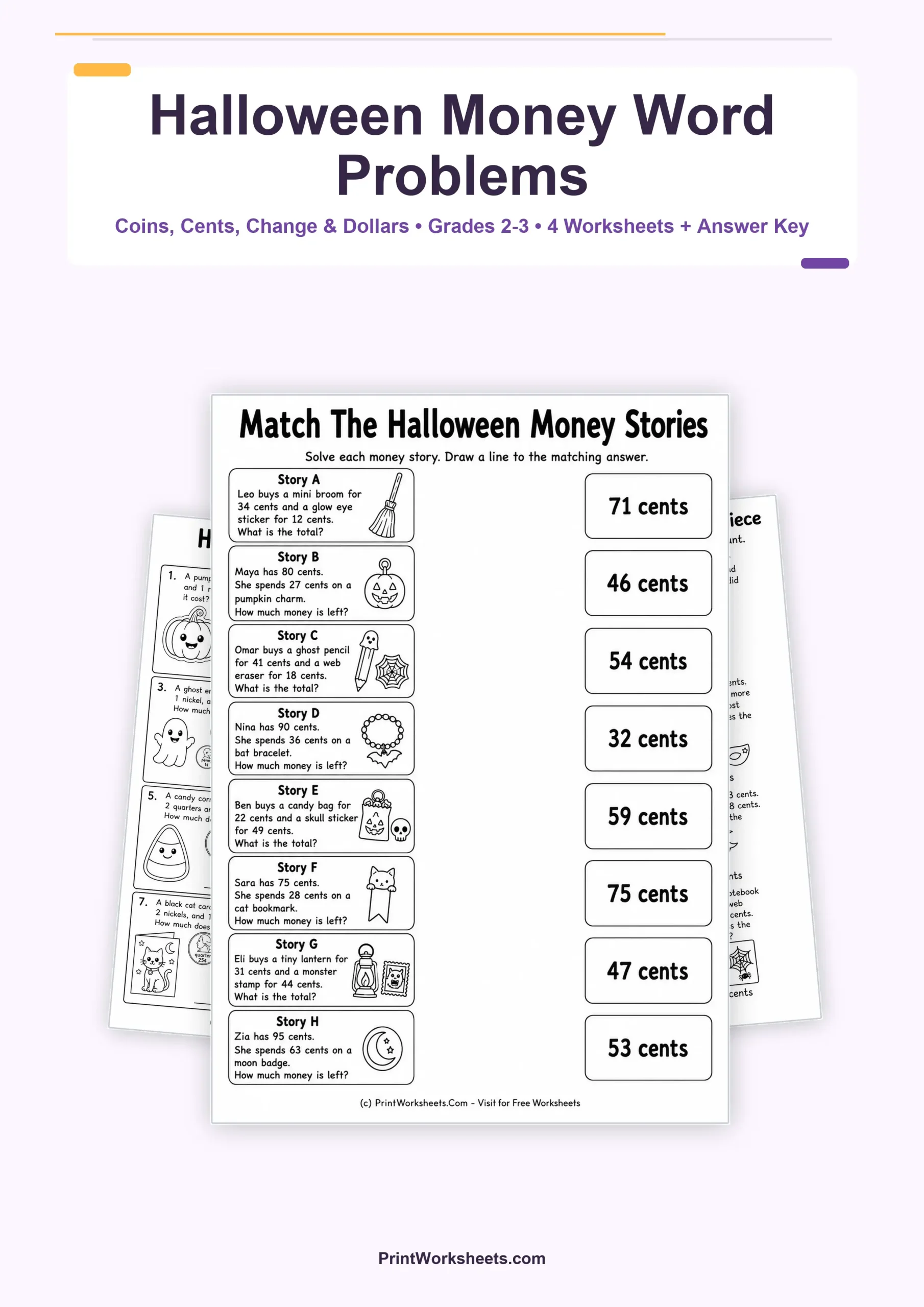
Halloween money word problems give second- and third-grade students a focused way to practice real-world addition and subtraction while working with coins, cents, and dollars. This four-page printable set moves from counting pictured U.S. coins to solving short shopping stories, finding missing money amounts, and working with dollar-and-cent totals. The Halloween setting keeps the practice playful, but every activity stays centered on practical money skills students can explain and check.
Halloween money word problems that build in difficulty
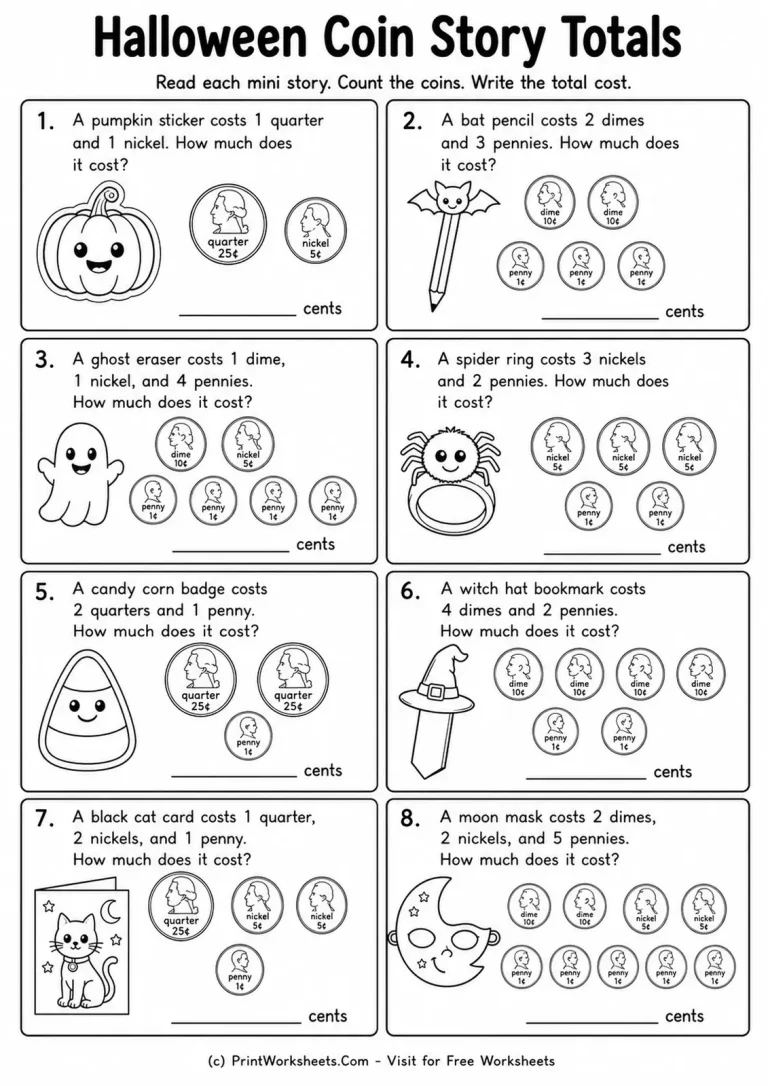
The first worksheet, Halloween Coin Story Totals, begins with concrete coin counting. Students read eight mini stories and determine the cost of items such as a pumpkin sticker, bat pencil, ghost eraser, spider ring, candy corn badge, witch hat bookmark, black cat card, and moon mask. Each problem shows the exact coins named in the story, including quarters, dimes, nickels, and pennies. Students count the values and record each answer in cents. This makes the page especially useful for learners who benefit from seeing both the written money situation and the coins they must combine.
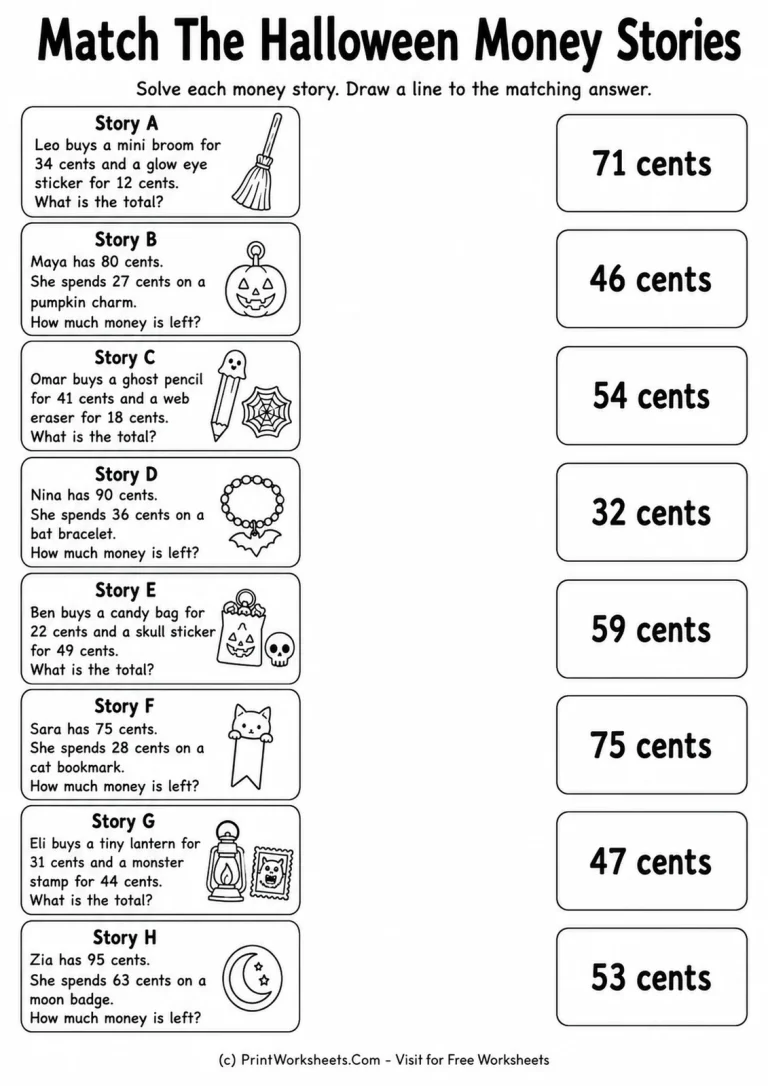
The second worksheet changes the response format with Match The Halloween Money Stories. Instead of simply writing a total, students solve eight stories labeled A through H and draw a line to the matching answer. Some situations ask for a total purchase amount, while others ask how much money remains after spending. The answer choices are shuffled, so students need to calculate rather than rely on position. Stories involving a mini broom, pumpkin charm, ghost pencil, bat bracelet, candy bag, cat bookmark, lantern, and moon badge provide repeated practice with addition and subtraction within 100 cents.
From missing amounts to dollars and cents
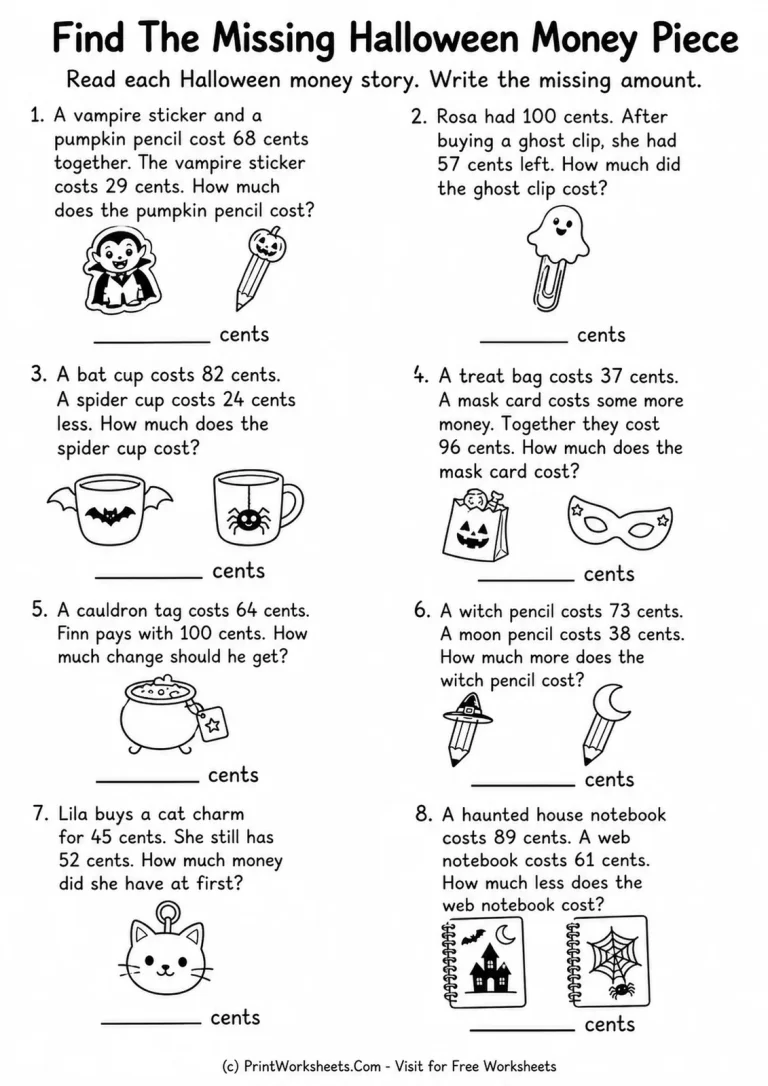
The third page, Find The Missing Halloween Money Piece, asks students to reason backward. The eight problems include finding an unknown item price from a combined cost, finding the amount spent when a starting and remaining balance are known, comparing two prices, calculating change from 100 cents, and determining an original amount. These are useful extensions because students are not only performing an operation; they must decide which relationship in the story will reveal the missing value.
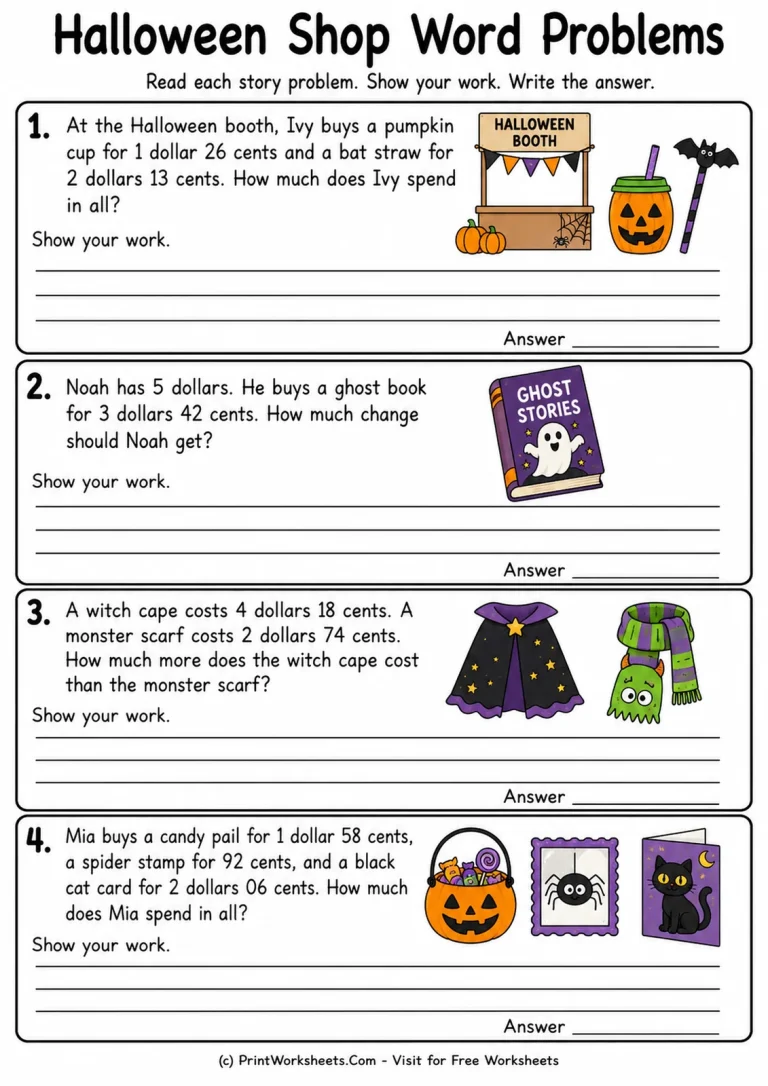
The fourth worksheet, Halloween Shop Word Problems, raises the challenge by introducing dollars and cents. Students solve four larger shopping problems and have space to show their work. The page includes adding two prices, finding change from five dollars, finding how much more one item costs than another, and adding three purchases. Amounts such as 1 dollar 26 cents, 3 dollars 42 cents, and 4 dollars 18 cents help students connect whole-dollar notation with cent values while keeping the arithmetic appropriate for Grades 2-3.
Skills covered across the printable set
Across the four student pages, children practice recognizing U.S. coin values, combining quarters, dimes, nickels, and pennies, adding and subtracting cent amounts, solving one-step money stories, identifying missing values, comparing prices, finding change, and working with mixed dollars and cents. Because the activity format changes from page to page, the set can be used as a short progression rather than four repetitions of the same worksheet.
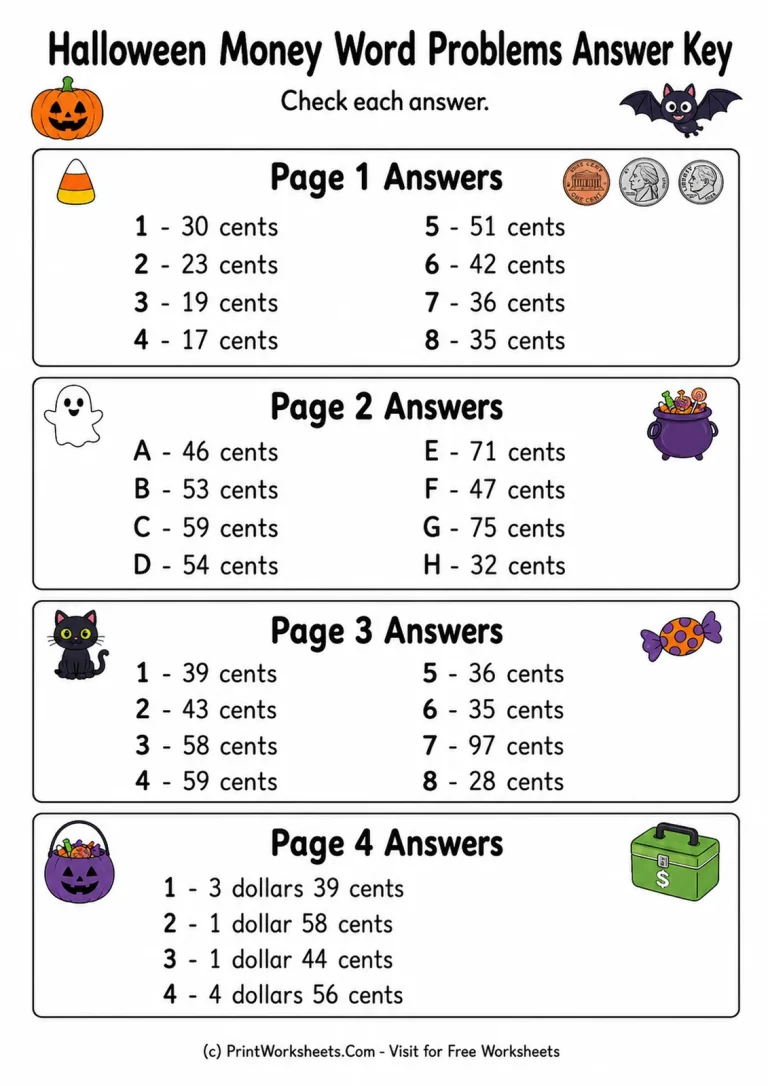
Teachers can begin with the coin-counting page for guided practice, use the matching page for independent work, and assign the missing-amount page when students are ready for more flexible reasoning. The dollar-and-cent page works well as the final challenge or as a small-group lesson where students explain how they chose an operation. A complete answer key is included for all four worksheets, making quick checking straightforward for classroom, tutoring, or home practice.
More Halloween math practice
Students who need a broader mix of seasonal arithmetic can continue with Halloween math word problems for Grades 2-3. That resource is a useful companion when you want Halloween-themed problem solving beyond this money-specific set. For younger learners preparing for these skills, Halloween math problems for Grade 1 provides an earlier seasonal practice option.
This set works especially well when you want students to move from visible coins to increasingly abstract money situations in one sequence. Start with a page that matches the learner’s current level, or use all four in order to build toward dollar-and-cent word problems with written work and independent reasoning.