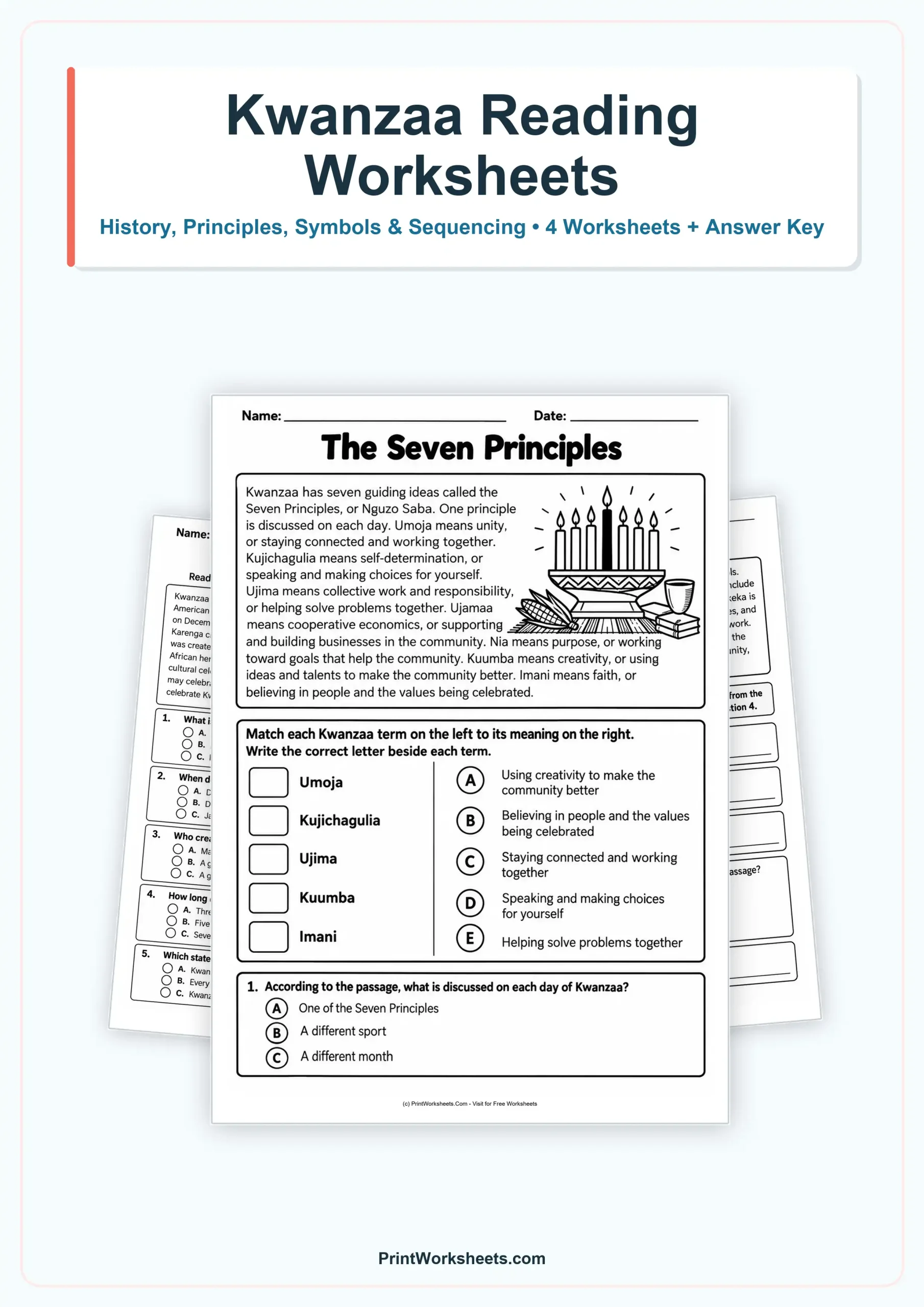


Kwanzaa brings together stories about culture, family, shared responsibility, and community. These Kwanzaa reading comprehension worksheets help students explore the celebration through four different reading activities. Children learn why Kwanzaa is observed, discover the meanings of its Seven Principles, identify important symbols, and follow the events of a family celebration. The printable set includes four student worksheets and a separate teacher answer key, making it useful for classroom reading lessons, holiday learning activities, and guided practice at home.
Inside the Kwanzaa Reading Comprehension Worksheets
Each worksheet approaches Kwanzaa from a different perspective. The activities move from identifying facts in informational passages to understanding vocabulary, writing text-based answers, and organizing events in chronological order. Students can complete the pages together as a short learning unit or work on individual reading skills.
1. What Is Kwanzaa? — Reading for Key Facts
The opening worksheet introduces Kwanzaa as a seven-day celebration of African American culture, family, and community. Students read that the celebration begins on December 26 and ends on January 1. The passage also explains that Maulana Karenga created Kwanzaa in 1966 to honor African heritage and shared values.
Five multiple-choice questions check understanding of the passage. Students identify its main idea, recall the starting date, name the founder, recognize the celebration’s duration, and select a statement supported by the text. This activity provides an accessible starting point for discussing the difference between finding a directly stated fact and understanding the overall message of a passage.
2. The Seven Principles — Vocabulary and Meaning
The second worksheet introduces the Seven Principles of Kwanzaa, also called Nguzo Saba. Its informational passage explains Umoja, Kujichagulia, Ujima, Ujamaa, Nia, Kuumba, and Imani. Students encounter ideas such as unity, self-determination, collective work, cooperative economics, purpose, creativity, and faith.
After reading, students match five selected principles to their meanings. For example, they connect Umoja with staying connected and working together, and Kuumba with using creativity to improve the community. A final multiple-choice question checks their understanding of how the principles are discussed during Kwanzaa. The matching format encourages students to read definitions carefully rather than simply memorize unfamiliar words.
3. Symbols of Kwanzaa — Finding Evidence in a Passage
This worksheet focuses on the objects and symbols associated with the celebration. Students learn about the kinara, a candleholder with seven candles; the mkeka, a mat used as the base of a display; and muhindi, ears of corn that may represent children and hopes for the future. The passage also describes the meaning of fruits, vegetables, and other crops.
Four short-answer questions ask students to locate exact words or short phrases in the reading. Another question uses multiple-choice answers to check the meaning of harvest symbols. Together, these tasks help children practice careful rereading, identifying relevant information, and recording concise responses that are supported by the text.
4. A Kwanzaa Evening — Putting Events in Order
The final student worksheet changes from informational reading to a short narrative. On December 28, Maya’s family gathers to celebrate Kwanzaa. They place a mkeka on the table, set a kinara on the mat, discuss Ujima, consider helping with a neighborhood food drive, and spend time listening to music and talking together.
Students use five labeled event cards to reconstruct the story from first to last. The passage contains sequence clues such as First, Next, Then, After that, and Last. Two additional questions ask students to identify the principle discussed and recognize which action best illustrates its meaning. The activity connects story structure with understanding how collective work and responsibility can appear in everyday life.
How to Teach These Kwanzaa Reading Activities
Begin by asking students what they already know about Kwanzaa, without assuming that every family celebrates it. Read the introductory passage together and have students underline the dates, founder, and purpose of the celebration. Before answering the multiple-choice questions, invite students to explain where they found each answer.
For the Seven Principles worksheet, introduce the unfamiliar vocabulary aloud. Students can highlight words that express an action or community value, then compare each meaning with the choices in the matching activity. Discuss how unity, creativity, and helping others might be demonstrated in a classroom or neighborhood.
Use the symbols worksheet to practice returning to a passage for precise information. Encourage students to find the sentence containing each answer before writing. Finish with Maya’s story and ask children to point out the transition words that establish the sequence. Students can explain why the food-drive example reflects Ujima rather than simply identifying the correct option.
Reading Skills and Grade-Level Use
These activities are particularly suitable for many third-, fourth-, and fifth-grade readers, depending on reading fluency and vocabulary knowledge. Third-grade students may benefit from teacher-led discussions of the Seven Principles and unfamiliar cultural terms. Fourth-grade students can work more independently on matching definitions and locating evidence. Fifth-grade students can extend the reading by explaining how the narrative connects an abstract principle with a concrete action.
Across the set, students practice identifying main ideas, recalling factual information, developing vocabulary, answering questions with textual evidence, sequencing narrative events, and drawing supported conclusions. The combination of informational passages and a short fictional story provides varied reading practice within one cultural topic.
Printable Worksheets With a Teacher Answer Key
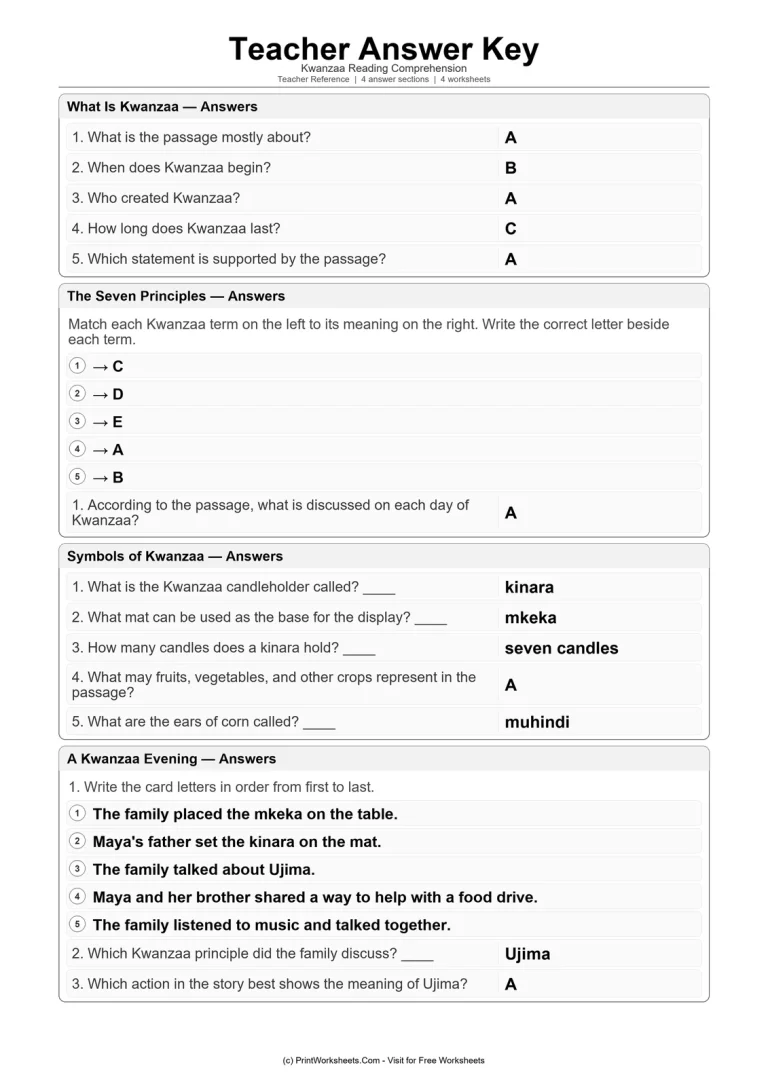
The set provides four student worksheets and one consolidated teacher answer key. The key includes the multiple-choice solutions, principle-matching answers, short-answer responses about symbols, and the correct order of events in Maya’s story. Teachers can use it for quick checking, guided correction, or discussion after students complete the activities.
For another opportunity to practice reading about cultural celebrations, explore our Diwali reading comprehension worksheets. To extend informational reading into traditions of remembrance, see our Remembrance Day reading comprehension worksheets. Each topic offers a different context for reading carefully and discussing the meaning of important traditions.