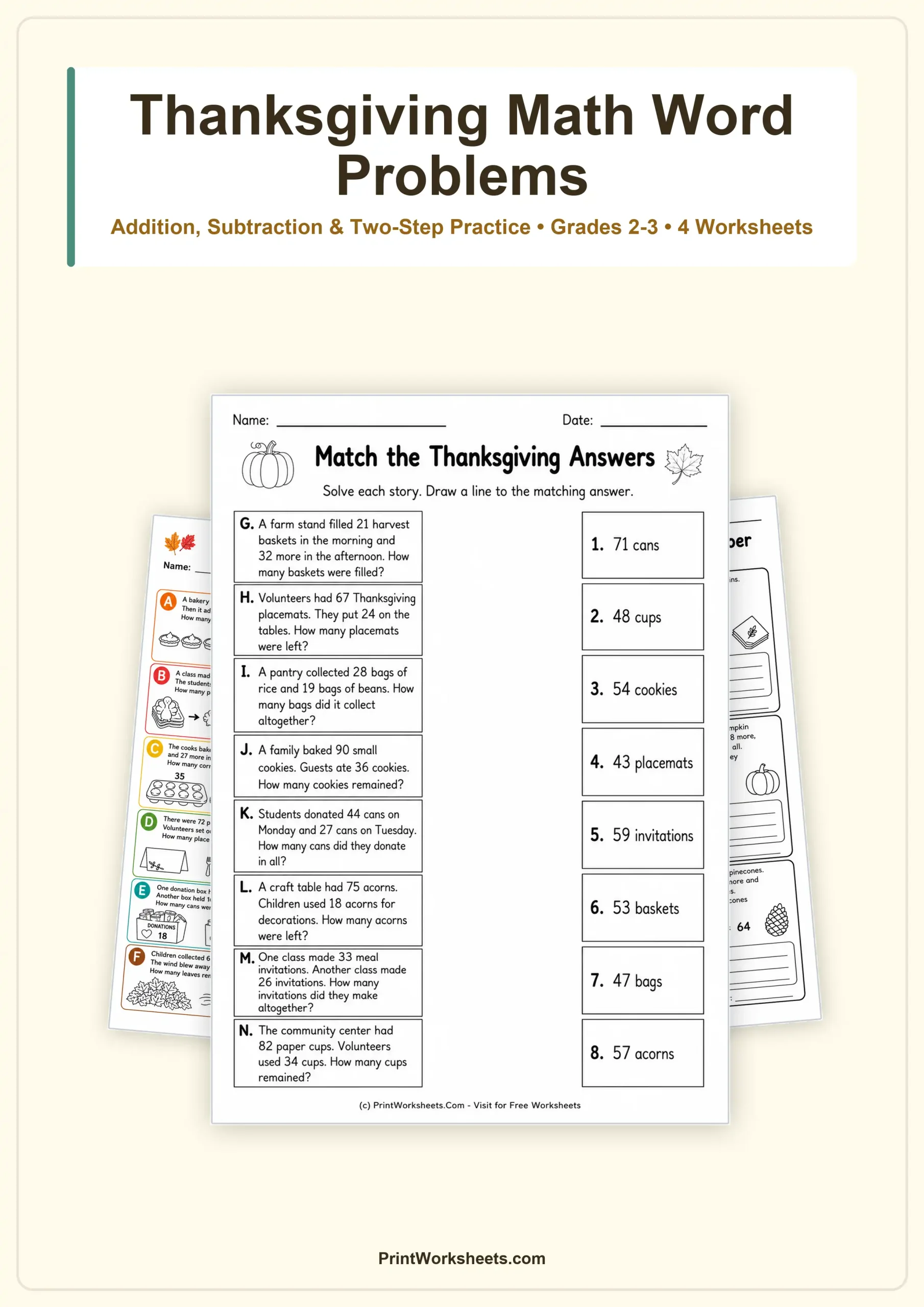
These Thanksgiving math word problems give second- and third-grade students a seasonal way to practice addition, subtraction, equation writing, missing-number reasoning, and two-step problem solving. Across four printable pages, the work moves from straightforward story situations to tasks that ask children to identify unknowns, connect problems with answers, and organize more than one operation. Thanksgiving contexts such as pumpkin pies, paper turkeys, food donations, place cards, cookies, invitations, table decorations, and meal tickets keep the arithmetic connected to familiar holiday situations without changing the mathematical focus.
A Four-Page Thanksgiving Math Word Problems Sequence
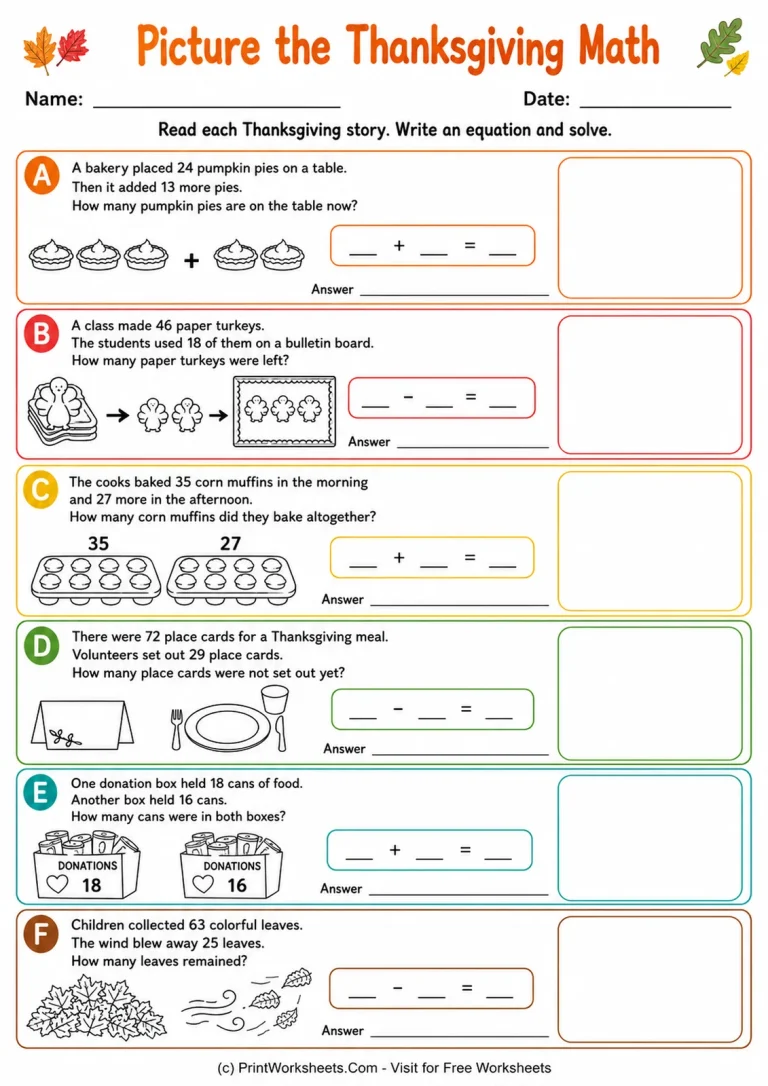
The first worksheet, Picture the Thanksgiving Math, contains six problems labeled A-F. Students read each short story, decide whether addition or subtraction is needed, write an equation, solve it, and record the answer. The numbers provide useful two-digit computation practice. One pumpkin-pie situation uses 24 plus 13, while a paper-turkey problem asks students to work with 46 minus 18. Other stories involve corn muffins, place cards, donated food, and leaves, giving students repeated practice translating words into mathematical operations instead of completing isolated number sentences.
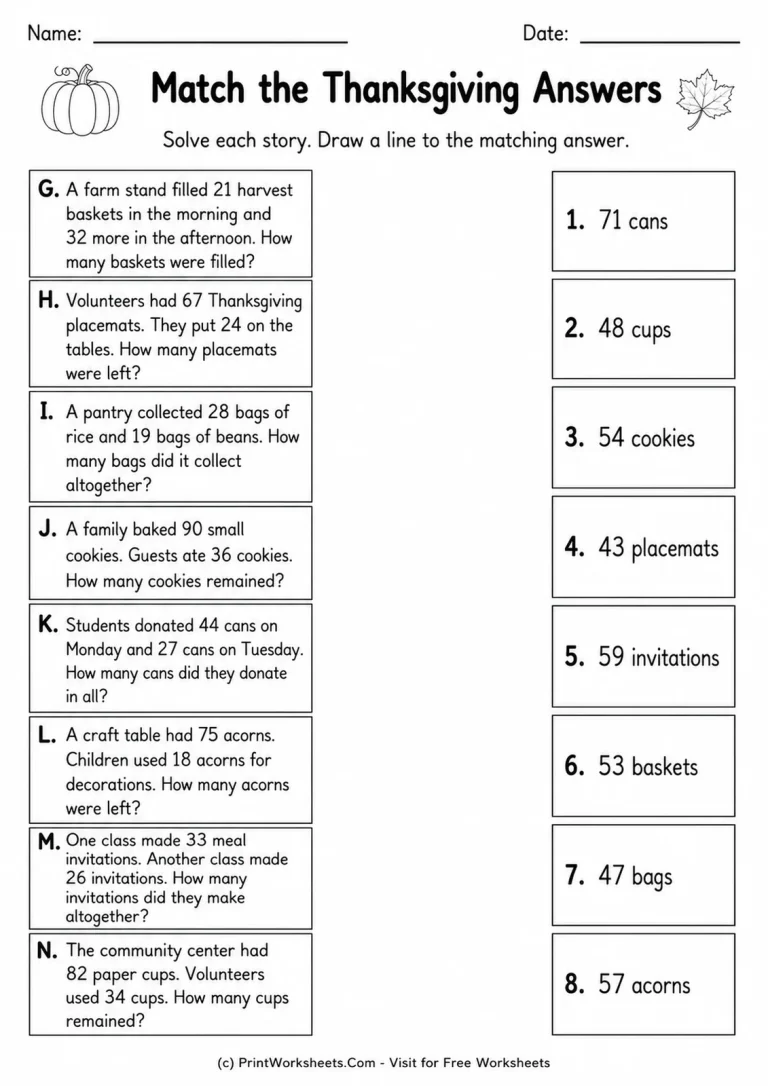
The second page changes the response format with Match the Thanksgiving Answers. Problems G-N cover eight Thanksgiving situations involving baskets, placemats, pantry bags, cookies, cans, acorns, invitations, and cups. After solving each problem, students draw a line to the correct numbered answer box. Because the eight answers match uniquely, the activity encourages careful computation and gives students an additional reason to check whether their solution makes sense before making a match.
Building From Operations to Missing Numbers and Two-Step Problems
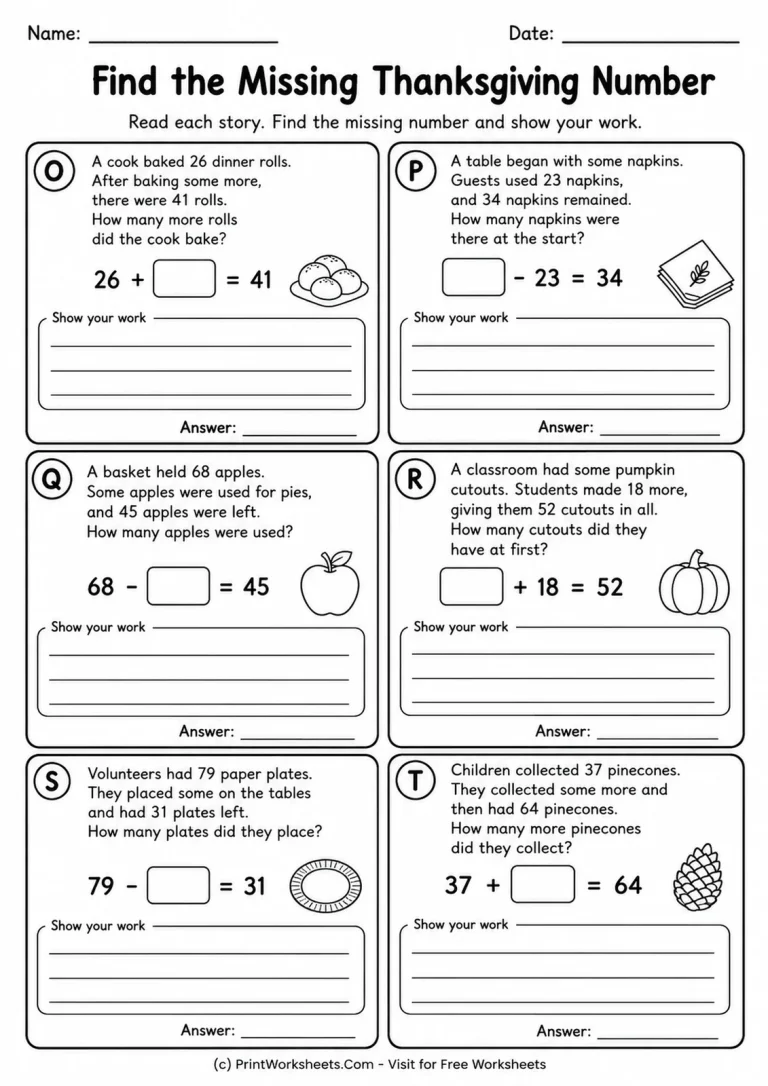
The third worksheet, Find the Missing Thanksgiving Number, shifts attention from simply finding a total or difference to reasoning about an unknown part of an equation. Problems O-T place the missing value in different positions within addition and subtraction situations. Students complete the displayed equation, show their work, and write the answer. For example, one napkin story describes an unknown starting amount, with 23 napkins used and 34 remaining. Students must work backward to determine the original quantity. This variation supports early algebraic thinking and helps children see the relationship between addition and subtraction.
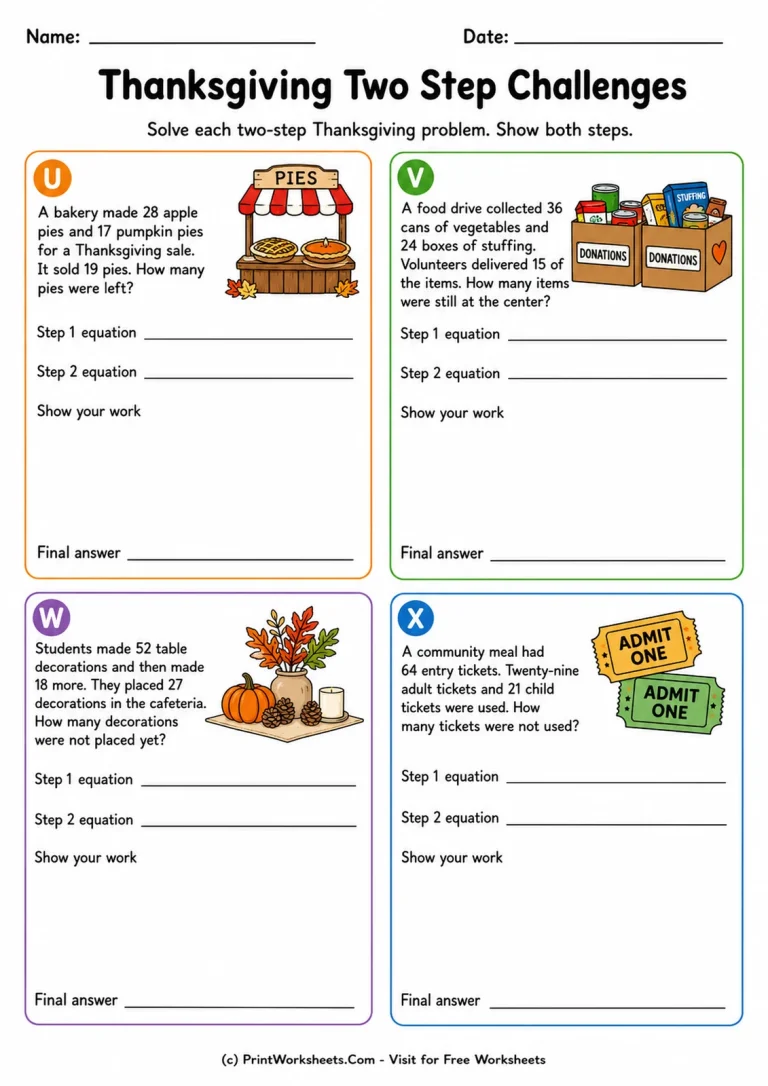
The final page, Thanksgiving Two Step Challenges, raises the level of organization without introducing an unrelated skill. Problems U-X involve pie sales, food-drive donations, table decorations, and meal tickets. Each problem requires two operations, and the worksheet provides separate spaces for a Step 1 equation and a Step 2 equation before the final answer. That structure is especially useful for students who can compute accurately but need support breaking a longer story problem into manageable pieces.
Ways to Use the Worksheets in Grades 2 and 3
Teachers can use the pages in sequence over several days or choose one activity that matches the class objective. For Grade 2, the first two pages work well for guided practice with identifying addition and subtraction in context. The missing-number page can follow once students are comfortable discussing what each number represents. Grade 3 students can begin with the earlier pages as a warm-up and then spend more time explaining the reasoning used in the missing-number and two-step challenges.
For independent work, ask students to underline important quantities and circle words that describe what is happening before they calculate. During small-group instruction, have students explain why they selected addition or subtraction and compare two different solution strategies. A useful exit ticket is to let students write their own short Thanksgiving story problem using one of the worksheet contexts, then exchange it with a partner who writes an equation and solves it.
Differentiation and Seasonal Extension
Students who need additional support can solve one story at a time with a number line, place-value drawing, or base-ten model before writing the equation. More confident students can estimate an answer first, solve exactly, and explain how the estimate helped them check reasonableness. For the two-step page, challenge students to label what the first answer represents before moving to Step 2; this reduces the tendency to combine every number in the story without considering its role.
After the math lesson, a short seasonal literacy activity can provide a change of pace while keeping the Thanksgiving theme. The Thanksgiving word search printable is a suitable follow-up for early finishers or a classroom center. Together, the activities can support a Thanksgiving-themed learning block while the math pages remain focused on computation, equation sense, and word-problem reasoning.