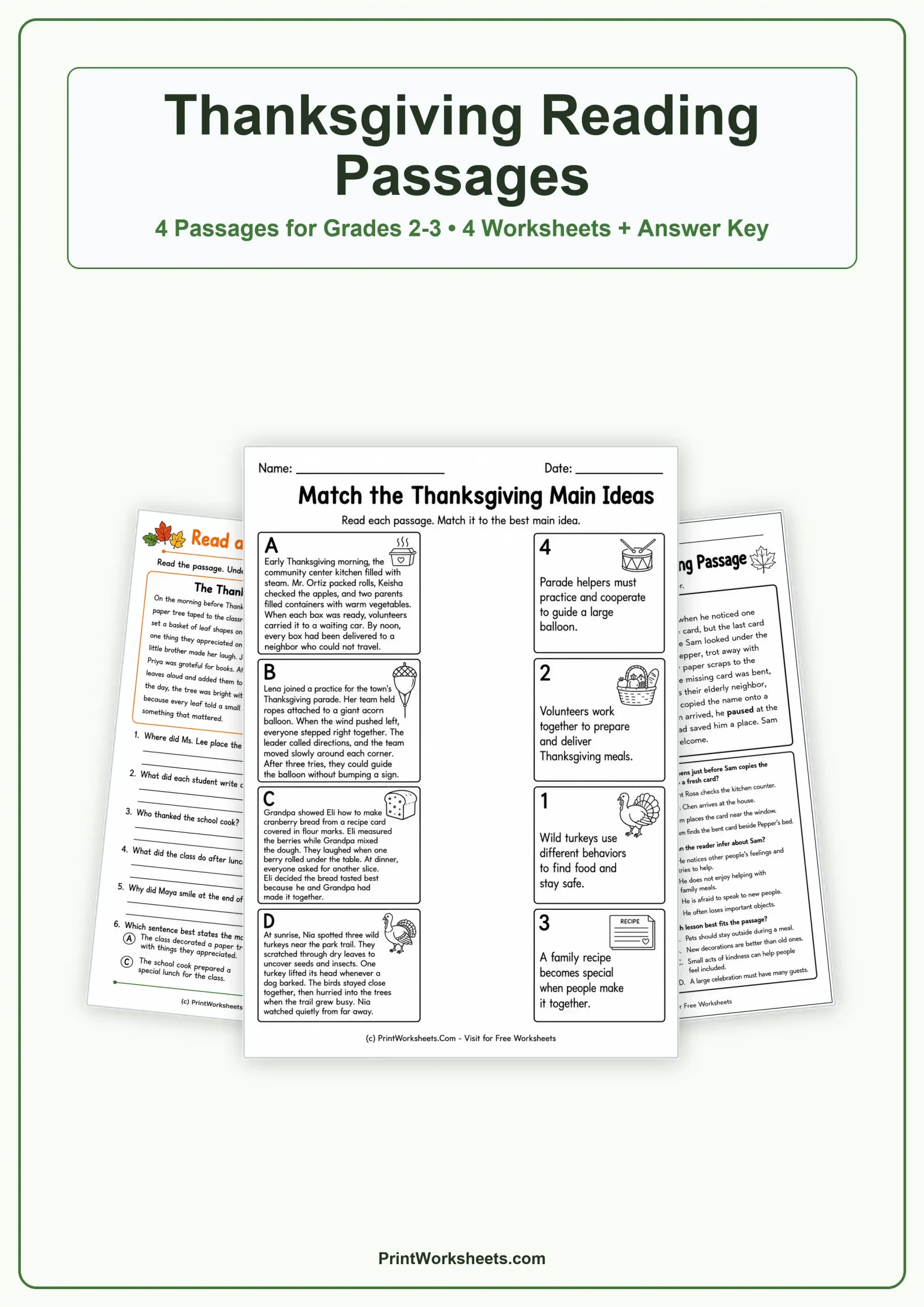
These Thanksgiving reading comprehension worksheets give second- and third-grade readers a seasonal set of passages that moves from straightforward understanding to deeper thinking with text evidence. Students read about a classroom Thankful Tree, Thanksgiving traditions, a missing place card, and a school pantry packing project while practicing details, main idea, sequence, vocabulary in context, inference, theme, and written explanation. The variety of response formats makes the set useful for whole-group reading, literacy centers, independent work, homework, or a short holiday review.
What these Thanksgiving reading comprehension worksheets practice
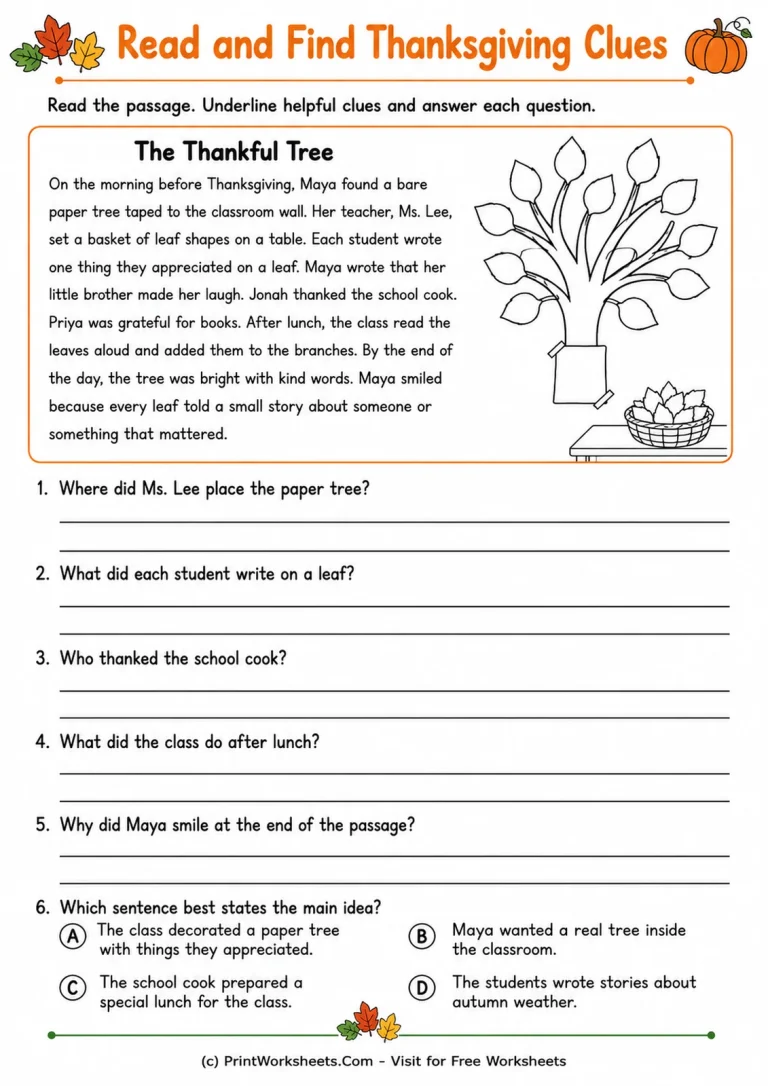
The first activity, Read and Find Thanksgiving Clues, centers on a short story about students adding thankful leaf notes to a classroom paper tree. Its six questions ask readers to identify the setting, recall important details, explain what happened, connect a reason to an action, and choose the main idea. This is a strong entry point for Grade 2 because the passage is compact and the questions keep students focused on information they can point to directly in the text.
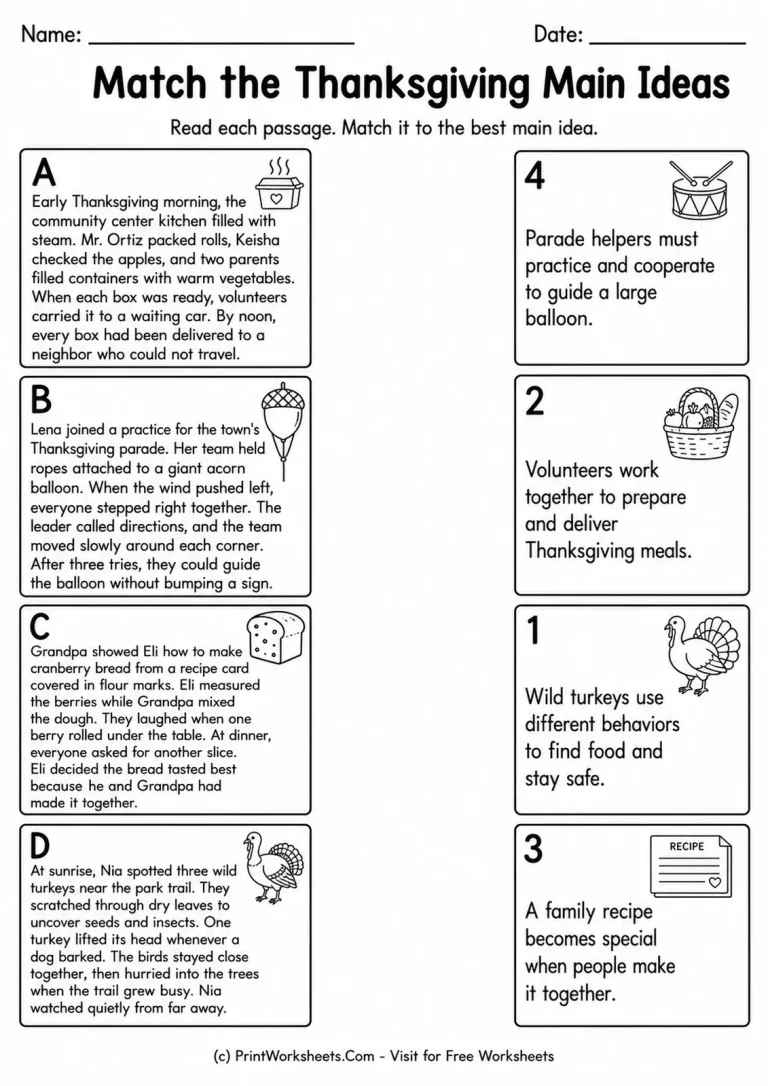
Match the Thanksgiving Main Ideas changes the task without changing the reading goal. Students read four separate mini-passages about neighbors receiving prepared meals, a parade team guiding a giant acorn balloon, a family following a cranberry bread recipe, and wild turkeys using feeding and safety behaviors. They then match each passage to its best main idea. Because the topics are clearly different, students must summarize what each passage is mostly about instead of relying on one repeated keyword.
From literal answers to inference and lesson
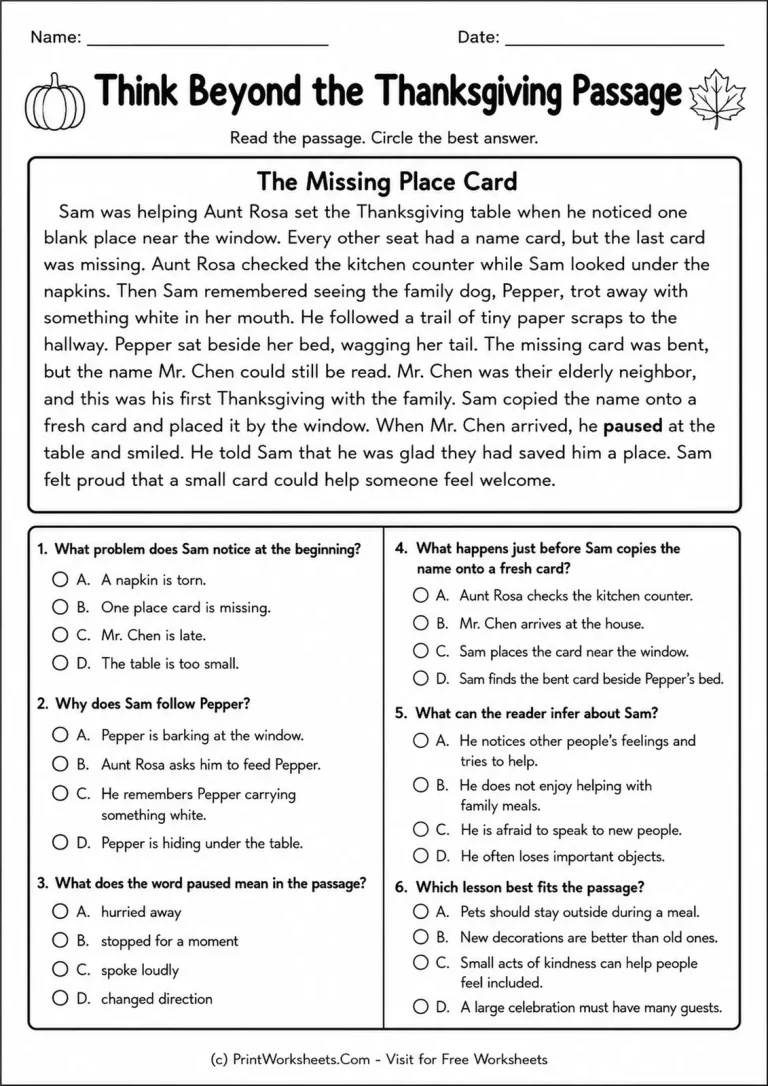
Think Beyond the Thanksgiving Passage raises the level of thinking through the story of Sam, a missing place card, and the family dog Pepper. Multiple-choice questions target the problem, cause, word meaning from context, event order, character inference, and the lesson of the story. Teachers can use this page to model how readers combine a stated detail with a reasonable conclusion. It also works well as a bridge from second-grade comprehension practice into the more analytical work expected in Grade 3.
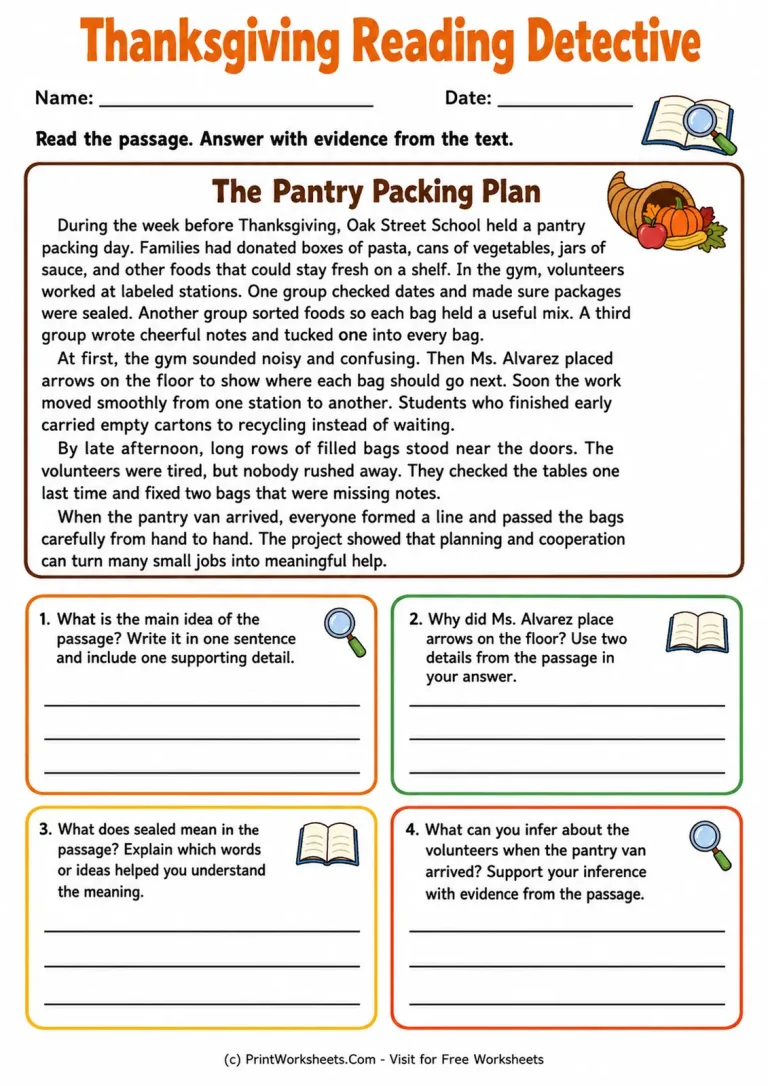
The final student activity, Thanksgiving Reading Detective, uses a longer passage about school volunteers organizing donated food for a pantry. Students follow the way the group improves its packing process, including the use of arrows to show workflow and the transfer of completed bags to a pantry vehicle. Four written-response questions ask for the main idea, cause and effect, vocabulary in context, and an inference supported by the passage. This gives students practice turning comprehension into complete written explanations rather than only selecting an answer.
A practical Grade 2 to Grade 3 reading progression
The sequence is useful because the cognitive load increases gradually. A student can begin with direct recall and a clearly stated main idea, move to comparing several short passages, then handle sequence and inference in multiple choice, and finally explain an answer with textual evidence. That progression makes it easier to differentiate within one seasonal theme. Grade 2 readers can spend more time on the first two activities and discuss answers orally, while Grade 3 readers can be asked to underline evidence and write complete responses on the later pages.
For small groups, try reading one paragraph aloud and asking students to name the clue that proves an answer. During independent practice, require students to circle or underline the sentence that supports each response before they answer. For an exit ticket, ask students to write one sentence explaining the difference between a detail and a main idea, then give an example from any passage in the set.
Teacher notes, differentiation, and extensions
Students who need support can preview key words such as thankful, recipe, pantry, and volunteer before reading. They can also work with a partner to retell each passage in one or two sentences before answering. Students ready for an extension can rewrite one multiple-choice item as an open-ended question, add a new text-evidence question to the pantry passage, or compare the central message of two different Thanksgiving selections.
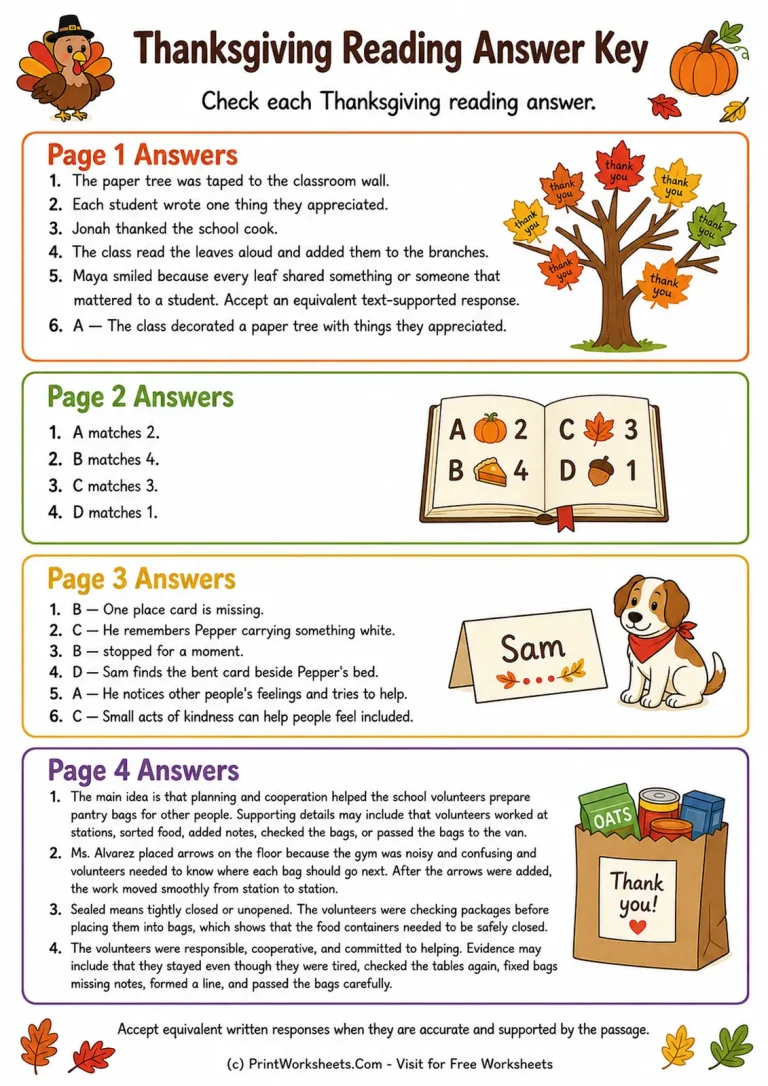
The included answer key supports quick checking of objective items and provides text-supported sample responses for the written questions. Equivalent answers can be accepted when they are accurate and grounded in the passage, which is especially useful when teaching students that open-response comprehension can be expressed in more than one valid way.
Build a seasonal reading routine
These printables can stand alone as a Thanksgiving week reading packet or be paired with another holiday text set to reinforce the same skills in a new context. For example, teachers who want a second seasonal set with a similar Grade 2-3 reading level can use the Halloween reading comprehension passages for Grades 2-3 for additional practice with comprehension across a different theme. The Thanksgiving set is especially effective when students are asked not only to answer correctly, but also to explain which words or events in the passage helped them decide.