Division word problems with equal groups worksheets for Grade 3 help students connect real-life sharing situations with division equations. Instead of solving isolated number facts, learners identify a total, determine how many equal groups are being formed, and calculate how many objects belong in each group.
This printable set contains three student worksheets with 20 problems. Students match written situations to equations, complete missing numbers in equal-groups stories, and solve longer problems by writing both a division fact and a complete answer sentence. The approved set does not include an answer key.
Understanding Division Through Equal Groups
Equal-groups division begins with a known total and a known number of groups. Students divide to determine the amount placed in each group.
For example, when 24 stickers are shared equally among 4 friends, the equation is 24 ÷ 4 = 6. The total is 24, the divisor represents the 4 equal groups, and the quotient shows that each friend receives 6 stickers.
Working with these situations helps students understand what each number in a division equation represents instead of relying only on memorized facts.
Grade 2 equal groups multiplication worksheet.
What Students Practice in This Set
- Matching situations and equations: Students connect eight short equal-groups word problems with their correct division facts.
- Completing division stories: Students fill in the missing amount in each group and complete the matching equation.
- Writing division facts: Students translate longer real-world situations into division equations.
- Completing answer sentences: Students explain what each quotient represents in the context of the problem.
- Working with larger facts: A few extension problems include a divisor of 12 or a quotient of 11.
Match Equal-Groups Situations to Division Equations
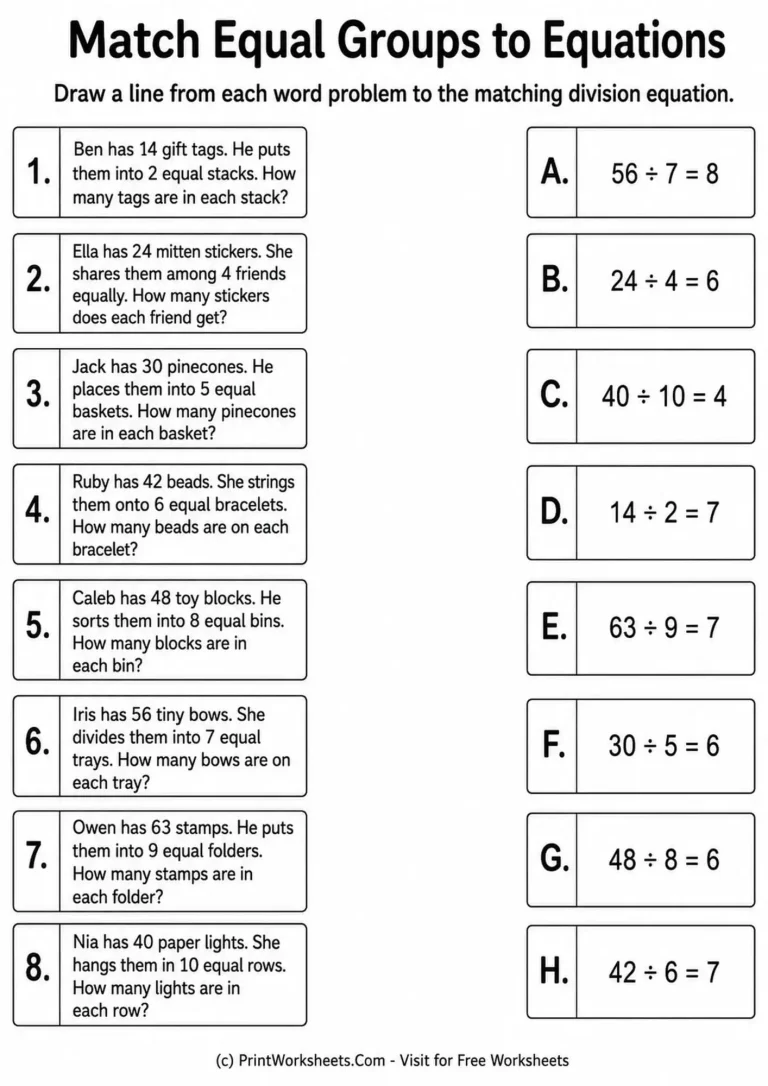
The first activity includes eight situations involving gift tags, stickers, pinecones, beads, toy blocks, bows, stamps, and paper lights. The division equations appear in a scrambled answer column.
Students must identify the total and the number of equal groups before drawing a line to the corresponding equation. Because the choices are not presented in problem order, learners must understand each situation rather than matching by position.
Complete the Missing Number in Each Story
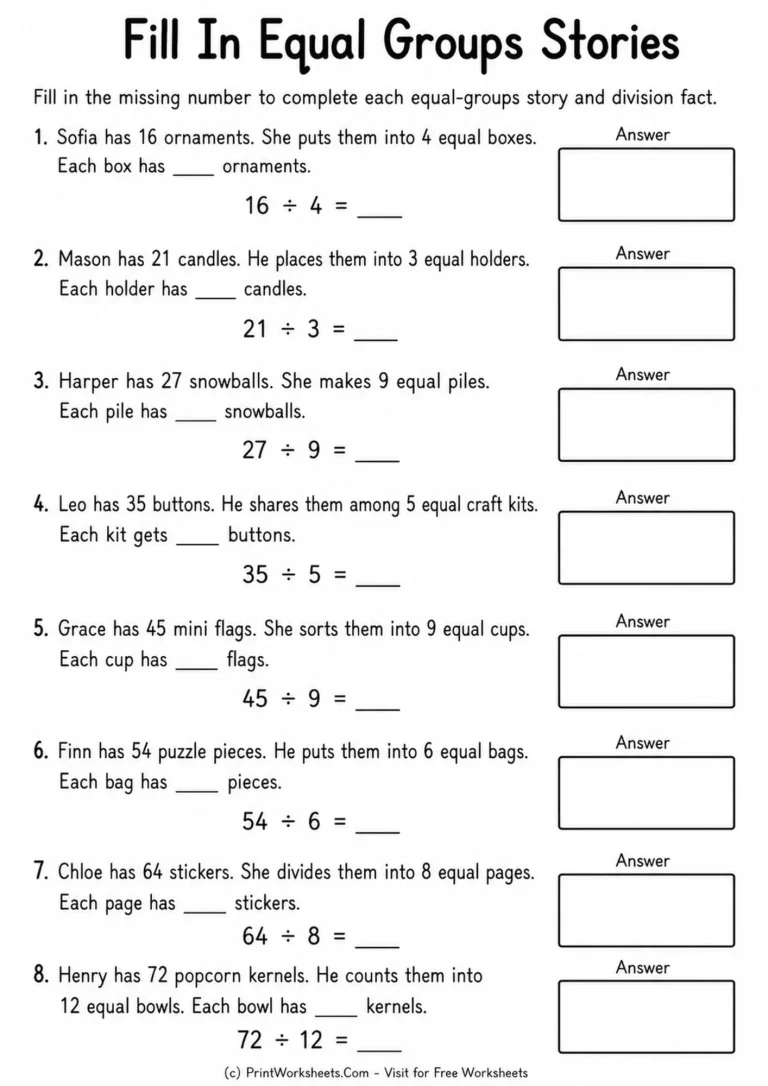
The next worksheet presents eight short equal-groups stories. Each problem includes a sentence blank, an incomplete division equation, and a separate answer box.
Students determine how many objects belong in each box, holder, pile, craft kit, cup, bag, page, or bowl. This repeated structure reinforces the connection between the written situation and its symbolic equation.
The final problem uses 72 ÷ 12 = 6. Teachers may use this as an extension question or provide additional support for students who have practiced mainly with one-digit divisors.
Apply Equal Groups in Real-World Problems
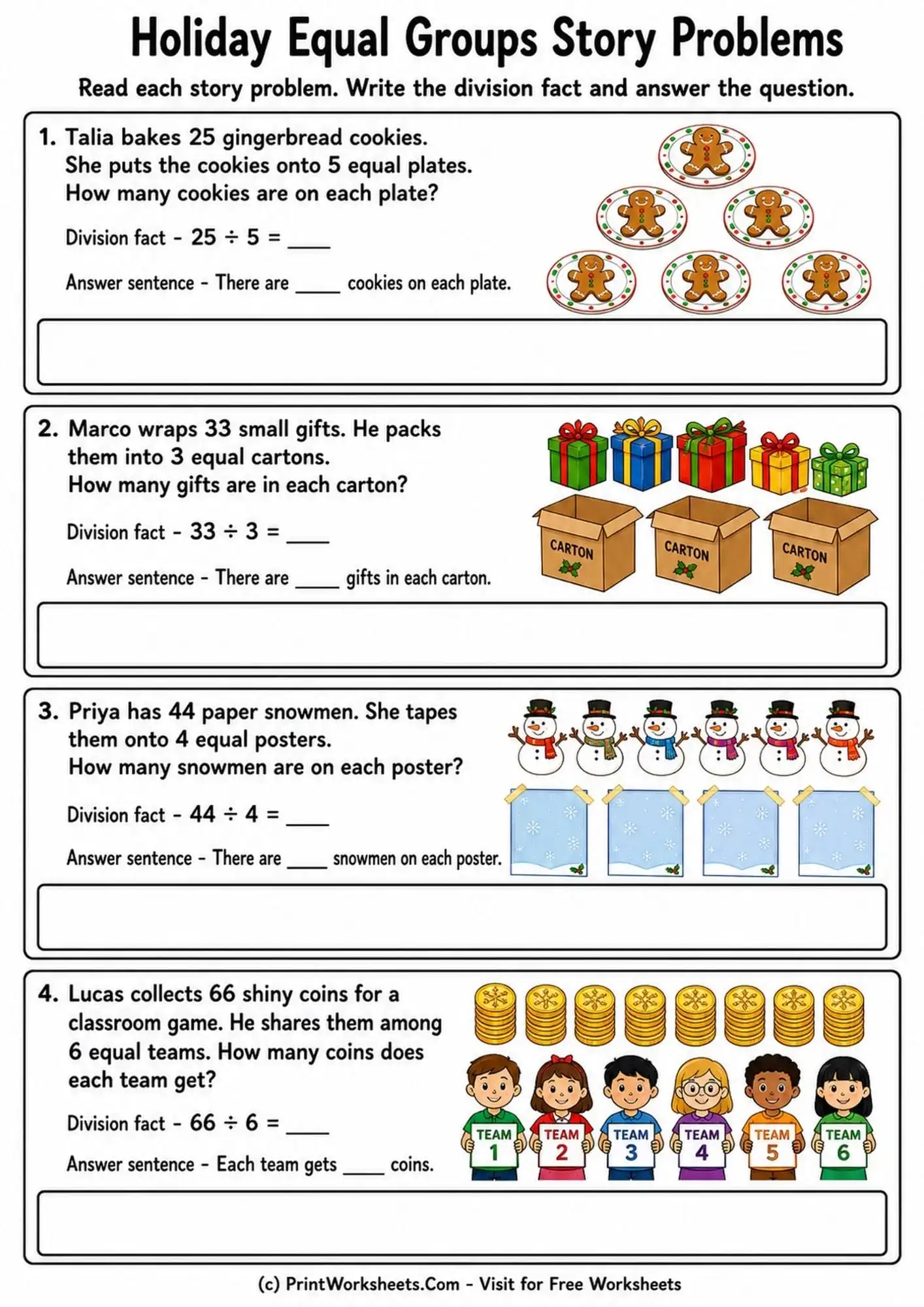
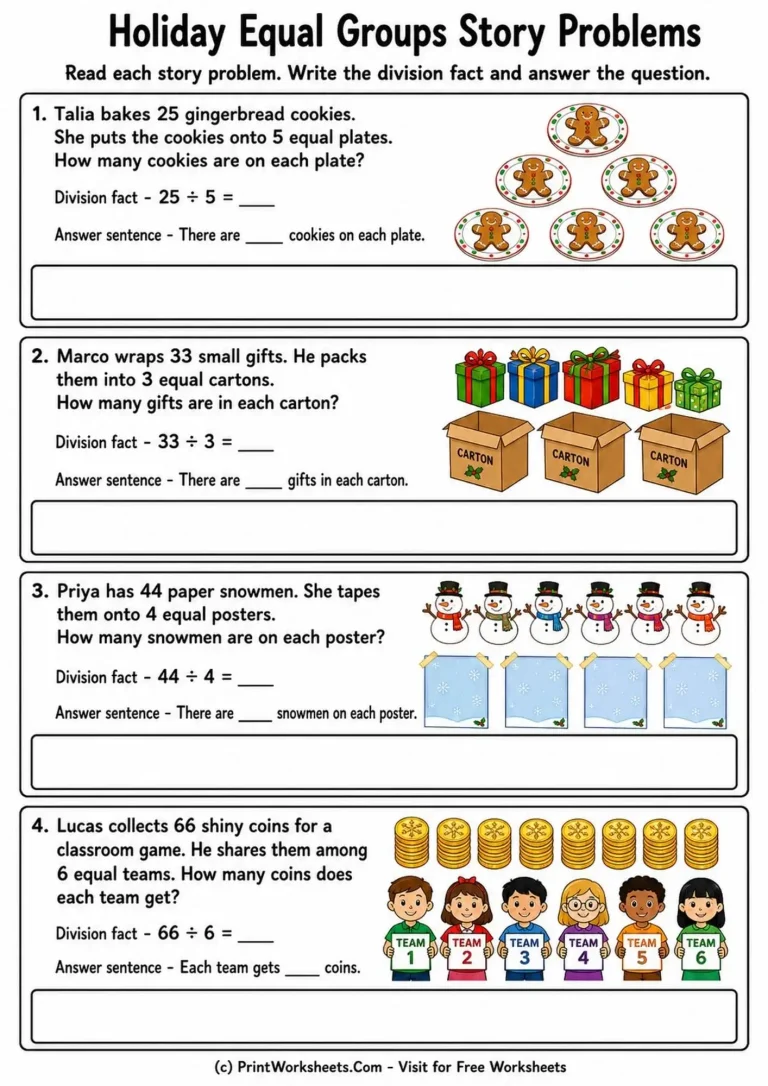
The final student page contains four longer situations involving cookies on plates, gifts in cartons, paper snowmen on posters, and coins shared among teams.
Students write the division fact, calculate the quotient, and complete an answer sentence that includes the correct unit. This allows teachers to check both computational accuracy and whether students understand what the answer means.
Several questions have a quotient of 11, providing an appropriate challenge for students who are ready to move beyond the most common single-digit fact families.
Grade 3 multiplication and division word problems.
Skills Reinforced
- Interpreting division as equal sharing
- Identifying the total and number of groups
- Finding the number of objects in each group
- Matching stories with division equations
- Completing missing quotients
- Writing division facts from written situations
- Using correct units in answer sentences
Classroom Uses
These worksheets can be used during whole-class instruction, independent practice, math centers, small-group intervention, homework, or assessment. Teachers may begin with the matching activity, continue with the structured fill-in stories, and finish with the longer open-response problems.