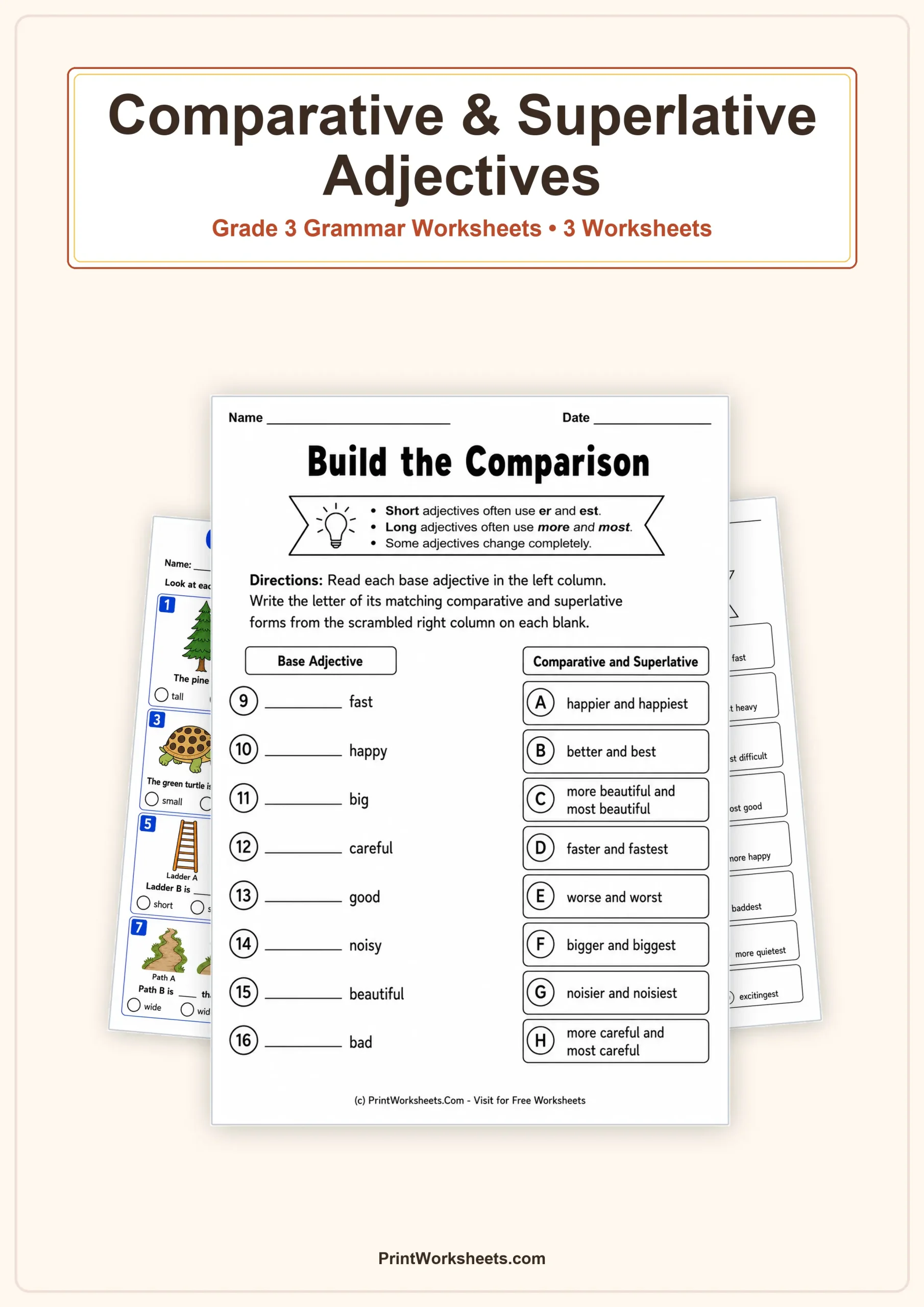
These comparative and superlative adjectives worksheets give third-grade students three different ways to practice describing how people, objects, and things compare. The printable set begins with picture-supported choices, moves into building adjective forms, and finishes with sentence-based decisions. Students work with both two-item comparisons and groups of three or more, so they can see when a comparative form such as taller is needed and when a superlative form such as tallest fits the meaning.
Comparative and Superlative Adjectives Practice for Grade 3
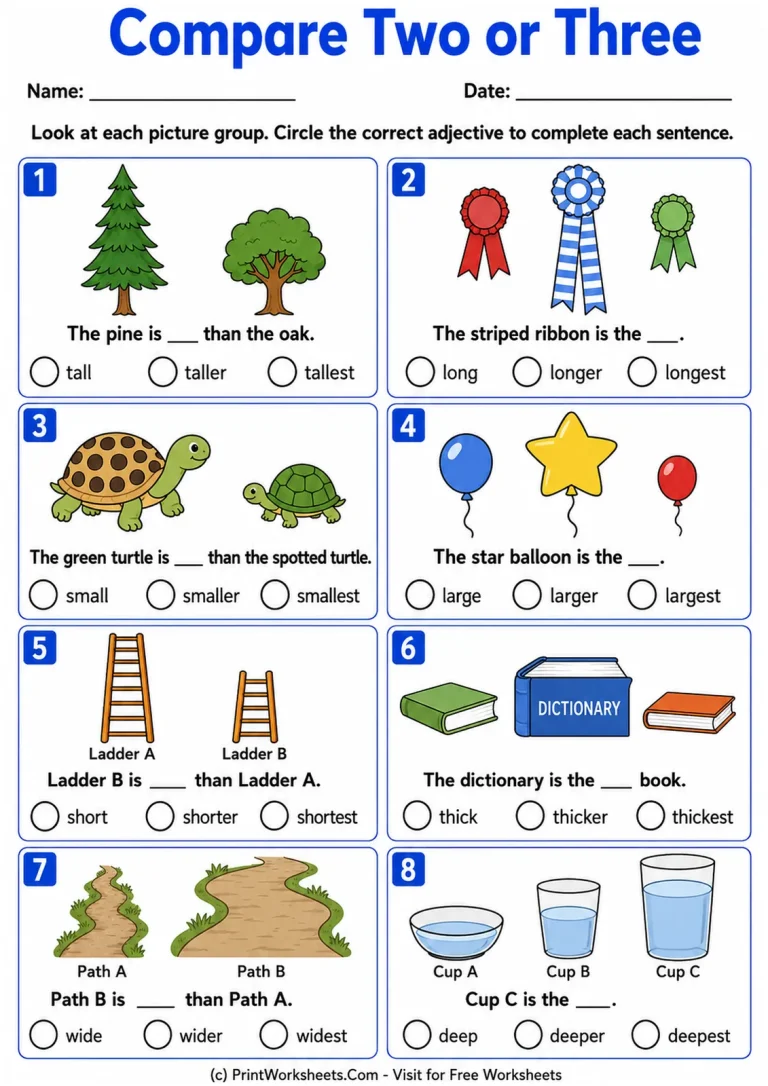
The first worksheet, Compare Two or Three, uses familiar pictures to make the grammar visible before students rely only on text. Learners look at groups such as trees, ribbons, turtles, balloons, ladders, books, paths, and cups, then circle the adjective form that correctly completes each sentence. A pair of turtles supports a comparative choice such as smaller, while a group of three ribbons requires students to identify the longest. Other items reinforce forms including shorter, thickest, wider, and deepest.
This visual approach is especially useful when students are still learning the difference between comparing two things and identifying one member of a larger group. Instead of memorizing an isolated rule, they connect the form of the adjective to what they can actually see. Teachers can use this page for direct instruction, guided practice, morning work, a grammar center, or independent review after introducing comparative and superlative forms.
Build Comparative and Superlative Forms
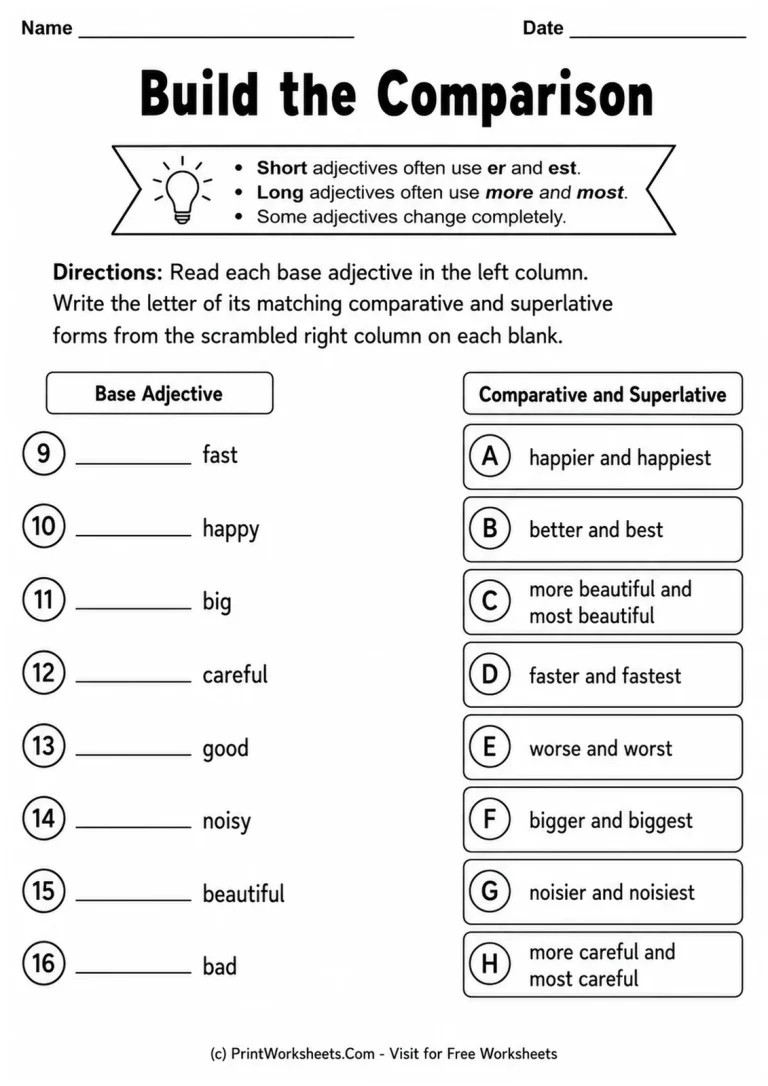
The second page, Build the Comparison, shifts attention from pictures to word formation. Students match eight base adjectives with scrambled comparative-and-superlative pairs by writing the correct letter. The vocabulary provides a useful range of spelling and grammar patterns: fast, happy, big, careful, good, noisy, beautiful, and bad.
Because the word list includes several formation patterns, students must do more than add the same ending every time. They encounter straightforward forms such as faster and fastest, spelling changes such as happier/happiest and bigger/biggest, longer adjectives that use more and most, and irregular adjectives such as good and bad. This makes the worksheet useful for checking whether learners recognize how the base adjective changes across all three forms.
Use Context Clues to Choose the Correct Adjective Form
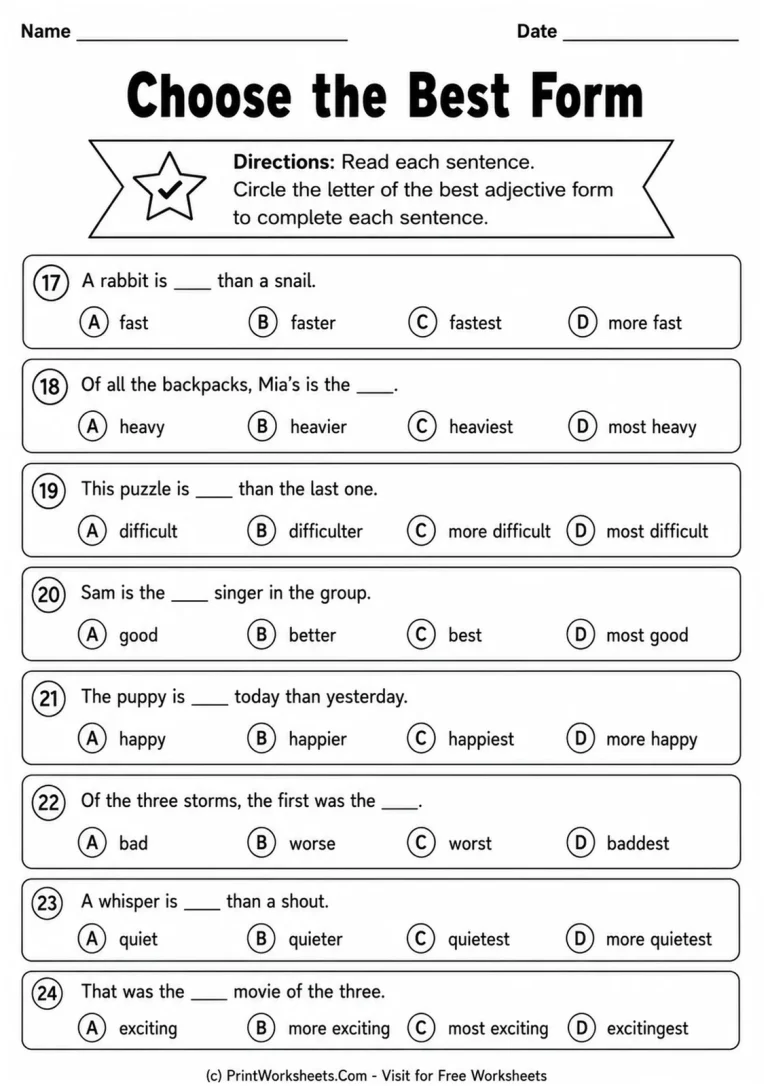
The third worksheet, Choose the Best Form, asks students to apply what they know inside complete sentences. Eight multiple-choice questions require them to decide whether the sentence needs a comparative or superlative adjective. Language cues such as than point toward a comparative form, while phrases such as of all, in the group, and of the three signal that a superlative form is likely needed.
This final step helps move students from recognizing patterns to using grammar meaningfully. A child may know that big, bigger, and biggest belong together, but sentence practice checks whether that child can select the correct form when the comparison is embedded in real language. The questions also mix regular adjectives, longer adjectives, and irregular forms so students cannot rely on one repeated pattern.
What Skills Do These Grade 3 Worksheets Cover?
Across the three pages, students practice identifying whether a comparison involves two items or a larger group, distinguishing comparative and superlative forms, matching base adjectives to related forms, noticing spelling changes, recognizing more/most constructions, working with irregular adjective forms, and using sentence clues to choose the form that makes grammatical sense. The progression keeps the practice focused while changing the task type from page to page.
The set can be used as a short grammar sequence across several lessons or divided among whole-group instruction, literacy centers, homework, and independent practice. The picture page offers a concrete starting point, the matching page concentrates on form building, and the sentence page provides a stronger check of independent understanding. This progression makes the worksheets practical for third graders who are learning the skill for the first time as well as students who need additional review before moving on to more complex adjective usage.
Printable Comparison Practice for Home or Classroom
Parents and teachers can print the pages separately or use all three as a compact practice packet. Students begin by comparing visible objects, continue by organizing adjective forms, and finish by selecting the best form from sentence context. That sequence gives learners repeated exposure to the same grammar concept without repeating the same activity, helping them build a clearer understanding of how comparative and superlative adjectives work in everyday English.