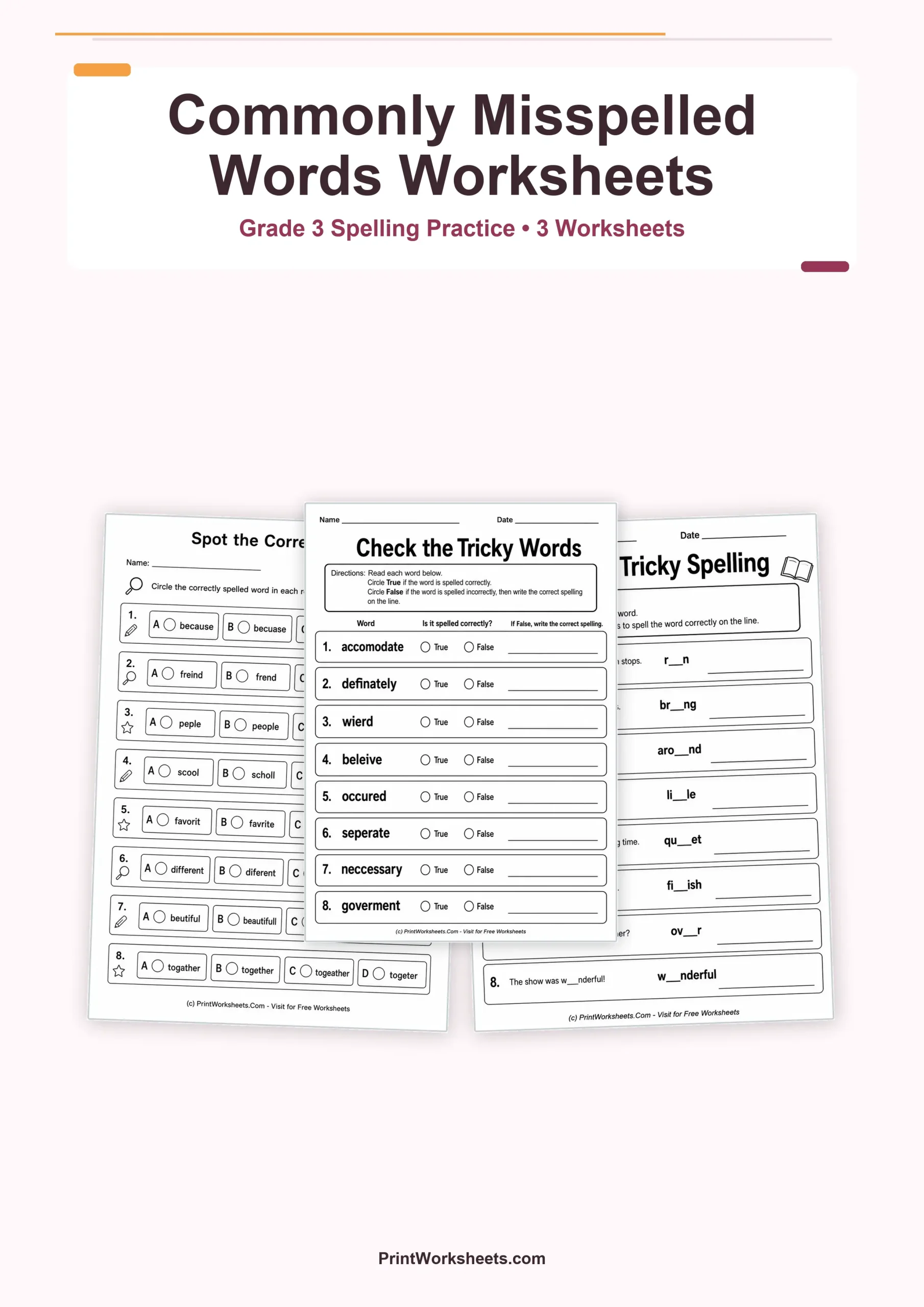
Students often know what a word means long before they can spell it reliably. These misspelled words worksheets for Grade 3 give learners three different ways to slow down, notice letter patterns, and practice accurate spelling. The set moves from choosing the correct form, to identifying and fixing an error, to completing a word inside a sentence. That progression makes the pages useful for targeted spelling review, independent practice, literacy centers, homework, or a short intervention block.
Misspelled Words Worksheets for Careful Spelling Practice
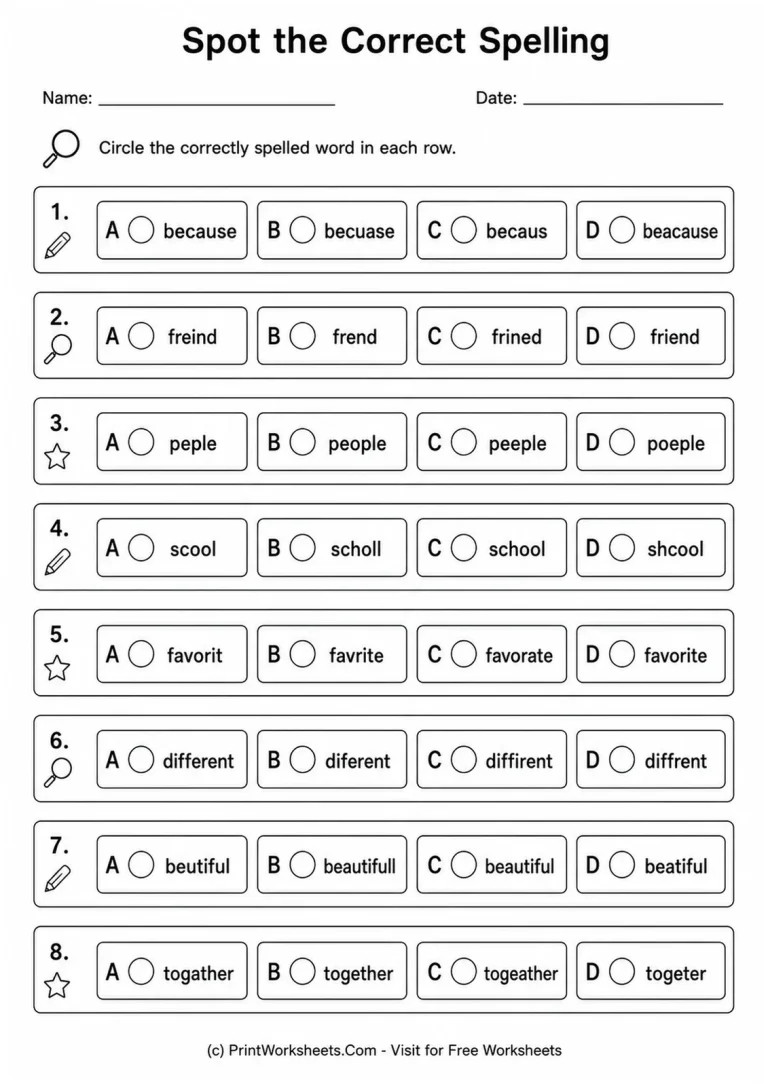
The first worksheet, Spot the Correct Spelling, asks students to circle the correctly spelled word in each of eight four-choice rows. Because the incorrect options are visually similar to the correct answer, students must look closely instead of relying on the general shape of the word. The target words are because, friend, people, school, favorite, different, beautiful, and together. These are useful high-frequency words for Grade 3 because students may use them often in reading and writing while still making spelling errors.
This page works well as a quick check before a spelling lesson. A teacher or parent can see whether a student recognizes the correct written form even when several plausible distractors are present. It can also be reused for oral review by asking the learner to explain what looks wrong in the rejected choices. That extra discussion encourages attention to letter order, repeated letters, vowel placement, and familiar word chunks.
From Recognizing Errors to Correcting Them
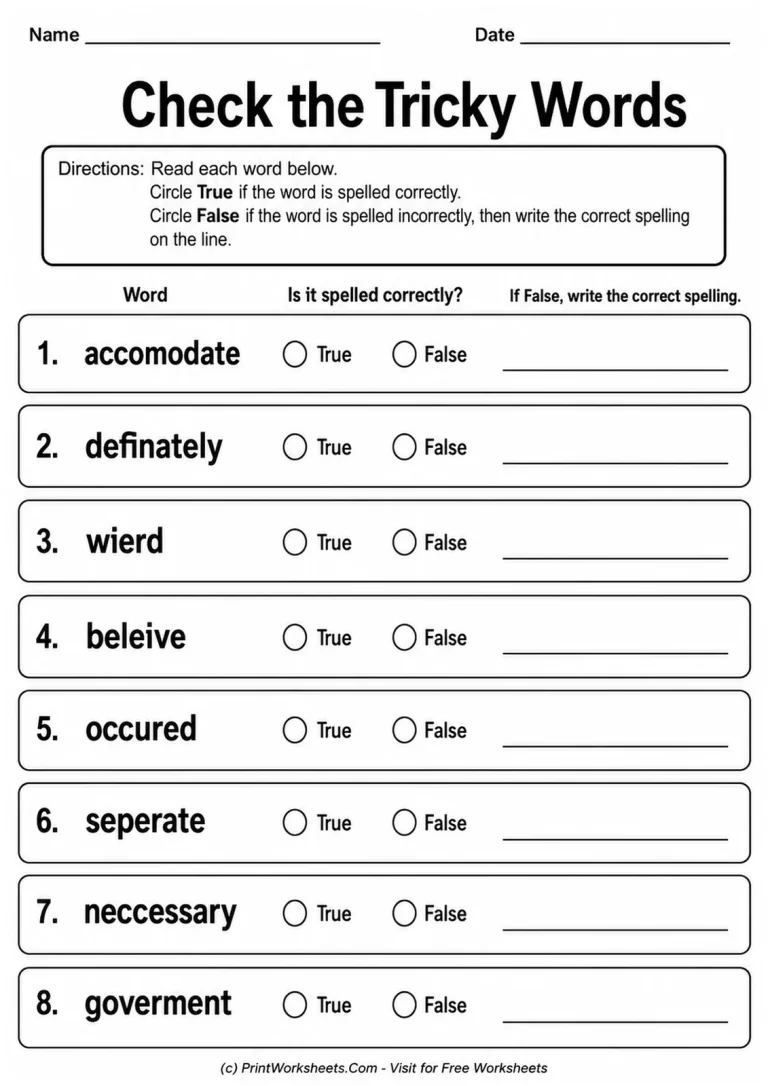
The second worksheet, Check the Tricky Words, raises the level of challenge. Students decide whether each printed word is spelled correctly and then rewrite the word when it is incorrect. The list includes accomodate, definately, wierd, beleive, occured, seperate, necessary, and goverment. Only necessary is correctly spelled as printed, so students get repeated practice noticing and repairing common errors.
Several words on this page are demanding for third graders, which makes the activity especially useful for stronger spellers, enrichment, or guided practice. Words such as accommodate, definitely, occurred, separate, and government require students to pay attention to details that are easy to overlook. Rather than simply copying a model, learners must first make a judgment and then produce the corrected spelling themselves. This helps connect visual recognition with written recall.
Sentence Context Adds a Final Layer of Support
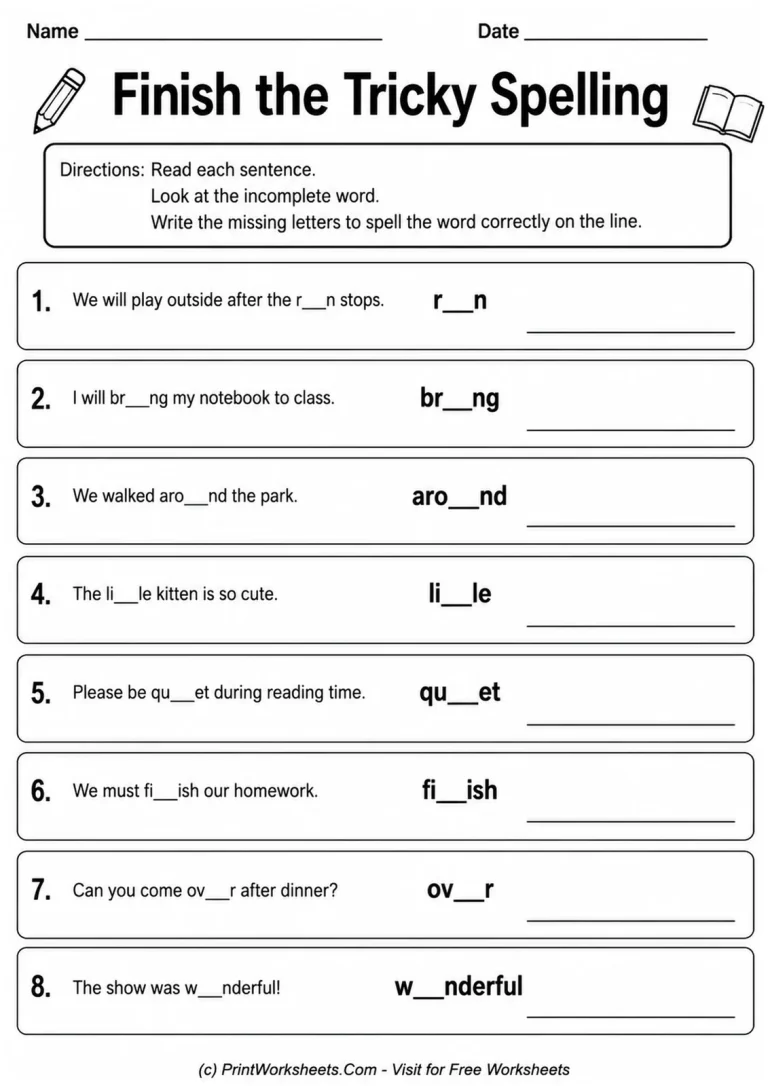
The third worksheet, Finish the Tricky Spelling, places incomplete words inside full sentences. Students supply the missing letters to complete eight target words: rain, bring, around, little, quiet, finish, over, and wonderful. Sentence context gives students meaning clues while still requiring them to think about the internal spelling of each word. This is a useful bridge between isolated word practice and the spelling decisions students make during everyday writing.
Because the words appear in sentences, teachers can extend the activity in several ways. Students can read each completed sentence aloud, underline the letters they added, or copy one or two target words into a personal spelling notebook. A follow-up writing task can ask students to use selected words in new sentences. These small extensions keep the focus on accurate spelling while also connecting the practice to reading fluency and written expression.
How to Use the Three-Page Progression
The pages can be used in order as a simple skill sequence. Begin with Spot the Correct Spelling to check recognition. Continue with Check the Tricky Words so students must diagnose and repair errors. Finish with Finish the Tricky Spelling to practice producing missing letters in meaningful context. The same sequence can be spread across several days or completed in one focused spelling session, depending on the learner.
For classroom use, these printable pages fit whole-group review, partner checking, literacy stations, morning work, or small-group intervention. At home, families can use one page at a time and review missed words after each activity. Instead of asking students to memorize long lists, the set gives them repeated opportunities to compare, correct, and complete words. That variety helps reveal which part of spelling is difficult for a learner: recognizing the correct form, spotting an error, or recalling the letters independently.
Build Accuracy with Words Students Actually Use
Common spelling mistakes can persist even when students read the words successfully. Practice is more useful when learners must actively inspect the spelling and make a decision. These Grade 3 worksheets provide that kind of practice with familiar everyday words and a few more advanced challenge words. Print the pages you need, use them in sequence or separately, and return to missed words later for another round of focused review.