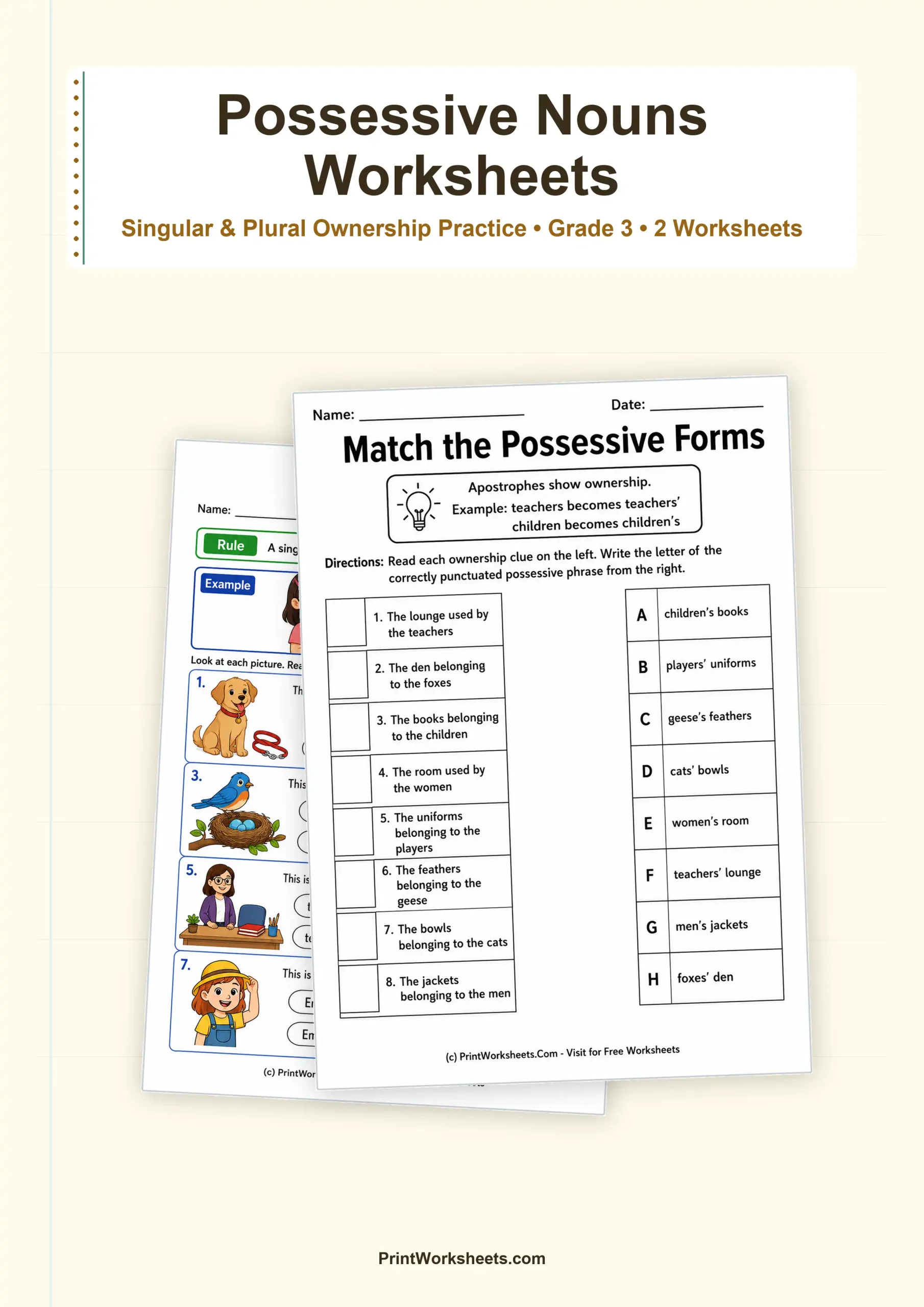
These possessive nouns worksheets give third graders focused practice with the apostrophes that show ownership. The two activities move from an accessible picture-based task with singular possessive nouns to a more demanding matching activity that includes regular plural and irregular plural possessives. Students work with familiar ownership examples such as a dog’s leash, a bird’s nest, Mia’s backpack, teachers’ lounge, children’s toys, and men’s belongings, making the punctuation rule easier to connect with meaning.
Possessive Nouns Worksheets for Grade 3: What Students Practice
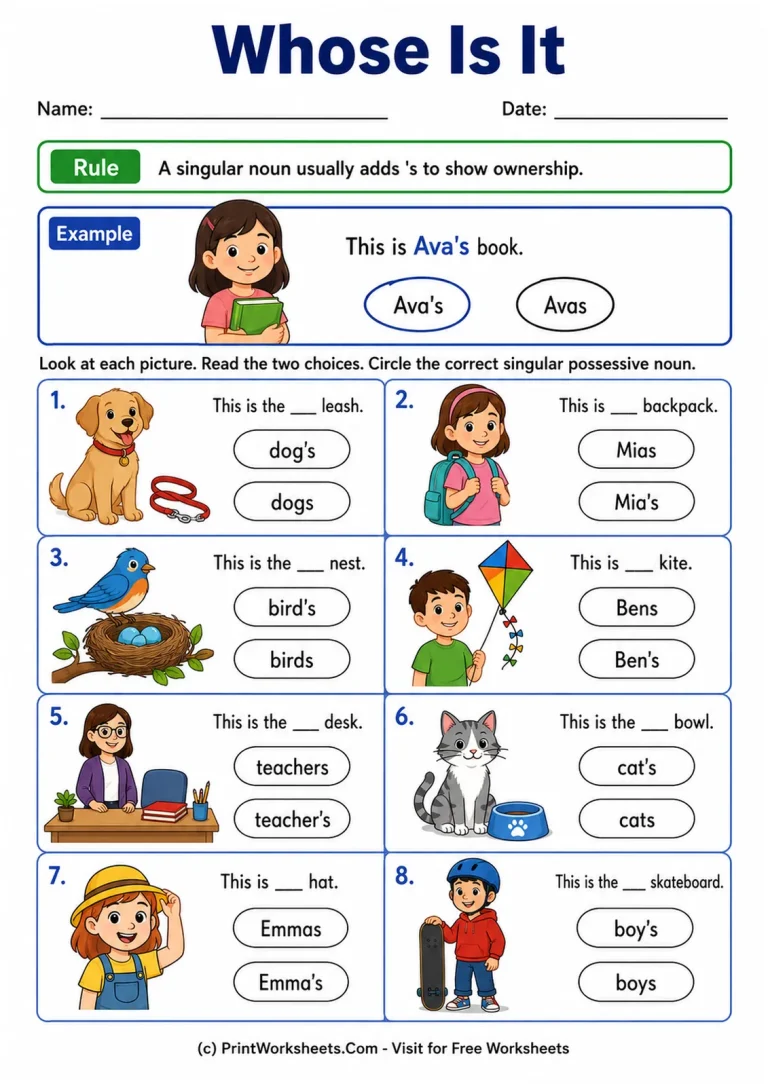
The first worksheet, Whose Is It, introduces ownership through eight picture-supported multiple-choice items. A worked example with Ava’s book shows the basic pattern before students begin independently. Each item asks children to study a picture and sentence, then choose the correctly punctuated possessive form instead of an unpunctuated noun form. Examples such as Ben’s kite, Emma’s hat, the teacher’s desk, and the cat’s bowl keep attention on one clear idea: a singular noun usually takes an apostrophe plus s when it shows that something belongs to someone or something.
This format is especially useful when students understand ownership in everyday language but still need a visual reminder of where the apostrophe belongs. Rather than treating punctuation as an isolated mark, the worksheet links the noun to the object it owns. That gives learners a concrete reason for writing dog’s leash instead of simply memorizing a punctuation rule.
Moving from Singular to Plural Possessive Nouns
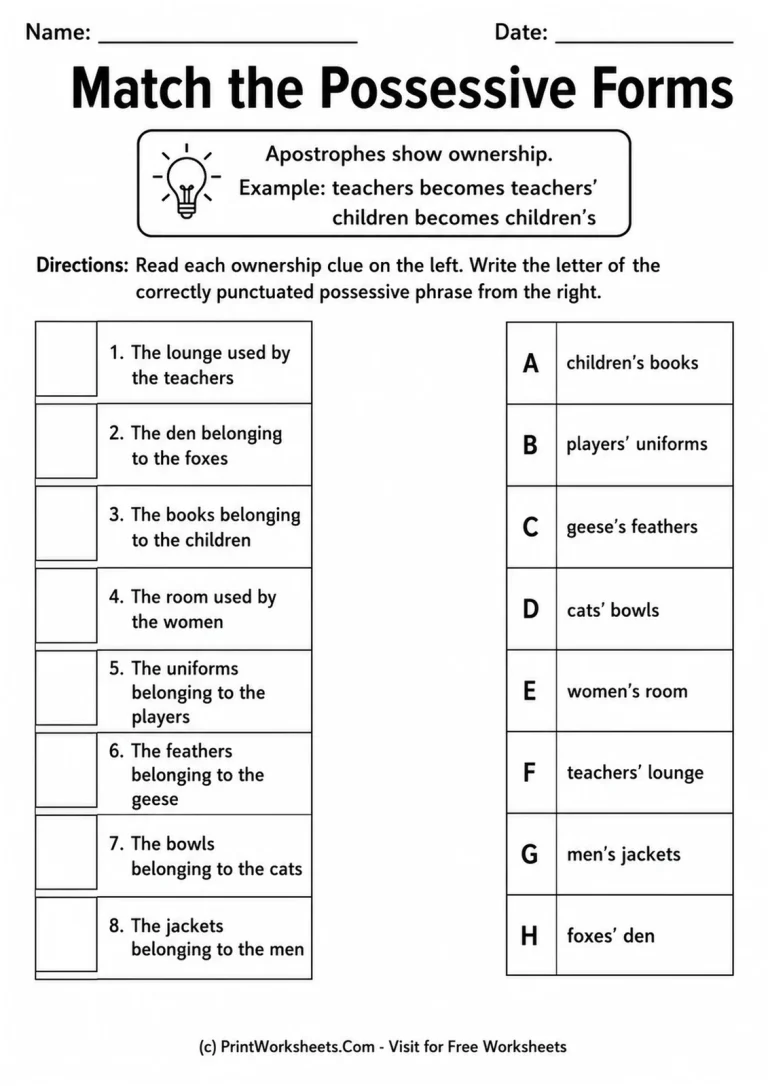
The second worksheet, Match the Possessive Forms, extends the skill beyond singular ownership. Students match eight ownership clues with correctly written possessive phrases. The choices include regular plural nouns that already end in s, such as teachers’, foxes’, players’, and cats’, as well as irregular plurals that do not end in s, including children’s, women’s, geese’s, and men’s.
This contrast helps third graders see why plural possessives do not all follow one identical spelling pattern. With a regular plural such as teachers, the ownership mark comes after the final s: teachers’ lounge. With an irregular plural such as children, students add apostrophe plus s: children’s. Practicing both patterns on the same page encourages students to look at the base noun first and decide whether it is singular, a regular plural, or an irregular plural before adding the possessive ending.
A Short Skill Sequence for Grammar Practice
Together, the worksheets create a compact progression rather than two unrelated activities. The picture choices on the first page build confidence with singular possessive nouns. The matching task then removes some of that visual support and asks students to apply punctuation across several plural forms. This makes the set useful for a grammar lesson, literacy center, independent practice, homework, or a quick review before students begin editing possessive nouns in their own sentences.
Teachers can also use the pages at different points in instruction. The first activity works well immediately after introducing the idea that possessive nouns answer questions such as “whose book?” or “whose bowl?” The second is better suited to the next step, when students are ready to compare examples such as cat’s bowl, cats’ bowls, and irregular forms such as children’s. Asking students to explain why the apostrophe moves can add a useful oral-language component to the written practice.
Supporting the Noun Skills Behind Possessives
Possessive noun work is easier when students can first recognize nouns and understand what they name. Learners who still need practice identifying basic noun words can use these identifying nouns and verbs worksheets before returning to ownership forms. Once students can confidently recognize the noun, they are better prepared to decide whether it is singular or plural and where the apostrophe should go.
Using the Worksheets at Home or in Class
For guided practice, complete the Ava’s book example together and ask students to say what is owned and who owns it before choosing an answer. On the matching page, encourage children to underline the base noun first. If it is a regular plural ending in s, they can look for the possessive form with an apostrophe after that s. If it is an irregular plural such as men or women, they can look for apostrophe plus s.
These Grade 3 printable worksheets keep the practice narrow enough for a focused grammar session while covering more than one possessive pattern. By moving from familiar singular ownership to regular and irregular plural forms, students get a clear opportunity to connect noun number, apostrophe placement, and meaning in one concise practice set.