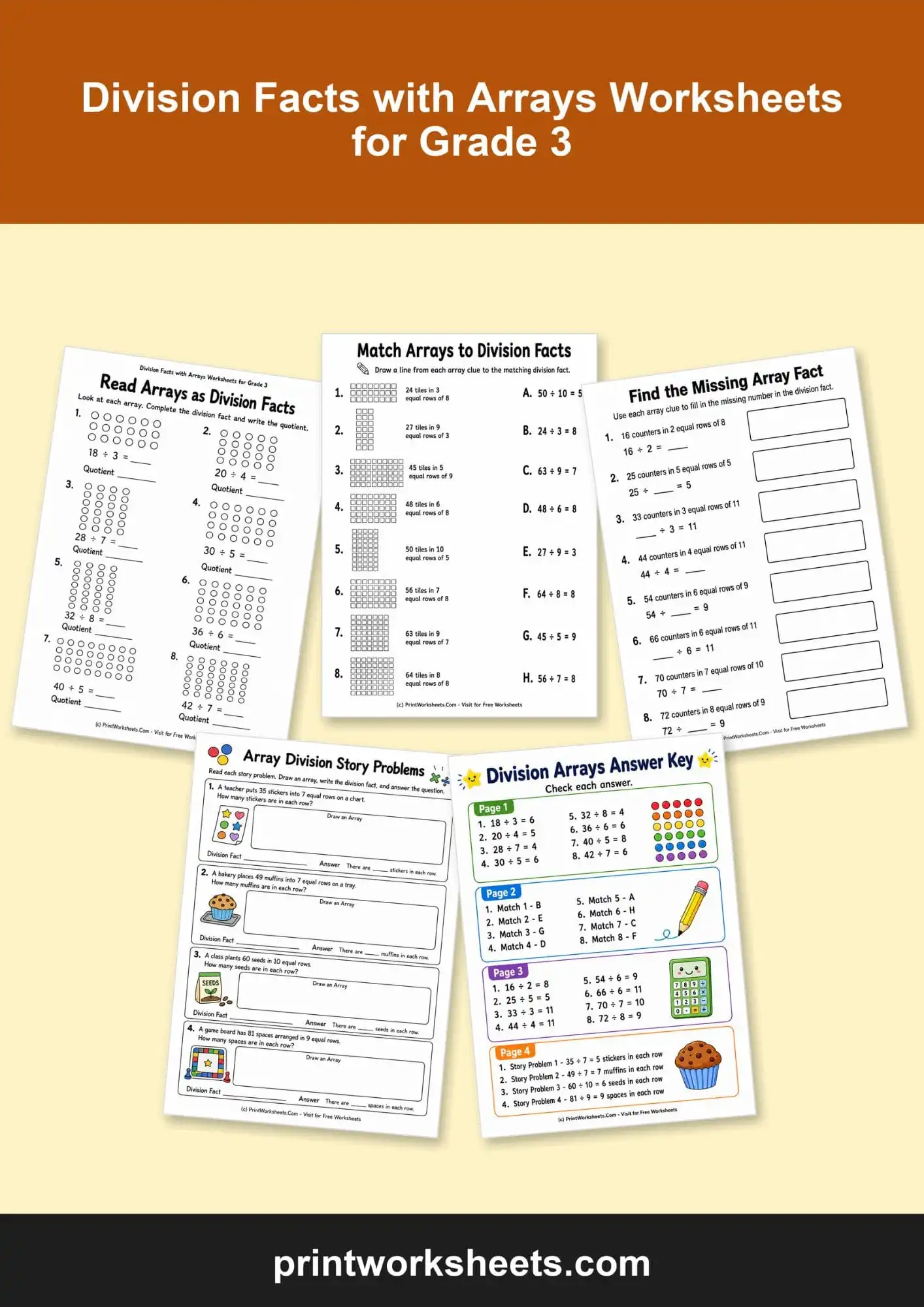
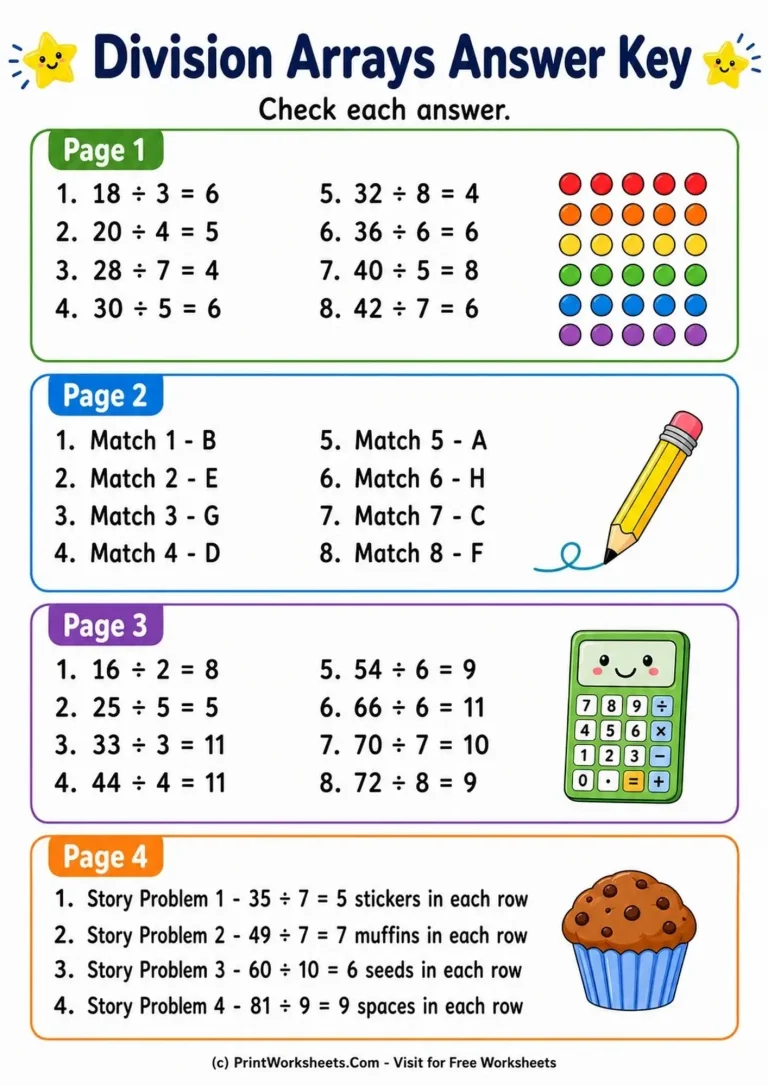
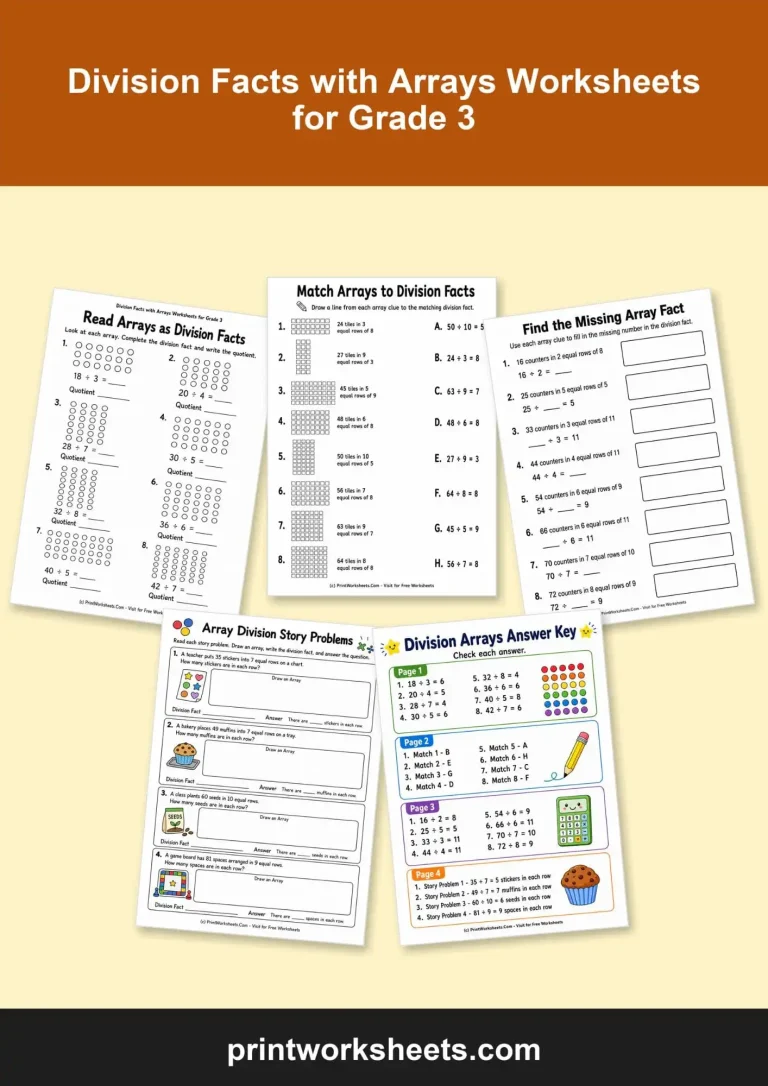
Division facts with arrays worksheets for Grade 3 help students understand division by connecting equations to organized rows and columns. This printable resource includes four student worksheets and a complete answer key, moving from direct visual models to matching, missing-number practice, and real-world story problems.
Arrays give students a clear way to see how a total can be separated into equal rows. Instead of memorizing a division equation in isolation, learners can identify the total number of objects, count the equal rows, and determine how many objects belong in each row.
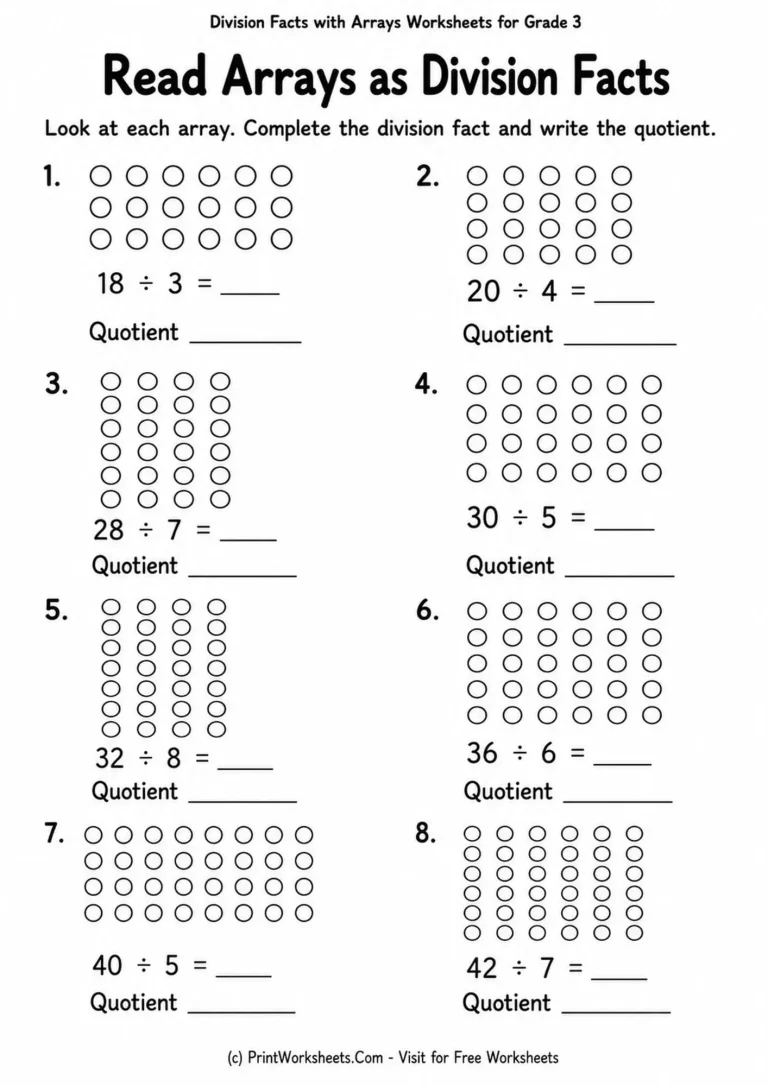
Read Arrays as Division Facts
The first worksheet presents eight arrays alongside incomplete division equations. Students count the objects, examine the number of rows, complete the division fact, and write the quotient.
The models include facts such as 18 divided by 3, 28 divided by 7, 36 divided by 6, and 42 divided by 7. This page works well for introducing the connection between visual arrays and symbolic division.
Grade 2 equal groups multiplication worksheets.
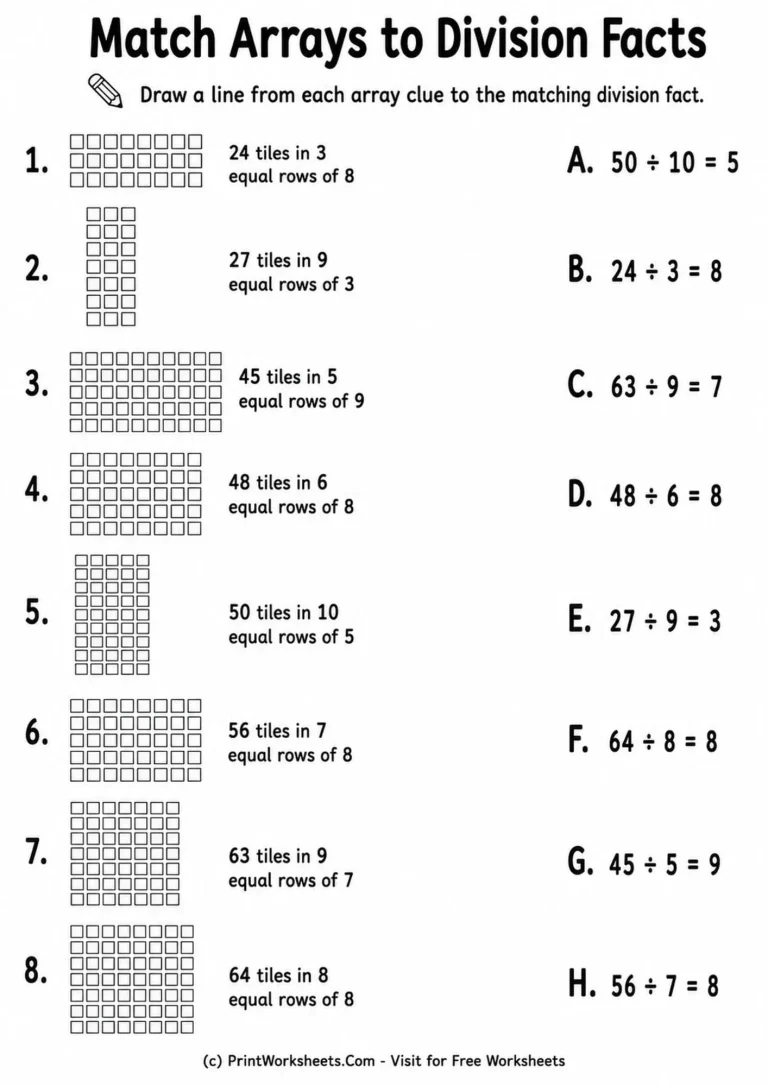
Match Arrays to the Correct Division Equations
The second worksheet asks students to match eight array clues with eight division facts. Each clue describes the total number of tiles, the number of equal rows, and the number of tiles in each row.
Because the equations are presented in a scrambled answer column, students must interpret each array instead of simply following the order of the page.
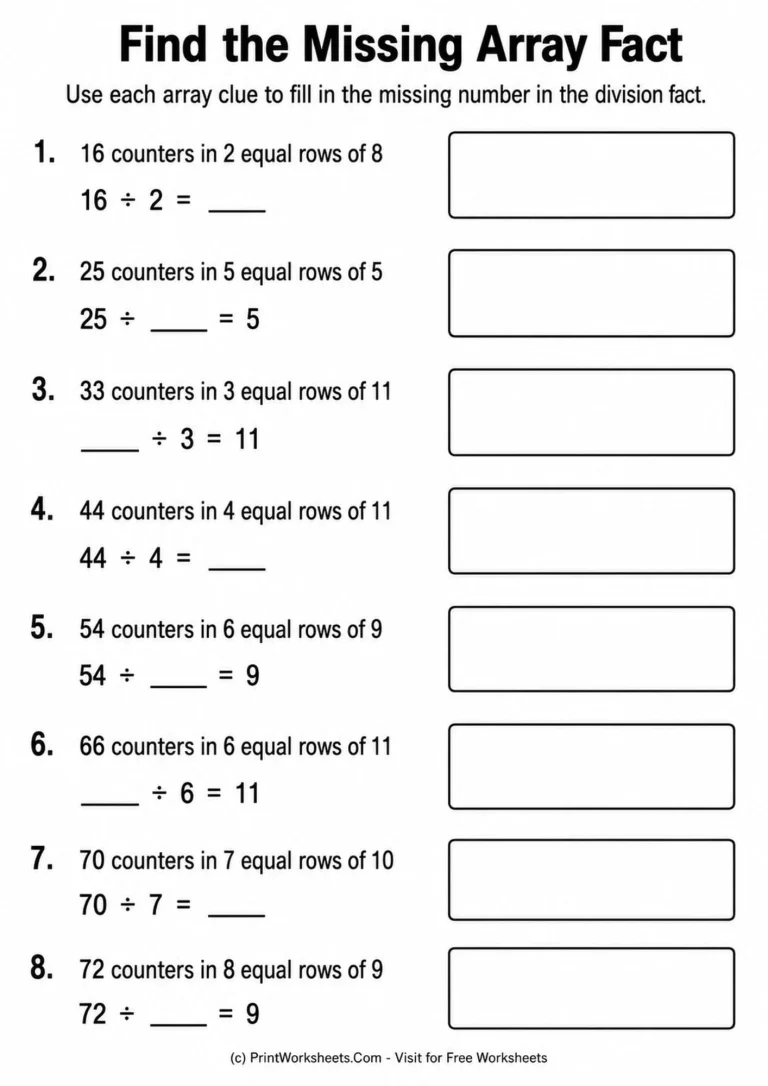
Find the Missing Division Number
The third worksheet develops flexible understanding by changing the location of the missing number. Students may need to find the quotient, divisor, or dividend.
Examples include finding the missing value in 16 divided by 2, determining the divisor in 54 divided by a missing number equals 9, and completing a division equation with a missing dividend.
A few problems include a quotient of 11, providing additional challenge for students who are ready to extend beyond the most common basic division facts.
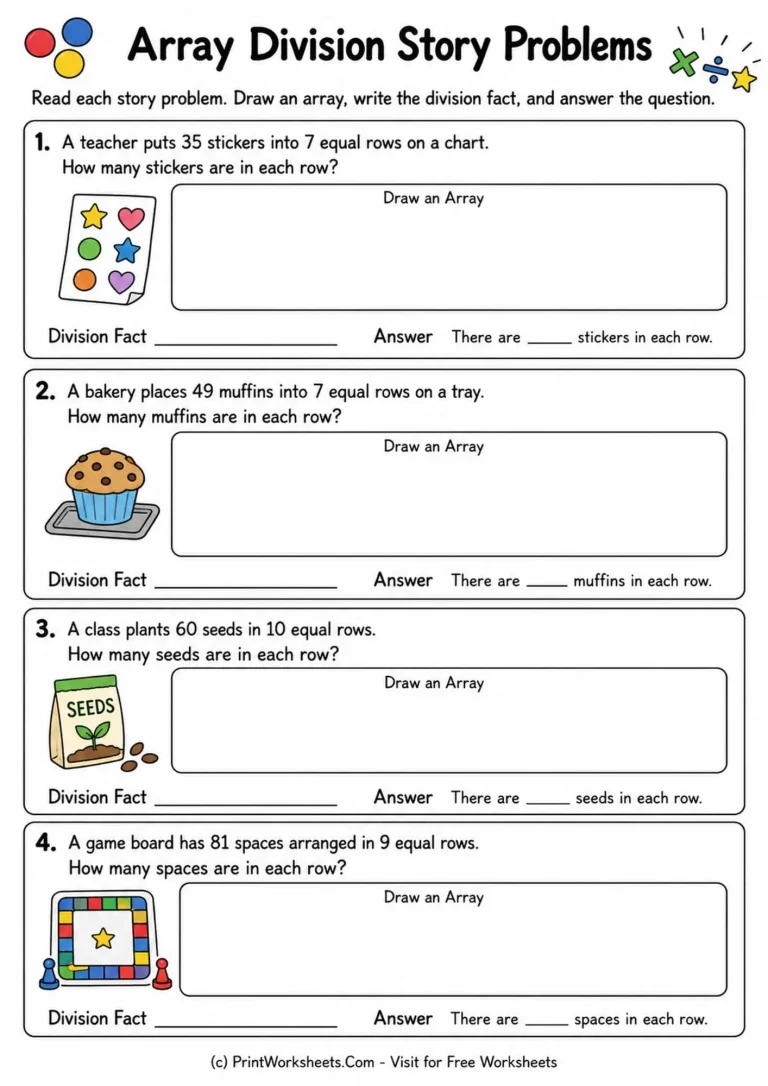
Solve Array Division Story Problems
The fourth worksheet applies division arrays to four familiar situations involving stickers, muffins, seeds, and spaces on a game board.
For each problem, students:
- identify the total and the number of equal rows,
- draw an array,
- write the matching division fact, and
- complete the answer sentence.
This structure allows teachers to check both conceptual understanding and calculation accuracy.
Grade 3 multiplication and division word problems.
Skills Practiced
- Reading rows and columns in an array
- Connecting arrays with division equations
- Finding quotients
- Finding missing dividends and divisors
- Matching visual models to division facts
- Drawing arrays to represent story problems
- Writing complete mathematical answer sentences
Ways to Use These Worksheets
Teachers can use the pages for whole-class instruction, independent practice, small-group intervention, homework, math centers, or assessment. The pages increase gradually in complexity, so they can be assigned in order or selected individually according to student needs.