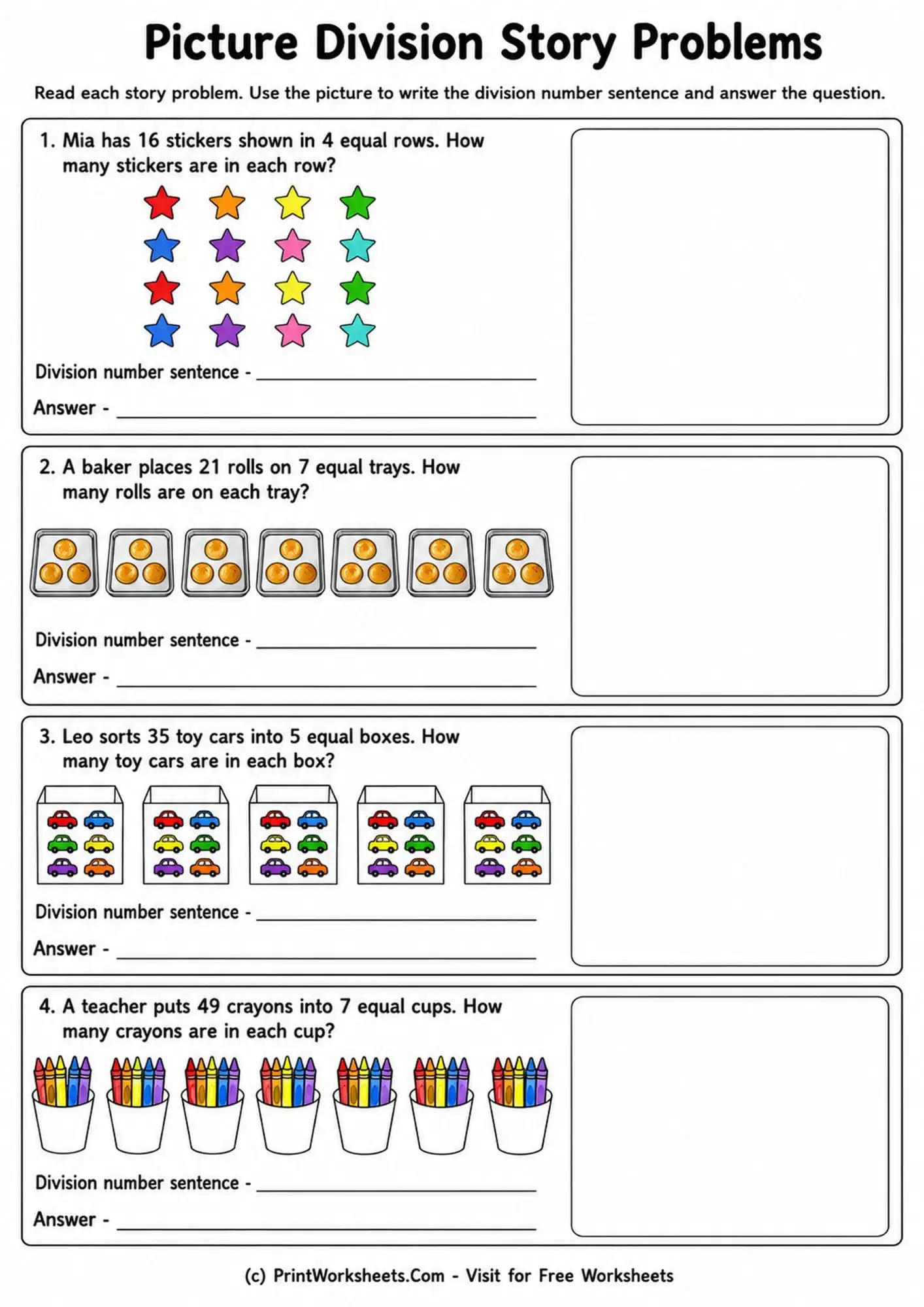
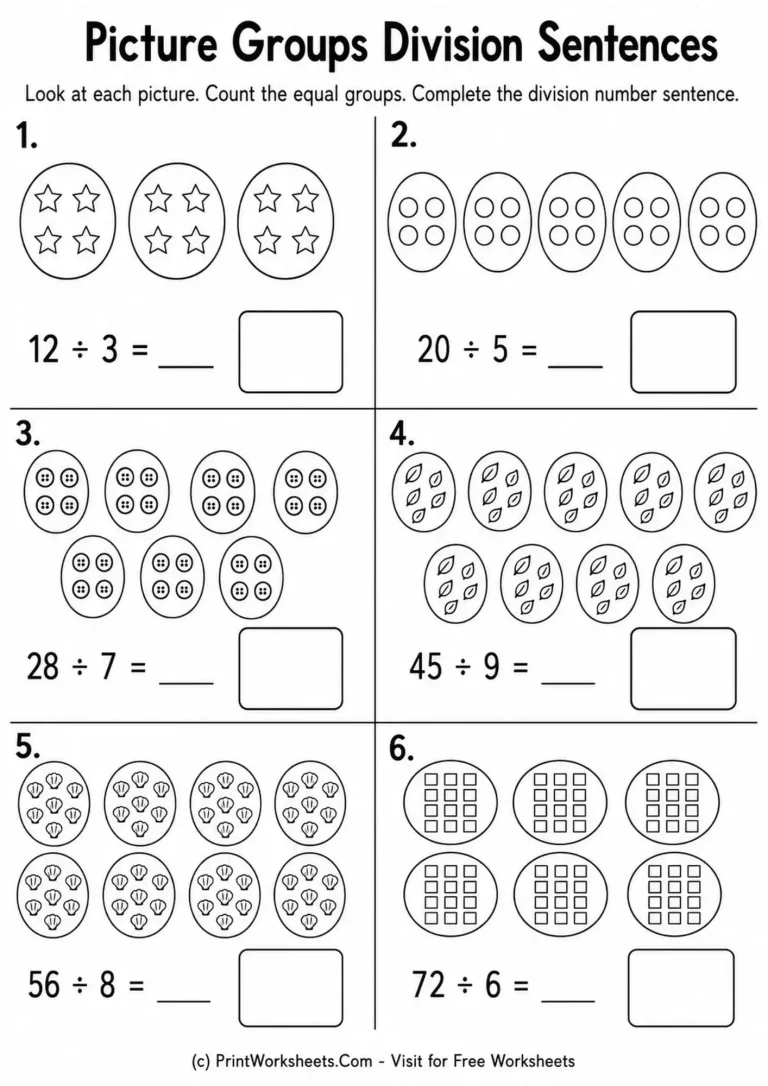
These division number sentences from pictures worksheets for grade 3 turn ten visual division tasks into a focused two-page printable. The black-and-white page asks students to count equal groups and complete six quotients, including 12 ÷ 3, 45 ÷ 9, and 72 ÷ 6. The color page then places division in four picture-supported situations with stickers in rows, rolls on trays, toy cars in boxes, and crayons in cups. Students write a division number sentence and a labeled answer for each story.
Division Number Sentences from Pictures Worksheets for Grade 3
The first worksheet, Picture Groups Division Sentences, begins with clearly separated equal groups. Students count the total objects, identify how many groups are shown, and complete the quotient. The six items move from familiar groups of four to larger facts such as 56 ÷ 8 and 72 ÷ 6.
This page keeps the language short so the visual model remains the main source of information. It is useful when students are learning to connect the dividend, divisor, and quotient to a picture. One common mistake is counting the number of groups as the answer instead of counting how many objects are in each group. The printed models make that difference visible.
Count Equal Groups and Complete Six Quotients
The direct practice page includes stars, circles, buttons, leaves, shells, and square tiles. Each problem shows a different number of equal groups, while every object set matches the printed division sentence. Students record answers of 4, 4, 4, 5, 7, and 12 across the six problems.
Students who need a review of equal groups can first use the 2 and 3 times table worksheets. The multiplication models provide related practice with repeated groups before students return to division.
Move from Picture Models to Four Division Stories
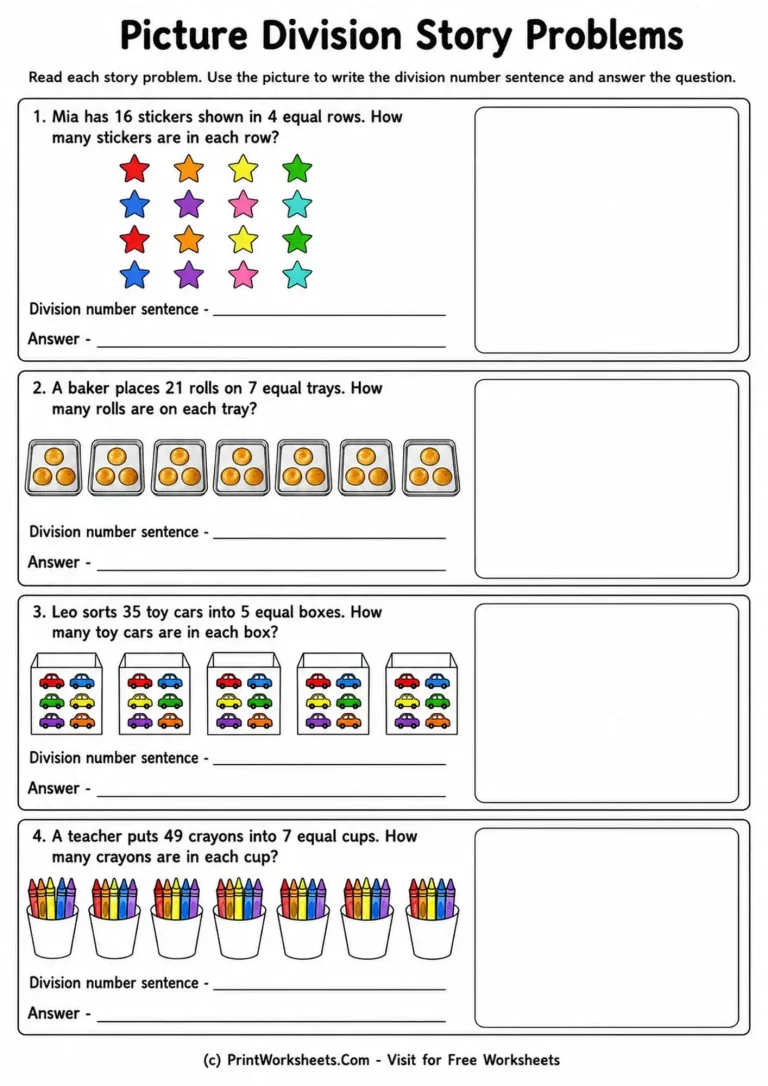
The second worksheet, Picture Division Story Problems, asks students to translate a short situation into an equation. The pictures show 16 stickers in four rows, 21 rolls on seven trays, 35 toy cars in five boxes, and 49 crayons in seven cups. Students write 16 ÷ 4, 21 ÷ 7, 35 ÷ 5, or 49 ÷ 7 and then label the answer with the correct object.
The large work areas on the right give students room to sketch, reorganize the groups, or show repeated subtraction. Because every story already includes a visual model, the reading load stays manageable while the mathematical action remains clear.
For a later mixed-operation extension, continue with the Grade 3 multiplication and division word problems. That resource asks students to decide which operation fits each story, while this printable stays focused on division.
Use the Two Pages as a Short Division Sequence
- Use the equal-group page after demonstrating how a total is separated into the stated number of groups.
- Assign the story page when students are ready to write an equation from rows, trays, boxes, and cups.
- Place the two pages in a math center, independent-practice folder, homework packet, or review lesson.
This two-page printable keeps the skill narrow: read a picture, recognize equal groups, write the matching division sentence, and find the quotient. Download the worksheet PDF from this page and print the approved student pages for Grade 3 division practice.