

Add mixed numbers with like denominators worksheets for grade 4 give students three ways to practice the same skill. They build sums with fraction bars, check mixed-number equations for errors, and solve short addition stories using familiar measurement units.
Each worksheet keeps the denominators the same within a problem. Students can focus on adding the whole-number and fraction parts before deciding whether the fraction total needs to be regrouped into another whole.
Add Mixed Numbers with Like Denominators Worksheets for Grade 4
The printable download includes three student practice pages. The activities move from visual fraction bars to error analysis and independent story problems.
Students who need a review of adding fraction parts can begin with the add fractions with like denominators worksheets for grade 4.
Build Mixed Number Sums with Fraction Bars
The first worksheet contains six mixed-number addition equations with fifths. Whole-number boxes and five-part fraction bars show the value of both addends.
Some equations can be solved by adding the whole numbers and fraction parts directly. Other equations produce five or more fifths, so students must exchange the completed fraction bar for one additional whole.
The visual models help students see why regrouping changes the whole-number part of the answer. A long line beneath each problem provides space to record an equation or show the regrouping step.
Find and Correct Mixed Number Addition Errors
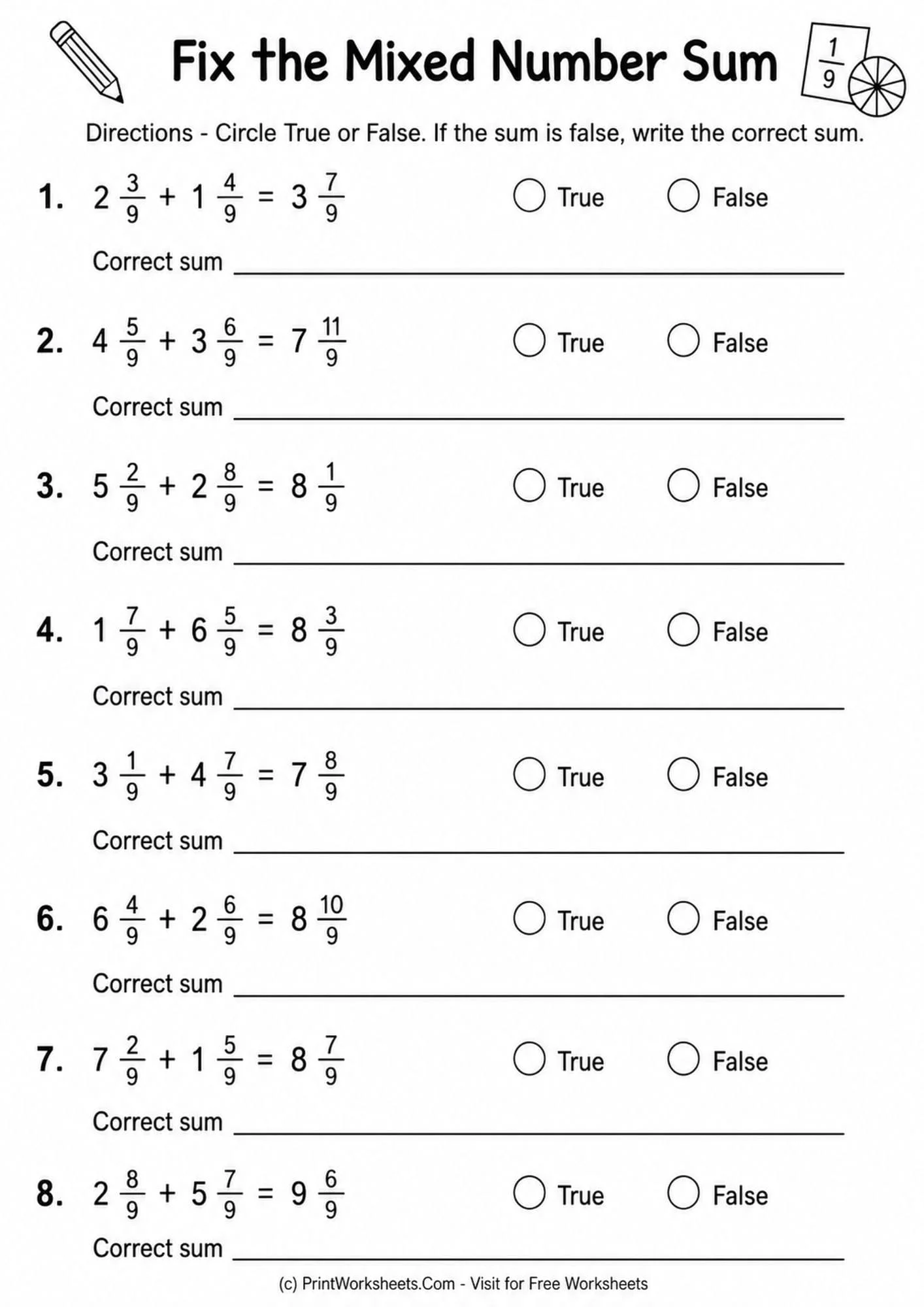
The second approved worksheet presents eight mixed-number sums using ninths. Students circle True when the stated sum is written correctly and circle False when the result must be corrected.
Several examples show fraction parts greater than one whole. Students must recognize that a result such as eleven ninths cannot remain as the fraction part of a mixed number. Other examples include an incorrect whole-number total, requiring students to recalculate the entire expression.
This format works well for partner discussion because students must explain what is wrong rather than only provide a final answer.
A Simple Error-Checking Routine
- Add the whole numbers: Record the whole-number subtotal.
- Add the fractions: Keep the common denominator.
- Check the numerator: Regroup when it is equal to or greater than the denominator.
- Check the complete sum: Make sure the new whole is included.
Solve Mixed Number Addition Stories
The final worksheet includes four real-world addition problems. Students work with miles, cups, yards, and square feet while adding mixed numbers with denominators of 11, 12, 13, and 15.
Each problem includes a separate equation line, a large workspace, and a final-answer line. This layout encourages students to translate the story into an equation before beginning their calculations.
The changing units also remind students to include the correct label in the final answer rather than writing only a number.
Classroom Uses for the Three Worksheets
- Teacher modeling: Complete one fraction-bar example and demonstrate how five fifths form another whole.
- Partner practice: Ask students to justify each True or False choice.
- Independent work: Use the four story problems after students understand the regrouping process.
- Exit ticket review: Select one error-analysis problem and ask students to explain the correction.
For practice changing between mixed numbers and improper fractions, use the mixed numbers and improper fractions worksheets for grade 4.
Download the Approved Mixed Number Worksheets
The printable PDF contains the three approved student pages: fraction-bar sums, True or False error correction, and mixed-number addition stories. The matching page and answer key are not included.