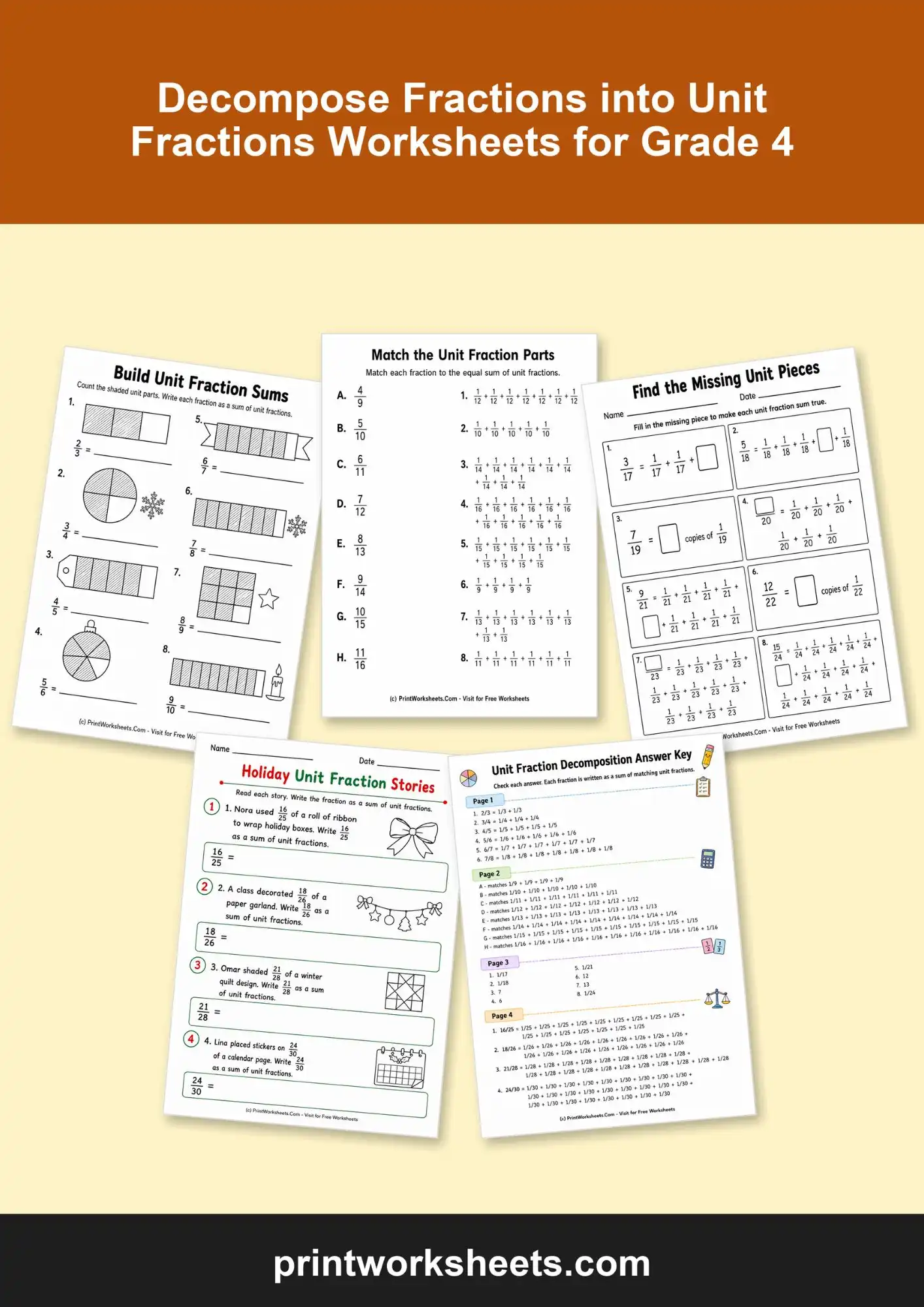
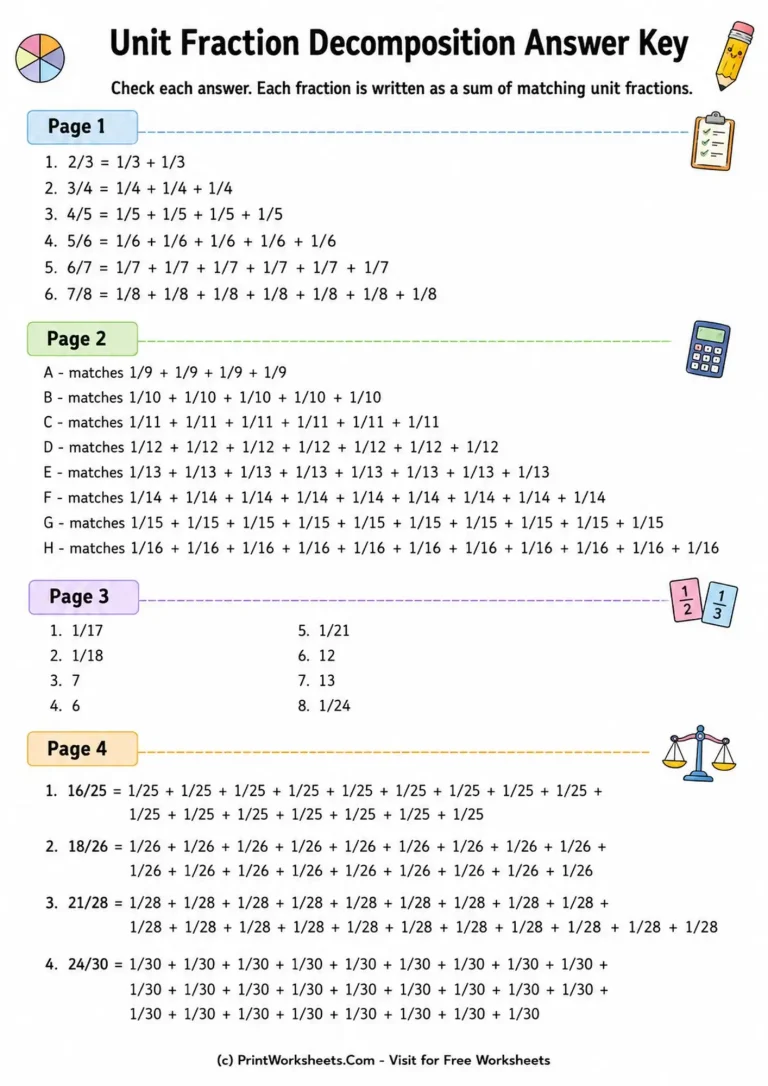
What are decompose fractions into unit fractions worksheets for grade 4? Decompose fractions into unit fractions worksheets for grade 4 are specialized instructional resources designed to teach the additive nature of fractions. By breaking down complex rational numbers into their foundational components, these materials explicitly demonstrate that any non-unit fraction is simply a sum of unit fractions (e.g., 3/4 = 1/4 + 1/4 + 1/4). Utilizing a targeted concrete-representational-abstract (CRA) instructional sequence, the printables provided at PrintWorksheets.Com help students transition from analyzing visual fraction models to manipulating abstract algebraic equations. This foundational mathematical framework is essential for meeting fourth grade math standards and preparing learners for advanced fractional operations such as addition, subtraction, and multiplication of rational numbers.
Establishing topical authority in fourth-grade mathematics requires a systematic progression of skills. Before learners can successfully decompose complex rational numbers, they must first possess a firm grasp of what a single fractional unit represents conceptually. We highly recommend utilizing our unit fractions on number lines worksheets to secure this prerequisite spatial reasoning and conceptual understanding of fractions prior to introducing the additive models contained within this packet.
What is Included in the PDF?
This comprehensive pedagogical packet from PrintWorksheets.Com is structured to sequentially increase cognitive load and test multiple dimensions of mathematical comprehension. Each distinct worksheet isolates a specific algebraic or visual calculation strategy:
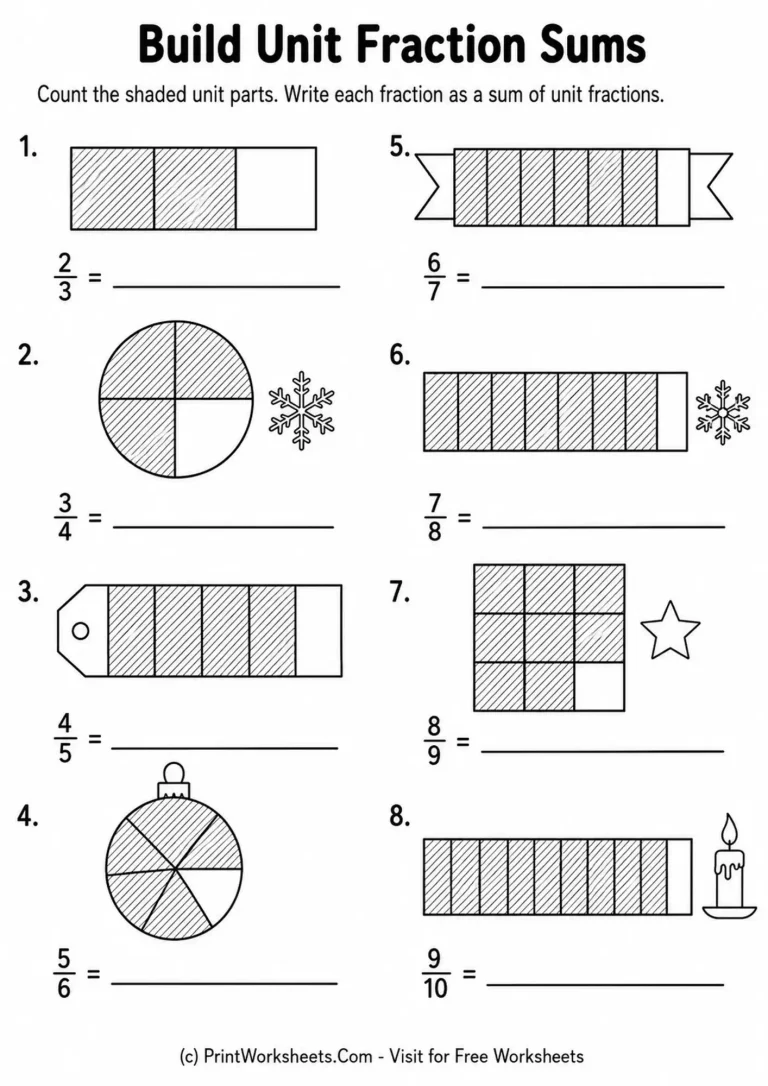
- Build Unit Fraction Sums: This section explicitly targets visual fraction models. Students must analyze shaded geometries (circles, tape diagrams, grids), identify the constituent unit parts, and translate the visual representation into a mathematical equation showing the sum of unit fractions.
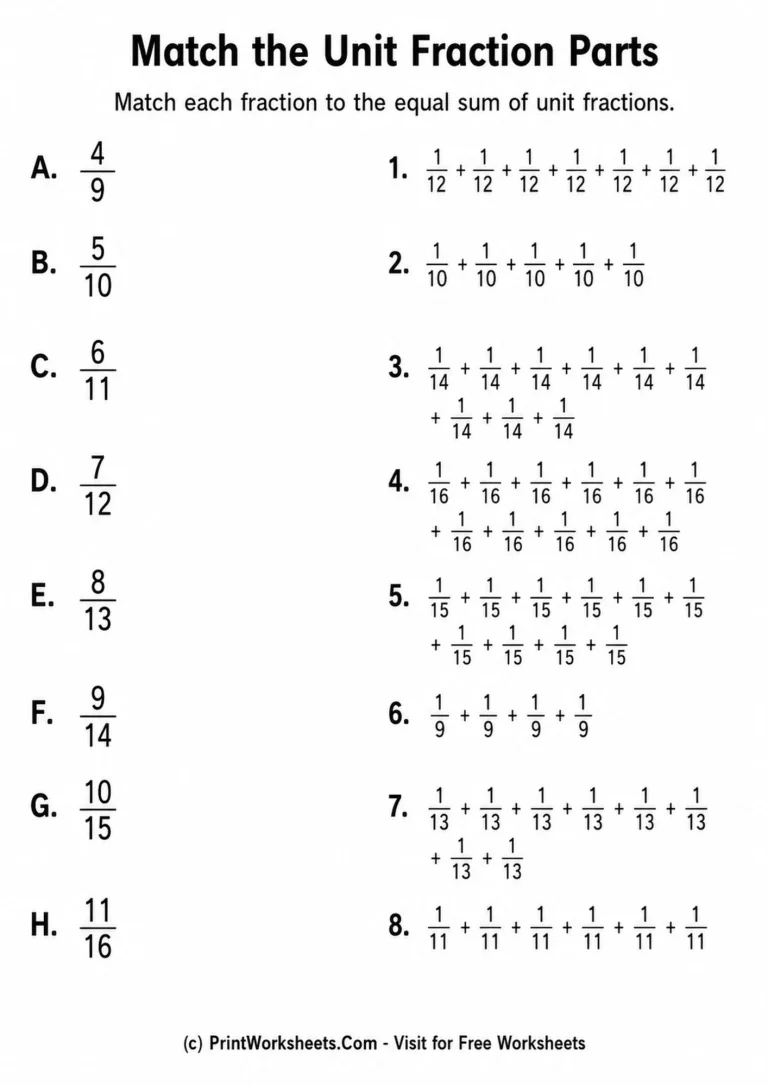
- Match the Unit Fraction Parts: A cognitive processing and fluency exercise. Students evaluate abstract fractional values and map them to their corresponding expanded unit sums. This removes visual scaffolding and forces reliance on algorithmic understanding.
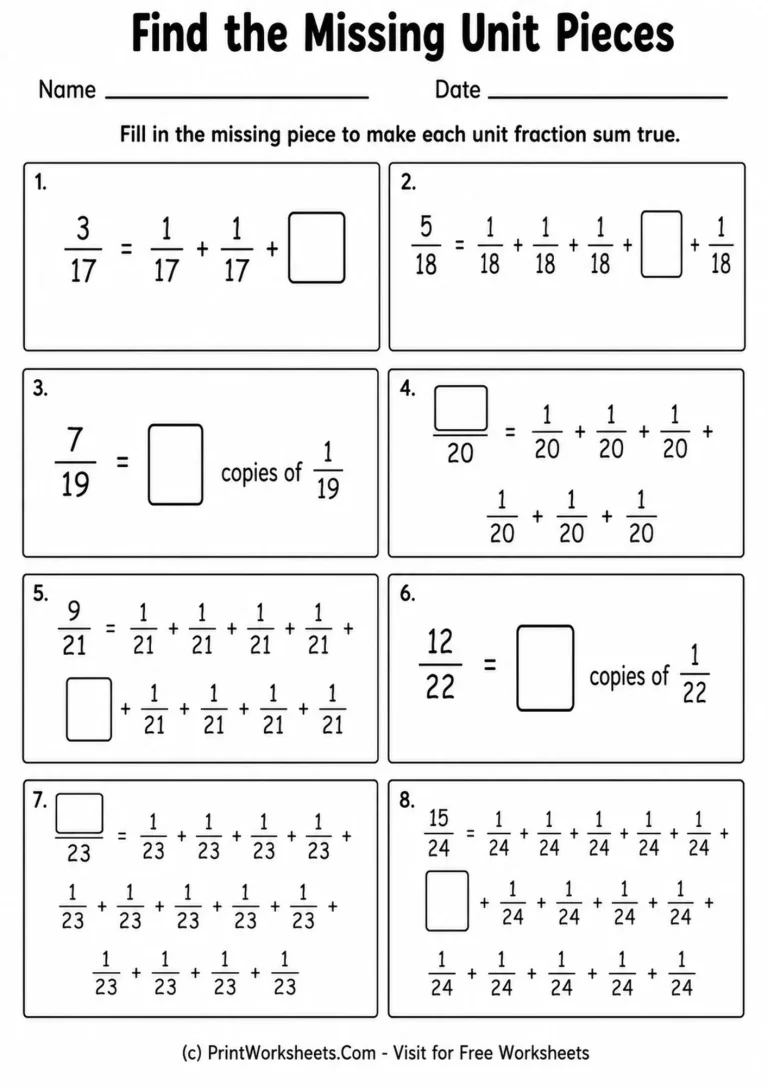
- Find the Missing Unit Pieces: Serves as an introduction to early algebraic thinking. Students are given a target fraction and an incomplete additive sequence. They must calculate the missing unit parts or determine the exact number of “copies” required to balance the equation, solidifying their grasp of rational number composition.
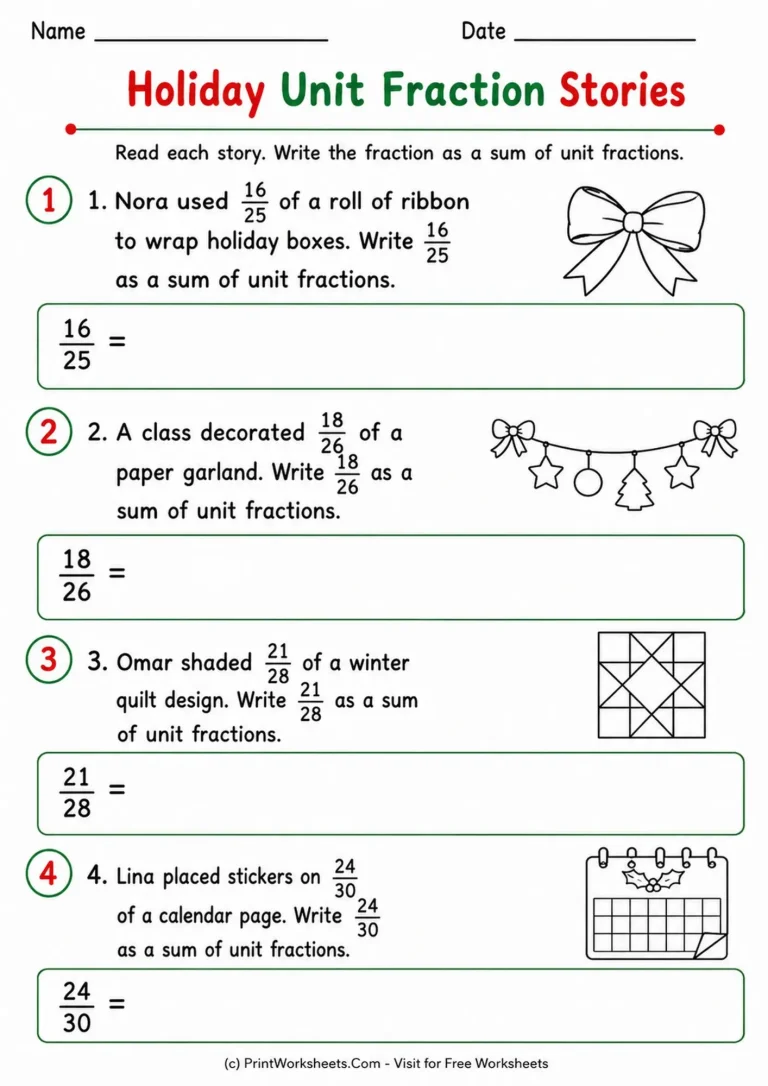
- Holiday Unit Fraction Stories: Contextualizes abstract arithmetic. Students extract numerical data from real-world word problems and write the target fractions as a sum of unit fractions, proving their conceptual understanding of fractions in applied scenarios.
The Pedagogical Benefits
The core academic utility of these decompose fractions into unit fractions worksheets for grade 4 lies in their ability to rectify common fractional misconceptions. A prevalent error in early mathematics is viewing a fraction like 4/5 as two distinct, unrelated whole numbers (a 4 and a 5) separated by a line. By physically forcing students to write out 1/5 + 1/5 + 1/5 + 1/5, these exercises restructure the student’s mental model, proving that 4/5 is actually four distinct iterations of the base unit 1/5. This mastery of the additive nature of fractions prevents operational errors when students eventually learn to add fractions with common denominators.
Furthermore, the sequential fading of visual scaffolds within this packet directly supports cognitive development. The initial use of visual fraction models lowers the affective filter and provides spatial proof of the equation. As the student progresses to the “Find the Missing Unit Pieces” section, the visual models are removed. This deliberate instructional design forces the brain to internalize the concept and rely strictly on working memory and algebraic logic to determine the sum of unit fractions, ensuring true mathematical mastery rather than rote mimicry.
How to Use
For maximum academic impact, educators should implement these materials based on the learner’s specific phase of mathematical acquisition:
- Direct Instruction Phase: Deploy the “Build Unit Fraction Sums” page on an interactive whiteboard. Model the process of isolating one shaded section, labeling it as a unit fraction, and subsequently adding the remaining sections to achieve the total.
- Guided Practice: Utilize the “Match the Unit Fraction Parts” worksheet during small group instruction. Require students to verbally read the equations aloud (e.g., “four-ninths equals one-ninth plus one-ninth plus one-ninth plus one-ninth”) to reinforce auditory mathematical processing.
- Formative Assessment: Administer the “Find the Missing Unit Pieces” page as an independent evaluation. A student’s ability to accurately identify the missing components of the equation indicates operational readiness for fourth grade math standards regarding fractional addition.
- Homework and Extension: Assign the “Holiday Unit Fraction Stories” to bridge the gap between abstract calculation and applied reading comprehension.
Frequently Asked Questions
Why is understanding the sum of unit fractions critical for fourth-grade students?
It establishes the operational foundation for all future fraction arithmetic. Before students can mathematically add or subtract fractions with like denominators, they must conceptually understand that fractions are composed of cumulative unit pieces. Decomposing fractions proves this additive nature of fractions definitively.
How do visual fraction models prevent mathematical misconceptions?
They provide spatial proof of algebraic concepts. When students see a tape diagram divided into eighths, and physically count seven individual 1/8 blocks to reach 7/8, it prevents the common misconception of treating the numerator and denominator as isolated whole numbers.
Can these decompose fractions into unit fractions worksheets for grade 4 be used for intervention?
Yes, the explicitly tiered design is optimal for Tier 2 interventions. If a student struggles with the abstract missing piece equations, educators can easily revert them to the visual fraction models page, allowing them to rebuild their conceptual understanding of fractions using concrete representations before attempting abstract logic again.