What are compare fractions with unlike denominators worksheets for grade 4? Compare fractions with unlike denominators worksheets for grade 4 are targeted mathematical resources designed to teach students how to evaluate the magnitude of rational numbers that do not share the same base unit. Unlike comparing fractions with matching bottom numbers, this advanced algebraic skill requires students to utilize equivalent fractions, cross-multiplication strategies, and common denominators to accurately determine greater than, less than, or equal values. By utilizing the structured printables from PrintWorksheets.Com, fourth-grade students can bridge the gap between visual spatial reasoning and abstract calculation, fulfilling critical fourth grade math standards.
Establishing topical authority in fraction mathematics dictates that students must master simpler comparative operations before tackling unlike bases. If learners are struggling to identify fractional magnitude, we strongly advise educators to first review our compare fractions with same denominators worksheets to solidify foundational part-whole relationships before introducing the complexities of unlike denominators found in this packet.
What is Included in the PDF?
This pedagogical resource from PrintWorksheets.Com is specifically curated to move students through the Concrete-Representational-Abstract (CRA) instructional framework. The packet includes three mathematically verified worksheets, each isolating a specific stage of fractional reasoning:
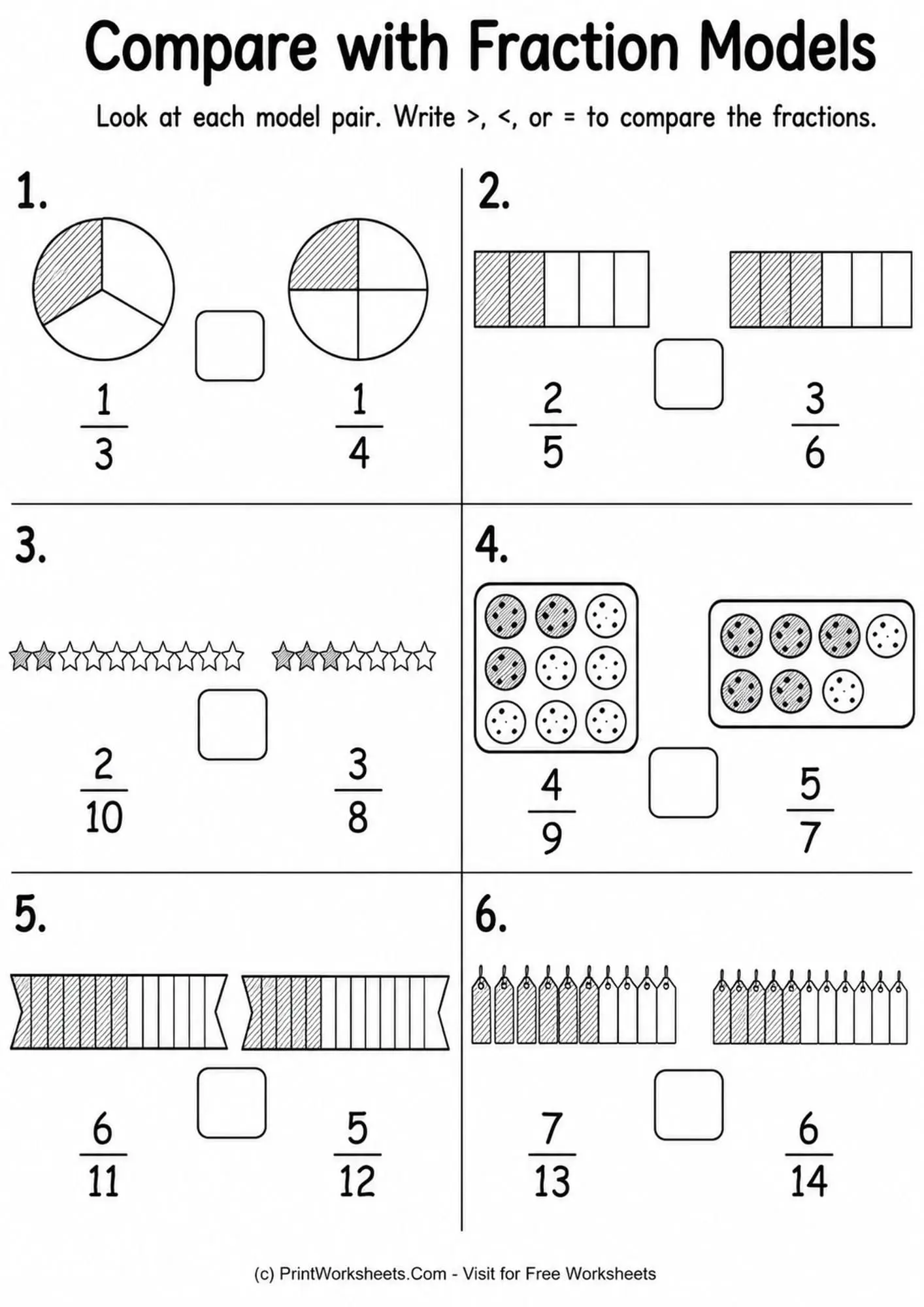
- Compare with Fraction Models: This page serves as the representational scaffold. Students evaluate two distinct geometries (circles, tape diagrams, sets) to visually determine which shaded area is larger. By writing the comparison symbol directly beneath the visual models, students connect spatial size to abstract numerical value without immediately needing to calculate common denominators.
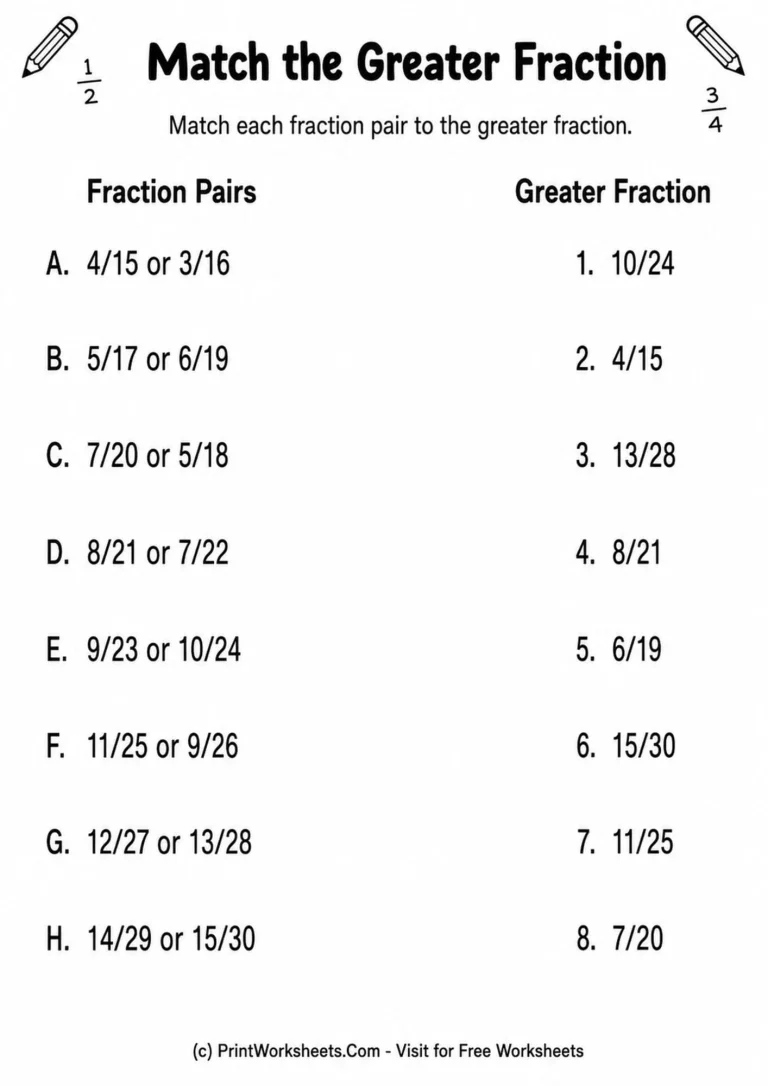
- Match the Greater Fraction: This exercise removes visual models, forcing cognitive reliance on calculation. Students evaluate a pair of fractions with unlike denominators and must match the pair to the fraction possessing the higher mathematical magnitude. This requires internalizing cross-multiplication strategies or mental equivalence conversions.
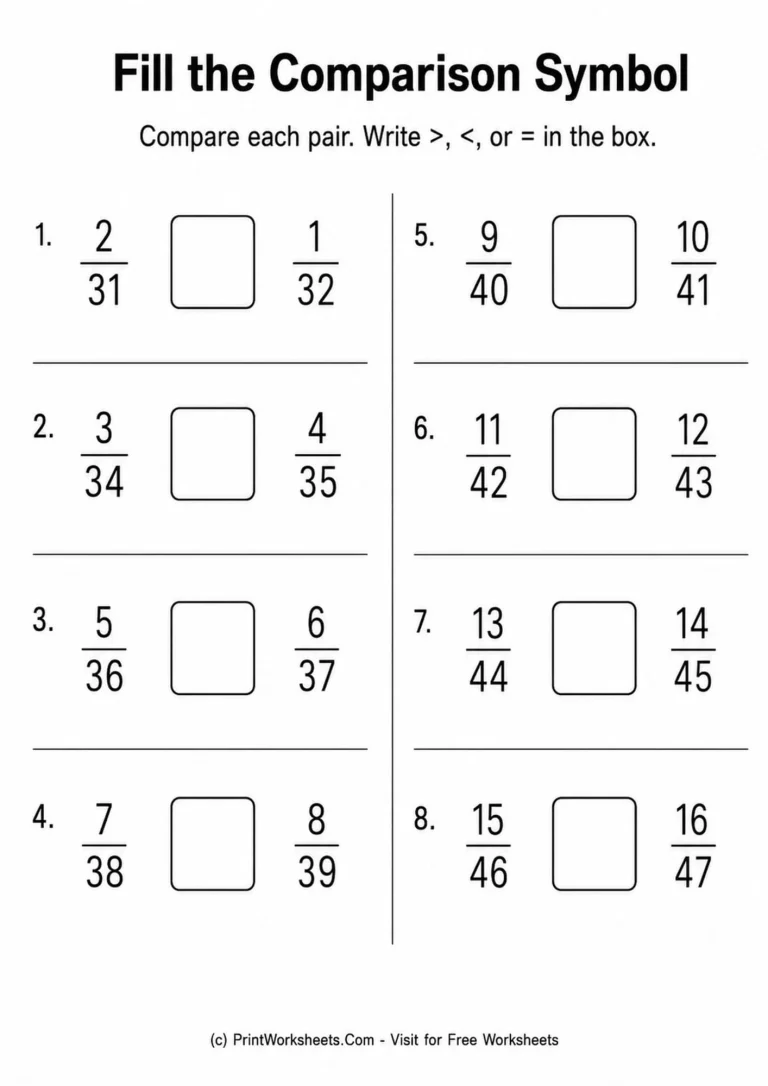
- Fill the Comparison Symbol: A strict fluency and abstract reasoning test. Students are presented with bare equations and must insert the correct greater than, less than, or equal symbol. This format ensures automaticity in generating common denominators to verify relationships between complex rational numbers.
The Pedagogical Benefits
The academic efficacy of these compare fractions with unlike denominators worksheets for grade 4 lies in their structured deconstruction of algorithmic dependencies. Many students attempt to compare fractions by simply looking at the numerators or denominators in isolation (e.g., mistakenly assuming 2/10 is larger than 3/8 because 10 is larger than 8). By providing explicit visual models on the first page, these worksheets physically disprove that misconception, proving that mathematical magnitude is determined by the relationship between the numerator and denominator, not the raw digits themselves.
Furthermore, the sequential removal of visual aids ensures that students do not become dependent on pictorial representations. As they progress to the “Fill the Comparison Symbol” section, they are forced to apply arithmetic properties, specifically finding the lowest common multiple (LCM) to generate equivalent fractions. This rigorous transition from visual proof to algorithmic execution is what cements true mathematical reasoning and prepares students for more complex operations involving the addition and subtraction of unlike rational numbers.
How to Use
To maximize knowledge retention, educators and homeschool instructors should deploy these materials systematically:
- Initial Instruction: Use the “Compare with Fraction Models” worksheet on an interactive board. Ask students to verbally explain why one shaded area is larger than another before writing the symbol, linking spatial language to mathematical symbols.
- Guided Practice Groups: Implement the “Match the Greater Fraction” page during small group sessions. Require students to explicitly state the common denominator they used to arrive at their answer (e.g., “I converted 4/15 and 3/16 using a common denominator to prove 4/15 is larger”).
- Independent Assessment: Administer the “Fill the Comparison Symbol” page as a quiet, independent task to measure individual fluency and identify students requiring Tier 2 intervention for cross-multiplication strategies.
Frequently Asked Questions
Why do students struggle to compare fractions with unlike denominators?
Students often apply whole-number logic to rational numbers. When a student sees denominators of 5 and 12, their instinct is to assume the fraction with the 12 is larger because 12 is a larger whole number. They fail to realize that a larger denominator actually means the whole has been divided into smaller pieces.
What is the most effective strategy for comparing these complex fractions?
Generating equivalent fractions using a common denominator is the most reliable method. By multiplying the numerator and denominator of each fraction by the necessary factor to align their bases, students can easily compare the resulting numerators to determine mathematical magnitude.
Can visual models completely replace algorithmic calculation?
No, visual models are a temporary scaffold. While crucial for establishing initial conceptual understanding, visual models become inefficient as fractions grow more complex. Compare fractions with unlike denominators worksheets for grade 4 explicitly transition students away from models toward abstract arithmetic calculation.