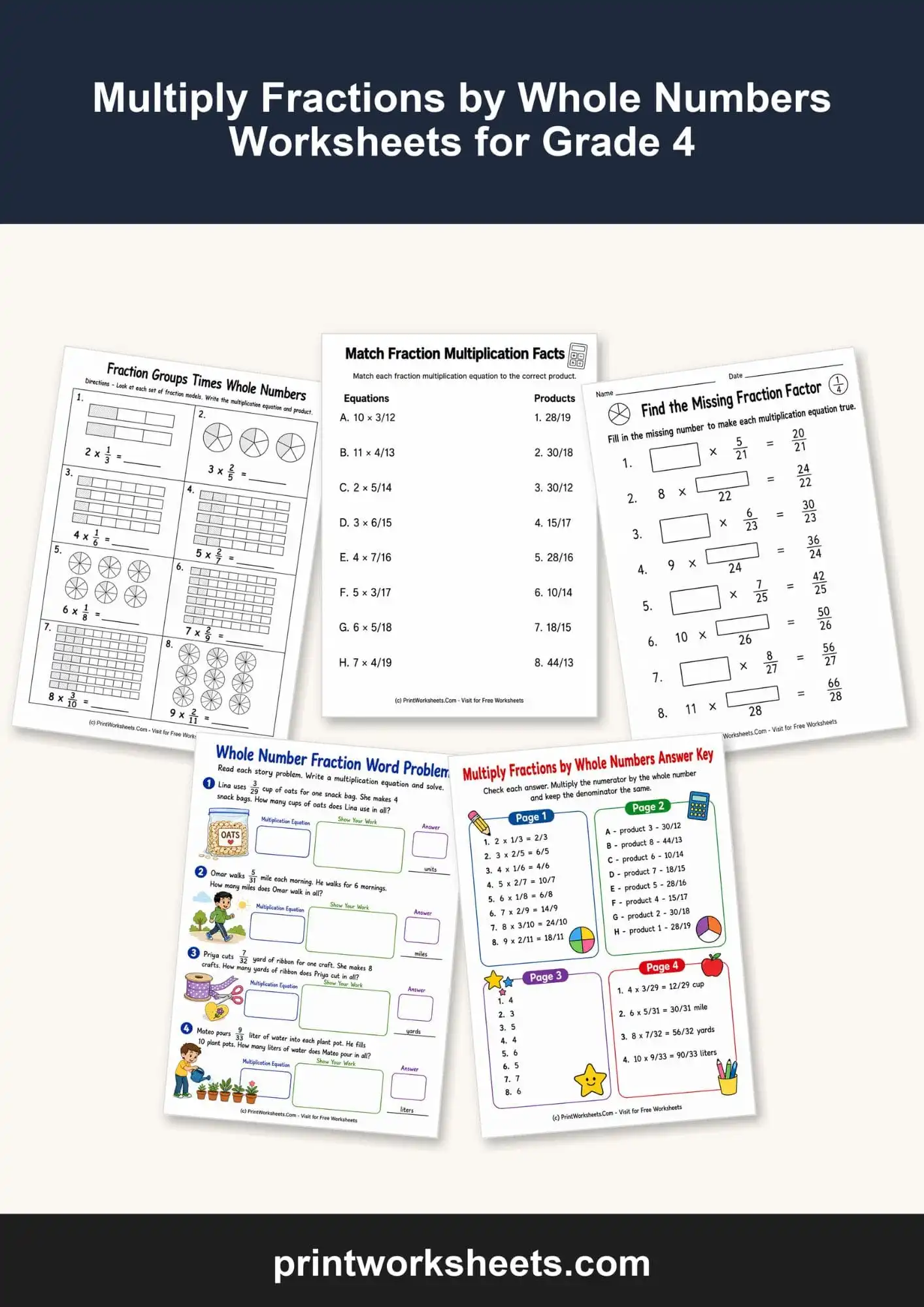
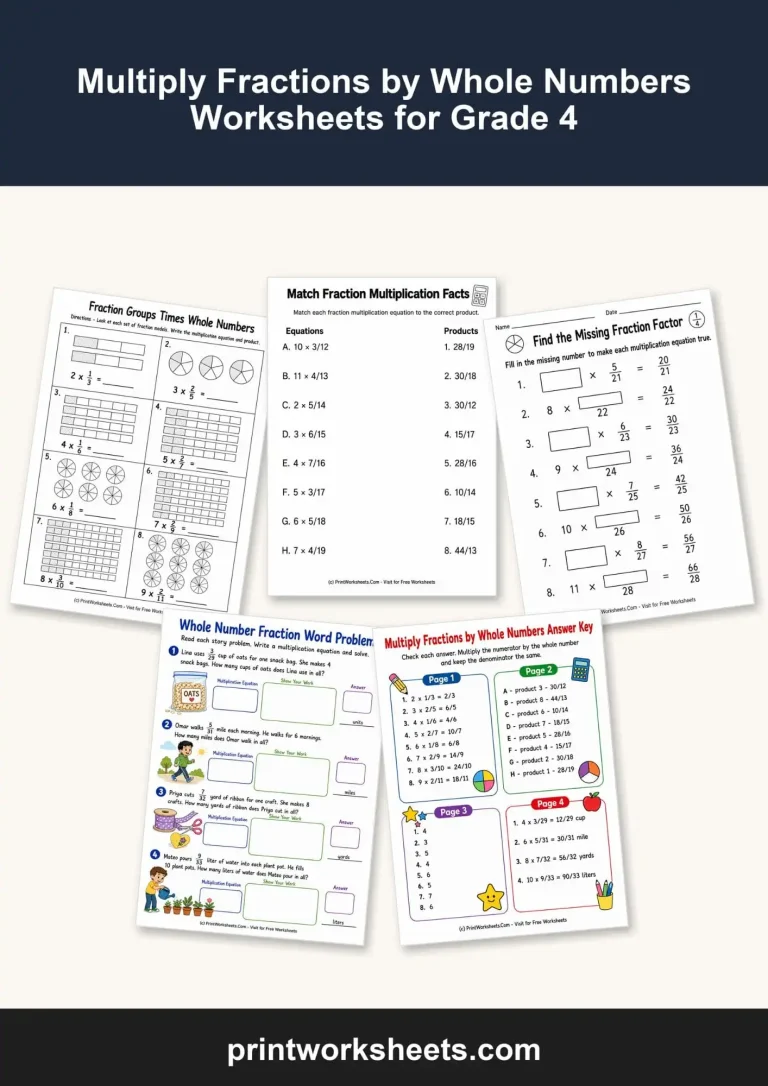
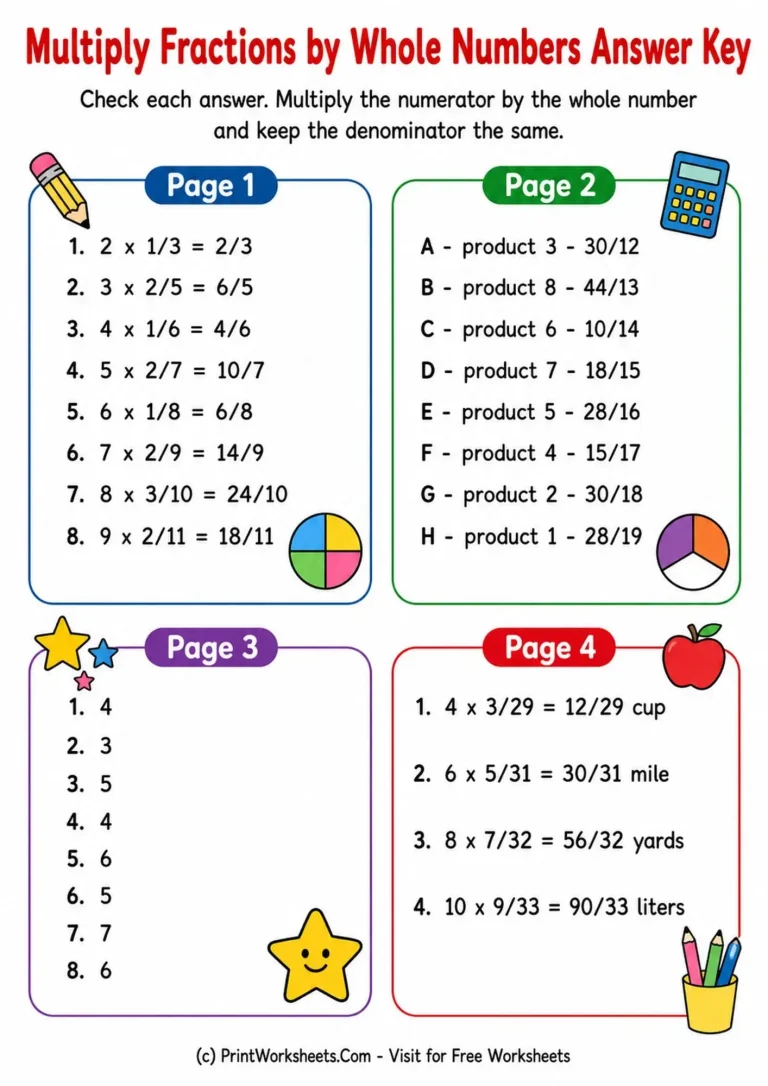
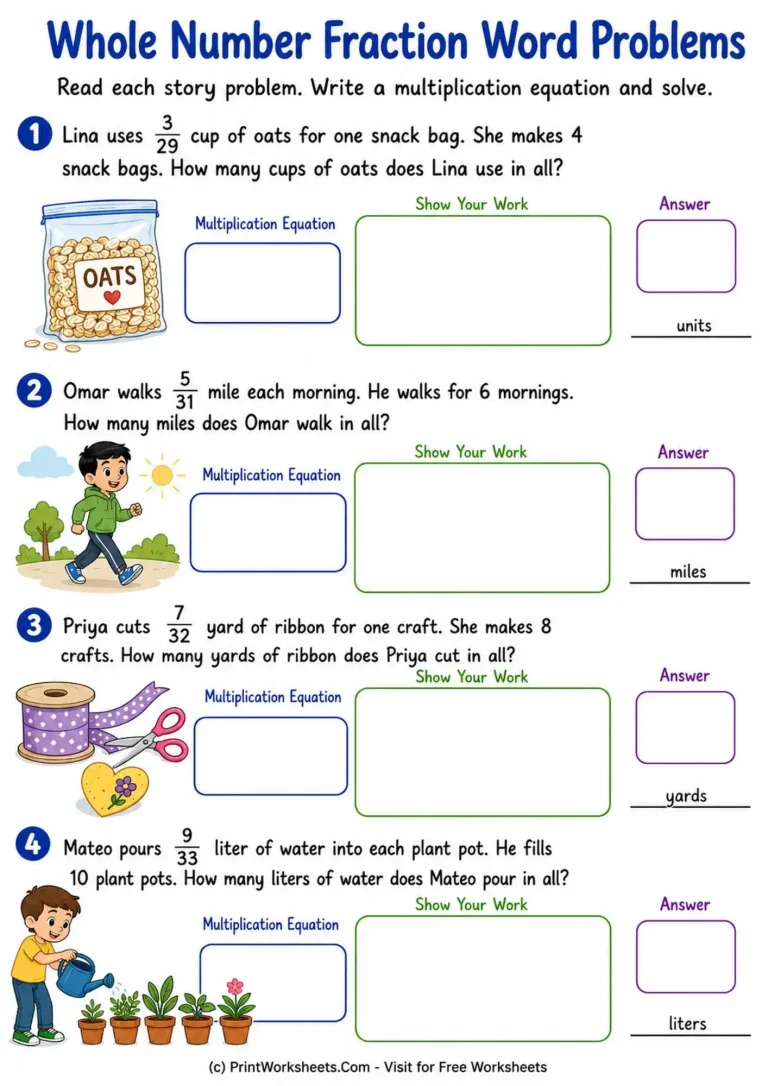
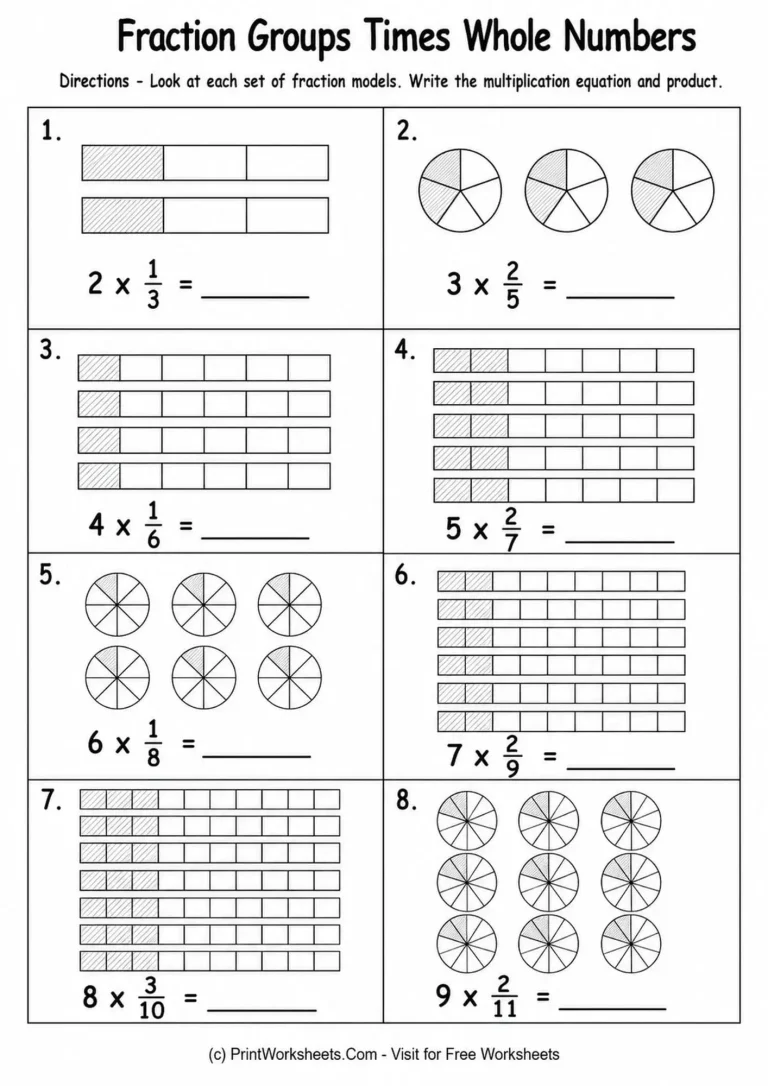
Finding quality resources that bridge the gap between visual addition and abstract multiplication can be difficult, which is why we created these multiply fractions by whole numbers worksheets for grade 4. When fourth graders first encounter a problem like 4 x 1/6, their instinct is to use repeated fraction addition (1/6 + 1/6 + 1/6 + 1/6). While this works for small numbers, it becomes incredibly frustrating when the multiplier is large. These pages are designed to show students exactly why multiplying the numerator is the most efficient strategy.
Because these multiplication equations often result in top-heavy answers (like 24/10), it is very helpful if your students have already practiced with mixed numbers and improper fractions before starting this unit. Knowing how to convert their final products will make these exercises much more meaningful.
Using Our Multiply Fractions by Whole Numbers Worksheets for Grade 4
This four-page math packet is structured to slowly remove visual scaffolds. Instead of handing out a page of raw equations, we start with concrete models and build toward algebraic reasoning:
- Fraction Groups Times Whole Numbers: The crucial visual step. Students look at a series of shaded shapes (for example, 3 groups of 2/5) and write out the multiplication equation. This physically proves that only the number of pieces changes, while the size of the pieces (the denominator) remains exactly the same.
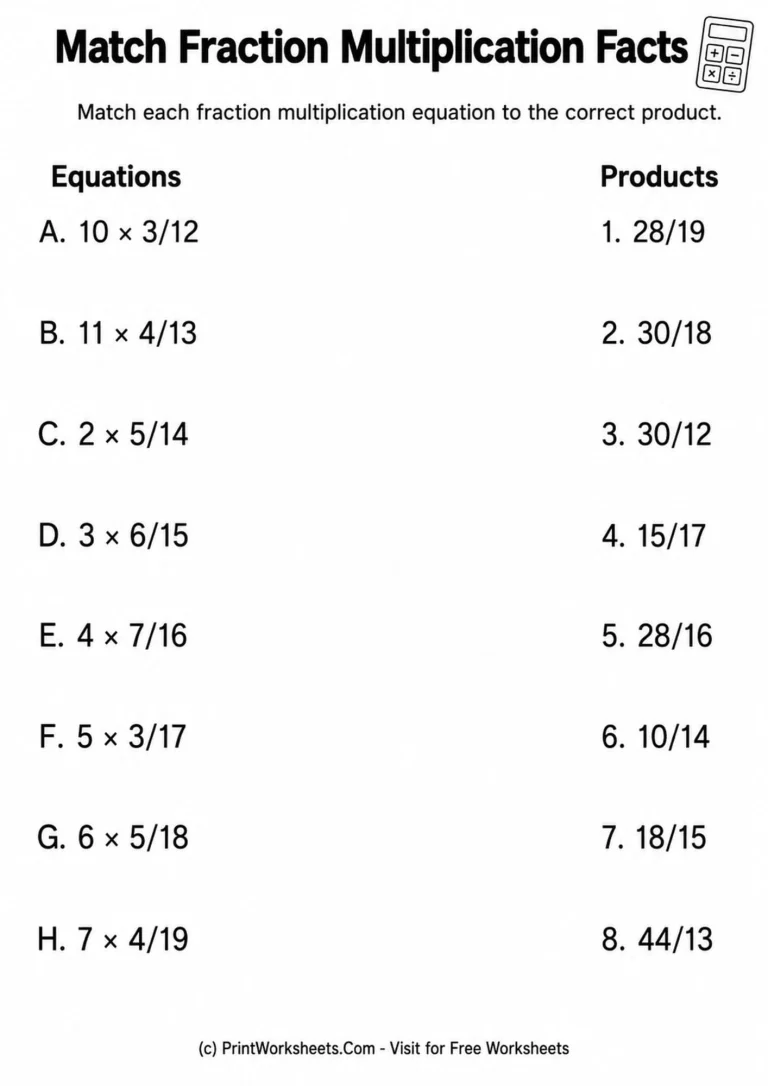
- Match Fraction Multiplication Facts: A straight fluency check. Students match a standard equation on the left to its correct improper fraction product on the right.
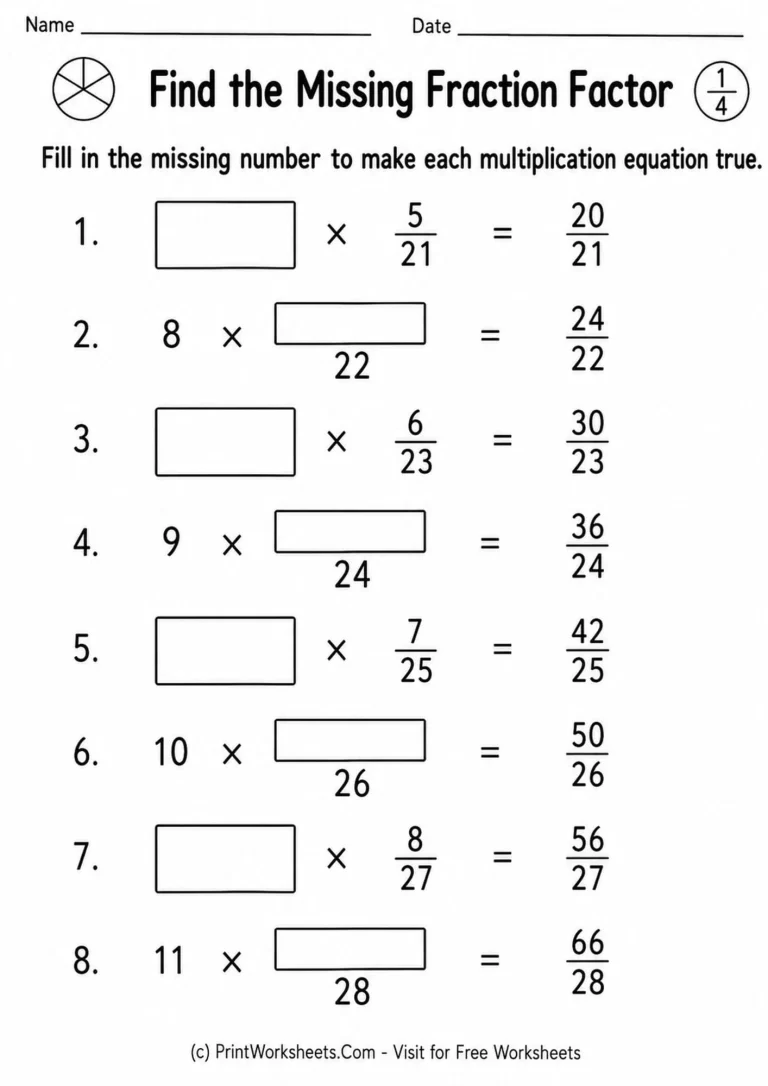
- Find the Missing Fraction Factor: This page challenges early algebraic thinking. Students are given an equation with a missing piece (e.g., 8 x [ ]/22 = 24/22) and must work backward to find the missing numerator or whole number.
- Whole Number Fraction Word Problems: Four real-world scenarios. Students read a short story, extract the correct whole number and fractional measurement, and solve the equation in the workspace provided.
Common Student Mistakes
The single most common mistake 4th graders make when multiplying a fraction by a whole number is multiplying both the numerator and the denominator (e.g., thinking 3 x 2/5 = 6/15). They confuse the rules of multiplication with the rules for making equivalent fractions. To correct this, pull out the first page of our packet. Point to the visual fraction circles and ask, “Did the size of the slices change, or just how many slices we have?” This visual proof stops the denominator mistake in its tracks.
Classroom Ideas
The matching worksheet makes a fantastic morning work activity to build quick retrieval speed. For the “Find the Missing Fraction Factor” page, we highly suggest letting students work in pairs. Having them verbally explain to a partner how they figured out the missing number drastically improves their math communication skills.