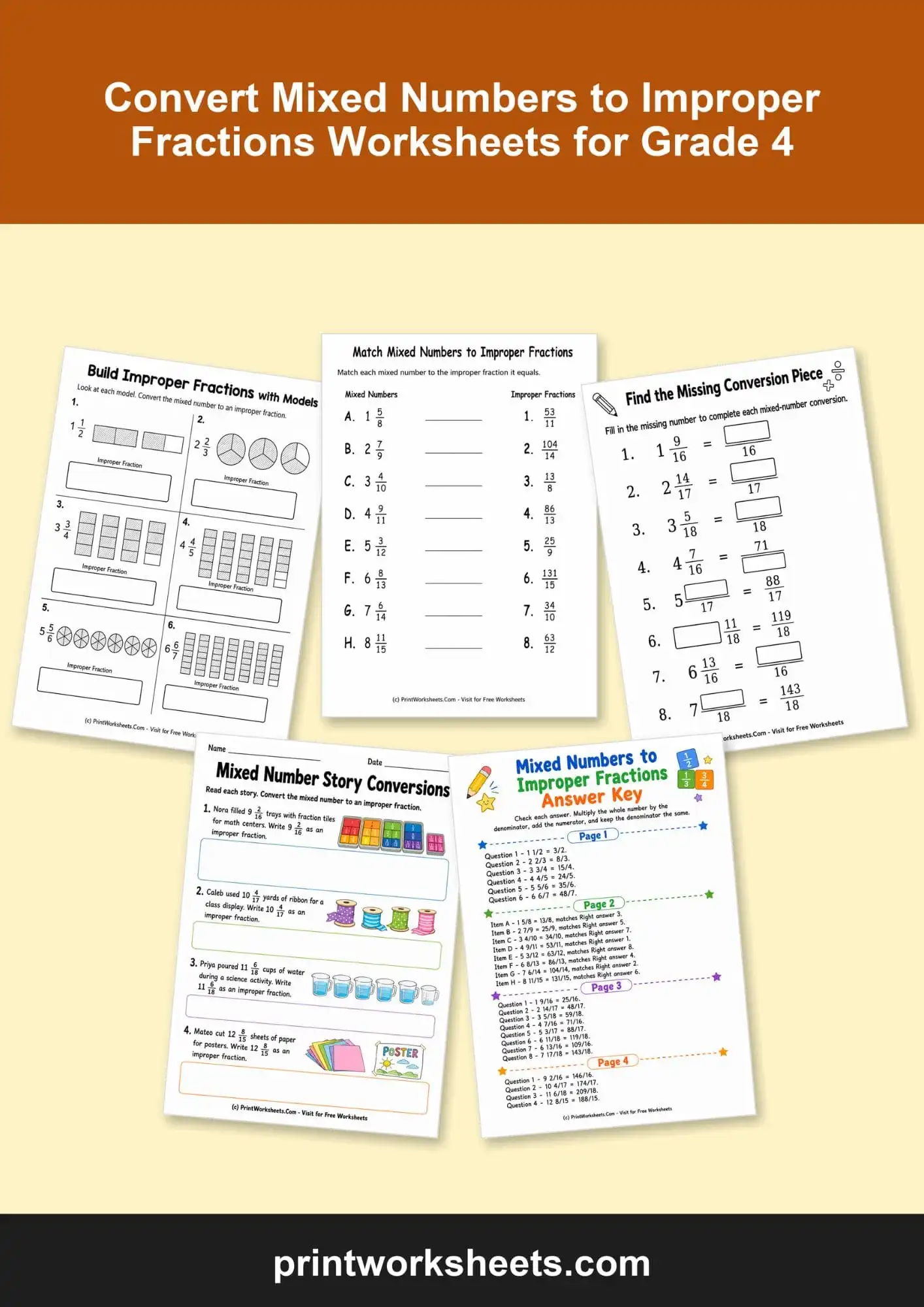
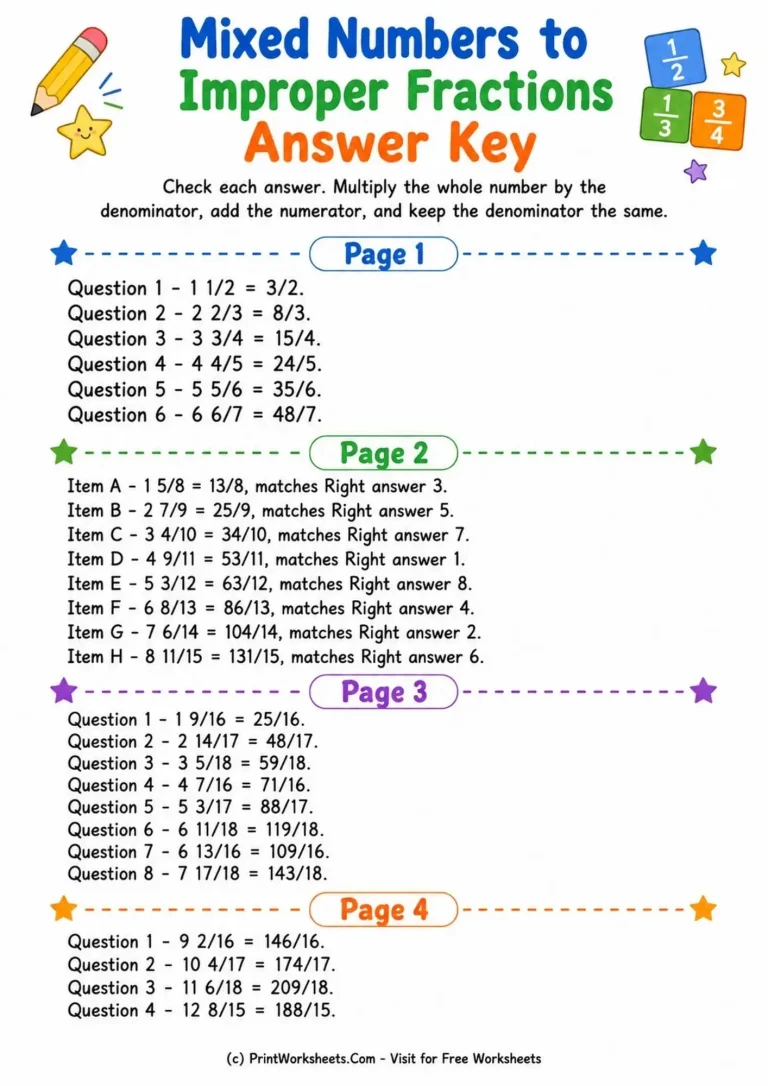
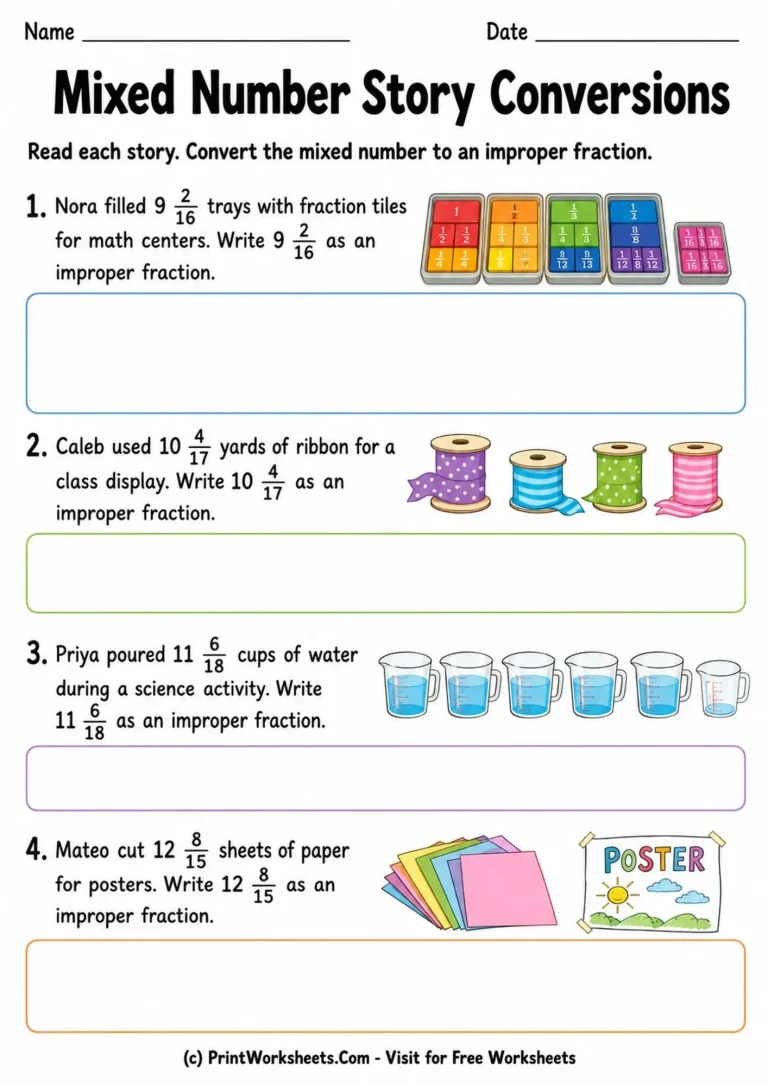
Teaching students the “multiply the whole number by the denominator and add the numerator” rule is a classic 4th-grade math lesson. However, if students simply memorize this algorithm without understanding the *why* behind it, they often mix up the steps later on. These convert mixed numbers to improper fractions worksheets for grade 4 are structured to build genuine conceptual understanding before requiring students to execute abstract arithmetic.
For a broader overview of how these two fraction forms relate to one another, you can also review our general mixed numbers and improper fractions worksheets for grade 4. Since the conversion process relies heavily on multiplication facts, ensuring your students have practiced with equivalent fractions with multiplication worksheets will make this transition much smoother.
Worksheet Activities
This four-page packet slowly removes visual scaffolding to help students build independent calculation skills. Here is the breakdown of the included activities:
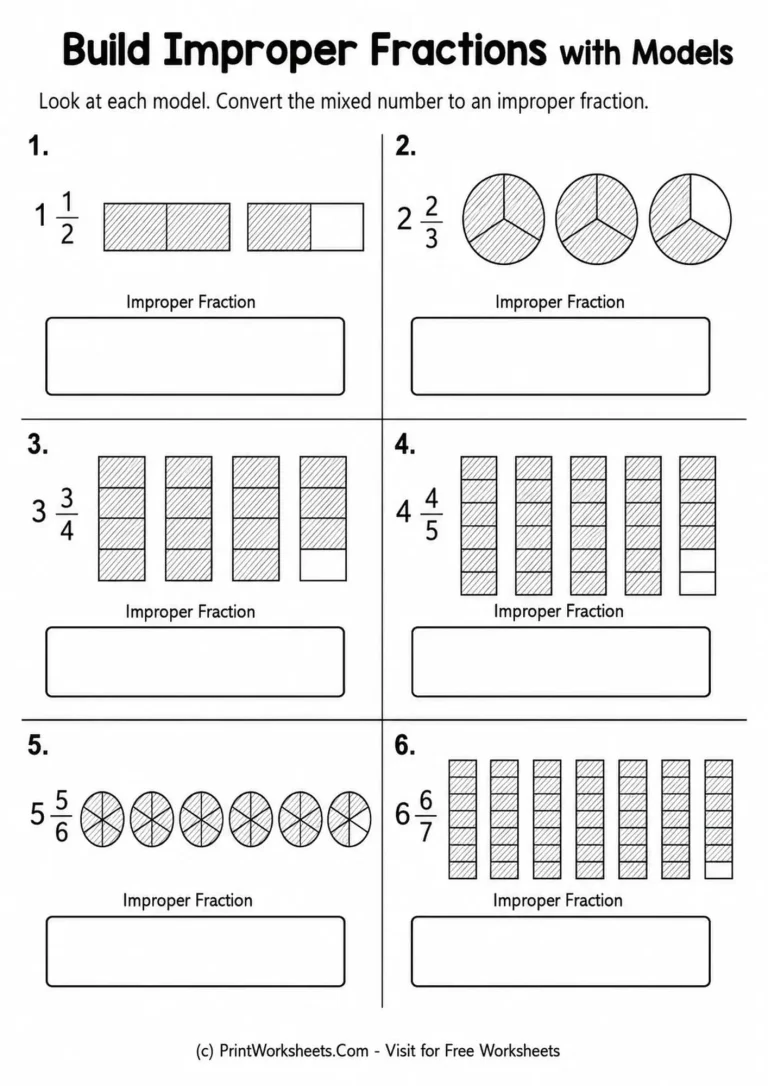
- Build Improper Fractions with Models: Students count the fully shaded shapes and the remaining pieces to write the improper fraction. Seeing that 3 whole shapes divided into fourths plus 3 extra fourths equals 15 total pieces visually proves why the multiplication algorithm works.
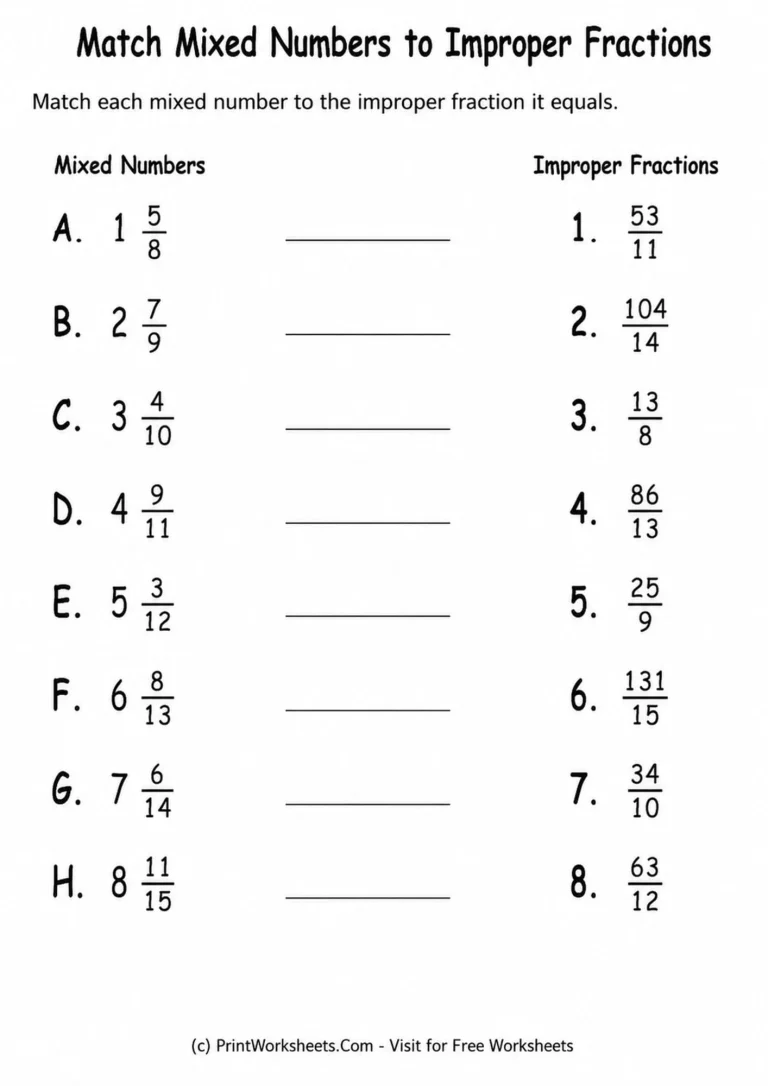
- Match Mixed Numbers to Improper Fractions: A calculation-heavy page where students apply the standard conversion algorithm and match their results to the correct improper fraction in the opposite column.
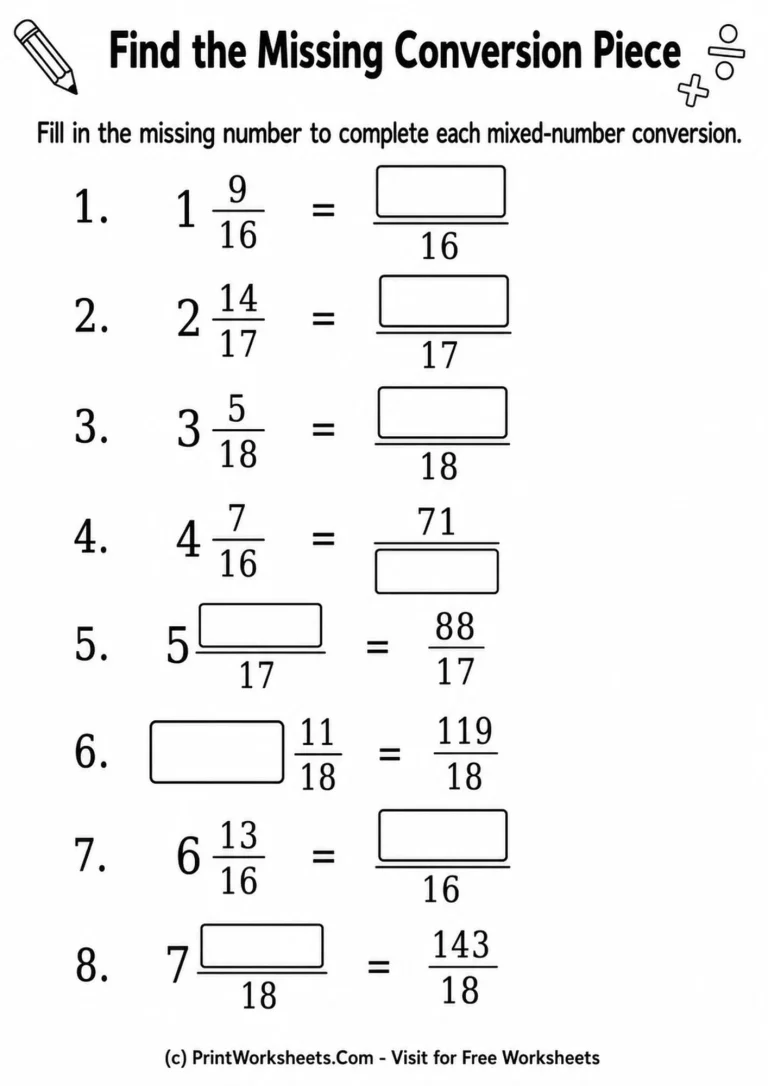
- Find the Missing Conversion Piece: This page challenges students to think algebraically. Instead of just solving the equation straight through, they must find missing numerators or denominators to balance the conversion statement (e.g., finding the missing whole number when given 94/17).
- Mixed Number Story Conversions: Four short word problems that place the mathematical equations into real-world contexts, such as measuring yards of ribbon or pouring cups of water.
Common Student Mistakes
The most frequent mistake students make when converting mixed numbers is simply adding the whole number directly to the numerator (e.g., turning 3 1/4 into 4/4). They forget that the whole number represents groups of the denominator. By starting your lesson with the visual models provided on page one of this set, you can physically point to the whole shapes and ask, “How many fourths are inside these 3 whole shapes?” This grounds the arithmetic in reality.
Teaching Tips
Use the matching page as a quick formative assessment or morning work assignment to check for algorithm fluency. If you notice a student struggling with the “Find the Missing Conversion Piece” page, provide them with a whiteboard and have them draw out the fraction models. Sometimes stepping back into the visual phase is all it takes to get them past a roadblock.