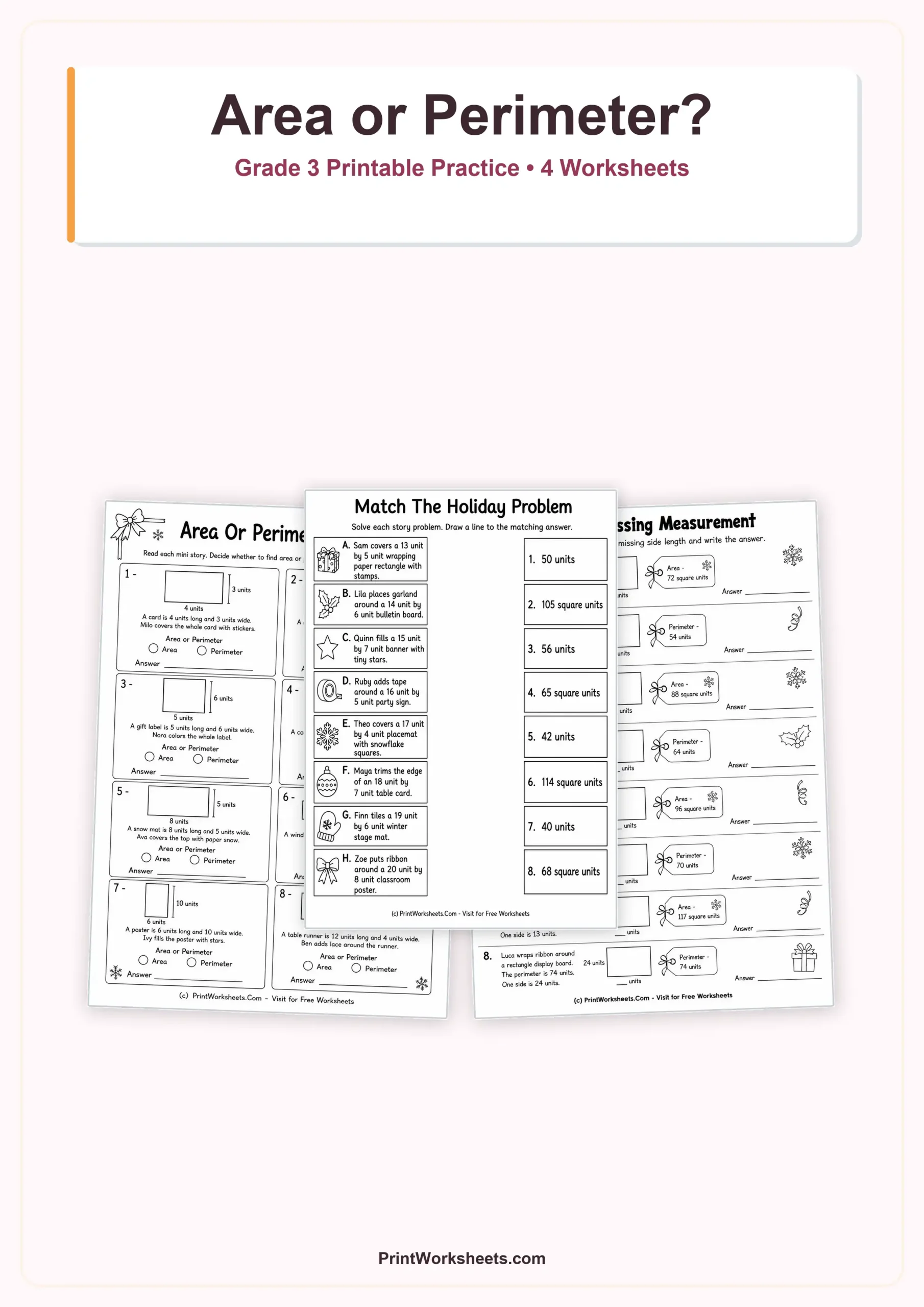
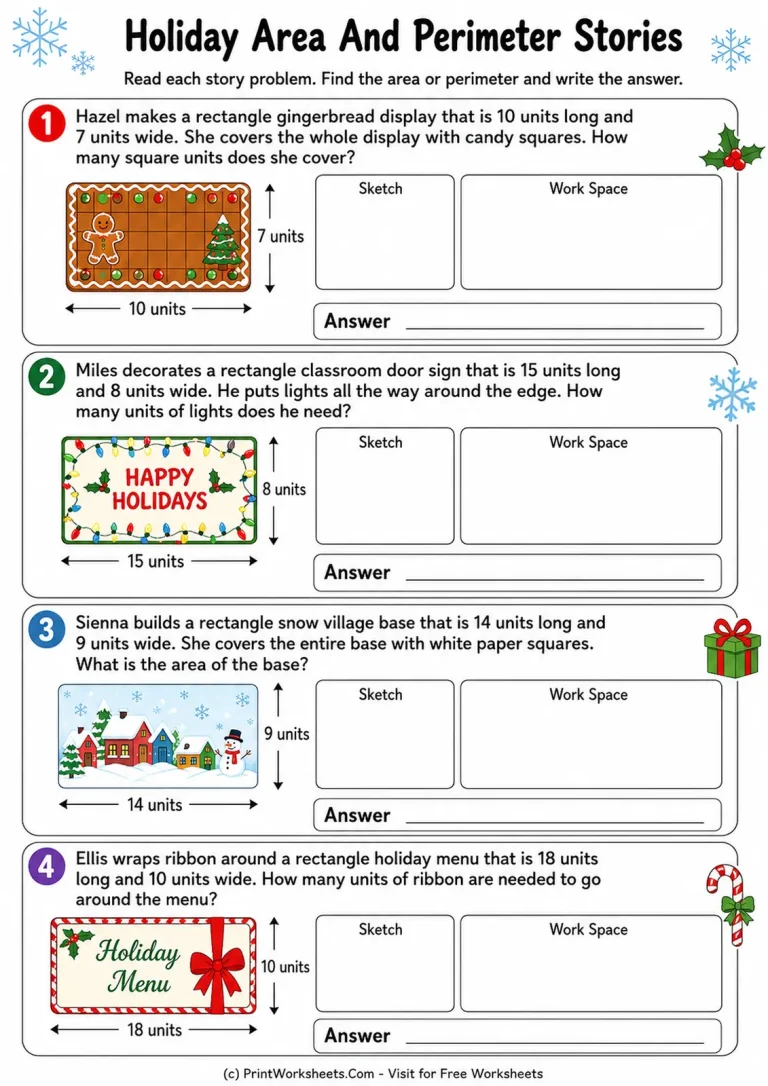
Area and perimeter word problems worksheets give Grade 3 students practice deciding which measurement a story actually asks for before they calculate. This printable set uses rectangles in familiar situations such as cards, patches, trays, posters, bulletin boards, gift boxes, and holiday displays. Students read each clue, notice whether the story describes covering a surface or going around an edge, and then use the given side lengths to solve. The activities move from choosing between area and perimeter to matching, reverse-solving missing side lengths, and completing longer visual story problems with room to sketch and work.
Area and Perimeter Word Problems Worksheets for Grade 3
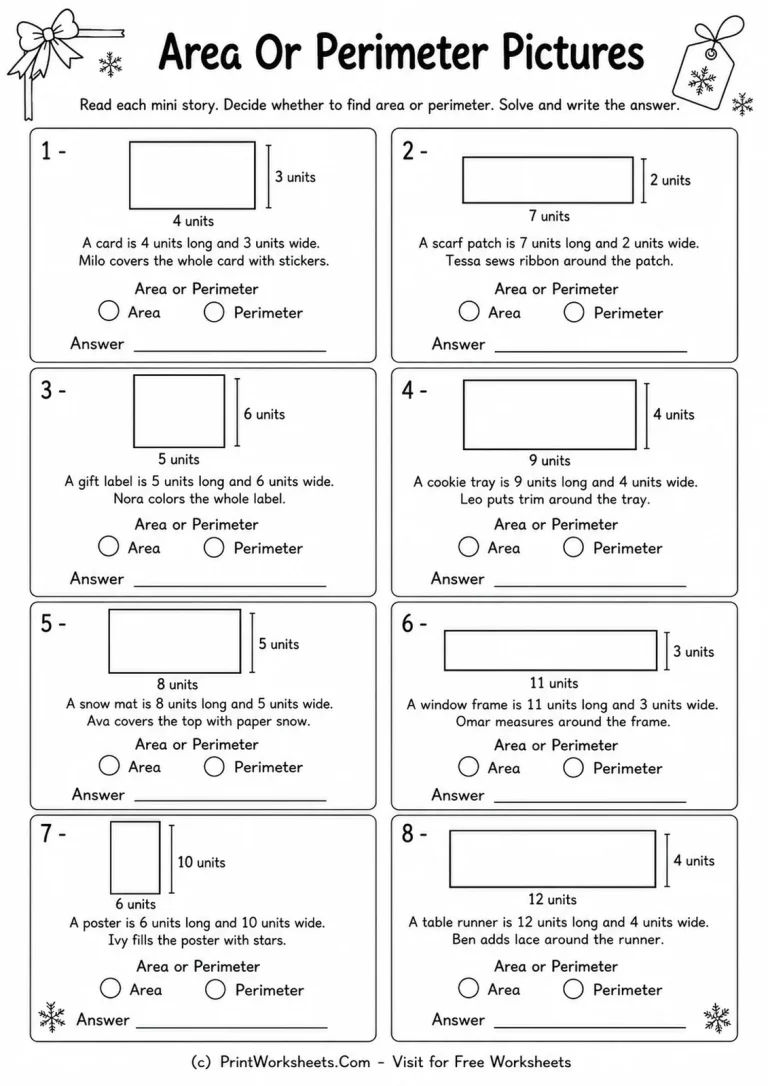
The first worksheet, Area Or Perimeter Pictures, presents eight short rectangle stories with labeled dimensions. A 4-by-3 card is covered with stickers, a 7-by-2 scarf patch gets ribbon around it, a 9-by-4 cookie tray is trimmed around the edge, and a 12-by-4 table runner gets lace around it. For each problem, students choose Area or Perimeter and write the numerical answer. This format makes the language clue part of the math: words such as covers, fills, around, and trim help students connect the situation to square units or linear units.
Match Story Problems to Area or Perimeter Answers
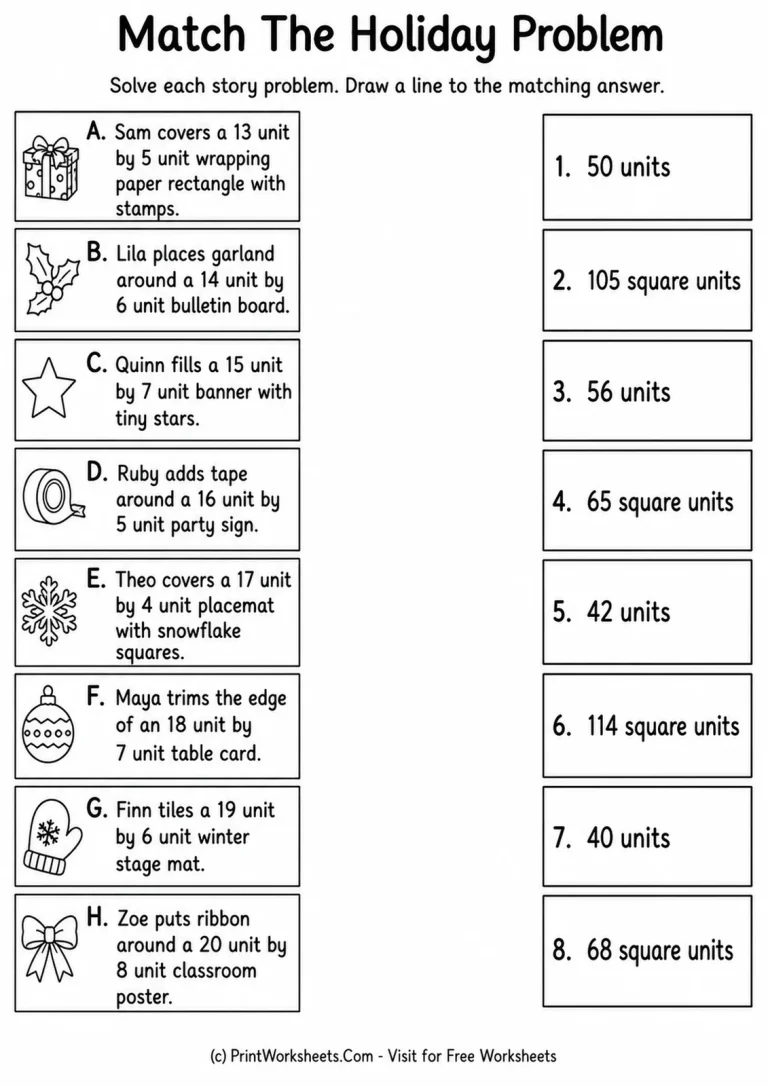
The matching worksheet changes the response format while keeping the same core reasoning. Eight holiday-themed problems appear on the left and eight answers appear on the right. Students solve situations such as covering a 13-by-5 wrapping-paper rectangle, placing garland around a 14-by-6 bulletin board, filling a 15-by-7 banner with stars, and putting ribbon around a 20-by-8 classroom poster. Because the answer bank mixes perimeter totals in units with area totals in square units, students must select both the correct operation and the correct measurement label. The one-to-one matching structure also gives students a quick way to check whether every answer has been used once.
Find Missing Rectangle Measurements
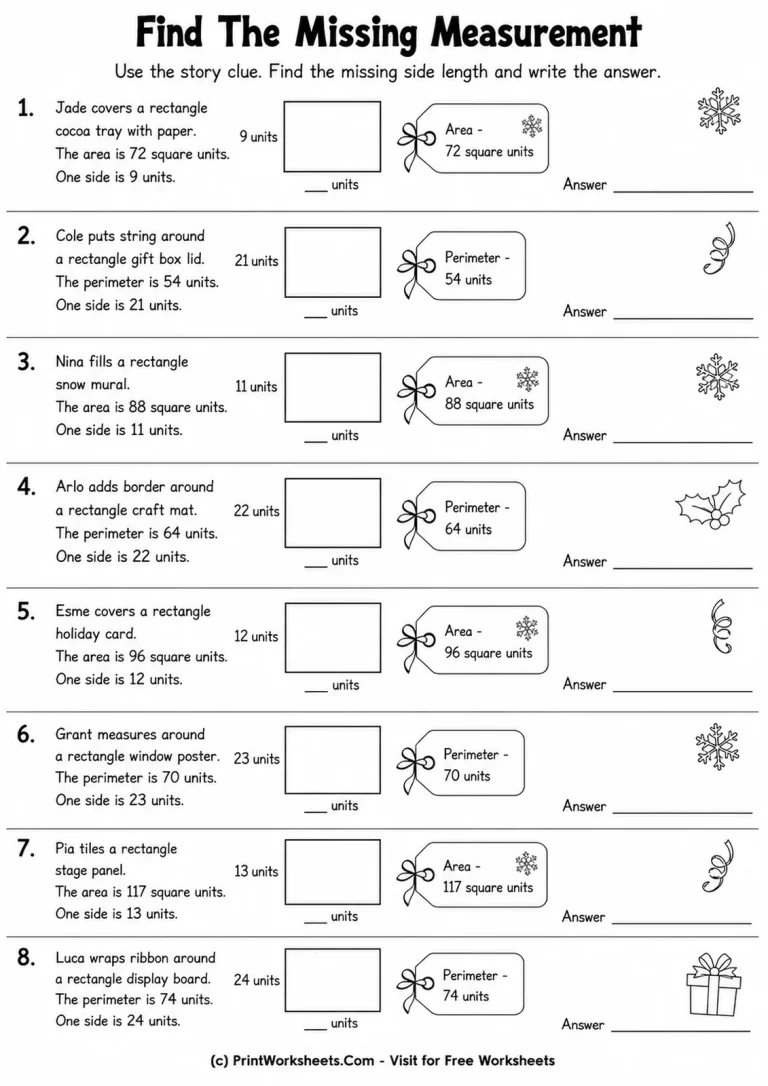
The next activity asks students to work backward. Instead of always finding area or perimeter from two known side lengths, students are given a total measurement and one side of a rectangle. For example, one problem gives an area of 72 square units and a side length of 9 units, while another gives a perimeter of 54 units and one side of 21 units. Additional problems use totals such as 88 square units, 64 units of perimeter, 96 square units, 70 units of perimeter, 117 square units, and 74 units of perimeter. Students find the missing side and record it beside the rectangle and on the answer line. This makes the set useful after students understand the basic formulas and are ready to reason in reverse.
If students need a more concrete area model first, the area with unit squares worksheets for Grade 3 provide grid-based practice before these story problems. For extra work on adding side lengths around shapes, the perimeter of polygons worksheets for Grade 3 focus specifically on perimeter calculation.
Holiday Area and Perimeter Stories with Work Space
The final worksheet uses four larger visual story problems and gives students separate Sketch, Work Space, and Answer areas. Hazel covers a 10-by-7 gingerbread display, Miles puts lights around a 15-by-8 classroom door sign, Sienna covers a 14-by-9 snow village base, and Ellis wraps ribbon around an 18-by-10 holiday menu. The illustrations support the context, but the dimensions and story language still carry the mathematical information. Students can draw a rectangle model, write a multiplication or addition equation, and then record the final measurement on a dedicated answer line.
Ways to Use This Grade 3 Printable Set
These worksheets work well for independent practice, small-group review, math centers, homework, or a quick check after teaching rectangle area and perimeter. A practical sequence is to begin with the choose-area-or-perimeter page, continue with the matching activity, move to the missing-side challenge, and finish with the longer visual stories. That progression keeps the focus on meaning rather than memorizing a formula in isolation. Students repeatedly decide whether a context describes the inside of a rectangle or the distance around it, then calculate and label the result appropriately.
Use the set when you want Grade 3 students to practice reading measurement language as carefully as they practice computation. The mix of short clues, matching, reverse reasoning, and visual word problems gives students several ways to show that they understand both area and perimeter in real rectangle situations.