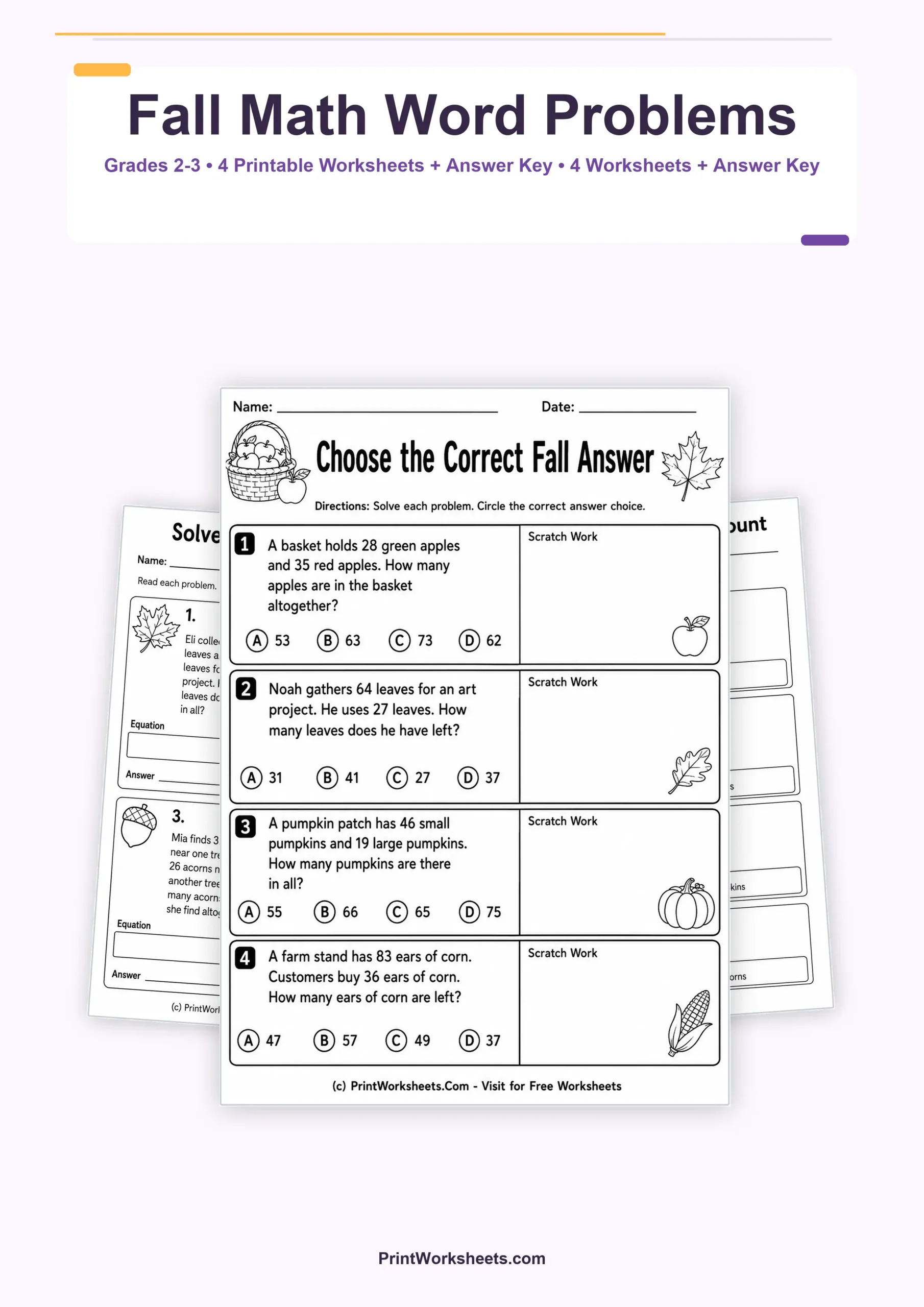
These fall math word problems give second- and third-grade students a clear path from basic addition and subtraction stories to missing-number reasoning and two-step problem solving. The four student worksheets use familiar seasonal settings such as apples, leaves, acorns, pumpkins, corn, and fall crafts, so students can focus on understanding the math without needing specialized background knowledge. Each page changes the response format, helping children practice not only calculation but also deciding which operation makes sense, organizing work, and checking whether an answer fits the story.
Fall Math Word Problems for Addition and Subtraction
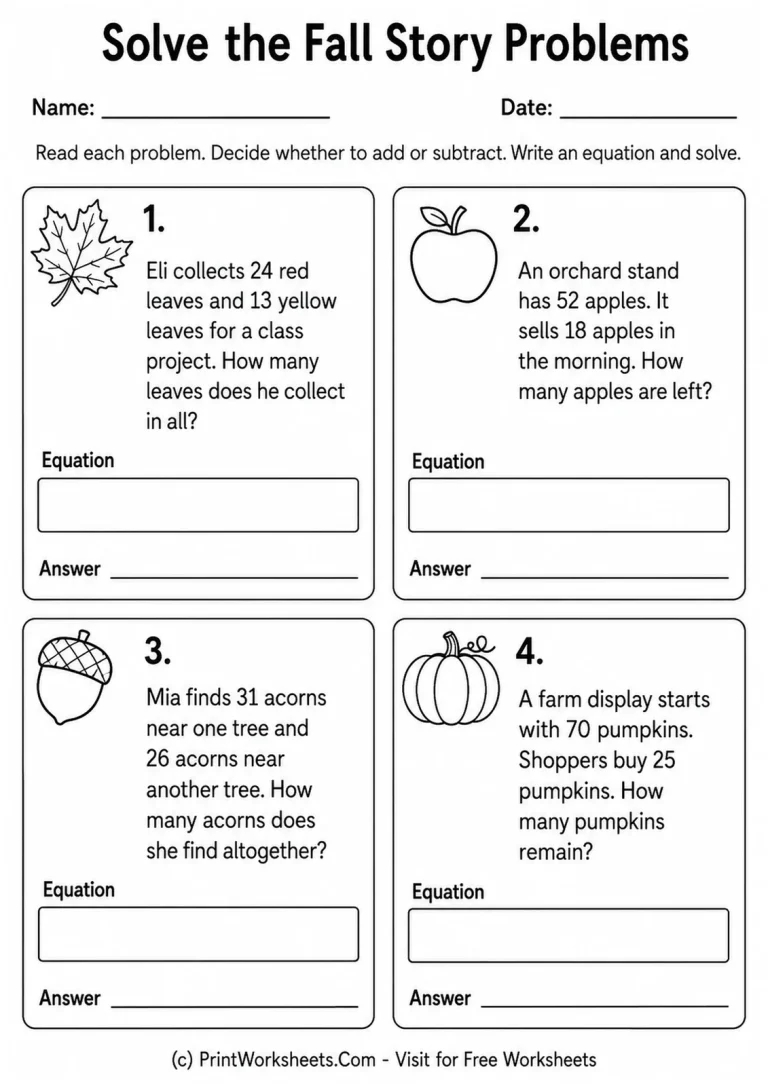
The first worksheet, Solve the Fall Story Problems, asks students to read four short situations and decide whether to add or subtract. Instead of choosing from ready-made answers, students write an equation and solve it. The problems include combining 24 red leaves with 13 yellow leaves, finding how many apples remain after 18 are sold from 52, combining two groups of acorns, and subtracting purchased pumpkins from a farm display. This page works well when students are learning to translate words such as in all, left, altogether, and remain into mathematical operations.
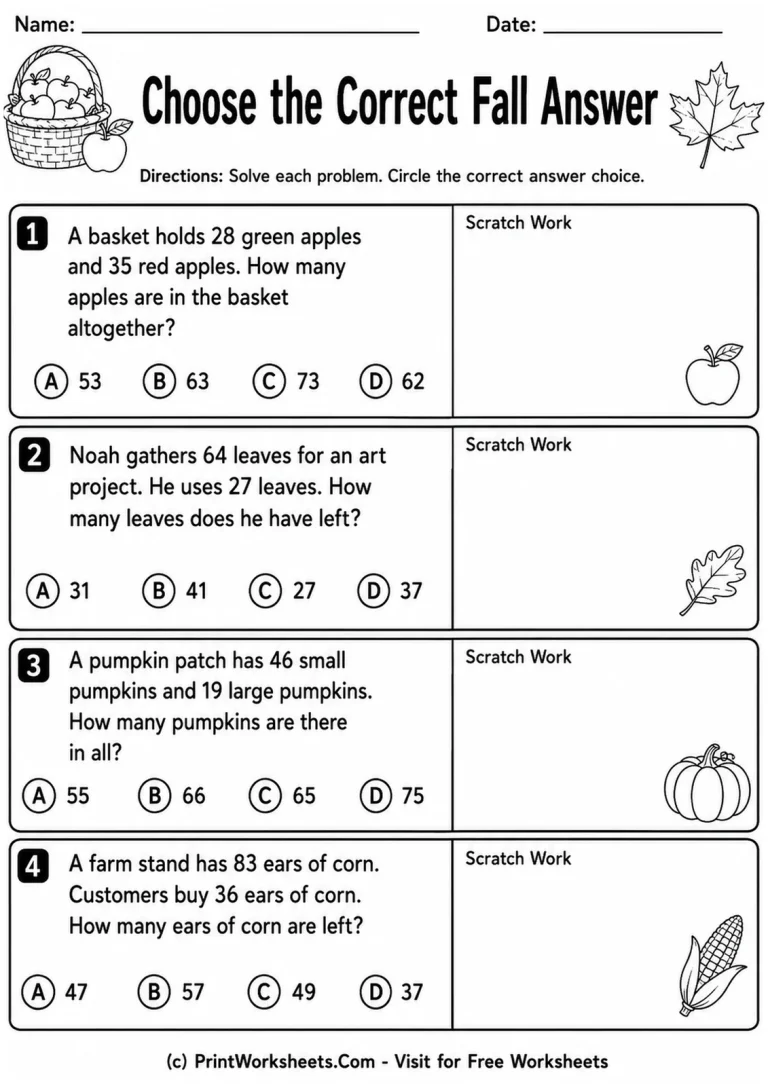
The second page, Choose the Correct Fall Answer, keeps the same core addition-and-subtraction skill but changes the response style. Students solve four problems and circle one of four answer choices. Each problem also includes a large Scratch Work section. The numbers remain within a manageable two-digit range, while the answer choices encourage students to calculate carefully rather than rely on a quick guess. Problems feature baskets of apples, collected leaves, pumpkins of different sizes, and ears of corn at a farm stand.
Build Missing-Amount Reasoning
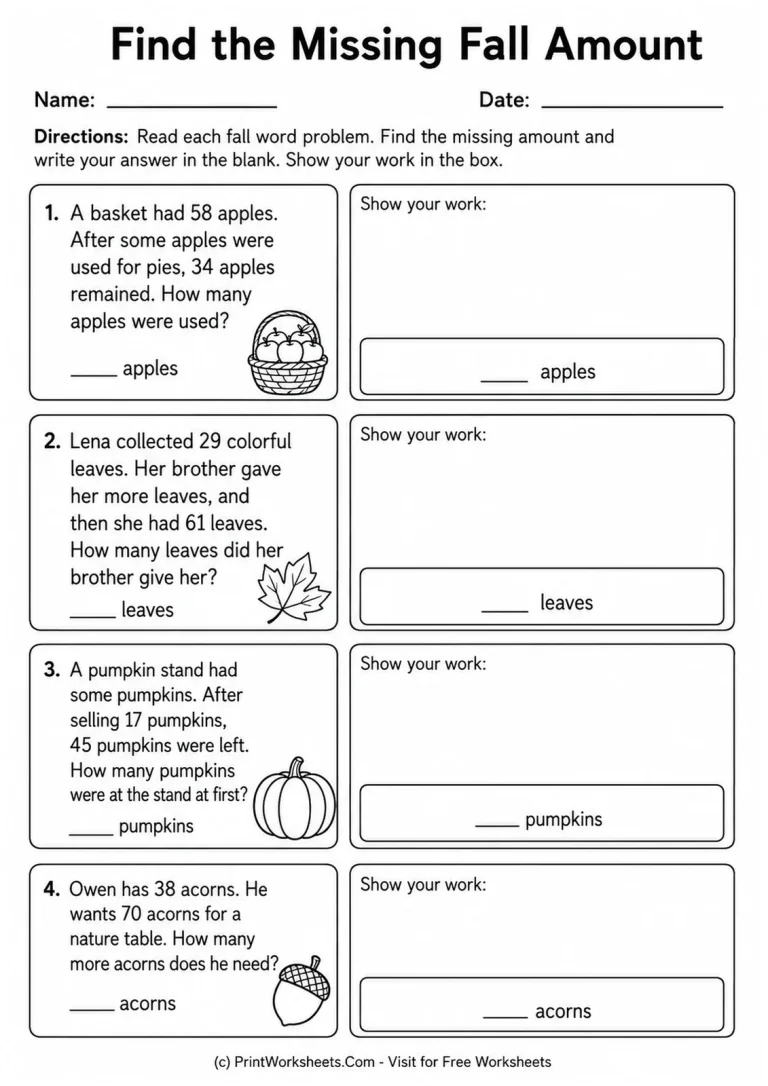
The third worksheet, Find the Missing Fall Amount, moves beyond straightforward result questions. Students must determine a missing part, a missing change, or an unknown starting amount. One problem gives 58 apples at the beginning and 34 remaining after some were used, so the student finds how many were used. Another starts with 29 leaves and ends with 61 after more are added. A pumpkin problem asks students to reconstruct the starting amount after 17 were sold and 45 remained, while the final problem asks how many more acorns are needed to reach a target of 70.
This variation is useful because students cannot depend on a single keyword strategy. They have to consider the relationship among the quantities and determine whether addition or subtraction will reveal the unknown. Every item includes a dedicated Show your work area and a labeled answer blank, giving teachers a quick way to see both the student’s reasoning and final response.
Move Into Two-Step Fall Word Problems
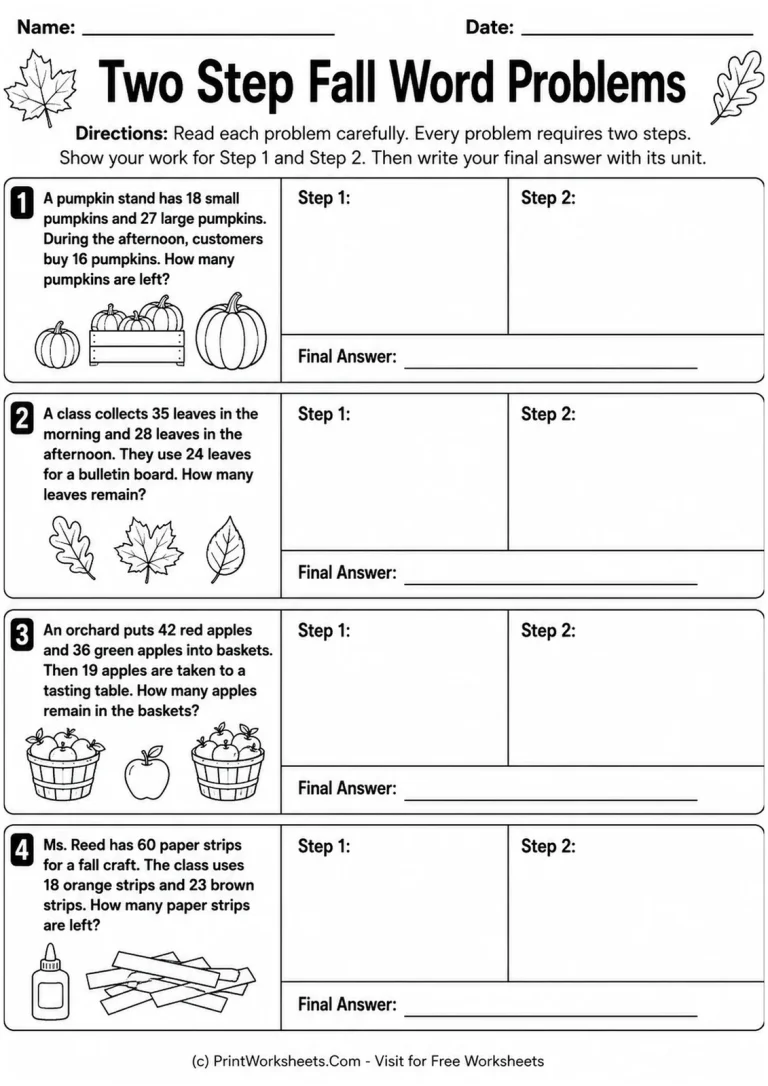
The fourth page, Two Step Fall Word Problems, is the most advanced worksheet in the set. Every problem requires two operations, and the layout separates the work into Step 1, Step 2, and Final Answer. Students combine two groups and then subtract an amount in several different contexts. For example, they total 18 small pumpkins and 27 large pumpkins before subtracting 16 purchased pumpkins. Another problem combines morning and afternoon leaf collections before subtracting the leaves used for a bulletin board.
The page also includes an orchard problem with red and green apples and a fall craft problem involving paper strips. Because the two operations are visually separated, the worksheet can help students who understand addition and subtraction individually but need more support organizing multi-step reasoning. It is suitable for guided practice in Grade 2 and independent review or warm-up work in Grade 3.
Ways to Use This Printable Set
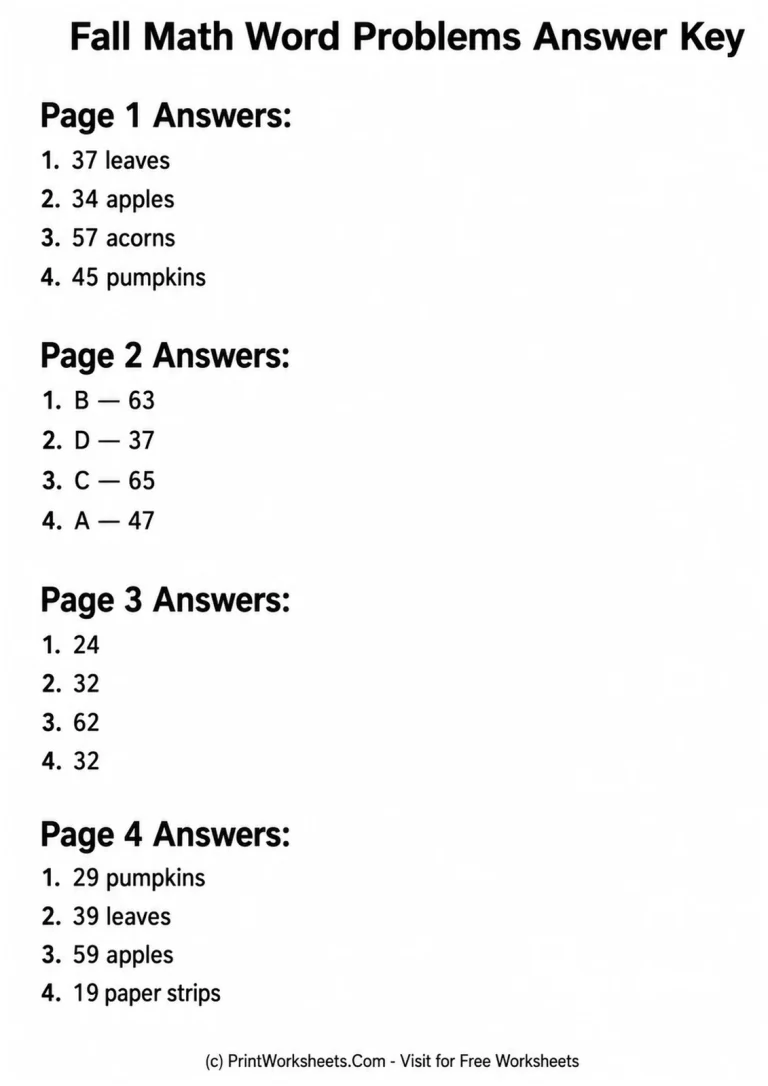
Teachers can use the pages in sequence as a short seasonal math unit, or select individual worksheets to match the skill being taught. Page 1 is a good fit for equation writing, Page 2 works well for independent practice or a quick check, Page 3 targets unknown quantities, and Page 4 provides a natural challenge for students ready for two-step situations. The complete answer key lists answers for all four worksheets, including both the letter and numerical answer for the multiple-choice page.
For another seasonal set that practices related Grade 2-3 problem-solving skills, see these Labor Day math word problems. Third graders who are ready to move from addition and subtraction stories into a different operation can also practice with these Grade 3 multiplication word problems.
A Practical Fall Math Review for Grades 2-3
This set works especially well when students need repeated word-problem practice without completing the same task format four times. Across the pages, children write equations, select answers, find unknown amounts, show scratch work, and organize two-step solutions. That variety makes the worksheets useful for morning work, math centers, homework, small-group instruction, seasonal review, or extra practice before moving into more complex multi-step problems.