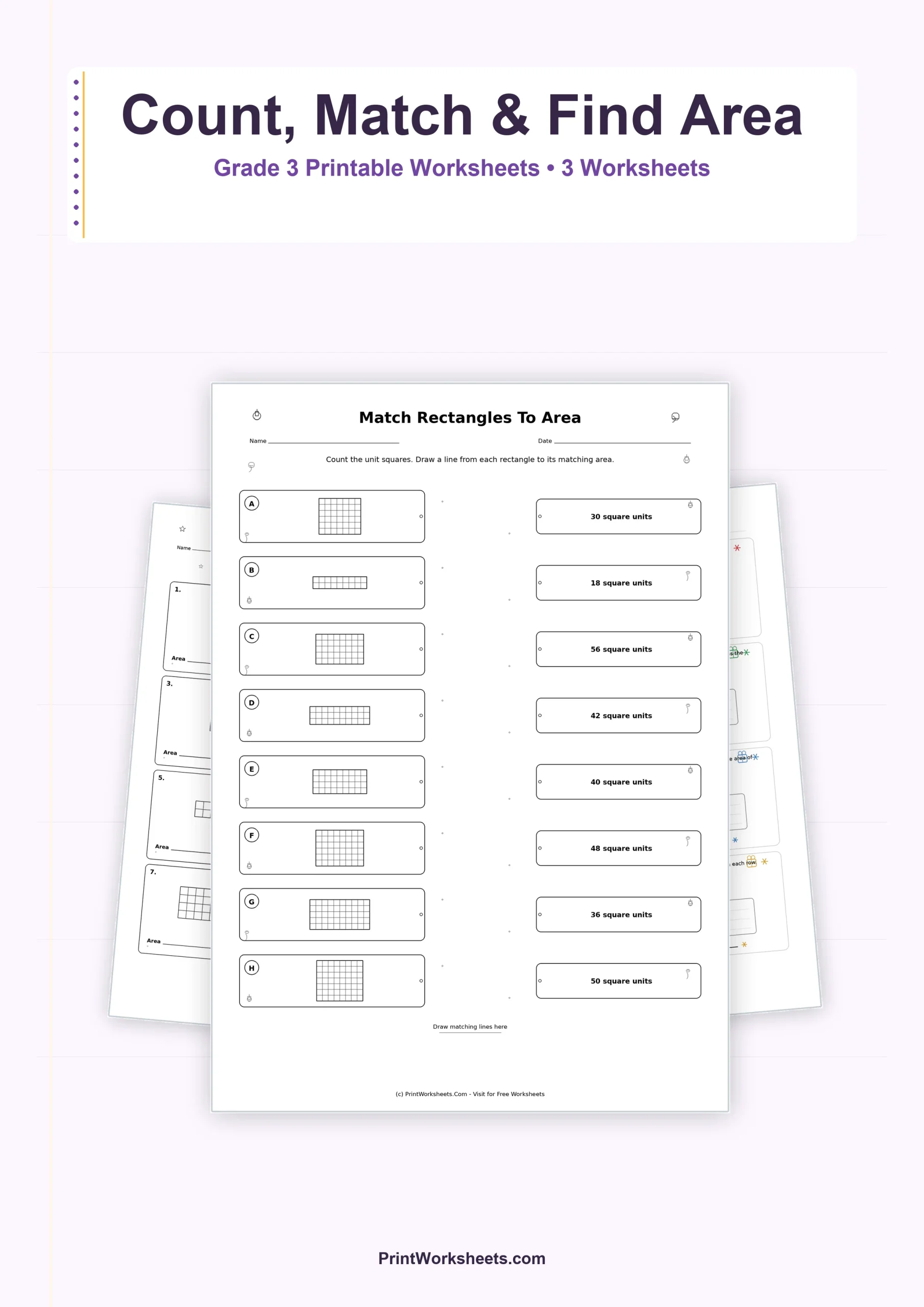
These area with unit squares worksheets for Grade 3 give students three different ways to build and use rectangle-area understanding: count visible unit squares, match rectangles to area values, and solve short story problems with grid support. The set keeps the area model concrete. Students can see the rows and columns, record answers in square units, and move from direct counting toward multiplication-based reasoning without losing the visual meaning of area.
Area with Unit Squares Worksheets: Count and Record
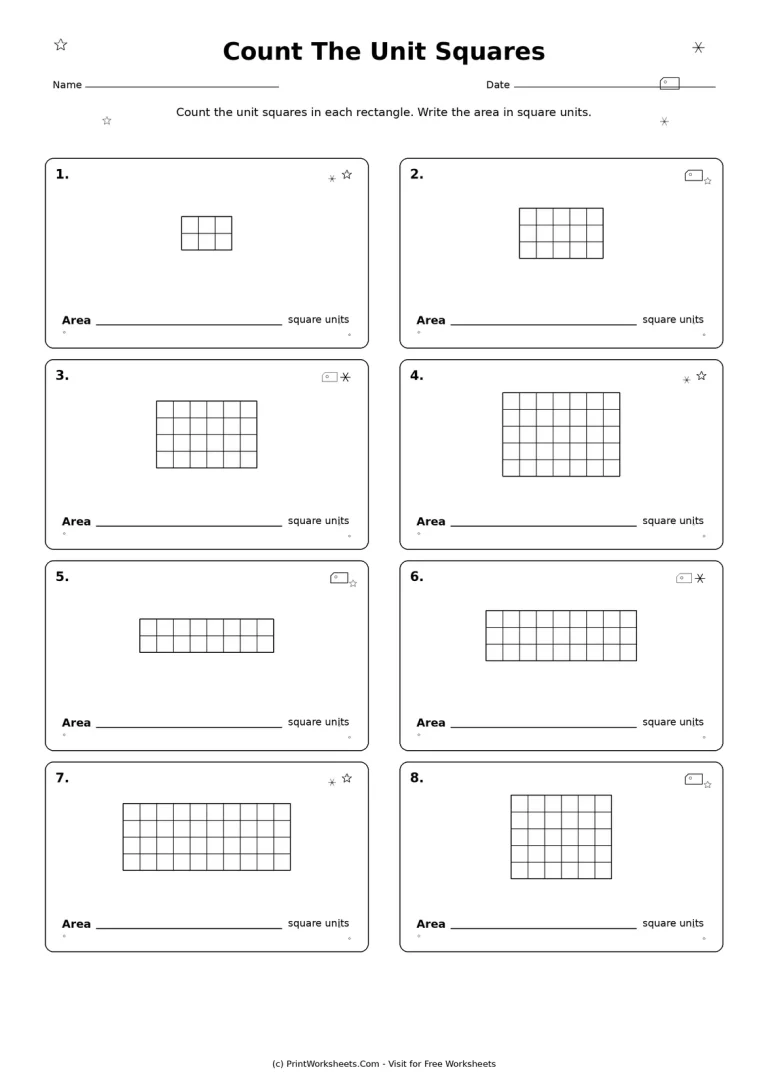
The first worksheet, “Count The Unit Squares,” presents eight rectangular grids with an area line beneath each one. The rectangles increase in size and vary in shape, so students do not simply repeat the same layout. Examples include a small 3-by-2 rectangle, a 5-by-3 rectangle, a 6-by-4 rectangle, a 7-by-5 rectangle, a long 8-by-2 rectangle, and larger grids such as 10-by-4 and 6-by-5. Students count the unit squares and write each total as an area in square units. This page works well for introducing or reviewing the idea that area measures the number of square units that cover a rectangle.
Because every square is drawn, students can use several strategies. A learner who is still developing area concepts can count one square at a time. A student who notices structure can count the number of squares in each row and use repeated addition. Students who are ready can multiply the number of rows by the number of columns. The same visual therefore supports different levels of Grade 3 reasoning while keeping the task clear and self-contained.
Match Rectangles to Their Areas
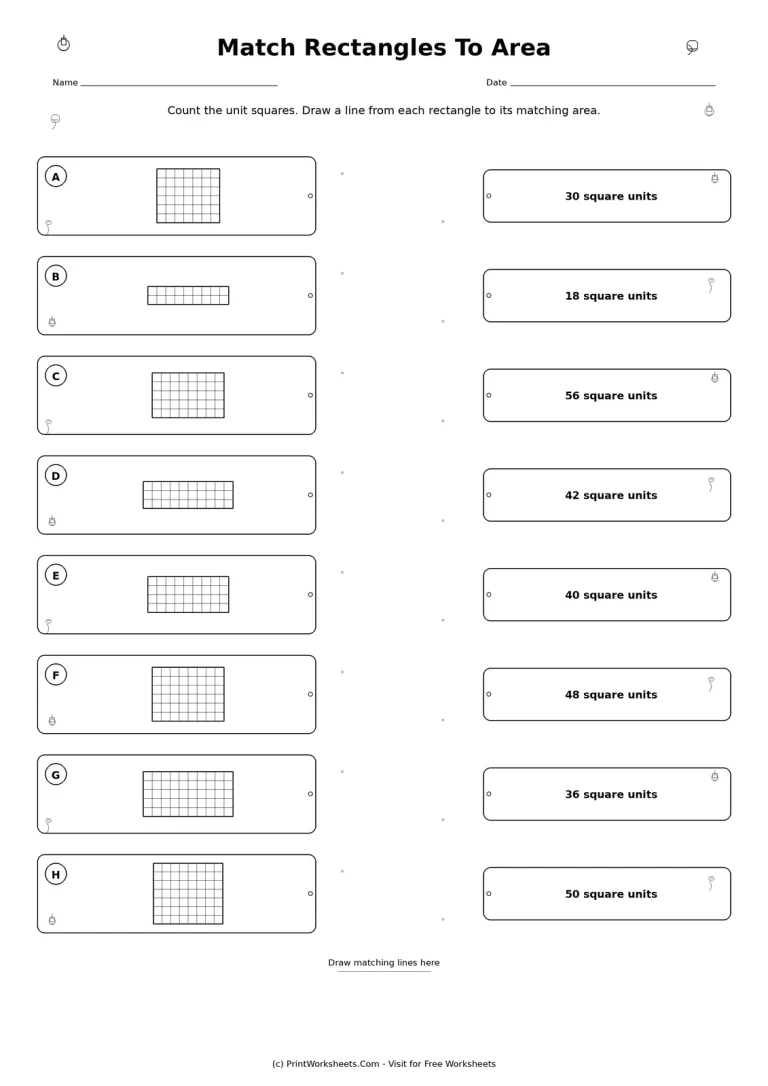
The second worksheet changes the response format. In “Match Rectangles To Area,” students see eight rectangles labeled A through H on the left and eight area choices on the right. The choices include 18, 30, 36, 40, 42, 48, 50, and 56 square units. Students count or organize the grid squares, then draw a line from each rectangle to its matching area. The rectangles include short, wide grids and taller rectangular arrays, so students must focus on the actual rows and columns rather than judging area from appearance alone.
This matching format is useful after students understand the basic meaning of square units. Instead of writing a separate answer for every model, they compare their computed area with a fixed set of choices. Since each visible rectangle has one matching value, students get practice checking whether their counting or multiplication result is reasonable before drawing the line. The page can be used independently, with a partner, or as a quick center activity focused on rectangular arrays and area.
Apply Rectangle Area in Story Problems
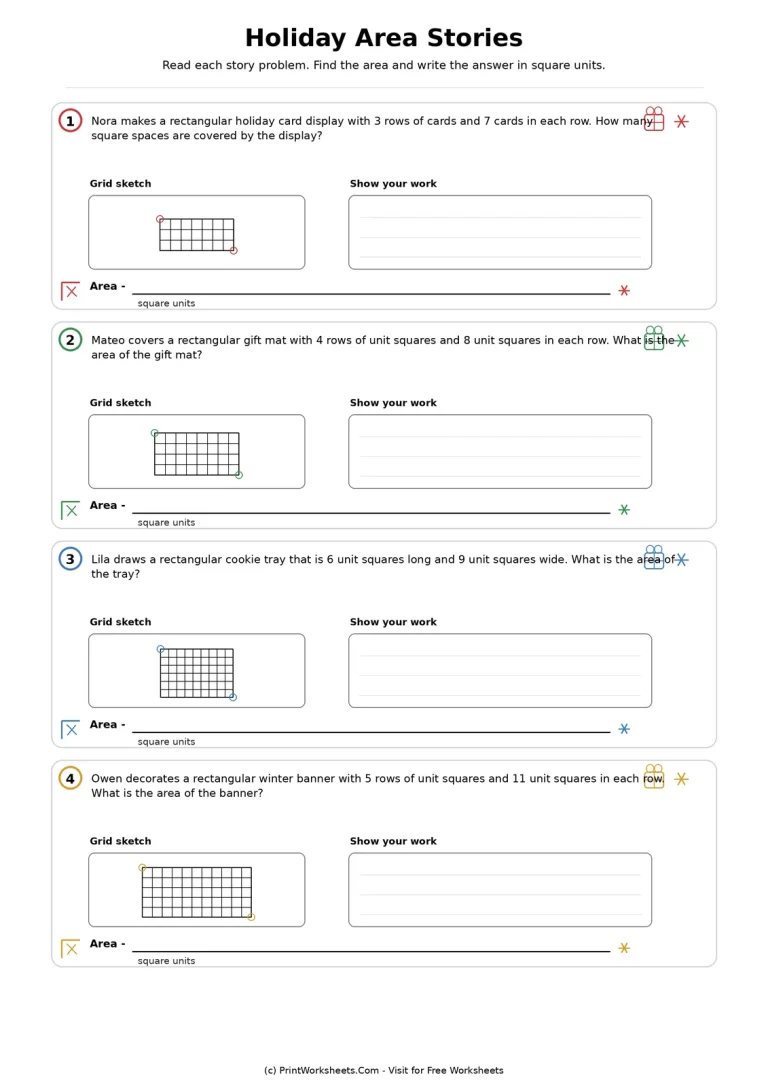
“Holiday Area Stories” moves the same concept into short contexts while preserving visual support. Nora’s holiday card display is described as 3 rows with 7 cards in each row. Mateo’s gift mat uses 4 rows of 8 unit squares. Lila’s rectangular cookie tray is represented by a 6-by-9 grid, and Owen’s winter banner uses 5 rows with 11 unit squares in each row. Each problem includes a grid sketch, a “Show your work” space, and an area response line labeled in square units.
The story page helps students connect a rectangular array to a situation described in words. Teachers can ask students to identify the two dimensions before calculating, circle the row and column information, or explain how the grid confirms the numerical result. The work boxes also make it possible to accept different strategies: repeated addition, skip counting, multiplication facts, or a labeled equation.
Grade 3 Area Practice That Builds Toward Multiplication
Across these worksheets, the progression stays focused on one core idea: area is the number of square units covering a rectangle. Students first read fully drawn grids, then distinguish among multiple area values, and finally use row-and-column information inside story problems. This sequence supports common Grade 3 goals involving unit squares, rectangular arrays, multiplication, and the relationship between side lengths and area.
A practical lesson sequence is to begin with the counting page as guided practice, use the matching page for independent work or a station, and finish with the story problems as an application check. Students who still need support can physically trace rows or lightly mark groups of squares. Students who are ready for a challenge can write a multiplication equation beside each grid before recording the area. For older learners moving from rectangular area into multiplication strategies, the box method multiplication worksheet for 4th grade provides a related visual next step.
Use the Set for Review, Centers, or Homework
These printable pages can fit a full area lesson, a short review block, math centers, intervention practice, or homework. The clear grids make student thinking visible, while the varied response types prevent the practice from feeling like the same exercise repeated three times. If a student makes an error, the rectangle itself gives a built-in way to check the work by recounting rows and columns. That makes the set especially useful when the goal is not only to get an area answer, but to understand why that answer is measured in square units.