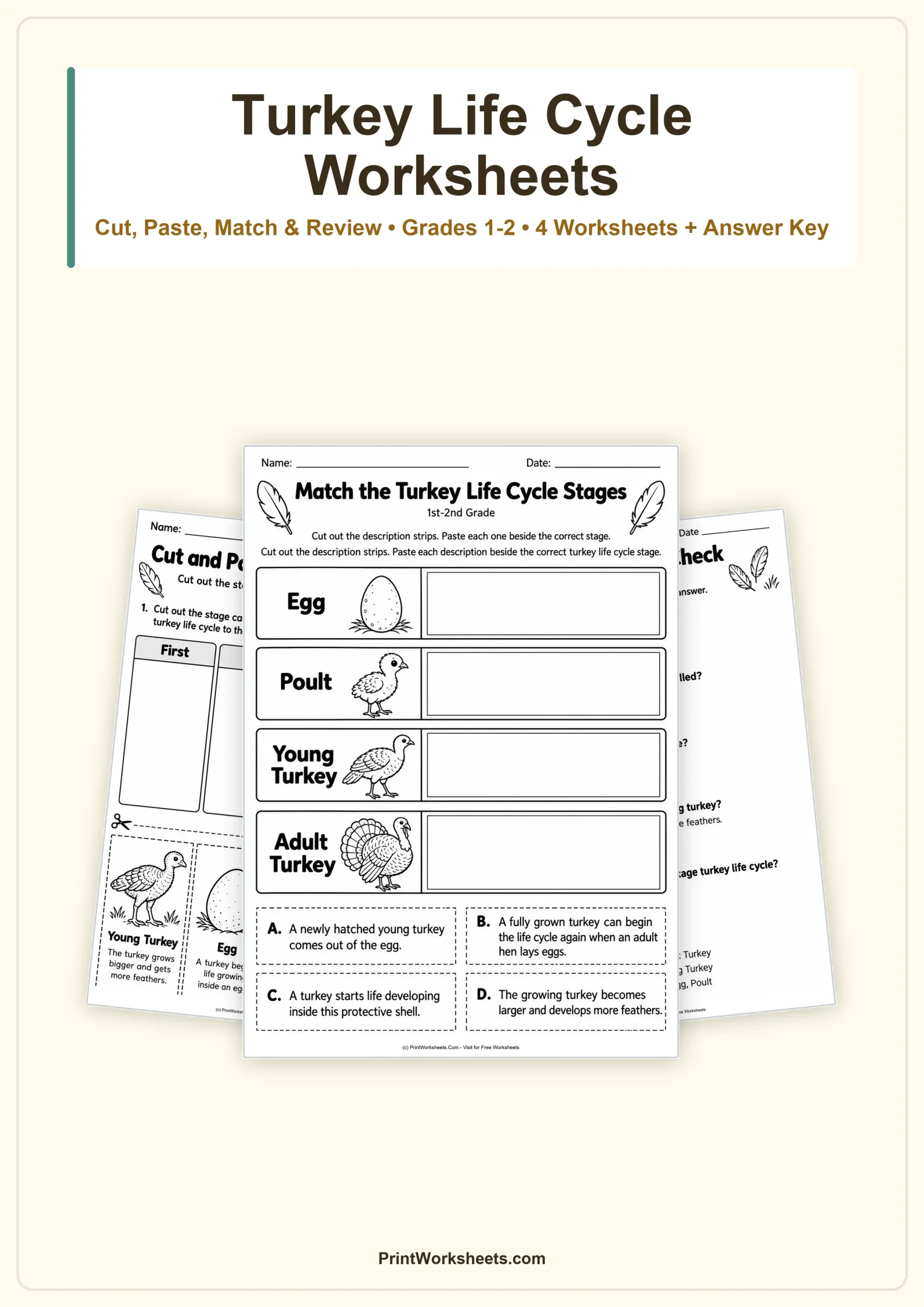
These turkey life cycle worksheets give 1st and 2nd grade students four different ways to learn how a turkey develops from an egg into an adult. The set combines hands-on cut-and-paste work with picture-supported vocabulary, stage matching, clue classification, and a short multiple-choice check. Because the same four stages appear across the activities—Egg, Poult, Young Turkey, and Adult Turkey—children get repeated practice without simply completing the same page again.
Turkey Life Cycle Worksheets for Sequencing and Vocabulary
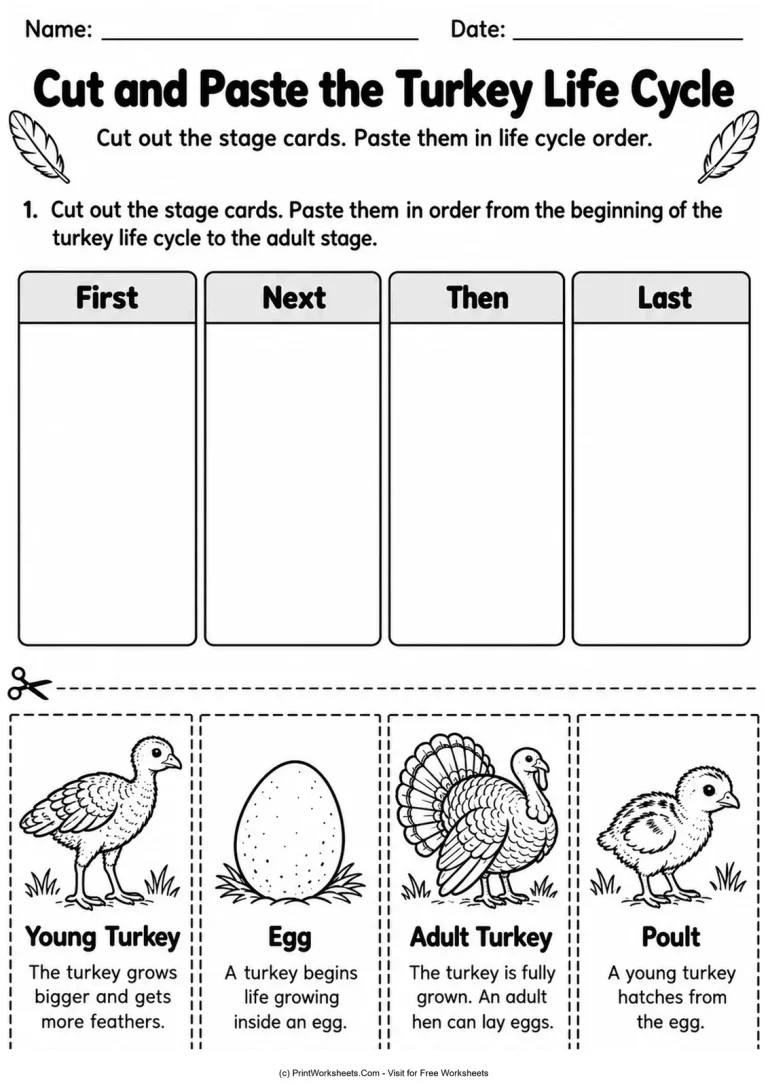
The first worksheet focuses on order. Students cut out four illustrated stage cards and place them into boxes labeled First, Next, Then, and Last. Each card includes both a picture and a short description, helping early elementary learners connect the visual stage with the science vocabulary. The correct sequence is Egg, Poult, Young Turkey, and Adult Turkey, so the page works well after a brief lesson, a read-aloud, or a class discussion about animal life cycles.
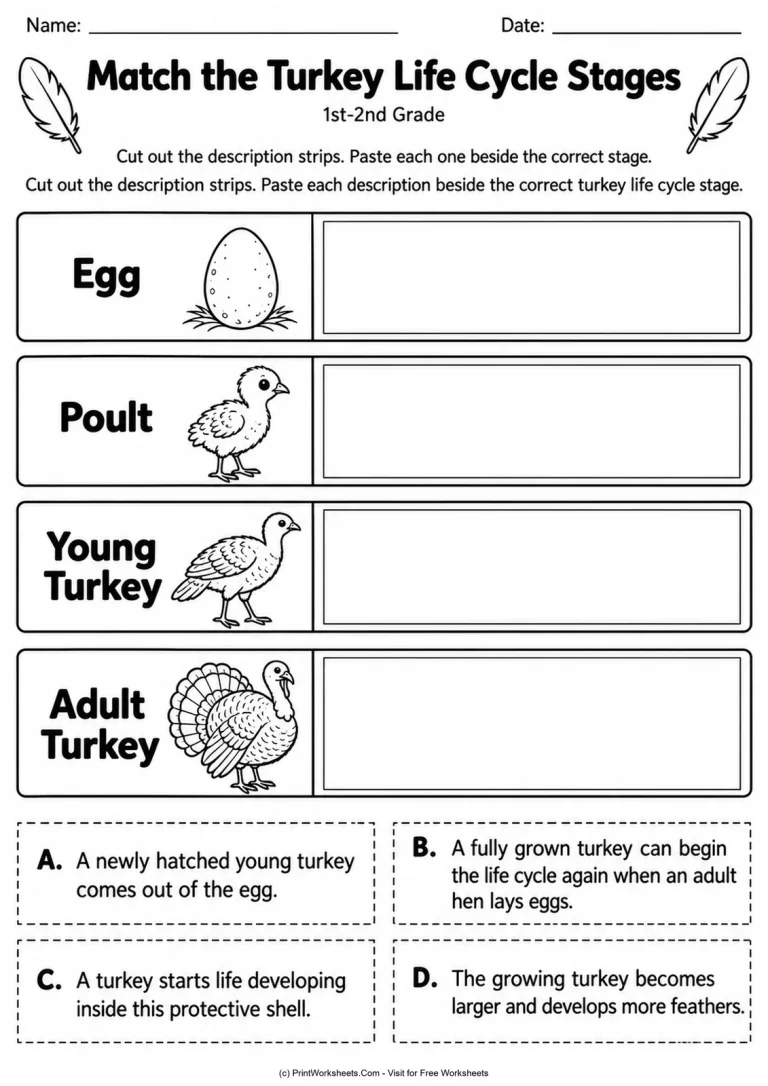
The second activity changes the task from sequencing to matching. Students see the four stage names with illustrations and then cut out four lettered description strips. They match a turkey developing inside a protective shell with Egg, a newly hatched young turkey with Poult, a growing turkey with more feathers with Young Turkey, and a fully grown turkey that can lay eggs with Adult Turkey. This page is useful for checking whether students understand what each stage means, not just where it belongs in a sequence.
Cut-and-Paste Practice With Four Turkey Stages
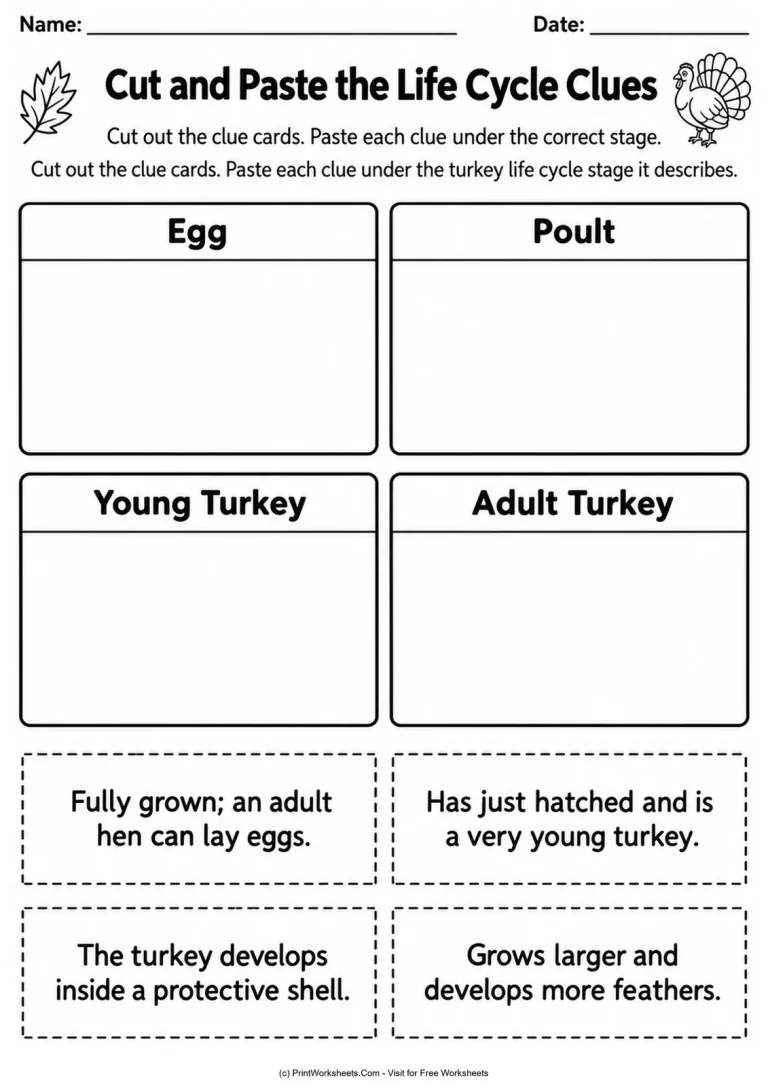
The fourth worksheet gives students another hands-on classification task. Instead of matching descriptions beside pictures, children paste clue cards under four labeled stage boxes. The clues include developing inside a protective shell, just hatching, growing larger and developing more feathers, and being fully grown. The format encourages students to read for meaning before choosing a category, which adds a simple literacy connection to the science content.
These cut-and-paste pages can work especially well in a science center, small group, morning work block, or independent practice station. Teachers can pre-cut the cards for students who need fine-motor support, or let students do the full cutting and pasting process when scissor practice is part of the goal. Parents can also use the pages at home as a seasonal science activity around Thanksgiving while still keeping the focus on real life science vocabulary.
Quick Turkey Life Cycle Check for 1st-2nd Grade
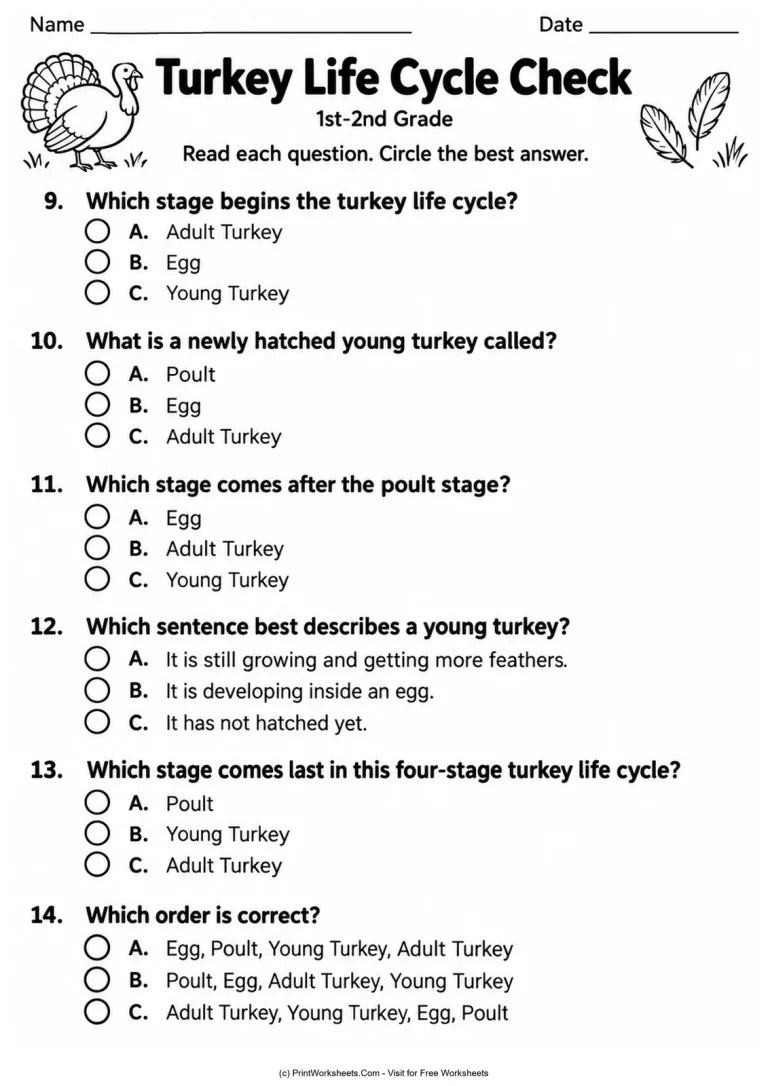
The multiple-choice page provides a simple way to check understanding after the hands-on work. Six questions ask which stage begins the life cycle, what a newly hatched turkey is called, which stage comes after the poult stage, how a young turkey can be described, which stage comes last, and which four-stage order is correct. The questions reinforce both vocabulary and sequence, making the page a practical exit ticket, review sheet, or short assessment.
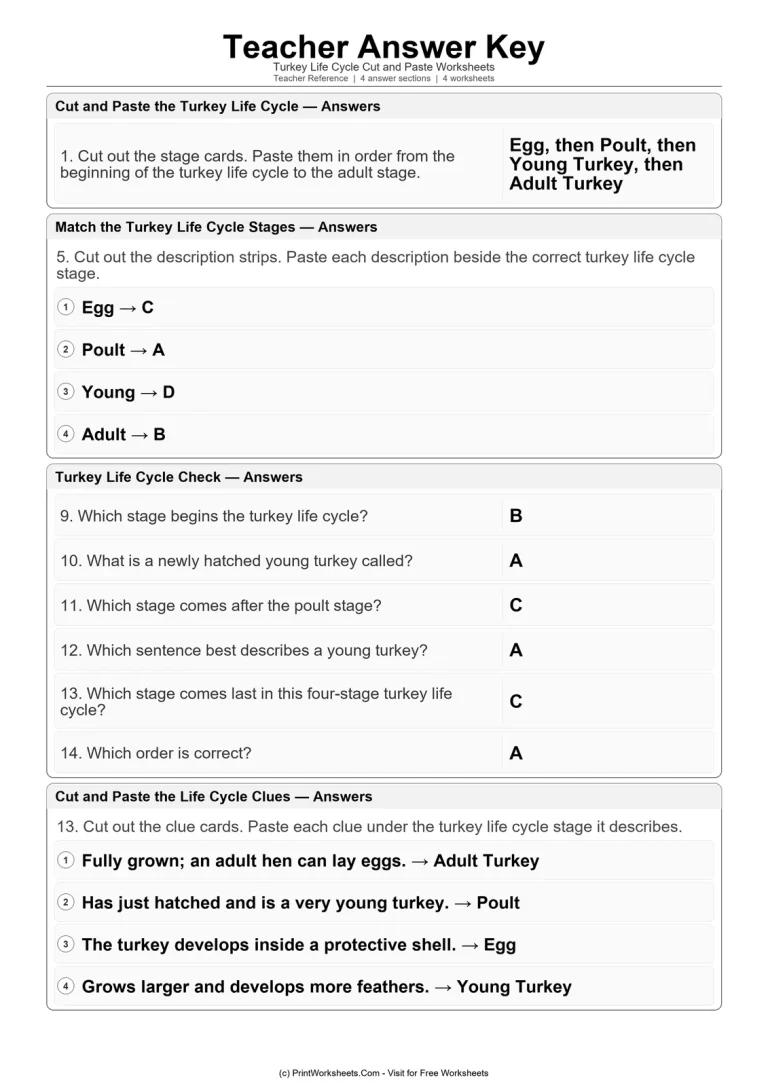
A teacher answer key is included for all four student worksheets. It gives the correct life cycle order, the matching answers, the multiple-choice answers, and the clue classifications. That makes it easy to use the pages for independent practice and check work quickly afterward.
Ideas for Using This Turkey Life Cycle Printable
For a full lesson, begin by introducing the four words Egg, Poult, Young Turkey, and Adult Turkey. Then use the sequencing page so students can build the life cycle in order. Follow with either matching activity to strengthen the meaning of each stage, and finish with the multiple-choice check. You can also split the pages across several days and use one activity at a time for review.
If your class is comparing several plant and animal life cycles, pair this resource with our pumpkin life cycle cut and paste worksheets. Students can discuss how both topics use stages and sequencing while noticing that plants and animals develop in different ways.
What Students Practice
This set supports several early elementary skills at once: ordering events, reading short informational descriptions, matching vocabulary to meaning, classifying clues, and answering simple comprehension questions. The repeated use of the same four turkey stages helps students become more confident with the terms while each worksheet asks them to apply that knowledge in a different way. Use the pages as a focused life science mini-unit, a Thanksgiving science center, or a printable review set for grades 1-2.