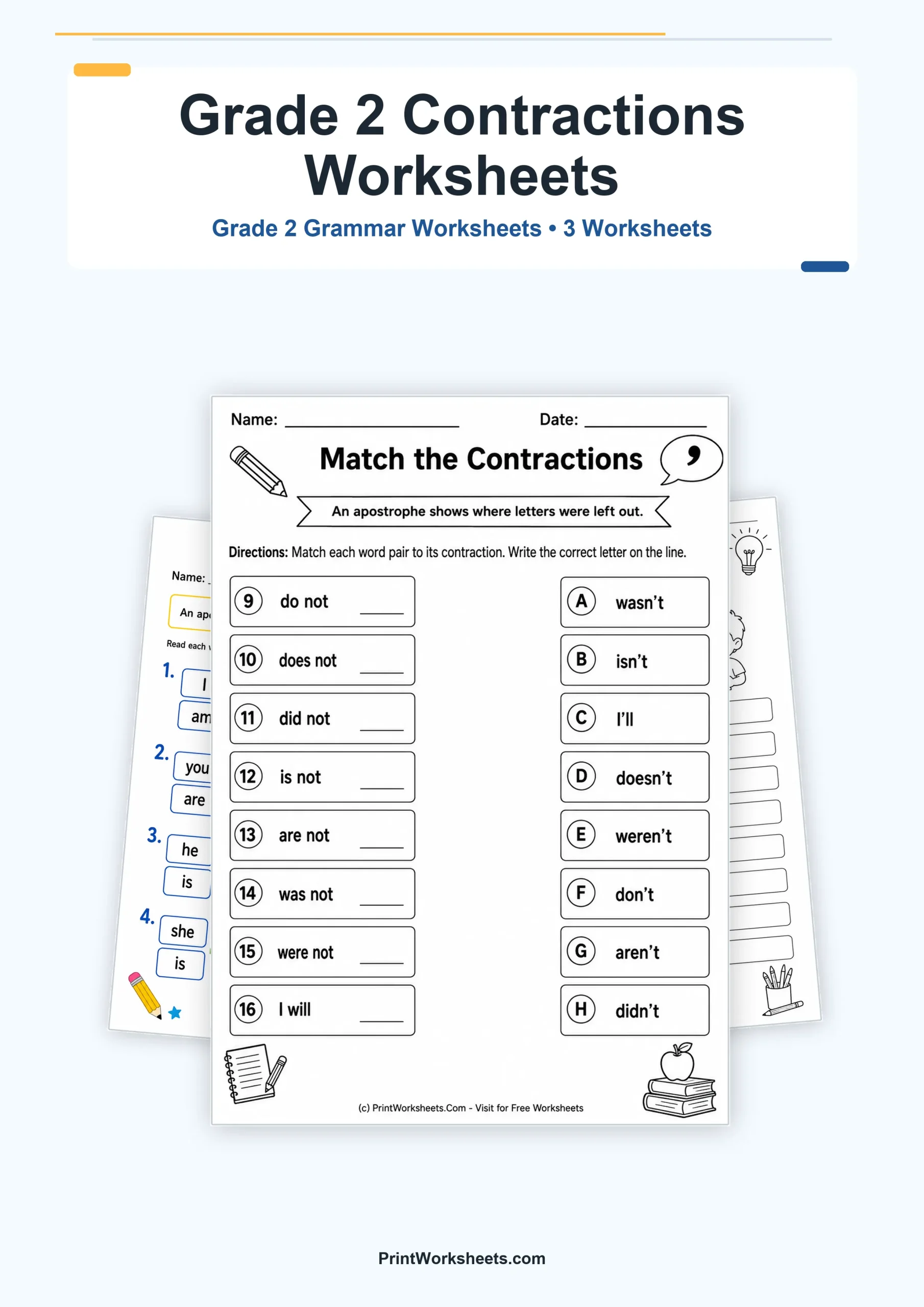
These apostrophes in contractions worksheets give second-grade students three connected ways to practice how two words can be shortened into one contraction. Children first build contractions from familiar word pairs, then match word pairs with the correct shortened forms, and finally take contractions apart into their original two words. The sequence helps students notice that the apostrophe has a specific job: it shows where letters have been left out.
Apostrophes in Contractions Practice for Grade 2
This printable set focuses on common contractions that young readers are likely to meet in classroom texts and everyday writing. The activities use short, direct tasks so students can concentrate on the spelling change rather than decode complicated directions. Across the three worksheets, students work with forms such as I’m, you’re, he’s, she’s, it’s, we’re, they’re, can’t, don’t, doesn’t, didn’t, isn’t, aren’t, wasn’t, weren’t, I’ll, I’ve, you’ve, we’ve, they’ve, he’ll, she’ll, we’ll, and they’ll.
Because students see contractions in more than one format, the worksheets support both recognition and production. A child who can identify don’t in a list still needs to understand that it comes from do not. Likewise, a student who knows that we are becomes we’re must also learn where the apostrophe belongs. These pages give practice with both directions of that relationship.
Build Contractions from Two Words
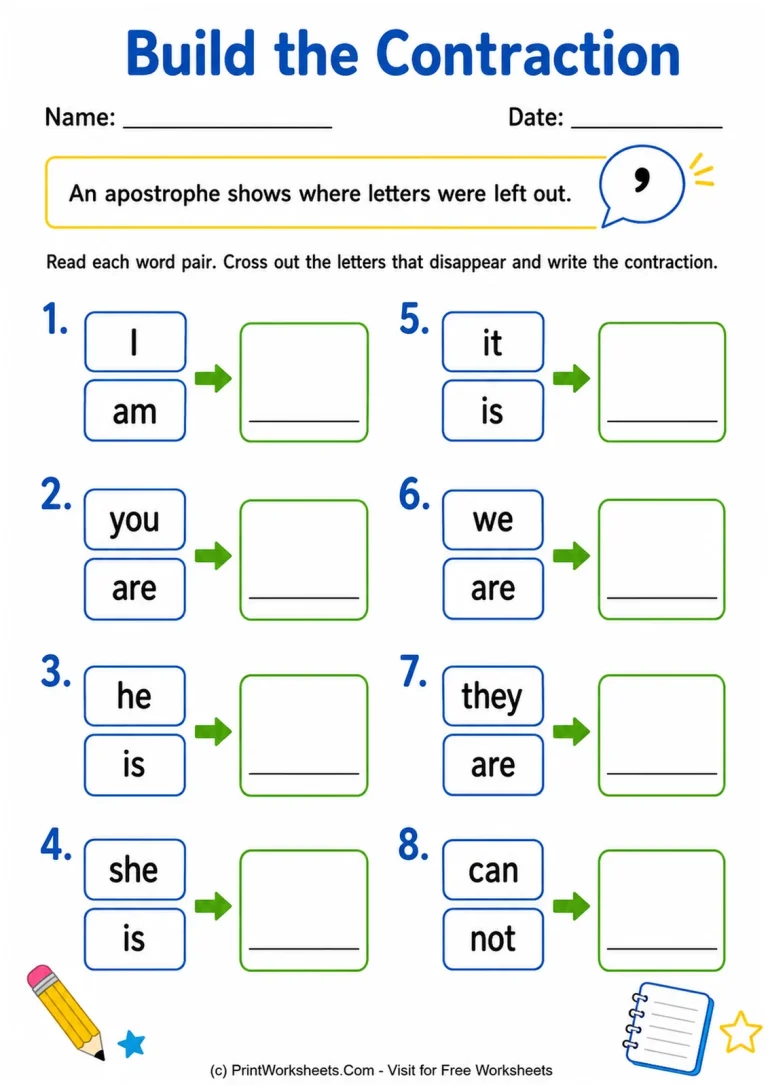
The first worksheet asks students to combine two words into a contraction. The word pairs include I am, you are, he is, she is, it is, we are, they are, and can not. Students write the shortened form and pay attention to the letters that disappear. This is a useful starting point because the original words remain visible while children decide how the contraction should be written.
The page also reinforces an important spelling idea: the apostrophe takes the place of omitted letters. Instead of treating the mark as decoration, students connect its position to a real change in the words. That makes the activity useful for an introductory grammar lesson, guided practice, or a short independent assignment after a teacher demonstration.
Match Word Pairs to Common Contractions
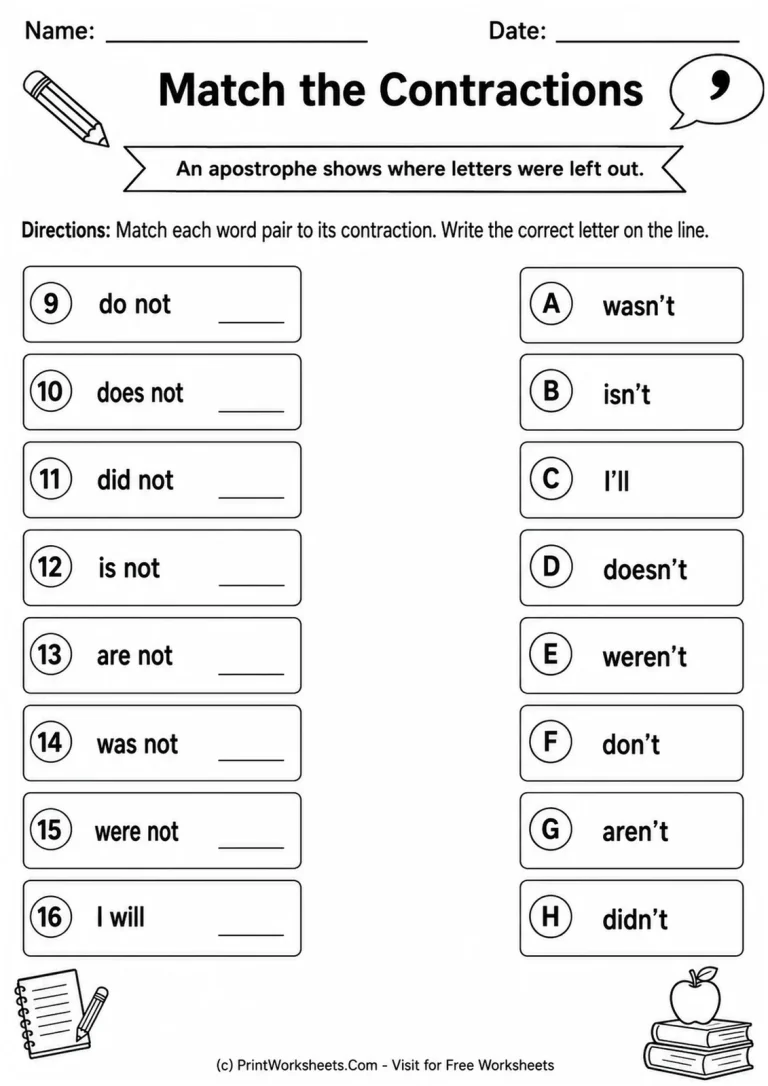
The second worksheet shifts from writing contractions to recognizing them. Students match eight word pairs with eight contraction choices. Much of the practice centers on negative contractions, including do not, does not, did not, is not, are not, was not, and were not. The page also includes I will and its contraction I’ll.
This matching format helps students compare similar-looking forms carefully. For example, isn’t and aren’t both contain apostrophes and end in n’t, but each comes from a different pair of words. By matching each pair to one clear answer, students practice looking at both the base words and the final spelling of the contraction.
Take Contractions Apart into Two Words
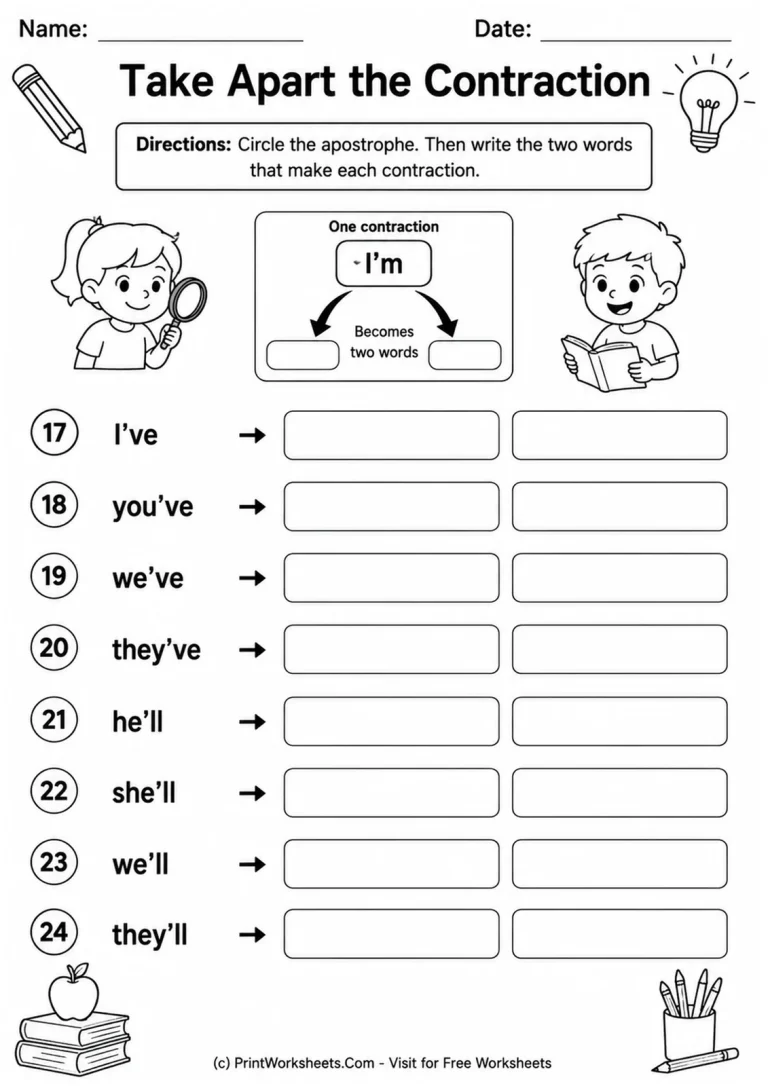
The third worksheet reverses the process. Students see contractions such as I’ve, you’ve, we’ve, they’ve, he’ll, she’ll, we’ll, and they’ll and write the two words that created each one. They are also asked to circle the apostrophe. This directs attention to the exact punctuation mark while students analyze what the contraction means.
Expanding contractions is especially helpful for checking understanding. A student may be able to copy he’ll correctly without realizing that it represents he will. Asking children to restore the full words makes the meaning visible and gives teachers or parents a quick way to see whether students understand the structure rather than only recognizing the spelling pattern.
Skills Students Practice with Contractions
These Grade 2 grammar worksheets support several related skills at once. Students practice placing apostrophes correctly, identifying letters that are omitted, connecting contractions with their complete word pairs, reading common shortened forms, and moving between contracted and expanded forms. The pages also expose students to contractions formed with am, are, is, not, will, and have.
The progression works well for a short lesson sequence. Students can begin with the building page while the two original words are provided, continue with the matching page to strengthen recognition, and finish with the take-apart page to demonstrate that they understand what each contraction represents. Teachers can also use individual pages for morning work, literacy centers, grammar review, homework, or extra practice.
Printable Contraction Review for Second Grade
Use these worksheets when students are learning why apostrophes appear in contractions and how the punctuation changes two words into a shorter form. The combination of building, matching, and expanding keeps the practice focused while requiring students to think about contractions in different ways. Print the pages together for a compact Grade 2 grammar set or choose the activity that best matches the skill your students are practicing.