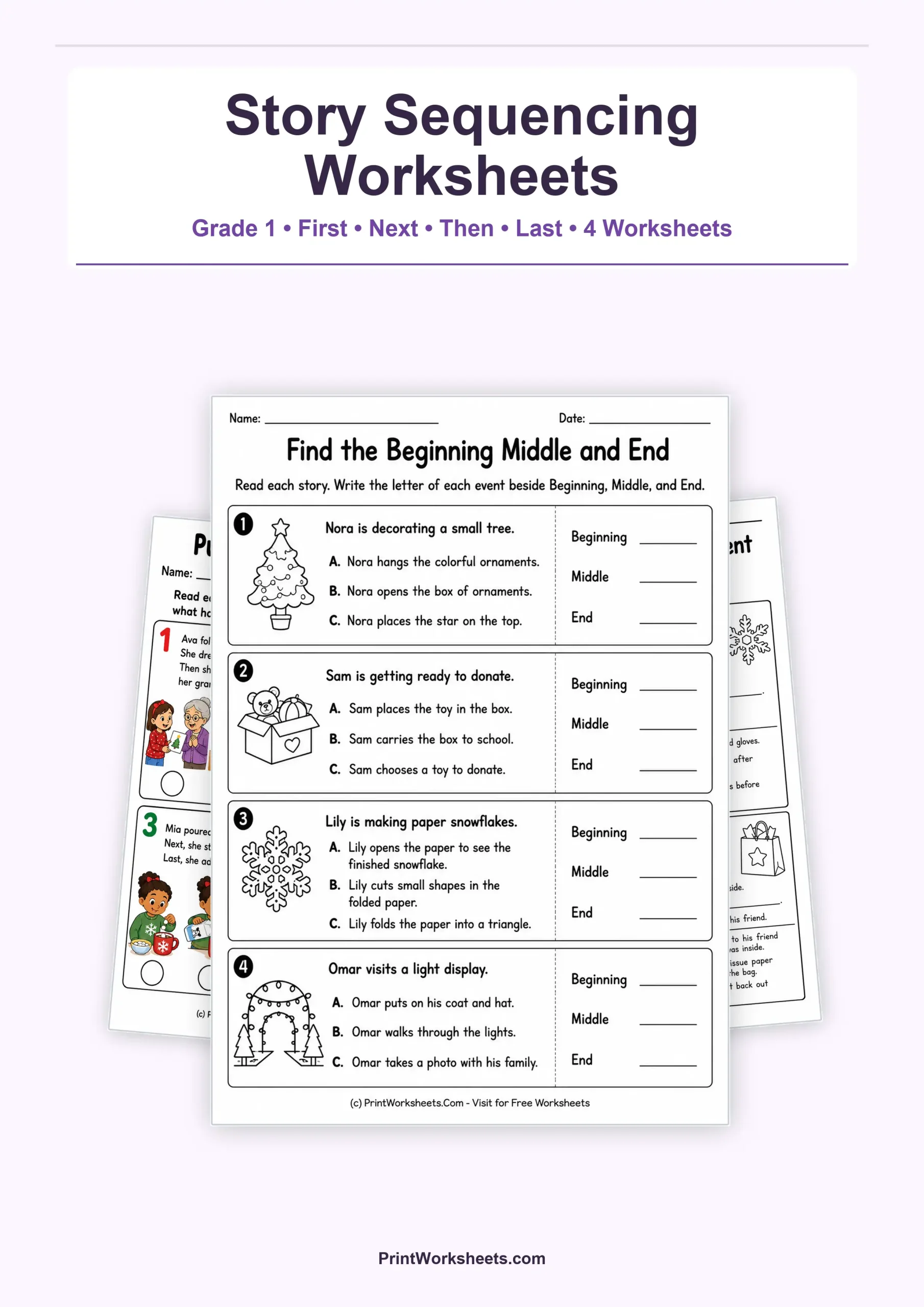

These story sequencing worksheets give first graders several ways to practice putting events in a logical order. Instead of asking children to work through one long passage, the set uses short, concrete mini-stories with familiar actions such as making a card, building a snow figure, preparing cocoa, decorating a tree, baking cookies, and getting ready for a class party. The activities move from picture-supported three-step sequences to text-based four-step stories, helping students connect what happens first with what follows next and how an event ends.
Build story sequencing skills step by step
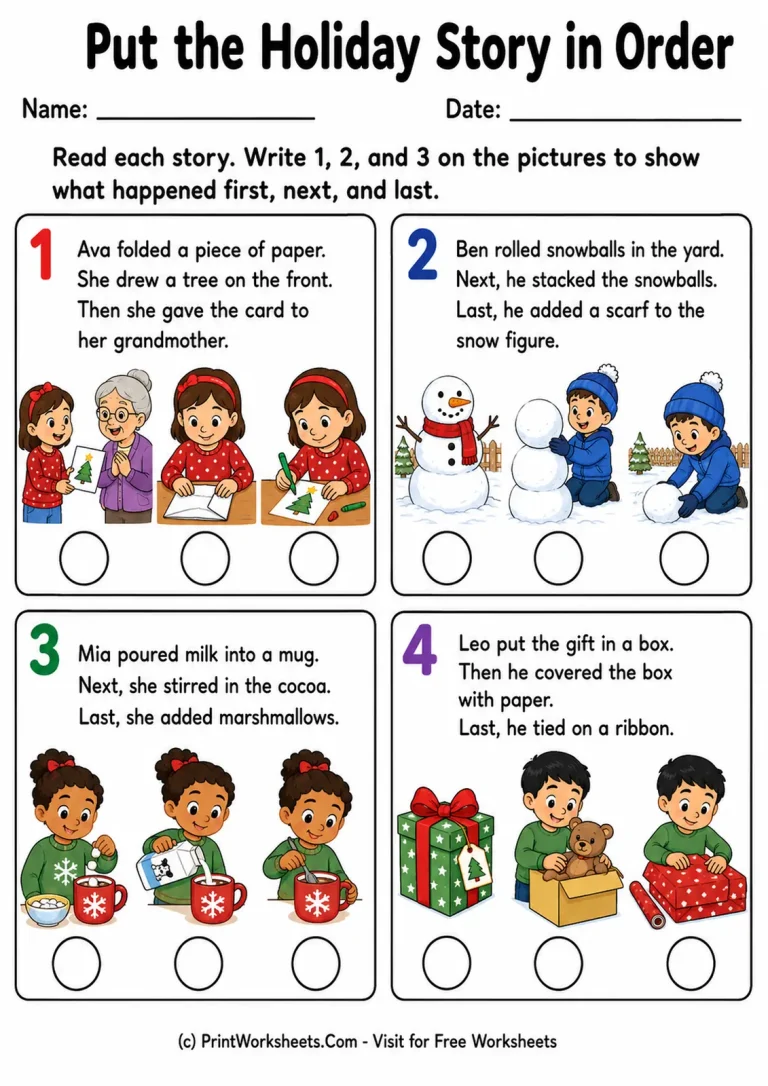
The first worksheet, Put the Holiday Story in Order, is a visual starting point. Students read four brief stories and number three pictures in the correct order. Ava folds paper, draws a tree, and gives a card to her grandmother. Ben rolls and stacks snowballs before adding a scarf. Mia works through the steps of making cocoa, while another mini-story follows gift wrapping. Because each sequence has only three events and includes picture support, this page works well for children who are beginning to connect reading details with chronological order.
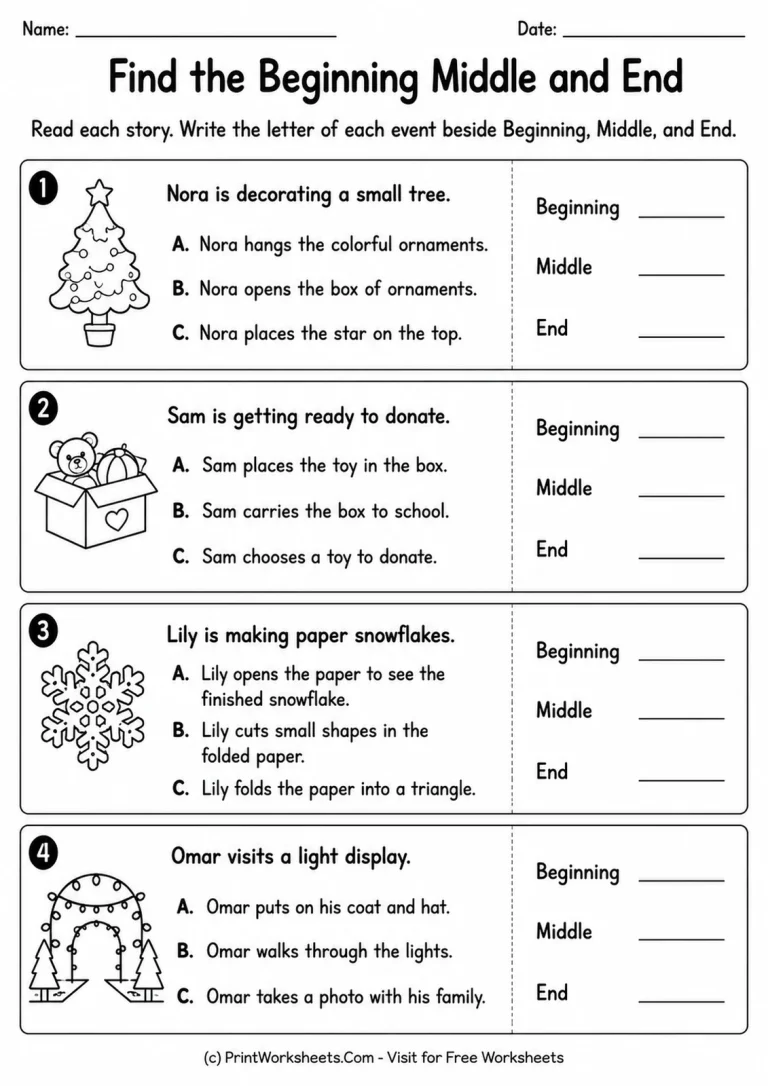
The next activity shifts attention from pictures to story structure. In Find the Beginning Middle and End, students read three lettered events for each scenario and decide which belongs at the beginning, middle, and end. The situations include decorating a small tree, preparing a toy donation, making a paper snowflake, and visiting a light display. The snowflake sequence, for example, requires students to recognize that folding comes before cutting and that opening the paper reveals the finished design. This encourages children to use meaning rather than simply looking for familiar sequence words.
Practice first, next, then, and last
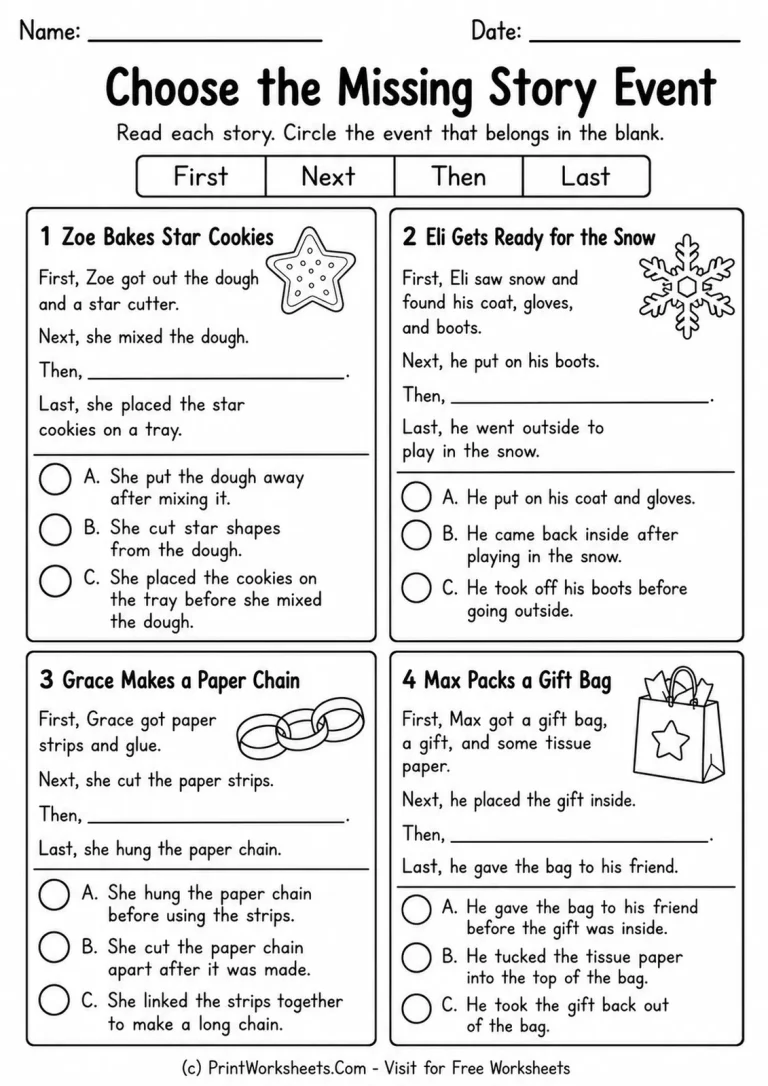
Once students are comfortable ordering complete event sets, the third worksheet asks them to reason about a missing step. Each short passage follows a First, Next, Then, Last structure, but the Then event is missing. Students choose the event that logically completes the sequence from three answer choices. The stories involve baking star cookies, dressing for snow, making a paper chain, and packing a gift bag. This format adds a useful comprehension challenge because children must consider both what has already happened and what must happen before the final event.
The fourth page, Sequence the Holiday Adventures, extends the skill to four-event stories. Students work with lettered events and place them into First, Next, Then, and Last positions. Maya prepares for a class party, Jack makes a bird feeder, Ana mails a holiday card, and Theo gets ready for movie night. The passages explicitly include sequencing language, so students can practice noticing temporal signal words while also checking whether the actions make sense as a complete story.
Ways to use these Grade 1 sequencing passages
The four worksheets can be used as a short progression rather than four unrelated practice pages. Begin with the picture-ordering page for whole-class modeling or a small reading group. Ask students to explain why one picture has to come before another. Move to Beginning, Middle, and End when they can order visible actions confidently. The missing-event page is useful for checking deeper understanding because students cannot solve it by copying the sequence directly. Finish with the four-step activity when students are ready to manage a longer chain of events.
Teachers can also split the set across several lessons. One page can serve as guided practice, another as independent work, and another as a quick reading-comprehension center. Parents can use the short scenarios at home by asking a child to retell the sequence orally after completing each item. Questions such as “What happened first?” or “What had to happen before the last step?” reinforce the same skill without adding a new worksheet.
Connect sequencing with broader reading comprehension
Sequencing is one part of understanding a passage, so it can be paired with practice that asks students to answer questions about characters, details, and events. For additional seasonal reading work, try these Grade 1–2 fall reading comprehension passages. Using both types of activities can help students move between identifying details and organizing those details into a meaningful order.
This printable set is especially useful when students need repeated sequencing practice without repeating the same response format. The combination of pictures, letter matching, multiple choice, and four-step event ordering gives children several entry points into the same reading skill. Start with the page that best matches each student’s confidence level, then move toward the text-heavy activities as they become more comfortable explaining how a story unfolds from beginning to end.