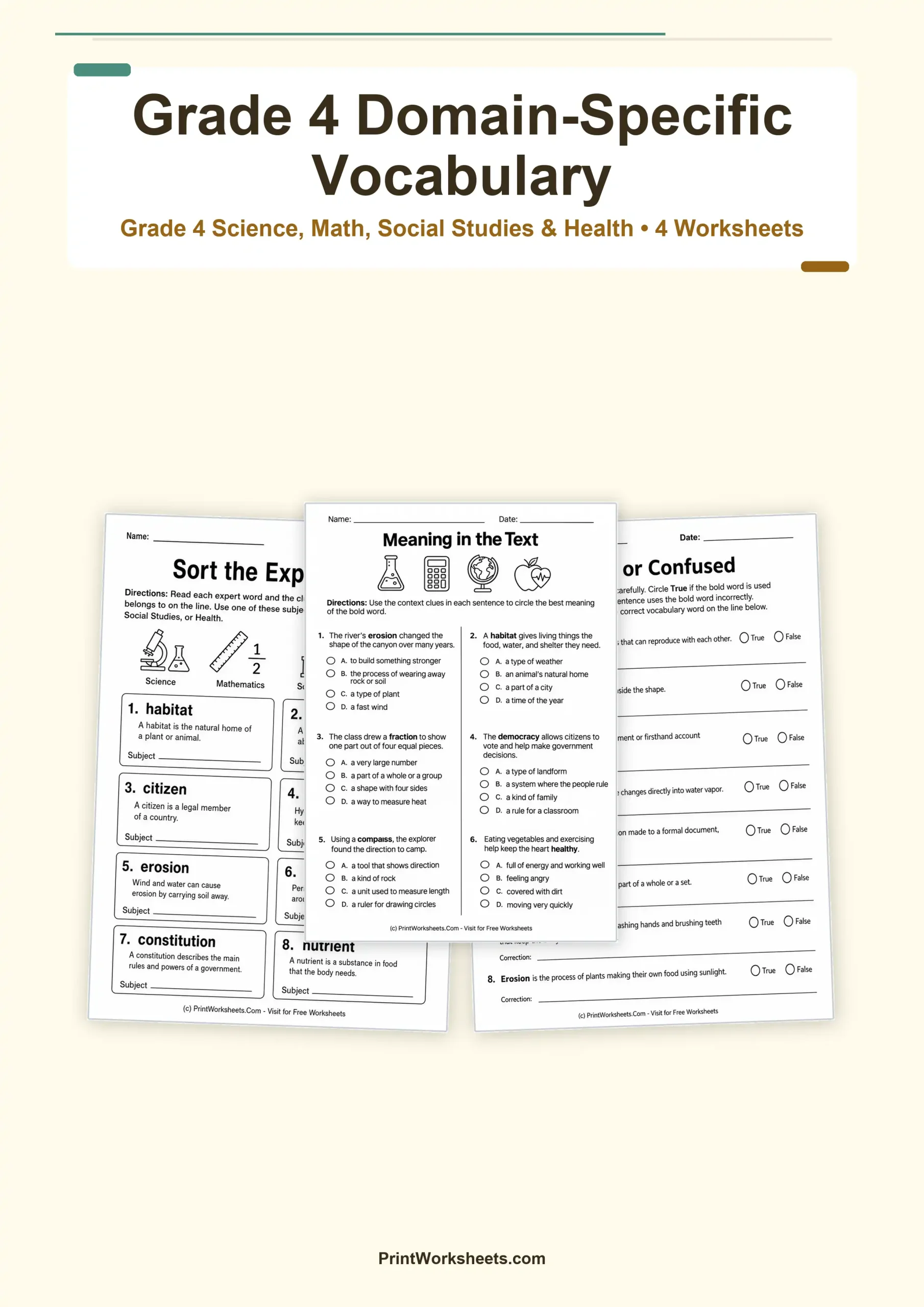
Strong readers do more than recognize everyday words; they also learn the specialized language used in different school subjects. These domain-specific vocabulary worksheets for Grade 4 give students focused practice with terms from Science, Mathematics, Social Studies, and Health. Across four printable activities, learners sort expert words by subject, use context clues to determine meaning, judge whether specialized terms are used correctly, and replace broad expressions with more precise vocabulary.
Build Domain-Specific Vocabulary Across Four Subject Areas
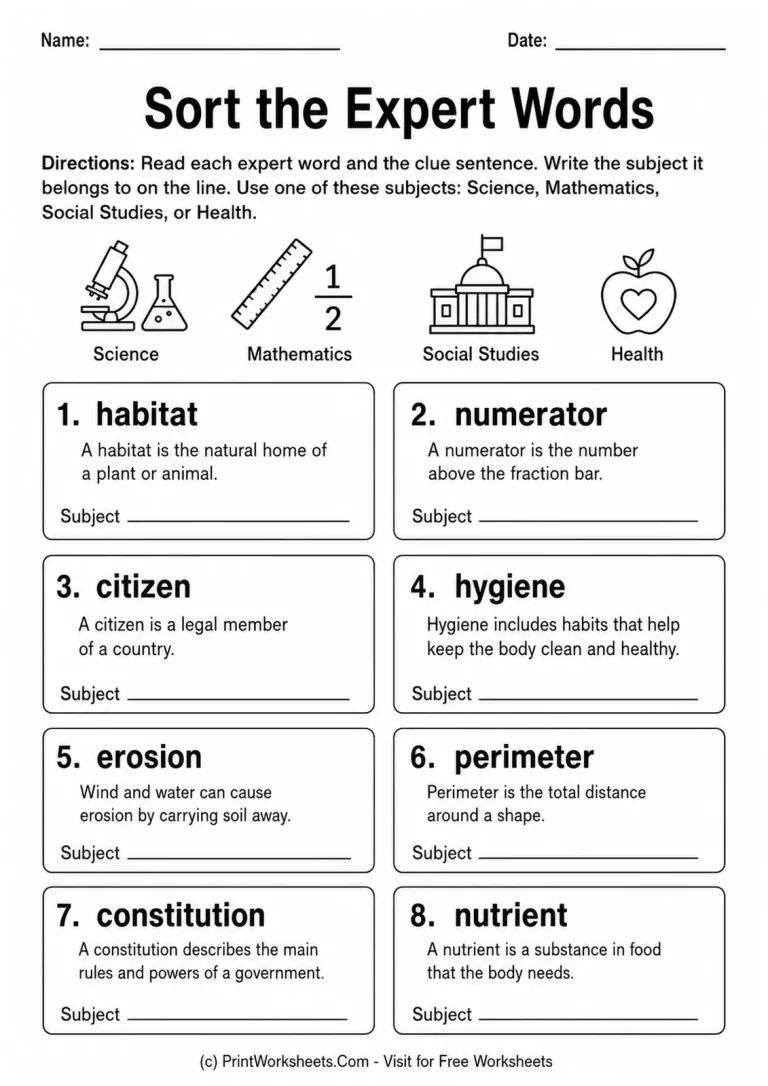
The first worksheet, Sort the Expert Words, introduces the idea that certain words belong naturally to particular fields of study. Students work with terms such as habitat, numerator, citizen, hygiene, erosion, perimeter, constitution, and nutrient. Instead of memorizing each word in isolation, they use short clue sentences to decide whether each term belongs to Science, Mathematics, Social Studies, or Health.
This classification task helps students notice that vocabulary carries information about topic and purpose. A word such as numerator signals mathematical thinking, while constitution points toward civics and social studies. Habitat and erosion connect naturally to science, and hygiene fits the language of health. Sorting these words encourages students to organize new vocabulary into meaningful mental categories.
Use Context Clues to Work Out Meaning
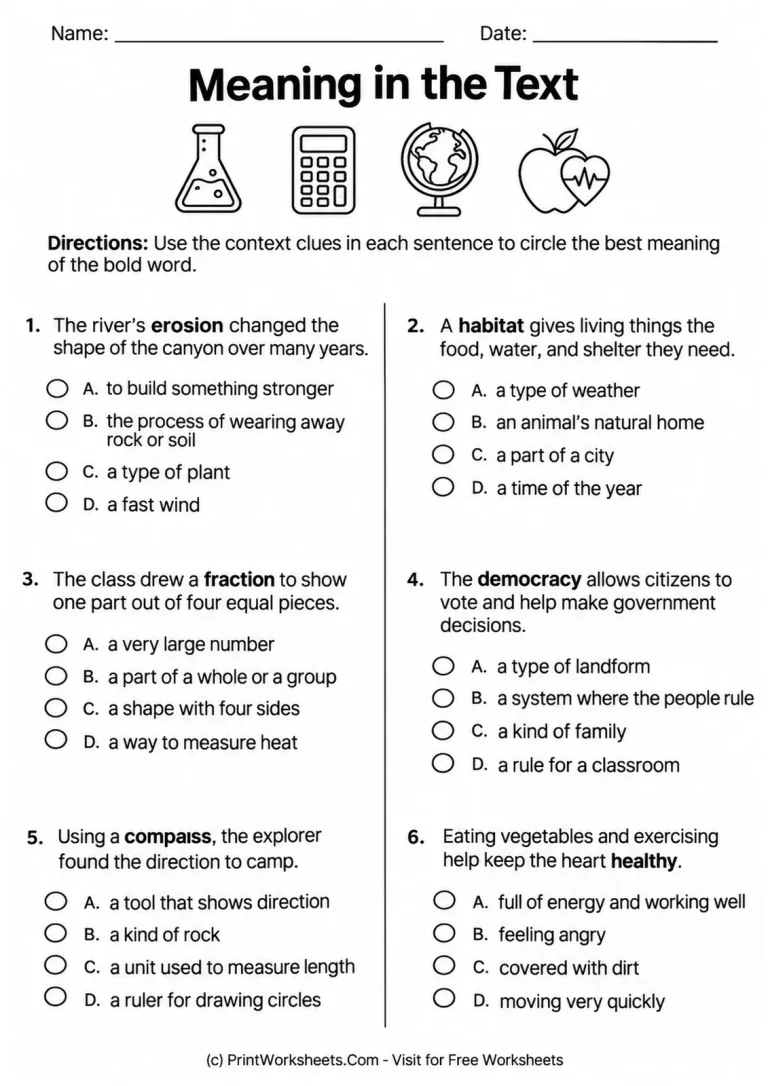
The second activity, Meaning in the Text, shifts from subject classification to close reading. Students encounter bold vocabulary inside complete sentences and choose the meaning that best fits the context. Target words include erosion, habitat, fraction, democracy, compass, and healthy.
This page is useful because students cannot rely only on word recognition. They must read the surrounding sentence, consider what makes sense, and distinguish the best answer from other choices. That process supports an important Grade 4 reading habit: using nearby information to clarify unfamiliar or specialized vocabulary without immediately stopping to look up every word.
Move from Word Meaning to Accurate Word Use
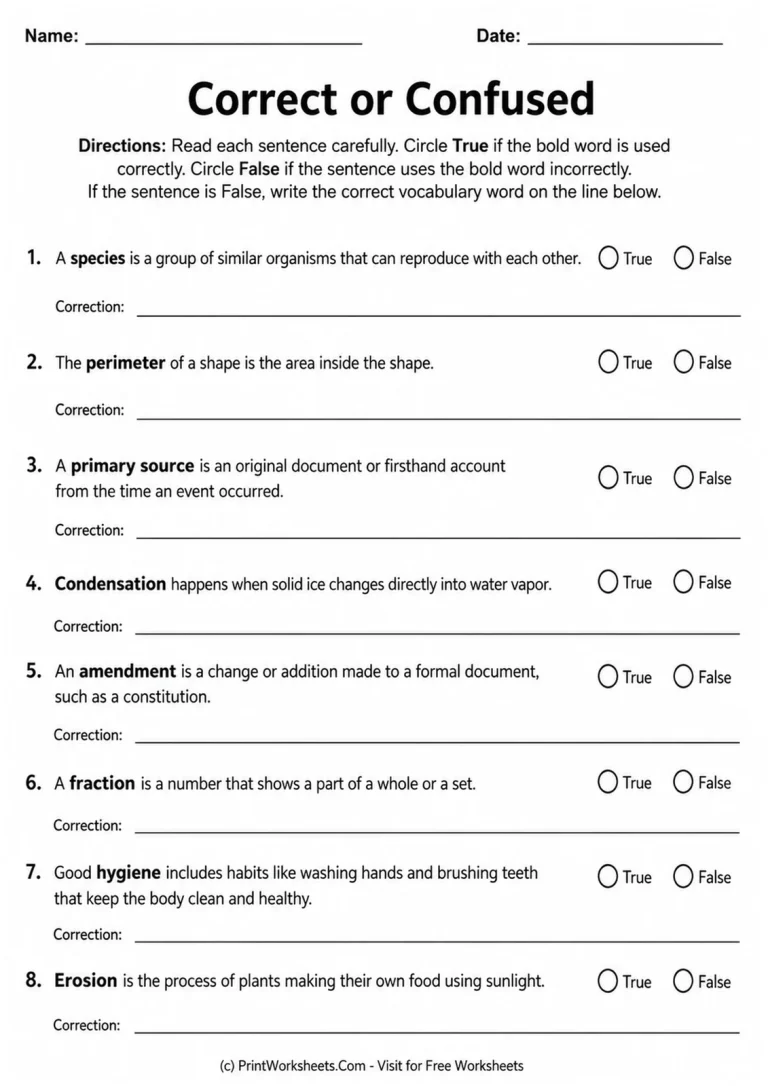
Knowing a definition is only part of vocabulary mastery. The Correct or Confused worksheet asks students to decide whether a bold domain-specific word has been used correctly in a sentence. Words include species, perimeter, primary source, condensation, amendment, fraction, hygiene, and erosion. Students mark each example True or False and, when a word is used incorrectly, write a better vocabulary word on the correction line.
This format adds a valuable reasoning step. Students must connect meaning with actual usage and explain the correction through their word choice. It works well for independent practice, small-group discussion, or a quick formative check because incorrect examples reveal whether learners can distinguish related concepts rather than simply repeat definitions.
Choose the Most Precise Academic Word
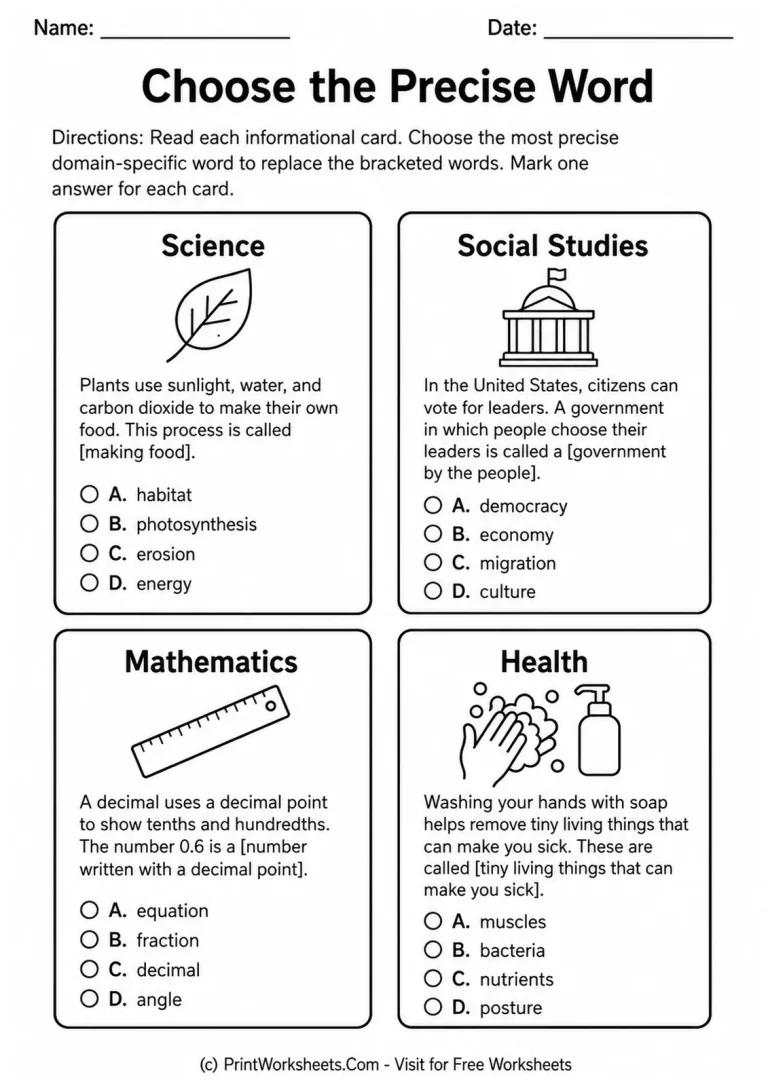
The final worksheet, Choose the Precise Word, asks students to replace general descriptions with accurate subject-area terminology. Four information cards draw from Science, Social Studies, Mathematics, and Health. Students connect descriptions with words such as photosynthesis, democracy, decimal, and bacteria.
For example, recognizing photosynthesis as the precise term for a plant food-making process requires students to move from an everyday explanation to the vocabulary used in science. Similar thinking is required when students identify democracy in social studies or decimal in mathematics. This reinforces the idea that precise vocabulary makes academic speaking and writing clearer.
Ways to Use These Grade 4 Vocabulary Worksheets
Teachers can use the four pages as a short sequence over several lessons or select individual activities to match current instruction. Begin with the sorting page before a unit that combines several content areas, use the context-clue page during reading practice, and save the usage and precision activities for review or assessment. The variety of response types also makes the set suitable for literacy centers, homework, intervention groups, and early-finisher work.
For differentiation, invite students who need additional support to create a four-column word bank labeled Science, Mathematics, Social Studies, and Health before completing the tasks. More advanced learners can add a new term to each category and write an original sentence that demonstrates its meaning accurately. Students can also explain why a corrected vocabulary word fits better than the original choice.
Quick Exit Ticket and Extension Ideas
After completing the worksheets, ask students to choose one term from each subject area and write a one-sentence definition in their own words. As an extension, students can search a current textbook chapter for five additional domain-specific words, identify the subject area, and explain how each term helps communicate information more precisely.
By moving from sorting to context, usage, correction, and precise word choice, this printable set gives fourth graders several ways to demonstrate real vocabulary understanding. It is especially useful when students are ready to connect reading skills with the specialized language they encounter across the school day.