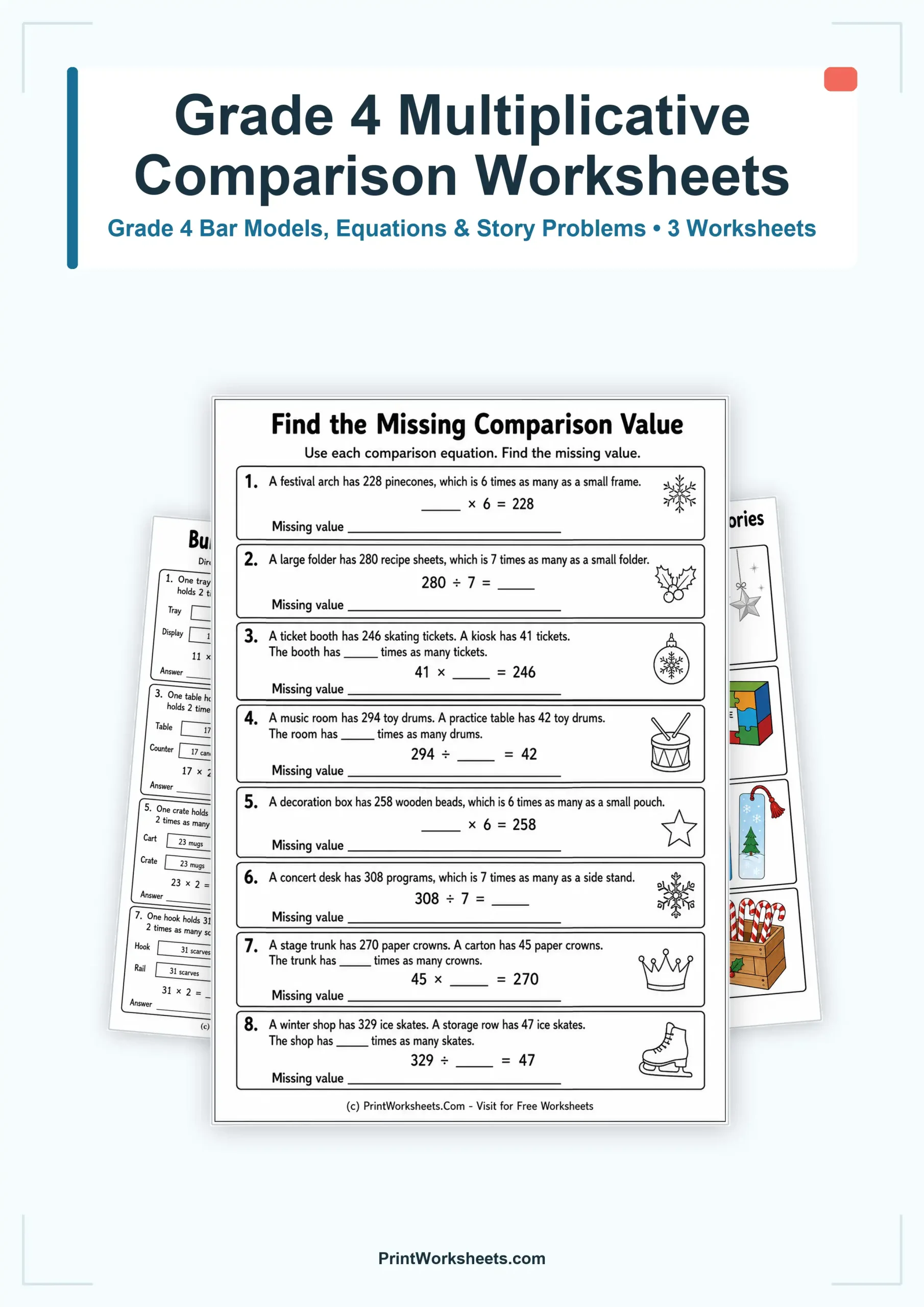
Multiplicative comparison word problems ask fourth graders to think beyond simply finding a product. Students must understand statements such as one quantity being 2 times, 3 times, 6 times, or 8 times another quantity, decide which value is known, and choose an operation that matches the comparison. These printable worksheets develop that reasoning through a three-stage sequence: visual bar models, missing-value comparison equations, and complete story problems that require students to write and solve their own equations.
Multiplicative Comparison Word Problems for Grade 4
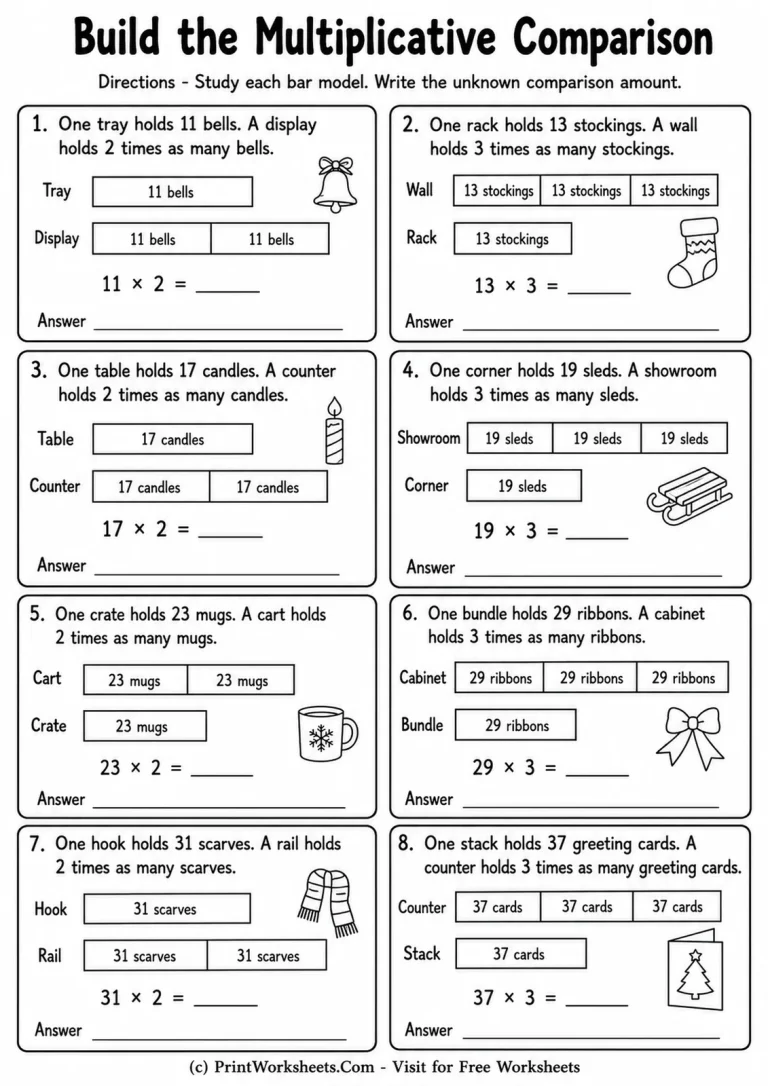
The first worksheet gives students a visual starting point with bar models. Each model shows a base quantity and a second quantity that is 2 or 3 times as large. Students use the diagram, the comparison statement, and a multiplication equation together. Problems include combinations such as 11 × 2, 13 × 3, 17 × 2, and 19 × 3, along with additional examples using 23, 29, 31, and 37 as starting values.
This page is useful when students are still learning what multiplicative comparison language means. Instead of treating phrases like “three times as many” as an abstract rule, learners can see that the larger bar is made from equal groups of the smaller amount. The visual structure helps connect comparison language to multiplication while keeping the focus on the relationship between two quantities.
Finding Missing Values with Multiplication and Division
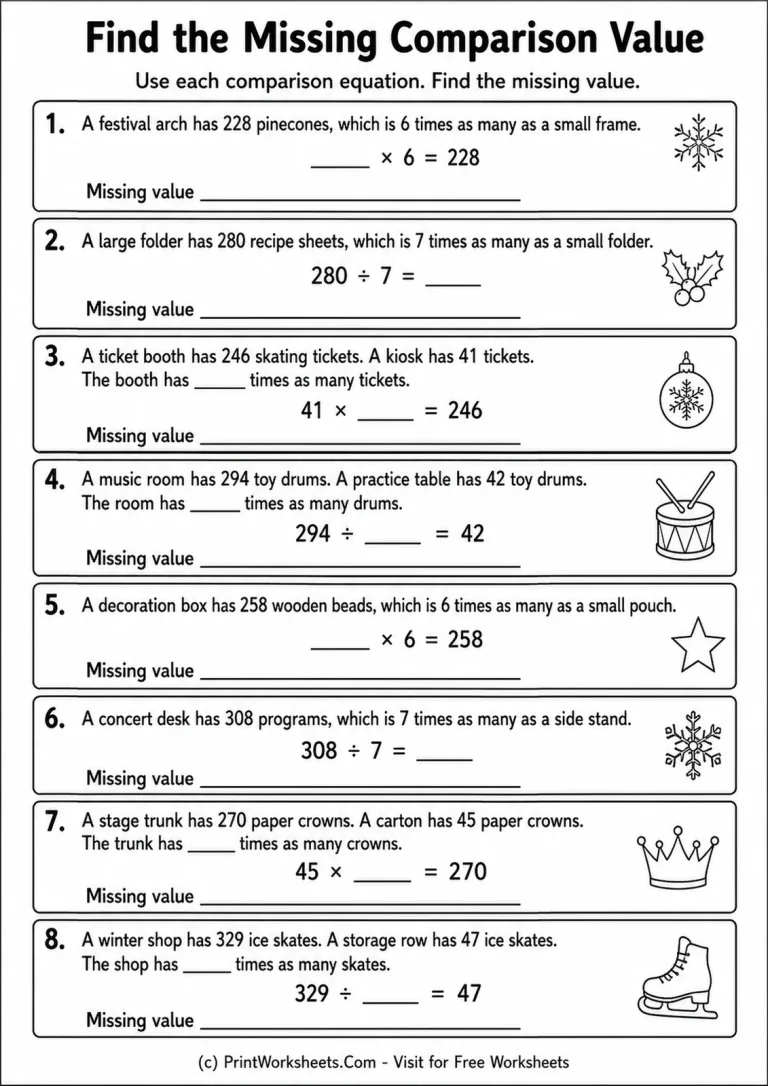
The next worksheet increases the level of reasoning by changing the location of the unknown. Students are not always asked to find the larger amount. In some problems they must determine the smaller base quantity, while in others they must find how many times as large one quantity is compared with another.
These questions encourage students to use multiplication and division as related operations. For example, a comparison involving 228 and a factor of 6 requires students to work backward to find the base amount. Other items use relationships such as 280 ÷ 7 and 308 ÷ 7. Students also solve equations such as 41 × ? = 246 and 45 × ? = 270, where the missing number represents the comparison factor rather than one of the quantities.
Because the unknown changes position from problem to problem, students must interpret the comparison before calculating. This makes the practice especially helpful for learners who can perform multiplication facts but still need experience deciding when division is the correct operation.
Practice Interpreting “Times as Many” Relationships
A major goal of the set is helping students distinguish the base quantity, the compared quantity, and the multiplicative factor. That distinction becomes important in Grade 4 because two problems may contain the same numbers but require different equations depending on what is unknown. Students therefore practice reading the relationship carefully instead of relying on a keyword alone.
Apply the Skill in Multiplicative Comparison Stories
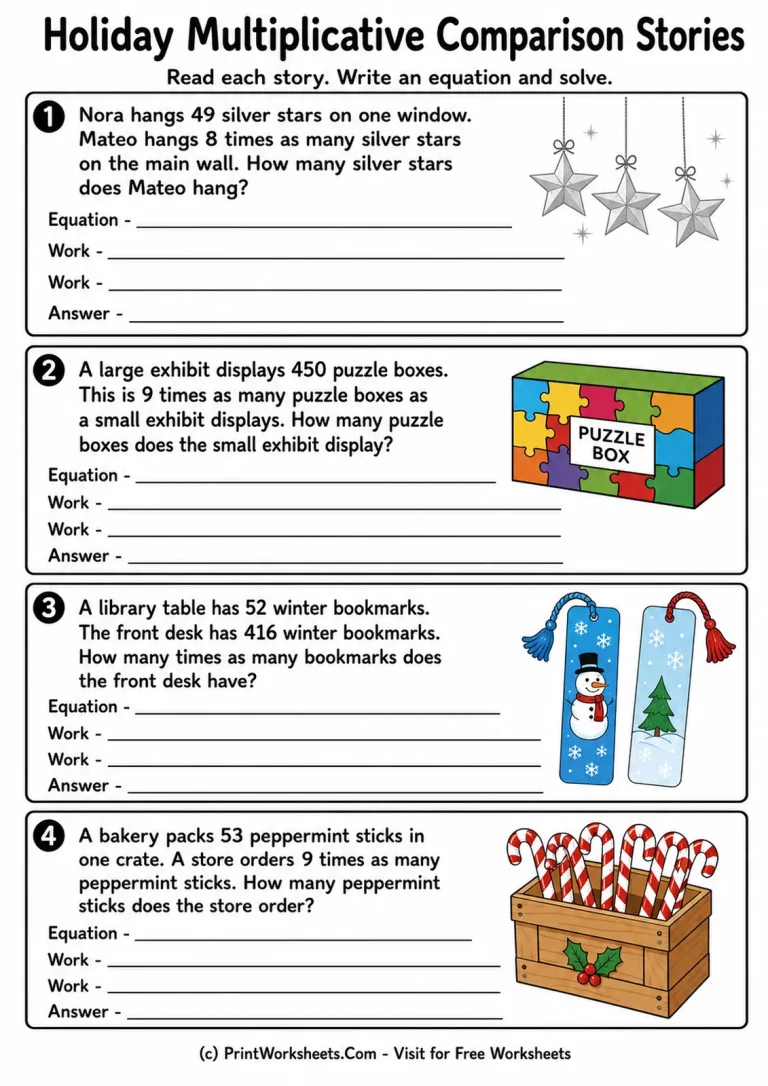
The final worksheet moves from structured equations to four holiday-themed story problems. Students read each situation, decide what the comparison means, write an equation, show their work, and calculate the requested value. The problems include different unknown types, so students may need multiplication in one story and division in another.
One comparison asks students to find a quantity that is 8 times 49, while other stories require finding a smaller starting amount or identifying the missing comparison factor. This variation gives students practice transferring the same mathematical idea across different problem structures rather than repeating one calculation pattern.
Writing an equation before solving also provides a useful check on comprehension. A student who correctly identifies which number should be multiplied or divided has usually understood the comparison relationship, while an incorrect equation can reveal a misunderstanding before the arithmetic is completed.
Ways to Use These Grade 4 Worksheets
The three worksheets can be used in sequence during a multiplicative comparison lesson or separately for targeted practice. Begin with the bar-model page when introducing or reviewing comparison language. Use the missing-value worksheet after students understand the basic model and are ready to work flexibly with inverse operations. Finish with the story-problem page for independent practice, homework, a math center, small-group instruction, or a quick formative check.
For students who need extra support, encourage them to identify three things before solving: the smaller or base quantity, the number of times being compared, and the quantity that is unknown. Students who are ready for a challenge can explain why their chosen operation matches the wording of the problem or write a related multiplication and division equation for the same comparison.
Together, these printable Grade 4 pages help students move from seeing a multiplicative comparison to representing it with equations and finally solving it in context. That progression makes the set useful for building both computational accuracy and the deeper reasoning students need for multiplication and division word problems.