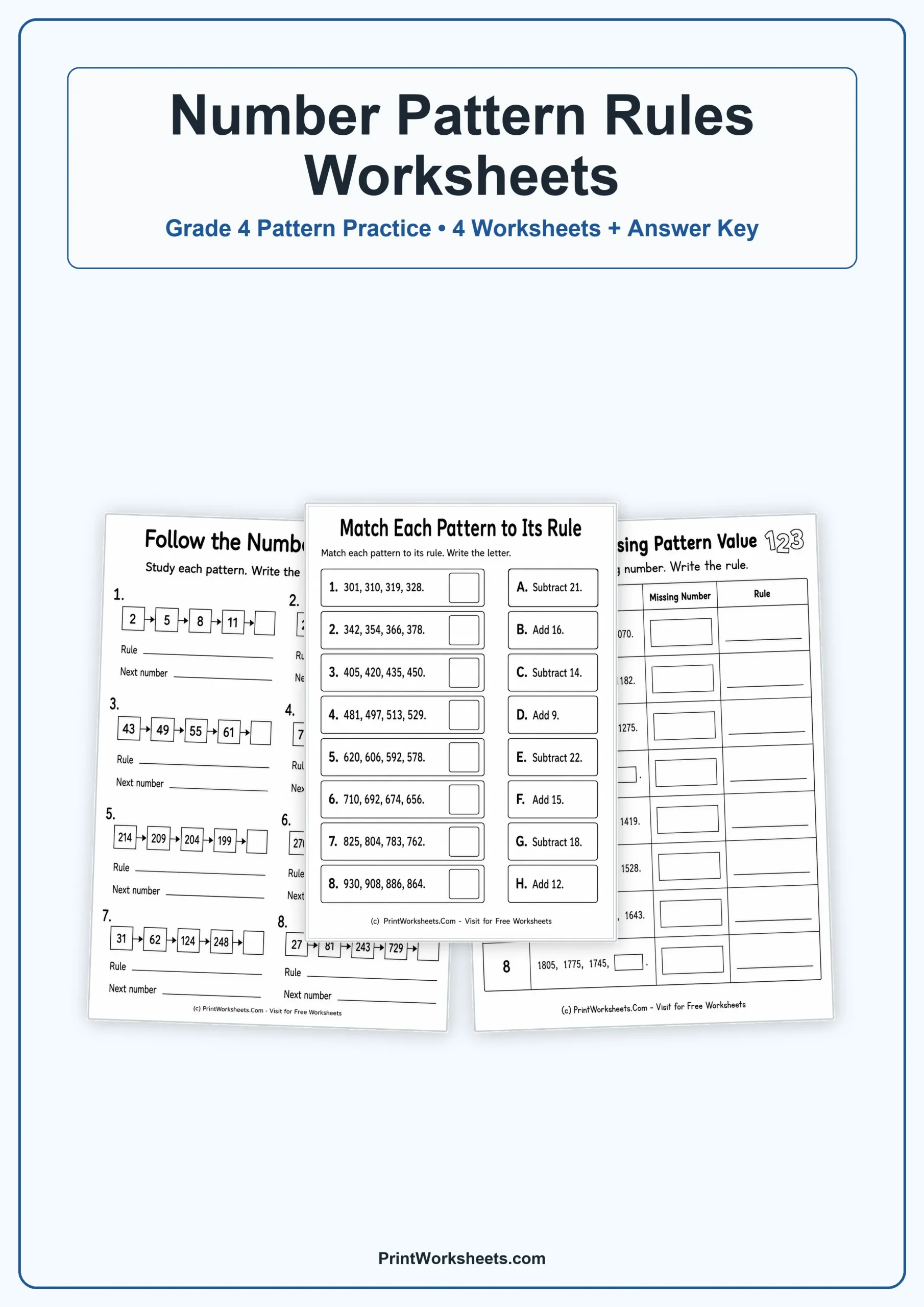
These number pattern rules worksheets give fourth graders repeated practice with recognizing how a sequence changes and using that rule to continue or repair the pattern. Across four student worksheets, learners work with addition, subtraction, and multiplication patterns, explain the rule behind each sequence, fill in missing values, and apply pattern reasoning inside short story problems. The activities move from direct rule identification to more demanding work with larger numbers, making the set useful for lessons, independent practice, homework, or skill review.
Practice Number Pattern Rules in Several Ways
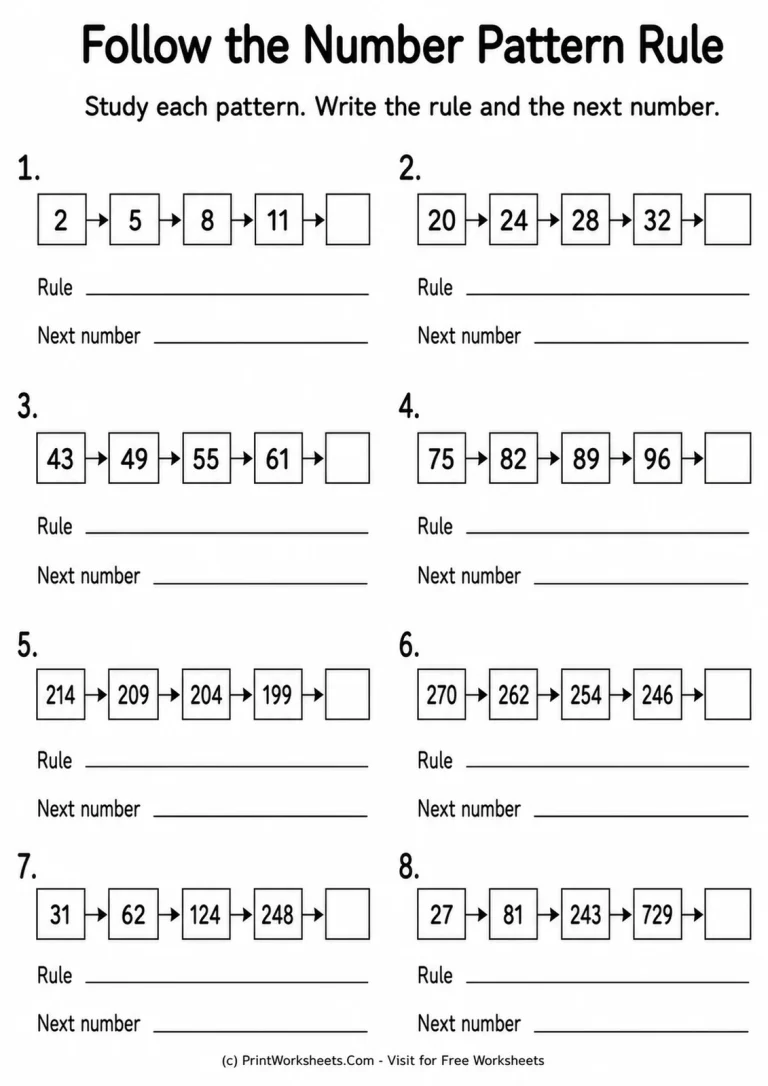
The first worksheet, Follow the Number Pattern Rule, begins with eight clear sequences. Students inspect each pattern, write the rule, and determine the next number. The page includes addition rules of +3, +4, +6, and +7, subtraction by 5 and 8, and multiplication by 2 and 3. Because the operation is not supplied in advance, students must look at the relationship between consecutive terms rather than simply perform a stated calculation.
This variety is especially useful for Grade 4 because students need to recognize that number patterns can grow or decrease by a constant amount and can also change multiplicatively. Asking students to state the rule as well as find the next term gives teachers and parents two pieces of evidence: whether the computation is correct and whether the student understands what is happening in the sequence.
Match Sequences to Addition and Subtraction Rules
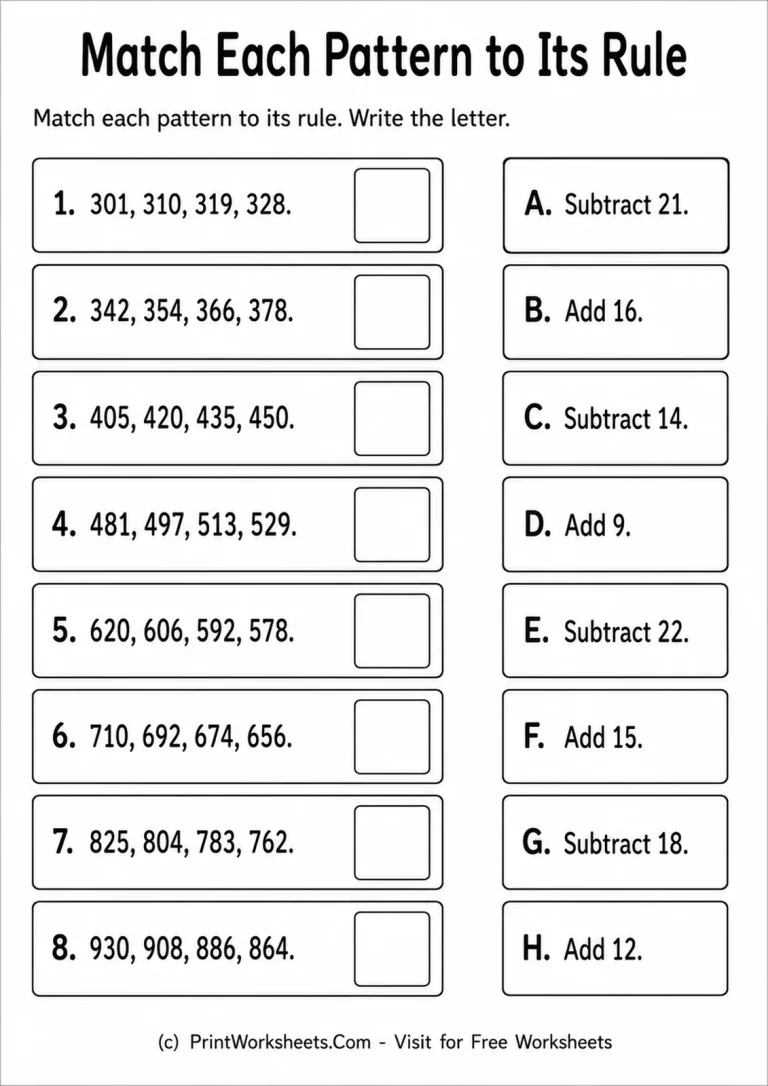
On Match Each Pattern to Its Rule, students work with eight four-term sequences and connect each one to a lettered rule. The possible rules include adding 9, 12, 15, or 16 and subtracting 14, 18, 21, or 22. Each pattern has one matching rule, so students can compare the amount of change from term to term and use elimination when several choices initially look possible.
This format shifts the task from producing a rule independently to distinguishing among several plausible rules. It encourages careful checking and helps reveal common mistakes such as comparing only two terms or overlooking whether a sequence is increasing or decreasing.
Find Missing Values in Larger Number Patterns
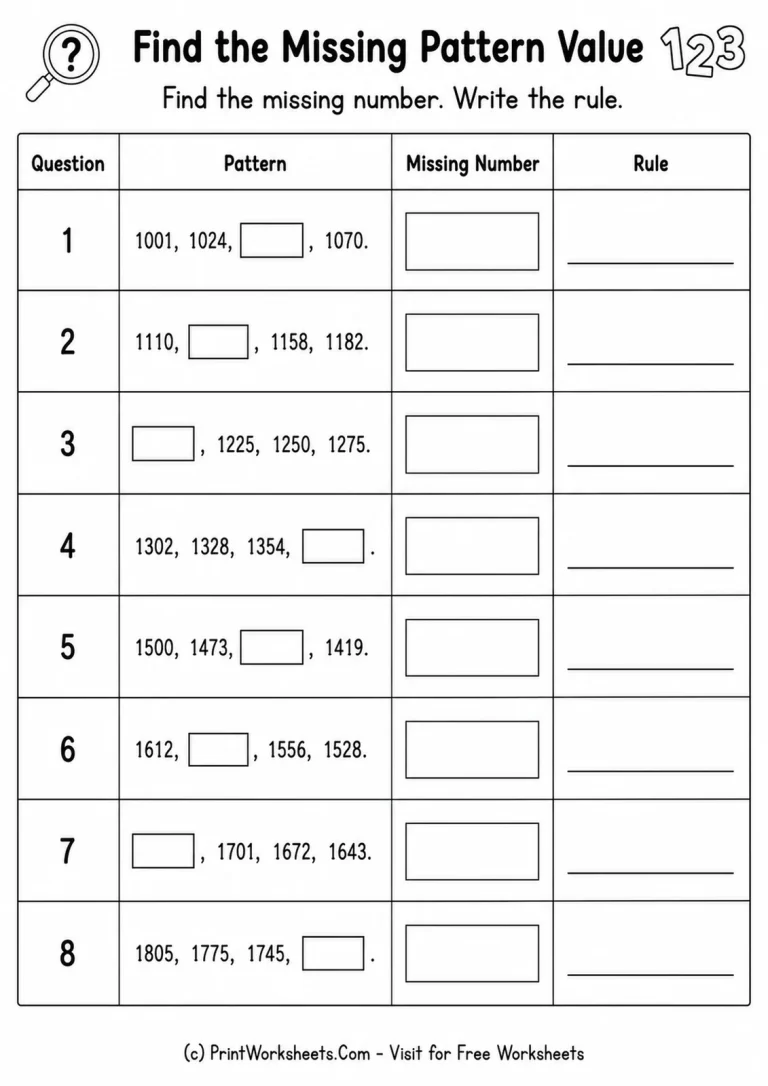
The third worksheet, Find the Missing Pattern Value, raises the difficulty by placing one missing number in different positions within eight four-term patterns. Students complete the sequence and record the rule. The increasing patterns use constant differences of +23, +24, +25, and +26, while the decreasing patterns use -27, -28, -29, and -30.
Several sequences use four-digit numbers, so students must combine pattern reasoning with accurate addition or subtraction across larger values. The blank does not always appear at the end of the sequence. It can occur near the beginning, in the middle, or later in the pattern, which prevents students from relying on a single routine. They may need to reason forward from an earlier term, backward from a later term, or check both directions to confirm the missing value.
Apply Pattern Rules to Story Problems
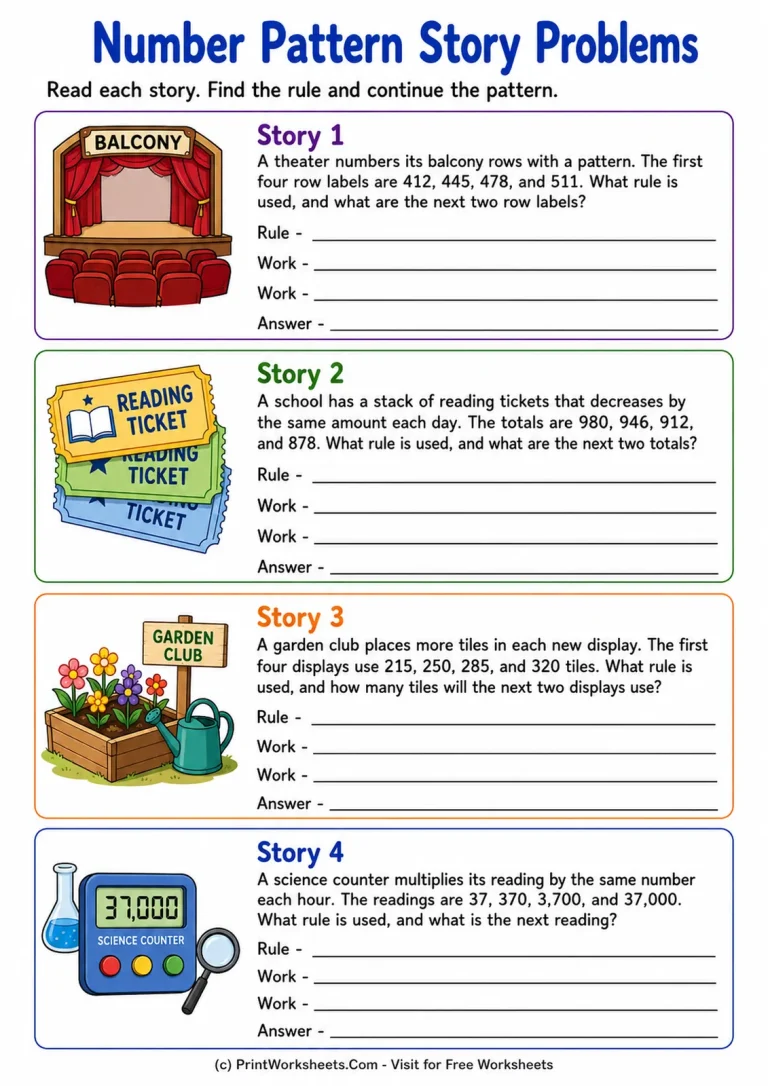
The final student page, Number Pattern Story Problems, places the same skills into four short contexts involving theater balcony rows, reading tickets, garden displays, and a science counter. Students identify the pattern rule, show their work, and continue each sequence. In the first three problems, they determine two additional values rather than stopping after a single next term.
This contextual step makes the set more than a collection of isolated sequences. Students must decide what the changing numbers represent, determine how the values are related, and then use the rule consistently. That progression supports the transition from recognizing a mathematical pattern to applying it as a problem-solving tool.
What Students Practice
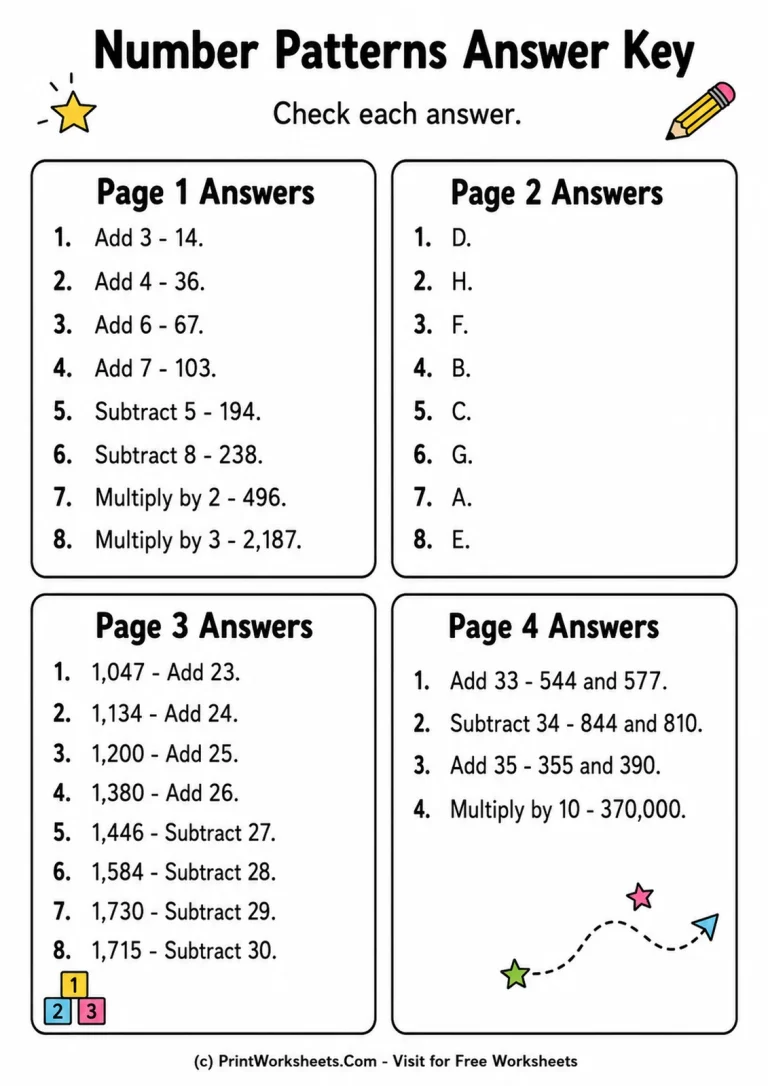
By completing the full packet, students practice identifying constant changes, distinguishing addition from subtraction and multiplication patterns, matching sequences to rules, finding missing terms, working with hundreds and thousands, extending sequences, and explaining pattern rules in writing. The included answer key covers the activities from all four student worksheets, making checking straightforward for classroom instruction, centers, tutoring, or home practice.
The set works well as a sequence of lessons because each page changes the type of reasoning required without changing the central skill. Students begin by spotting a rule, then compare rules, reconstruct incomplete patterns, and finally use pattern rules in story situations. That structure gives fourth graders several chances to demonstrate that they understand not only what number comes next, but why it comes next.