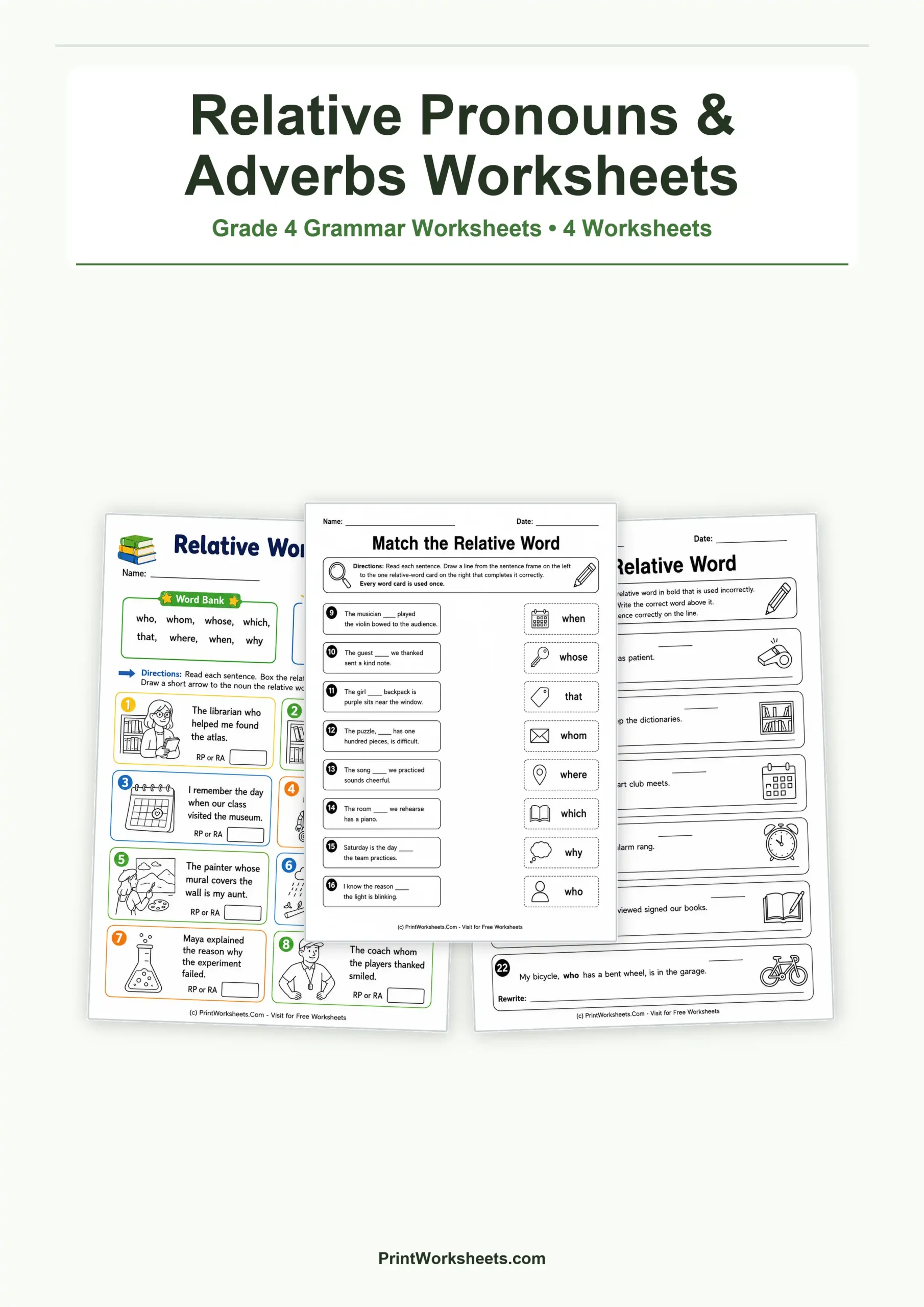
These relative pronouns and adverbs worksheets give fourth-grade students several ways to work with who, whom, whose, which, that, where, when, and why in complete sentences. Instead of practicing the words in only one format, the four-page set moves from noticing and classifying relative words to choosing them in context, correcting incorrect choices, and using them to combine related ideas. The activities are designed to help students pay attention to the relationship a relative word creates between a noun and the information that follows it.
Practice Relative Pronouns and Adverbs in Context
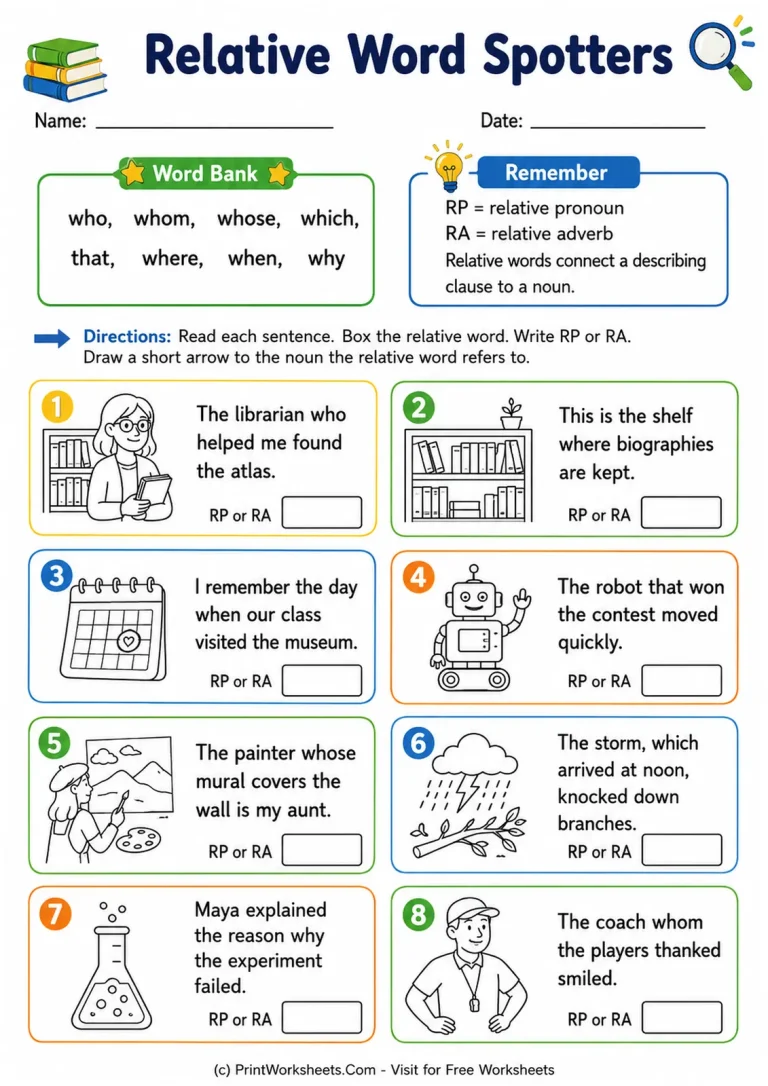
The first worksheet, Relative Word Spotters, begins with eight sentences that contain different relative words. Students locate the target word, decide whether it functions as a relative pronoun or a relative adverb, and mark the classification as RP or RA. They also draw a short arrow to the noun connected to the relative word. This extra step encourages students to look beyond the individual word and notice what information the clause is adding. The examples include relationships involving people, places, times, reasons, objects, and possession, so students see that relative words perform different jobs depending on the sentence.
Choose the Relative Word That Fits the Meaning
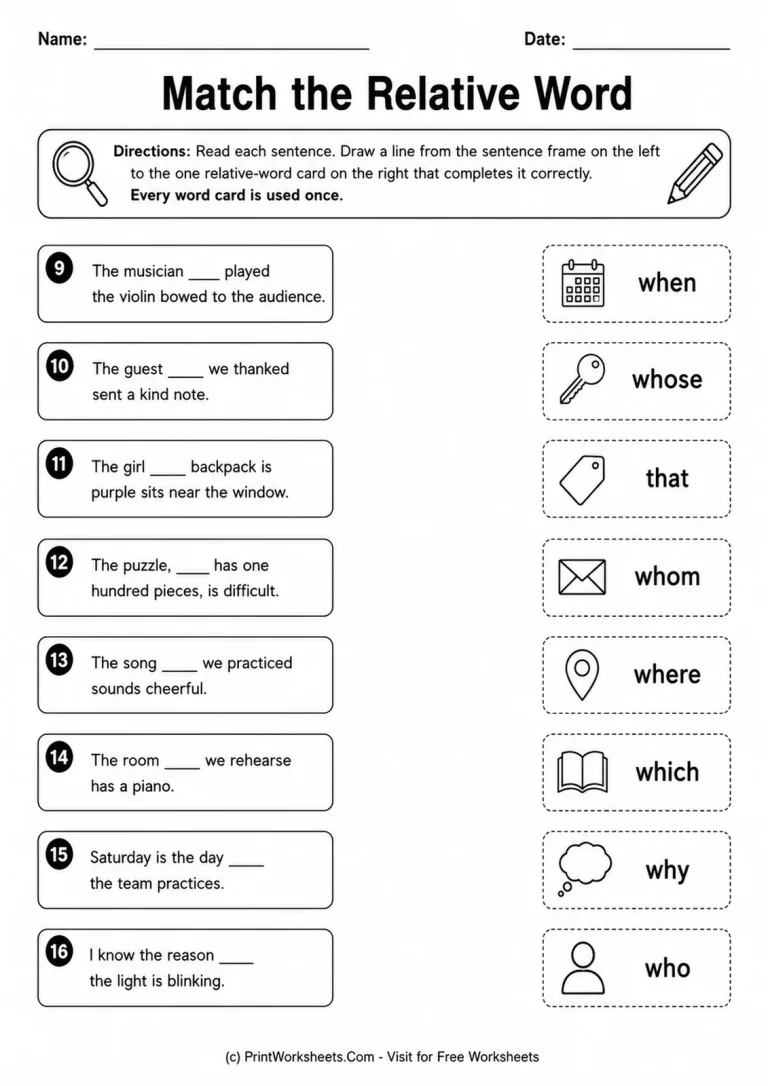
The second worksheet, Match the Relative Word, changes the task from identification to selection. Students work with eight sentence frames and a set of word cards containing when, whose, that, whom, where, which, why, and who. Each card is used once. Because the choices include both relative pronouns and relative adverbs, students must consider what type of relationship the blank requires. A sentence referring to a place calls for a different kind of connection than one referring to a person, time, reason, possession, or thing. Using every card once also encourages careful comparison across the full group of sentences instead of treating each blank as an isolated guess.
Correct Misused Relative Words
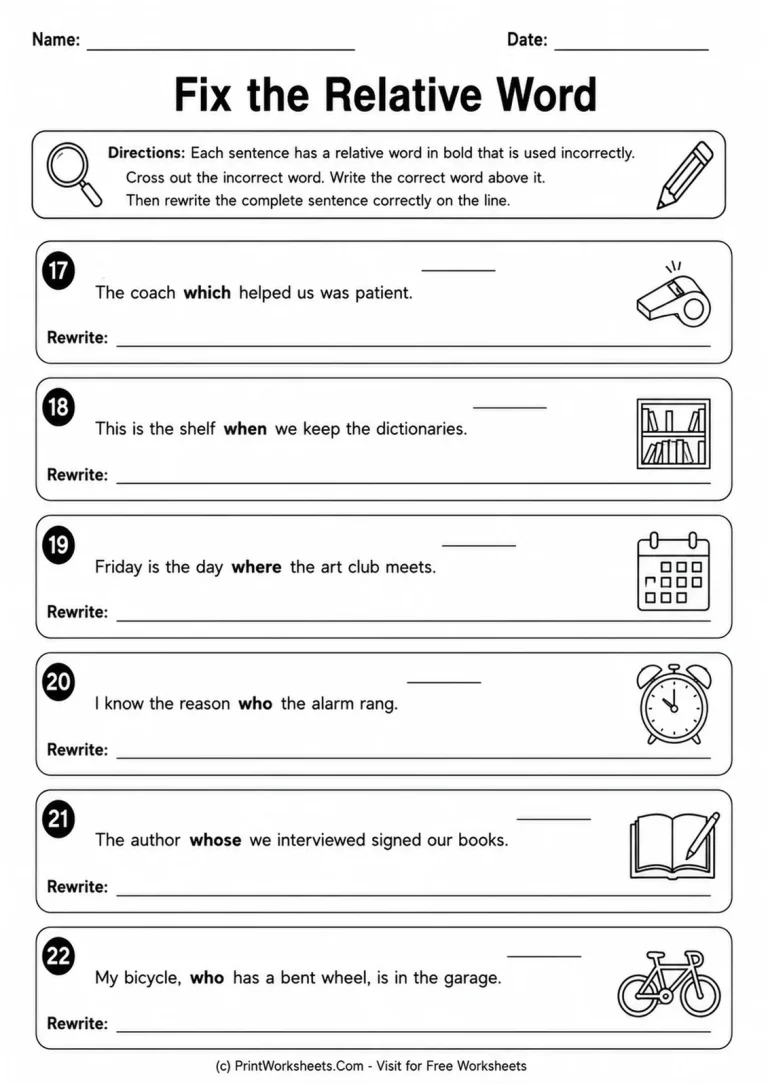
On Fix the Relative Word, students move into editing and rewriting. Six sentences contain an incorrect relative word. Students replace that word with one that makes sense and then rewrite the entire sentence correctly. The errors include contrasts such as which and who, when and where, where and when, who and why, whose and whom, and who and which. This activity asks students to use sentence meaning as evidence. They must identify whether the sentence is describing a person, location, time, reason, possession, or thing before deciding which relative word belongs in the sentence.
Combine Ideas Without Repeating the Noun
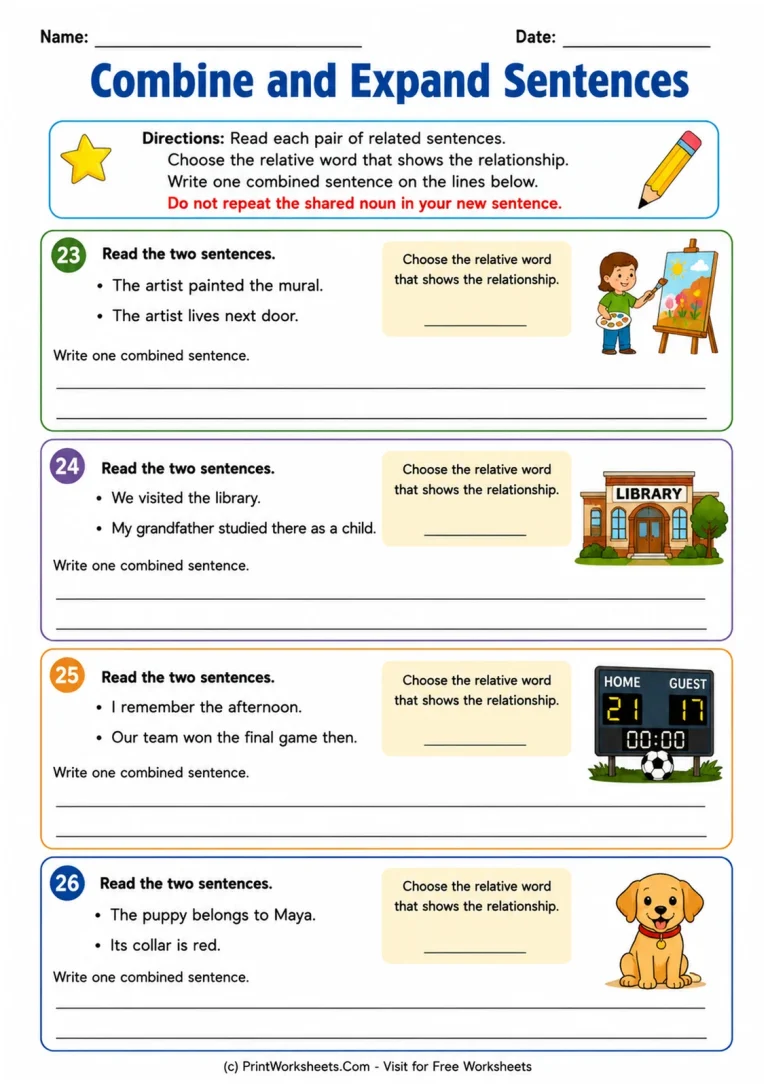
The final student worksheet, Combine and Expand Sentences, applies the skill to sentence construction. Students read two related sentences, choose a relative word that clearly expresses the relationship between the ideas, and combine the pair into one sentence without unnecessarily repeating the shared noun. The four prompts include relationships involving a person, a place, a time, and possession. This makes the activity useful for connecting grammar practice with more fluent sentence writing. Students are no longer only selecting a word from a list; they are deciding how that word can help organize information inside a longer sentence.
How to Use These Grade 4 Grammar Worksheets
The pages can be used together as a short sequence or separately when a particular skill needs more practice. The identification page works well after introducing the difference between relative pronouns and relative adverbs. The matching activity can follow as guided or independent practice. The correction page is useful when students are ready to explain why one relative word fits better than another, while the sentence-combining page provides a natural transition into writing. Teachers can also use selected pages for morning work, small-group grammar practice, independent review, homework, or an additional practice station.
Build Understanding From Recognition to Sentence Writing
Across the set, students repeatedly work with the same core relative words while the thinking demand changes. They first find and classify the words, then select them for sentence frames, repair incorrect choices, and finally use them to join related sentences. That progression helps make the grammar skill more meaningful because students see how relative pronouns and adverbs connect information rather than simply memorizing a word list. These printable Grade 4 worksheets provide focused practice for students learning to recognize the relationship between nouns, relative clauses, and the words that connect them.